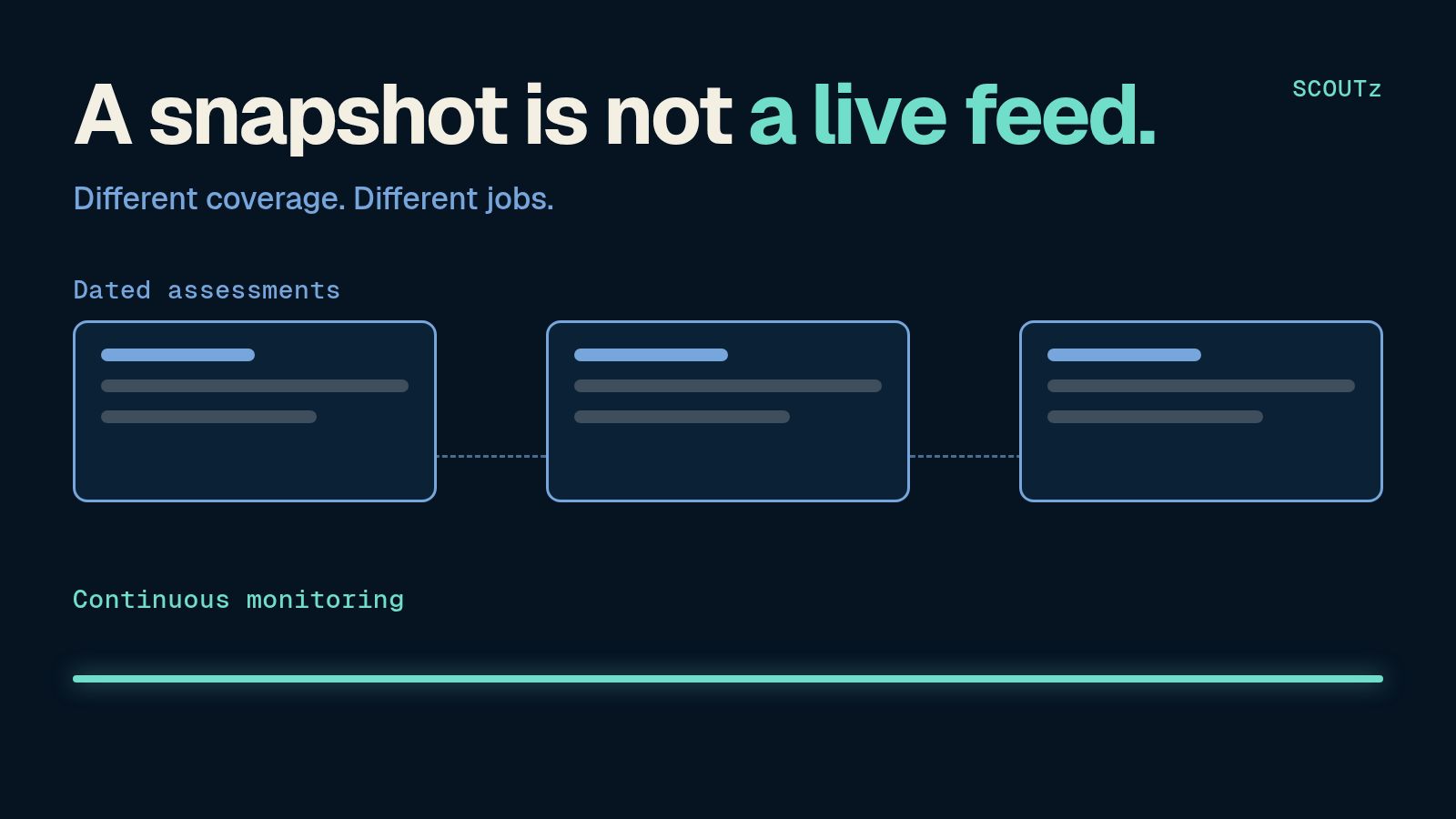
Repeat security assessments do not replace continuous monitoring. An assessment records what a defined source showed at a particular time; monitoring observes supported activity or conditions between reviews. For an MSP preparing a proposal or QBR, the useful comparison is between equivalent evidence, with the baseline, date and coverage still attached.
- Repeat security assessments vs continuous monitoring is a choice about observation timing and coverage.
- SCOUTz supports dated evidence and rescan comparisons for MSP conversations, not an always-on detection claim.
- A disappearing finding needs a coverage check before it can be called resolved.
- Keep public-domain observations separate from customer-authorized Microsoft 365 evidence.
Why this matters to an MSP
A customer can approve work after the first review and still need proof of what changed. An old report establishes the starting point. A later review can establish a new observation, but the difference is useful only when both reviews answer the same question.
The SCOUTz assessment workflow connects findings, investigation, work planning and supported verification. Delivery stays with the MSP and its operational systems. That division matters when the buyer asks whether a report proves the environment remained protected between runs.
It does not. A report can be accurate about its recorded date without describing today's condition. Treat that boundary as part of the advice, rather than an inconvenient footnote.
Do repeat security assessments replace continuous monitoring?
No. These approaches support different decisions, and an MSP can need both.
| Approach | What it establishes | Best for | Main limit |
|---|---|---|---|
| A single dated assessment | What the assessed sources showed during that review | Initial discovery and a bounded baseline | It becomes historical between runs |
| Repeat assessments | Comparable observations at separate review dates | Verification, proposals and QBR evidence | They do not establish the unobserved period |
| Continuous monitoring | The supported conditions or activity observed during monitoring coverage | Operational detection and response within the tool's remit | Coverage depends on the deployed sources and configuration |
| Manual validation | Evidence produced by a named check or test | Questions outside an automated review's scope | The result is limited to the validation performed |
Choose the method by the claim you need to support. A changed configuration can be investigated through a rescan. A claim about activity during the intervening period needs a source that actually observed that activity.
For a 2026 MSP sales conversation, avoid using continuous as a synonym for repeatable. Scheduling another review does not make the interval visible.
Keep the baseline before comparing the result
Start with an observation that another person can inspect. Record the affected domain, tenant or object, the check identity, the evidence source and the run date. Preserve the finding's wording and its coverage state.
A baseline should also capture the question the customer agreed to investigate. That question can change after discovery. If the original question concerns published email authentication and the later question concerns internal identity controls, the second review expands the scope rather than proving the first review improved.
Use a comparison record with these fields:
- Baseline observation and date.
- Current observation and date.
- Check identity and affected object.
- Source and authorization boundary.
- Coverage, unread sources and exclusions.
- Interpretation, owner and next decision.
Keep the baseline intact when correcting an interpretation. Add a dated explanation of the correction instead of silently changing the historical record to make the comparison look cleaner.
Compare coverage before calling a finding resolved
A missing finding has several possible explanations. The configuration changed. The object no longer exists. A permission changed. A source could not be read. The review covered a different set of objects.
Those possibilities do not support the same conclusion. The current run must still be able to observe the condition before absence becomes meaningful.
| Current result | Supported statement | What to establish next |
|---|---|---|
| Comparable source shows the condition changed | The observable state changed between the recorded dates | Whether the change matches the approved outcome |
| Source is unreadable | The current review cannot establish the state | Why access or collection failed |
| Object is outside current scope | The current review did not assess that object | Whether the exclusion was intentional |
| Check definition changed | The two results are not directly equivalent | What changed in the check's meaning |
| Condition is still observed | The recorded condition remains in assessed evidence | Whether the planned work was completed or relevant |
The SCOUTz methodology separates evidence states from coverage. Observed, Inferred and Unknown describe different kinds of support. Partial or Permission limited describes how much of the intended evidence was available. Do not compress both into a single reassuring label.
Public evidence and Microsoft 365 evidence answer different questions
Public-domain observations can support statements about published DNS, email authentication, certificates and other supported external evidence. They do not establish internal Microsoft 365 permissions, Conditional Access coverage, license assignments or tenant sharing configuration.
An internal review needs customer approval and an appropriate read-only source. Authorization is specific to the purpose and scope agreed with the customer. It is not blanket approval to inspect unrelated systems.
Keep the comparison within its layer:
- Compare public records with equivalent public observations.
- Compare authorized tenant configuration with equivalent tenant evidence.
- Keep source dates separate when collection times differ.
- Record permission and license limits on both runs.
- Preserve anything the review did not assess.
If public evidence prompts a deeper question, explain the unknown first. Then agree which source is necessary and who can authorize it. A broader review should improve the question, not erase the boundary of the earlier evidence.
Use an email-authentication example without inventing an incident
Consider an illustrative 2026 review of a domain whose published DMARC policy requests monitoring only. The observation is the published policy at the recorded time. The possible consequence needs context about the domain's mail flows, intended enforcement and reporting ownership.
A defensible opening is: the published policy requests monitoring only; who reviews the reports, and is that still the intended state? That question leaves room for a legitimate staged rollout or a business decision the MSP has not yet heard.
If the customer later approves a policy change, a new public observation can establish the currently published record. It does not, by itself, prove that every mail flow works correctly or that no spoofing attempt succeeded between reviews.
Keep three layers visible:
- Evidence: the record and its observation date.
- Insight: why the intended policy deserves discussion now.
- Proof: the later observable state compared with the baseline.
The example is a reasoning pattern, not a customer outcome or a recommendation to alter a live domain without validation.
Let the operational stack perform the work
An assessment creates a basis for a decision. The approved delivery process handles execution, dependencies, change control and rollback. Keep the engineer's work record separate from the later observation that verifies a supported condition.
A completed task is useful evidence of work. A rescan is useful evidence of observable state. Neither automatically establishes that a control is effective in every circumstance.
Assign the next action to a person rather than to the report:
- The business owner confirms purpose and priorities.
- The technical owner investigates the configuration.
- The authorized delivery owner performs approved work.
- The reviewer checks the relevant verification evidence.
- The account owner records the next customer decision.
For a 2026 QBR, this gives the customer a coherent account of the work without claiming that a review replaced their security operations.
Build a QBR around changes and remaining unknowns
Lead with the decision the customer needs to make. Then show the baseline, current evidence and limits. A report's summary should help the owner choose what to investigate, approve, defer or leave unchanged.
Separate new observations from carried-forward observations. A newly collected source can reveal an old condition; newly observed does not establish newly created. Conversely, an unchanged finding can still have different business significance after the customer confirms who uses the affected service.
A compact review can follow this sequence:
- State the question and the relevant scope.
- Show comparable observations with both dates.
- Explain what changed and what remains unknown.
- Record the customer's context and the accountable owner.
- Offer the next bounded choice.
Do not invent a standard review interval. The appropriate timing follows the condition's changeability, the approved work and the consequence of relying on stale evidence. Recheck when a meaningful decision requires current evidence.
Where a dated-evidence tool fits
SCOUTz supports MSP prospect preparation and client conversations with dated domain and customer-approved Microsoft 365 evidence. Its published assessment guidance describes comparisons against a baseline and keeps a report historical between runs.
That makes SCOUTz relevant when the MSP needs an inspectable evidence thread from discovery to supported verification. It is not a substitute for a monitoring service, an incident investigation or the MSP's judgment about the customer's environment.
For the current product boundary, review the security posture assessment guide. Choose any additional operational tools according to the activity or controls that need observation, rather than stretching an assessment into a claim it cannot support.
FAQ
Are recurring security assessments continuous monitoring?
No. Recurring assessments produce observations at separate review times. Continuous monitoring requires coverage of supported activity or conditions during the intervening period.
Can a rescan prove a security issue was fixed?
A comparable rescan can establish that a supported observable condition changed. Confirm the check, scope, affected object and source coverage before describing it as resolved.
Does a finding disappearing mean the client is secure?
No. A finding can disappear because coverage or readability changed. Verify that the current source can still establish the condition and keep other unknowns visible.
How often should an MSP repeat a security assessment?
Choose timing around the relevant decision, approved work and how quickly the assessed condition can change. There is no universal interval that makes every finding current.
Can a public-domain review verify Microsoft 365 controls?
Public-domain observations do not establish internal Microsoft 365 controls. Use customer-approved, appropriately scoped evidence for internal configuration questions.
What belongs in a baseline and rescan comparison?
Keep both dates, check identity, affected objects, sources and coverage. Add the interpretation, unresolved questions, responsible owner and next agreed decision.
One last thing
A repeatable review can make a mistake repeatable too. Before comparing the result, confirm that the check still answers the customer's actual question. In 2026, a defensible account of what changed is more useful than a stronger-looking number whose coverage cannot be explained.
If you want to evaluate this workflow with a real MSP prospect, Join Open Beta. SCOUTz prepares the conversation. The relationship and the sale stay yours.