A renewal meeting is not the place to recite everything your MSP did. Show the client what changed in their environment, which work contributed, and what decision is still open. That is a defensible account of value; a list of tickets is not.
- To show value to MSP clients, compare dated evidence before and after the work.
- Separate work completed from outcomes observed; do not claim credit for changes you cannot verify.
- SCOUTz is best used by MSPs who need evidence that survives from a review into the next client conversation.
Why the usual renewal recap stalls
The buyer remembers the monthly invoice. They may not remember the conditions your team corrected, because successful maintenance is quiet. A stack of completed tickets answers how busy the MSP was. It does not answer where the client stands today or why the contract should continue.
The SCOUTz scorecard field note draws this line between reporting activity and reporting position. The useful meeting moves through evidence, insight, and proof: what was observed, why it mattered to the client's decision, and what changed after work was completed.
Show the change, the work and the remaining decision
Build a short change record for each material issue. It needs a baseline observation with a source and date, the action the team actually performed, a later observation from a comparable check, and the remaining limitation. If the second check cannot confirm the outcome, report the action as complete but the result as unverified.
A renewal page can have three sections:
- Changed: a dated before-and-after observation with the relevant work item attached.
- Still open: a known condition, who owns it, and the decision needed to address it.
- Not assessed: controls outside the review scope. Unknown is not clean.
The distinction prevents accidental overclaiming. If an email-authentication record changed after your team implemented a client's approved change, show both observations and the work order. If a control was not read, do not turn its absence from a report into a green status.
Explain the consequence, not just the check name
A business owner does not need a lecture on DMARC syntax. They need to know whether their domain's published email policy matches the outcome they have agreed to pursue, who is responsible for changes, and what still needs validation. The technical appendix can carry the records. The main page should carry the decision.
Ask the client what would make the next term useful: preserving an improved state, completing an agreed gap, or investigating a new concern. The renewal argument then rests on the client's priorities, not on the MSP defending hours worked.
Make the next project earn its place
An upsell is justified only when the proposed work follows from an observed condition and a buyer-owned priority. Show the finding, its source, its boundary, the proposed verification or remediation, and the reason the existing agreement does not cover it. If that chain is weak, do not pad the scorecard with red boxes.
SCOUTz provides dated cybersecurity evidence and review context for MSP conversations. It does not decide whether a customer should renew or buy another project. The MSP and client must make that judgment together. A manual scorecard with the same source-and-date discipline is a valid starting point.
A reusable renewal evidence worksheet
Choose material work that relates to the client's stated priorities. Then assemble a comparable before-and-after record. This worksheet can be maintained manually; it is not a description of specific product fields.
| Field | Record to attach | Interpretation limit |
|---|---|---|
| Client objective | The outcome the client agreed to pursue | The MSP's priority is not automatically the client's |
| Baseline | Source, check, affected object and collection date | A baseline describes only its actual scope |
| Approved work | Authorization and delivery responsibility | A recommendation alone is not approval |
| Completed work | The actual work record and completion date | Completion does not prove the intended result |
| Verification | Comparable repeat check against the pinned baseline | A changed observation does not prove continuous protection |
| Remaining gap | Unread, unassessed or unresolved evidence | An omitted source is not a clean result |
| Next decision | Owner and choice to approve, defer or investigate | Proposed work is not a renewed commitment |
Keep the actual records available behind the summary. A client should be able to challenge the comparison without relying on the account manager's memory. Preserve the original baseline rather than replacing it with the most flattering recent observation.
An illustrative before-and-after record
Assume a client agreed to review its domain email-authentication policy. A dated public record established the baseline, the client approved a change and the MSP recorded the work. A later comparable check shows the updated published policy. This is a hypothetical teaching example, not a customer outcome.
The renewal statement can say that the approved work was completed and the later public record reflected the intended published state. Attach the two observation dates and the work record. Do not say the change prevented a breach or eliminated all email-related risk.
The public record does not establish internal Microsoft 365 policy coverage, every legitimate sending source or every receiver's behavior. Those remain separate questions. If further review is relevant to the client's objective, describe the additional scope rather than expanding the original conclusion.
If the work was recorded but no suitable verification exists, report completed, verification open. If the later check could not read the source, retain that limitation. The absence of a verification result must not become an implied pass.
Compare like with like before claiming improvement
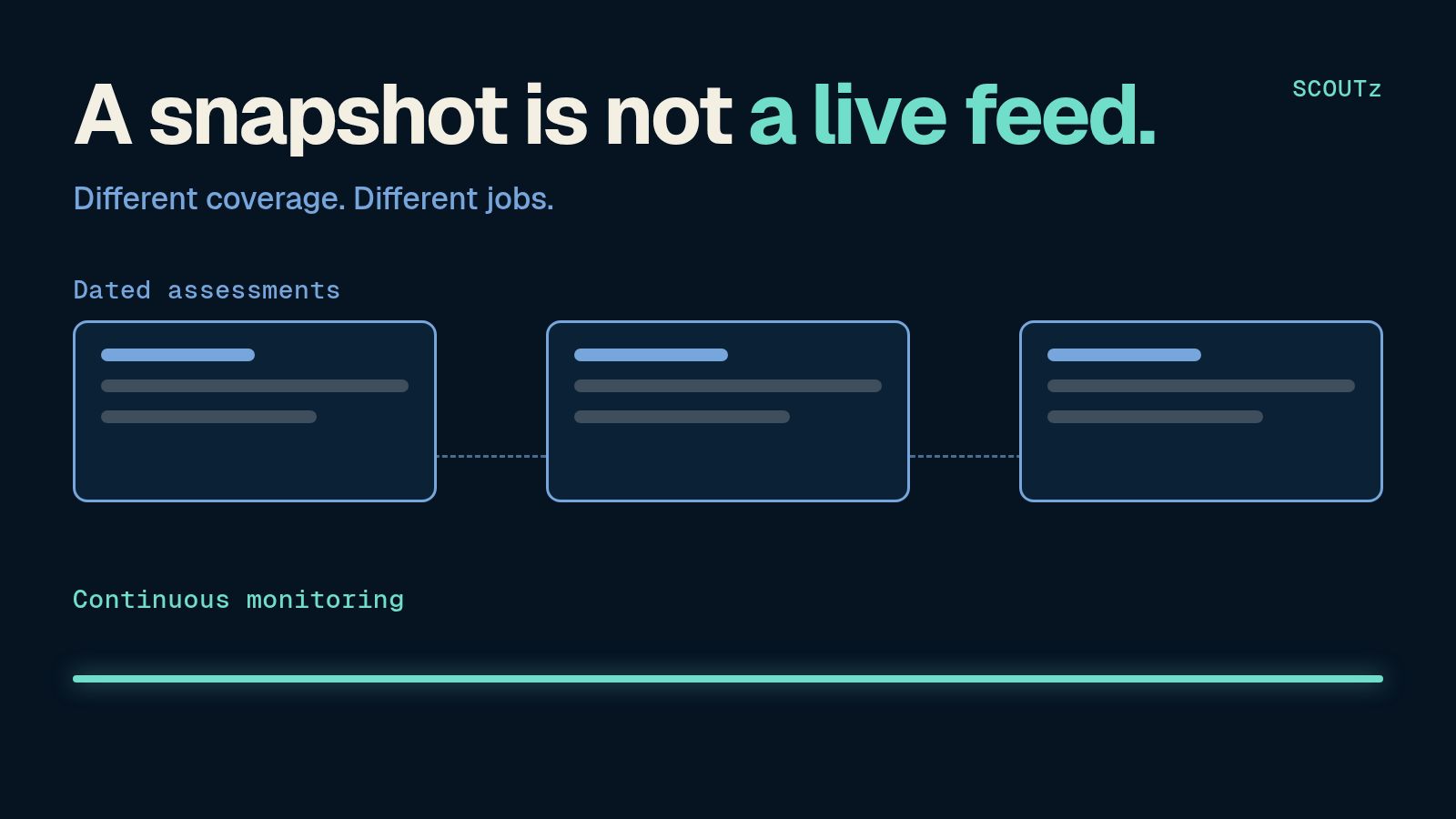
A later report can differ because the method, scope or available access changed. Check those conditions before presenting a difference as improvement. A broader scan with more findings can simply contain more coverage; a smaller finding count can reflect missing access.
| Difference between reviews | Check before interpreting it | Responsible presentation |
|---|---|---|
| Different source | Whether the observations measure the same condition | Keep unlike evidence separate |
| Different permission | Which records were readable in each review | Show coverage changes beside findings |
| Different check definition | Whether the result remains comparable | Explain the method change |
| Different affected objects | Whether the same systems were included | State the changed scope |
| Same method and scope | Whether approved work explains the change | Attach work and verification records |
Keep evidence states distinct from coverage. Observed describes a source result. Partial or permission-limited coverage describes what the review could examine. Neither should be collapsed into a single platform-wide score.
Build the client-facing renewal page
Start with the client's own priorities, then show the evidence relevant to them. A concise page can point to the supporting detail without reproducing every operational record. The technical appendix should retain the exact checks and dates.
- State the priority the client agreed to review.
- Summarize the baseline and its limits.
- Identify approved work that was completed.
- Show what comparable verification established.
- Name what remains unknown or unresolved.
- Present the next choice and responsible owner.
Separate the decision to continue a managed service from the decision to approve a new project. A renewal review can show ongoing responsibilities while leaving optional work outside the current agreement. The commercial scope should make that distinction explicit.
SCOUTz provides dated cybersecurity evidence for MSP client conversations. It does not determine whether a customer received value from every contracted service. Delivery records, customer context and the actual agreement remain necessary for that assessment.
Handle a missing baseline honestly
A missing baseline prevents a defensible before-and-after claim about that condition. You can still show the work performed and the current observation, but do not invent the earlier state. Ask the delivery owner whether an appropriate historical record exists before closing the gap.
If no record exists, establish a pinned baseline for the next agreed review. Record its source, date, scope and known limits. Define how a later check will be compared and who is responsible for interpreting the result.
A baseline is not a promise to perform continuous monitoring. If the client expects monitoring, alert handling or incident response, those commitments belong in the actual service agreement. The review cadence alone does not establish them.
Keep the next project tied to an actual decision
A proposed project should identify the condition, customer priority, requested outcome and why the current agreement does or does not include the work. Where the condition is uncertain, offer the scoped investigation needed before committing to remediation.
If the evidence does not justify additional work, say so. A renewal meeting can close a question without creating a new project. That result should remain visible rather than being omitted because it does not support an upsell.
Review the record before attributing value
Ask a colleague to trace the summary statement back to the source and work record. If the connection is uncertain, narrow the wording. State that a change was observed after work rather than claiming causation you cannot establish.
Then ask the client whether the documented outcome addresses the priority they set. Their answer belongs beside the technical result. Verified configuration and customer value are related questions, but the evidence for one does not automatically answer the other.
FAQ
What should an MSP include in a renewal review?
Include dated before-and-after evidence, work that was completed, unresolved decisions, and controls that were not assessed. Keep operational ticket detail in an appendix.
Can ticket counts prove an MSP's value?
Ticket counts prove work was recorded, not that the client's position improved. Tie material work to comparable observations and the client's stated priorities.
How do you present a security improvement without overstating it?
Name the exact check, source, date, and scope of both observations. Credit only the work you can connect to the change, and list what the check does not establish.
What if there is no clear before-and-after data?
Report what was completed and label the outcome unverified. Establish a baseline now so the next review can make a fair comparison.
When should an MSP propose additional work at renewal?
Propose it when a verified or clearly bounded observation leads to a decision the client considers important. State what is known, what requires authorization, and what the current contract covers.
Does a scorecard replace the client's business judgment?
No. A scorecard organizes evidence; the client decides priorities and trade-offs. An unread control must remain unknown rather than receiving a reassuring grade.
One last thing
The most persuasive renewal page sometimes shows that a concern was checked and did not justify a new project. That restraint makes the next recommendation easier to trust. MSPs who want a dated evidence trail for client reviews can Join Open Beta.