
MSP lead generation software has no single monthly cost: the subscription depends on whether you need contact research, outreach, pipeline management, or prospect security evidence. Compare the quoted fee with its billing unit, included work, and contract commitment in 2026. Your budget must also cover the people who validate evidence, prepare outreach, and handle discovery.
- How much does MSP lead generation software cost? Compare the quoted subscription with included work and contract commitment.
- SCOUTz is best for MSPs preparing evidence-led prospect conversations, rather than building contact lists.
- Separate public-domain observations from customer-authorized Microsoft 365 evidence before comparing assessment scope.
- Include evidence review, reporting, and follow-up work in your budget; subscription fees cover only part of the process.
Why this matters
A contact list and a dated security review serve different jobs. Treating both as lead generation software makes a monthly quote look comparable when the deliverables differ.
SCOUTz is best for MSP owners and sales leaders who need dated cybersecurity evidence for prospect conversations. Its prospect intelligence category sits between research and discovery; your CRM still owns the relationship. Start with SCOUTz when that evidence gap is the problem you need to solve.
For your 2026 budget, define the work before comparing subscriptions. A subscription that covers contact research does not establish tenant security conditions, and an assessment does not establish buying intent.
How much does MSP lead generation software cost per month?
The useful comparison is the quoted monthly commitment for a defined job. Ask each vendor to identify the billing unit, included capabilities, usage limits, and renewal terms in writing. Compare equivalent scope before choosing a subscription.
Use this table to separate the categories. These are purchasing jobs, not claims about any named vendor's features or commercial terms.
| Software category | Best for | Useful output | Limitation to budget around |
|---|---|---|---|
| Contact research | Identifying people to research | Account and contact records | A record does not establish need, consent, or buying intent |
| Outreach software | Organizing messages and follow-up | An outreach workflow | Your team still owns targeting, message accuracy, and sender practices |
| CRM | Managing relationships and opportunities | Account history and pipeline records | Pipeline records do not establish security conditions |
| Public-domain review | Preparing questions from external observations | Dated domain and email-security evidence | Public observations cannot establish internal tenant controls |
| Customer-authorized Microsoft 365 review | Preparing tenant-specific discovery | Configuration and metadata evidence within approved scope | Permissions, licensing, and unread sources limit coverage |
A lower subscription quote is useful only when it covers the work you need. Extra features have little value when they solve a different stage of your sales process.
Build the monthly comparison from written terms
Record these items beside every quote:
- The billing basis: workspace, user, account, usage, or another stated unit.
- The commitment: monthly cancellation or an annual agreement billed monthly.
- The included work: research, assessment, explanation, reporting, and rescanning.
- The boundaries: fair-use terms, permissions, licensing requirements, and exclusions.
- The renewal terms: what changes after an introductory or beta arrangement.
An annual agreement billed monthly is still an annual commitment. Compare the total obligation over the same period, then record the payment schedule separately.
Contact research and outreach: budget for execution
Contact research is best for deciding whom to investigate. Outreach software is best for organizing communication after you establish a suitable audience and message. Neither output proves that an organization wants to change MSPs.
The benefit is a defined research or communication workflow. The limitation is that someone must still validate the account context, decide whether contact is appropriate, and write a defensible message.
Ask a prospective vendor to demonstrate the exact deliverable included in its quote. Then have your sales lead describe the work remaining between that deliverable and a useful discovery conversation.
Keep public business events in their proper role. A leadership change or expansion can supply context for research, but it does not prove purchasing activity. An email open is a follow-up cue, not agreement.
Public-domain reviews: budget for evidence interpretation
Public-domain review is best for preparing specific questions about externally observable conditions. For example, a published DMARC policy requesting monitoring only gives your team a condition to discuss. It does not establish compromise or prove that the policy is unintended.
A useful review keeps the check, affected domain, observation date, and collection limits attached to the result. Your team then determines the business relevance and asks who owns the policy and reporting process.
The advantage is a concrete starting point for discovery. The limitation is visibility: public-domain observations cannot establish Conditional Access coverage, application permissions, license assignments, Intune device state, or tenant sharing configuration.
For your 2026 evaluation, inspect a sample report rather than judging the subscription by finding totals. Require the report to distinguish an observed condition from an inferred consequence and an unknown control.
Microsoft 365 reviews: budget for authorized scope
Customer-authorized Microsoft 365 review is best for discovery that requires internal configuration evidence. The scope must explain what the customer approves, what permissions are required, and what remains unread.
Configuration and metadata evidence differs from mailbox or document content. SCOUTz's cybersecurity prospect intelligence uses customer-authorized, read-only Microsoft 365 evidence; its stated boundary excludes mail, files, chats, documents, and prompts.
The benefit is tenant-specific context for the conversation. The limitation is incomplete visibility when permissions, licensing, or unread sources restrict assessment. Unread evidence stays unknown.
The client-provided product reference dated October 15, 2026 labels Microsoft 365 Review and Prospect Intelligence as Open Beta. Evaluate those capabilities against your workflow and the current written terms rather than assuming beta status means production fit.
Why MSP lead generation software costs vary
The subscription comparison changes when vendors quote different scopes. Use these factors to structure procurement questions without assuming that every vendor charges for each one.
- Billing unit. Establish whether the quote covers a workspace, named users, accounts, or measured usage. Record what triggers additional charges.
- Evidence scope. Separate public observations from customer-authorized internal evidence. Those deliverables answer different questions and require different access.
- Reporting work. Determine whether your team receives raw findings, operator explanations, or client-safe reports. Identify the human review still required.
- Repeat assessment. Ask whether rescanning is included and whether the workflow preserves a baseline for comparison.
- Usage terms. Read fair-use provisions and documented limits. An inclusive usage description still needs a clear operating boundary.
- Contract stage. Separate beta conditions, introductory arrangements, renewal terms, and cancellation rules. Record the dated terms that govern your decision.
These factors explain what to compare. They do not establish that a particular subscription is expensive or inexpensive.
Compare total monthly effort, not just the subscription
Your sales team must turn software output into a conversation someone can trust. Assign an owner to each handoff before approving the purchase.
| Work item | What to establish | What remains your responsibility |
|---|---|---|
| Account research | Sources and dates attached to account context | Decide whether the account fits your service |
| Evidence collection | What ran and what could be read | Confirm authorization and collection boundaries |
| Interpretation | Condition separated from possible consequence | Approve the claim before it reaches a prospect |
| Report preparation | Intended audience and included reporting functions | Remove unsupported conclusions and assign next steps |
| Follow-up | A clear question or agreed action | Manage the relationship and respect the response |
| Verification | A rescan compared with a pinned baseline | Explain changed results within comparable scope |
Use your own recorded staff effort to evaluate the operational burden. Do not turn vendor output volume into an assumed labor saving.
A tool that produces more findings can create more review work. Treat that as a workflow question, rather than evidence of higher value or better security coverage.
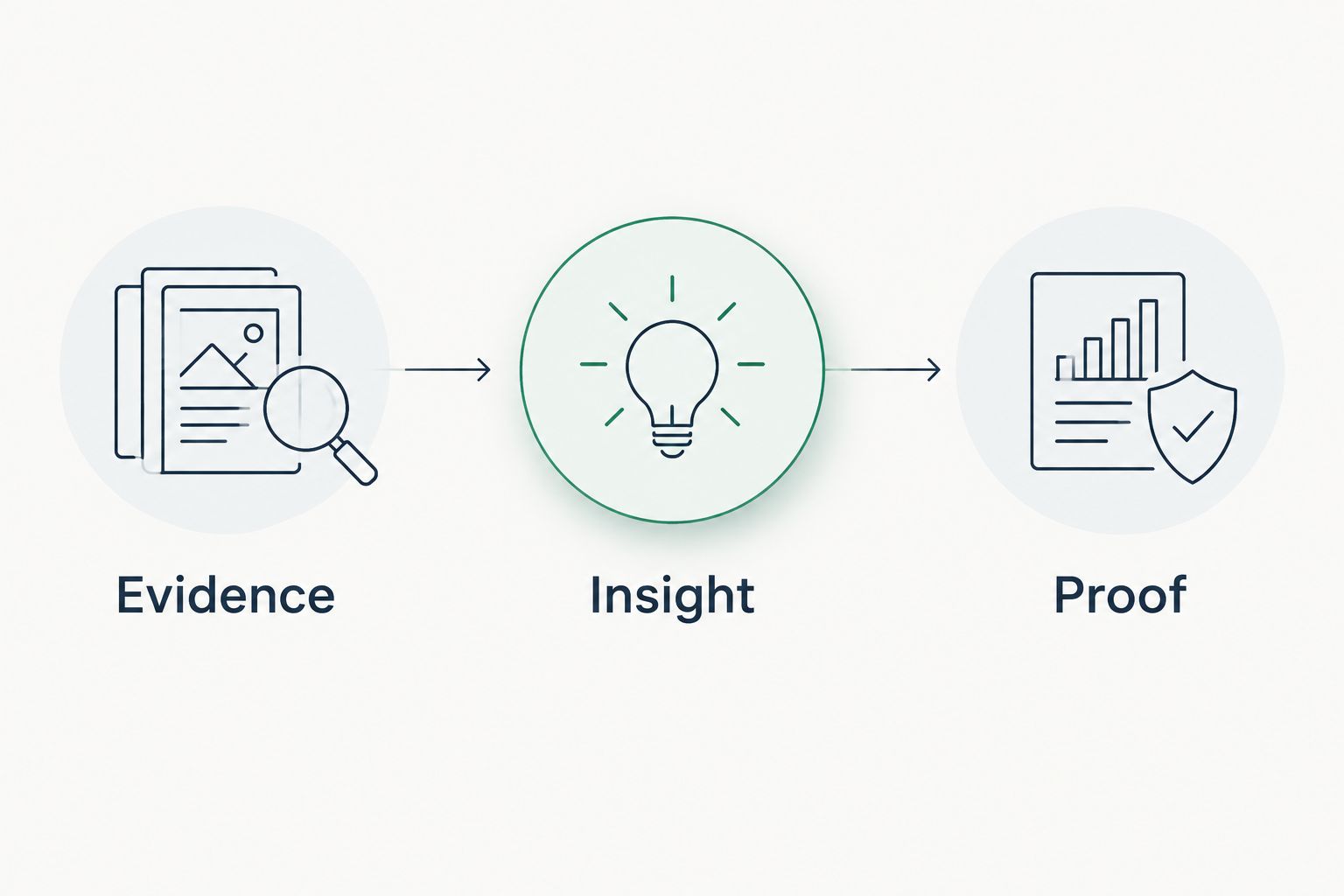
Evaluate the workflow through evidence, insight, and proof
A procurement demonstration should follow the same path your team will use with a prospect. The domain scan to first-call evidence packet workflow provides a related preparation topic to examine alongside the subscription terms.
Evidence
Inspect what ran, when it ran, and which object the result concerns. Require the source and collection boundary to remain visible when the finding moves into a report.
Keep evidence state separate from coverage. Observed, Inferred, Possible, Unknown, and Unreadable describe different evidence conditions; Partial or Permission limited describes assessment coverage. Neither belongs in a single implied certainty ladder.
Insight
Connect the observed condition to a bounded business question. A monitoring-only DMARC policy supports a discussion about intended enforcement and report ownership. It does not justify a claim that someone is spoofing the prospect's email.
Identify the owner and offer a next choice. That choice can be a process review, a service, a project, or no change after clarification.
Proof
Inspect how a rescan compares with a pinned baseline. A changed result needs the same attention to source, date, scope, and unknowns as the original observation.
Proof concerns the change that the evidence supports. It does not turn a rescan into a guarantee of security, remediation, or a sale.
Choose the subscription that fits the missing job
Write a purchase decision in terms of the job your current process cannot complete. For contact discovery, evaluate research output. For meeting preparation, inspect dated evidence and the questions your team can responsibly ask from it.
Keep delivery systems separate from sales preparation. PSA, RMM, and security platforms run delivery; a prospect evidence workflow prepares a conversation. Compare tools by those jobs rather than expecting one subscription to replace the stack.
For a 2026 beta evaluation, choose an authorized account and define the expected output before starting. Review whether the evidence is readable, the limits are visible, and your team can explain the result without adding unsupported claims.
Make Join Open Beta your next step when SCOUTz fits that preparation job. The application process includes a human MSP-fit review; applying does not establish acceptance. Confirm the current scope and terms before committing.
Prepare Your Next Prospect Conversation
Review the evidence-led approach and follow the current Open Beta application path.
FAQ
How much does MSP lead generation software cost per month?
There is no single monthly cost across contact research, outreach, CRM, and security evidence software. Compare written quotes for the same job, billing unit, included work, and contract commitment.
Is an annual plan billed monthly the same as a monthly subscription?
An annual plan billed monthly still carries the commitment stated in its contract. Compare the full obligation and cancellation rules, not just the payment schedule.
What's the best software for preparing an MSP prospect meeting?
SCOUTz is best for MSPs that need dated cybersecurity evidence and account context for prospect conversations. It prepares discovery; the relationship and sales decisions remain with the MSP.
Does a public-domain assessment include Microsoft 365 tenant settings?
Public-domain evidence cannot establish internal Microsoft 365 tenant settings. Tenant-specific configuration review requires customer authorization and remains limited by permissions, licensing, and readable sources.
Can a security finding prove a prospect needs a new MSP?
A security finding does not prove that a prospect needs a new MSP or intends to buy. Keep the observation, possible consequence, ownership question, and next choice separate.
What should I include besides the software subscription in my budget?
Include the staff work needed for account validation, evidence review, reporting, outreach, discovery, and rescanning. Use your own recorded effort rather than assuming a vendor's output creates a measured saving.
Should I choose the tool with the most checks?
Check counts do not establish quality or fit. Evaluate readable evidence, explicit unknowns, useful reporting, and baseline comparisons against the job your team needs to complete.
One Last Thing
Ask for a report that contains an unread source before approving the subscription. Inspect whether the report clearly preserves that unknown instead of presenting it as an absent problem.
That is a useful purchasing test for 2026. Your team needs evidence it can defend, including an honest account of what the review could not establish.