
Explain a DNSSEC validation failure as a failed authenticity check on a DNS answer: the resolver could not establish that the answer matched the domain’s signed chain of trust. A validating resolver can reject that answer, disrupting access for people using that resolver. The failure alone establishes neither a breach nor the cause; your explanation needs dated evidence, an affected hostname and a clear next step.
- DNSSEC validation failures can stop validating resolvers from returning usable answers; they do not establish a breach.
- Keep the hostname, query type, resolver, timestamp and validation details attached to each finding.
- SCOUTz is best for MSPs preparing evidence-led prospect conversations.
- Assign the DNS change to its owner, then verify against a pinned baseline.
How do you explain DNSSEC validation failures to a client?
Use a short sequence: state what failed, explain the possible service effect, name the evidence boundary and assign the next action. Keep the technical record behind the explanation so another practitioner can reproduce it.
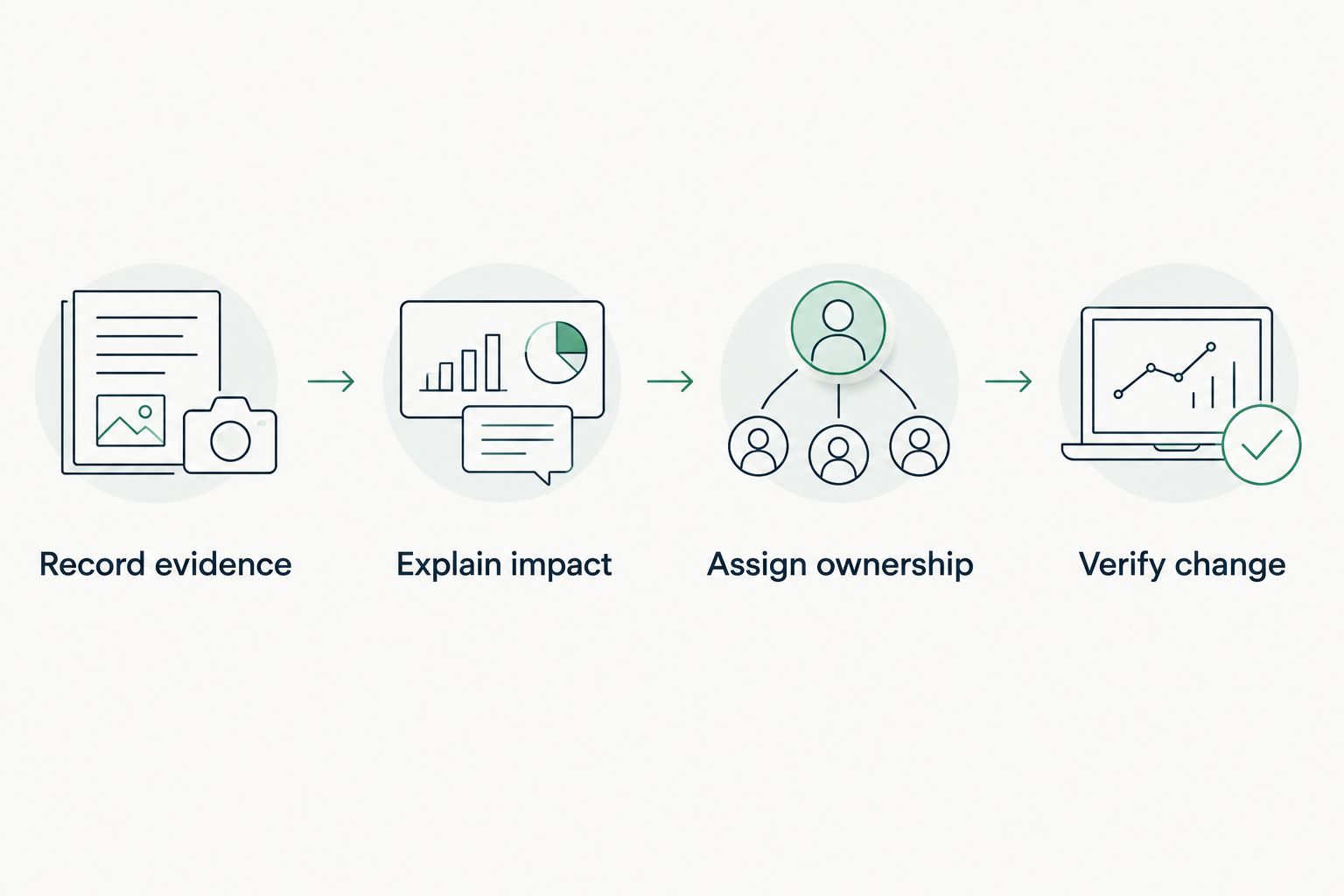
- Record evidence. Preserve the queried hostname, record type, resolver, timestamp and returned status. Attach validation diagnostics when available.
- Explain impact. Identify the service that depends on the affected answer. Describe observed failures separately from possible effects.
- State limits. A failed lookup does not identify an attacker, establish compromise or prove every user is affected.
- Assign ownership. Identify who controls the DNS zone, signing configuration and parent delegation before proposing a change.
- Verify change. Repeat the relevant checks against a pinned baseline and retain the new results.
For the broader conversation structure, use this guide to explaining security findings to a nontechnical MSP buyer.
Lead with the service consequence, then show the evidence that supports it. An owner needs to understand what requires attention. A technician needs enough detail to investigate without reconstructing your scan.
Why this matters
DNSSEC failures sit between a technical condition and a business consequence. A resolver returning a failure is observable; a customer being unable to reach a particular application requires separate evidence.
For a 2026 client review, keep those statements distinct. Report an observed lookup failure as an observed lookup failure, and confirm the application impact before describing an outage.
The same discipline applies during prospecting. Public DNS evidence gives you a condition to discuss. It does not establish buying intent, an unresolved support problem or dissatisfaction with the incumbent provider.
What the DNS response actually proves
DNSSEC validation checks signed DNS data through a chain of trust. A failure means the resolver could not successfully validate the relevant answer; the underlying reason requires investigation.
DNSSEC also distinguishes unsigned answers from answers that fail validation. Treating every unsigned domain as broken creates a false finding.
| Result | What it means | What you can tell the client | Boundary |
|---|---|---|---|
| Secure | The resolver successfully validated the relevant signed data | This answer validated through the resolver used | Validation does not establish website or application security |
| Insecure | The answer lacks a DNSSEC chain of trust under normal validation rules | This answer was not authenticated by DNSSEC | Unsigned does not mean a validation failure |
| Bogus | Data expected to validate failed the applicable checks | This resolver could not validate the answer | The result does not identify the cause or an attacker |
| Indeterminate | The resolver could not determine the applicable security status | The validation status remains undetermined | Keep the uncertainty visible |
| SERVFAIL | The resolver could not complete the query successfully | This lookup failed through this resolver | SERVFAIL alone does not establish a DNSSEC problem |
These distinctions follow the DNSSEC validation model described in IETF RFC 4033 and RFC 4035. They are protocol categories, separate from your report’s evidence-confidence labels.
Do not translate SERVFAIL directly into DNSSEC failure. Preserve the response and investigate the validation diagnostics before naming the cause.
What evidence belongs in the client explanation?
For your 2026 evidence packet, capture 1 affected hostname and its exact query type before expanding the scope. A domain-wide claim needs domain-wide support; a failed answer for one hostname cannot supply it.
Keep the following fields together:
- Observation: the response received and any validation-specific diagnostic.
- Source: the resolver queried and the tool or collector that recorded it.
- Time: the run date, timestamp and time zone.
- Object: the hostname and record type under review.
- Boundary: what the query did not assess or could not establish.
- Owner: the party responsible for investigating the relevant DNS configuration.
- Next choice: confirm intent, investigate, authorize a change or gather more evidence.
Use 2 resolver paths as a troubleshooting comparison when appropriate. Record both rather than treating disagreement as proof that either path is correct.
A validating resolver and a nonvalidating path can return different results when signed data is broken. That difference helps isolate the problem, but it does not replace a chain-of-trust investigation.
Public-domain observations remain separate from customer-authorized Microsoft 365 evidence. DNS results cannot establish Conditional Access coverage, application permissions, license assignments or tenant sharing configuration.
Why DNSSEC validation results vary
The visible failure can arise at different points in the chain. Describe these as investigation targets until evidence identifies the actual cause.
- Parent delegation: a DS record at the parent does not match the appropriate DNSKEY information in the child zone.
- Signature validity: a required signature has expired or is not yet valid according to the validator’s clock.
- Key rollover: parent records, published keys, signatures and cached data do not align during a transition.
- Response delivery: missing responses, truncation or transport problems prevent the resolver from obtaining required records.
- Resolver behavior: clock errors, trust-anchor configuration or validation policy affect the result.
- Authoritative consistency: different authoritative servers return inconsistent versions of the signed data.
A DNS provider migration is relevant context, but timing alone does not prove the migration caused the failure. Ask for the change record and compare the delegation, keys and signatures.
Avoid presenting the list as a diagnosis. Your finding should name the observed condition first and keep possible causes in a separate investigation section.
How to turn the finding into a client-safe explanation
Use Evidence, Insight and Proof as the structure for your 2026 conversation. Each part answers a different need: what ran, why the result matters and how the next review will establish what changed.
Evidence: describe the observed condition
Identify the affected hostname, query type, resolver and timestamp. Include the relevant response or validation diagnostic in the technical appendix.
Keep labels exact. Use Observed for a recorded response and Inferred for a conclusion drawn from supporting observations; do not treat those labels as interchangeable.
Insight: connect the condition to a bounded consequence
Explain that validating resolvers can withhold an answer when required DNSSEC validation fails. Name the dependent service only when the relationship is established.
An affected mail-routing lookup and an affected website lookup have different operational implications. Keep the affected object attached to the explanation rather than describing the entire business as exposed or offline.
Proof: define the verification before changing anything
Pin 1 baseline containing the original evidence. Agree on the result that would demonstrate the intended correction, then repeat the relevant lookup and validation checks after the authorized change.
A successful rescan establishes the result at its recorded time and scope. It does not guarantee that every cache has refreshed or every dependent service has recovered.
A practical handoff from finding to verification
Use this handoff when your sales team passes a finding to a technician or the client’s DNS provider. The same record should survive the transition from discovery to investigation.
- Record evidence: retain the original response and diagnostics.
- Explain impact: separate confirmed service symptoms from possible consequences.
- Assign ownership: name the party authorized to change the relevant records.
- Verify change: compare the new result with the pinned baseline.
Keep the report independent of the proposed vendor or service. The client can choose an internal correction, provider support, an MSP project or further investigation based on the evidence and responsibilities.
During a 2026 migration review, explicitly identify who controls the registrar account and who operates authoritative DNS. Those responsibilities can sit with different parties, and the corrective work can require coordination between them.
Should you disable DNSSEC to restore access?
Do not make disabling validation the default recommendation. Bypassing a failed check changes the protection applied to the answer and can leave the underlying configuration problem unresolved.
The corrective action depends on the cause and the owner’s authority. Repairing signatures, aligning delegation data or completing an intended rollover requires different work.
An emergency change needs an authorized decision, documented scope and a verification plan. Record any reduced protection and the intended follow-up rather than presenting a temporary bypass as proof of repair.
Never alter a prospect’s DNS as part of a sales review. Public observation and authorized remediation are separate activities with separate permissions.
Does a DNSSEC validation failure mean the client was hacked?
A DNSSEC validation failure does not establish that the client was hacked. It establishes a failed validation result only when the supporting diagnostics confirm that condition.
A compromise claim requires separate evidence. Keep suspected causes labeled as hypotheses, and avoid attaching breach costs or incident language to an unexplained DNS response.
Can the website still work while DNSSEC validation fails?
The website can still work for some users while other users encounter lookup failures. Different resolver behavior, cached data and the particular records queried can produce different experiences.
Record which path succeeded and which failed. A successful browser visit does not invalidate a failed DNS check, and a failed DNS check does not prove universal unavailability.
Where prospect intelligence fits
SCOUTz cybersecurity prospect intelligence is best for MSPs preparing evidence-led prospect conversations. It supplies dated evidence and account context; the MSP remains responsible for interpreting the finding and deciding what to say.
The useful output is a bounded discussion: what was observed, what remains unknown and who should investigate. The limitation is equally important: public-domain evidence cannot settle internal tenant questions or replace an authorized technical investigation.
For the client-supplied product reference dated October 15, 2026, Domain Review is available and Microsoft 365 Review is Open Beta. Treat those as dated status references rather than a promise about the exact DNSSEC checks included in a particular run.
For MSPs evaluating SCOUTz, the primary next step is Join Open Beta. Confirm the current scope before building a workflow around a specific collector or report field. SCOUTz prepares the conversation; the relationship and the sale stay yours.
FAQ
What does a DNSSEC validation failure mean?
A DNSSEC validation failure means a resolver could not successfully validate DNS data that required validation. Keep the response, resolver, timestamp and diagnostic details attached to the finding.
Is SERVFAIL always caused by DNSSEC?
SERVFAIL is not always caused by DNSSEC. It reports a query failure; validation diagnostics or further investigation are needed to establish a DNSSEC cause.
Does an unsigned domain fail DNSSEC validation?
An unsigned domain does not automatically fail DNSSEC validation. An insecure result is different from a bogus result where expected validation fails.
Can DNSSEC problems affect email delivery?
DNSSEC problems can affect email delivery when they prevent required DNS lookups from succeeding. Confirm the affected mail-related records and delivery evidence before claiming a delivery incident.
Who should fix a DNSSEC validation failure?
The authorized owner of the affected DNS configuration should coordinate the fix. The work can involve the DNS provider, registrar and MSP, depending on where the failure occurs.
Should I tell a prospect their domain is compromised?
A DNSSEC finding alone does not justify telling a prospect their domain is compromised. Describe the observed result and offer an authorized investigation without presenting a hypothesis as an incident.
How do I prove a DNSSEC correction worked?
Repeat the relevant validation checks against the pinned baseline and record the new source, timestamp and result. Report the verified scope separately from application recovery or cache-refresh assumptions.
One last thing
A successful lookup with validation bypassed is a diagnostic clue, not proof that the DNSSEC problem is fixed. The stronger completion record shows the intended answer validating through the relevant resolver path, with the new evidence attached to the original baseline.
Close the finding with a dated verification result, not a completed change ticket alone.