Spot outdated findings in a security sales deck by tracing every claim back to its check, source, observation date and assessment boundary. Recheck changeable evidence before presenting it as current. Keep older observations labeled historical when a new review cannot establish today's state.
- To spot outdated findings in a security sales deck, inspect the evidence date rather than the presentation date.
- A current slide can still contain historical, unreadable or out-of-scope evidence.
- Refresh a changeable observation before using it to support a current-state claim.
- SCOUTz supports dated prospect evidence; the MSP owns interpretation, authorization and the sales conversation.
Why this matters before the meeting
A deck can outlive the evidence that made it useful. A prospect can change a configuration after a review. An account team can reuse a slide without noticing that the underlying source was unavailable on the latest run.
The risk is a claim the evidence no longer supports. An old observation is still useful when it is clearly dated and relevant to the decision. The problem begins when historical evidence silently becomes a statement about the present.
The SCOUTz evidence methodology keeps source, observation date and coverage beside the conclusion. That discipline helps an MSP show what is known without turning a finding into a confirmed incident or a reason the prospect must buy.
How to spot outdated findings in a security sales deck
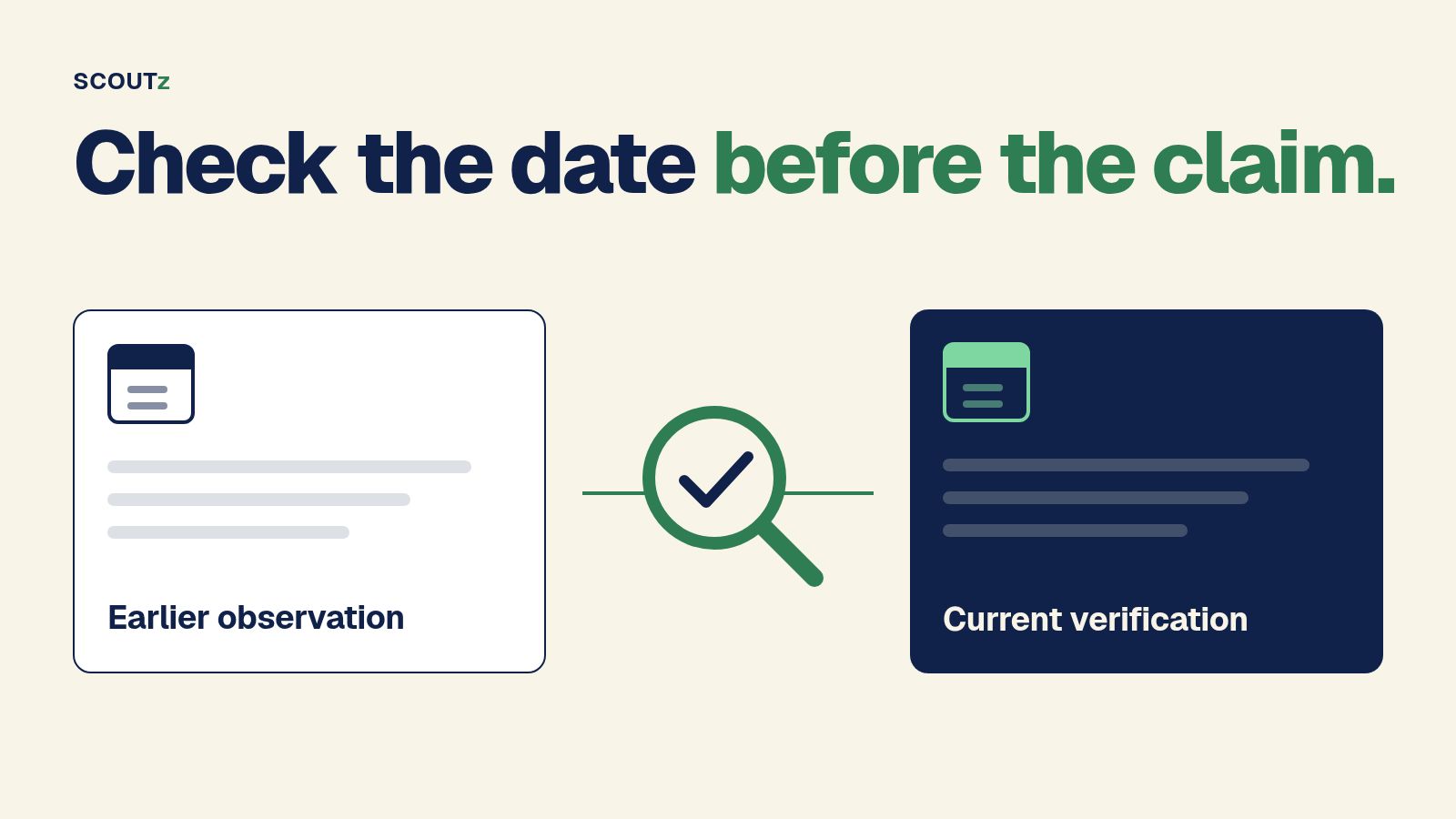
Review the evidence behind the headline before polishing the slide. A presentation's export date tells you when the file was produced, not when the condition was observed.
Use this inspection sequence:
- Find the original observation and its run date.
- Identify the affected domain, tenant or object.
- Confirm the check and source that supported the finding.
- Compare the claim's wording with the evidence boundary.
- Check for a later run, work record or customer correction.
- Decide whether to refresh, qualify or remove the current-state claim.
| Deck element | Warning sign | Better treatment |
|---|---|---|
| Finding headline | Present tense without an evidence date | State the observed condition and date |
| Summary score | No scope or source coverage | Keep the score with its assessed boundary |
| Before-and-after slide | Different sources or objects | Explain the difference before claiming improvement |
| Remediation slide | Work completed but state not verified | Separate completion from supported verification |
| Prospect context | Public event described as buying intent | Present the event as context and ask a question |
| Report screenshot | Capture treated as a live customer result | Preserve its original label and provenance |
A 2026 deck review should make these distinctions readable without requiring the buyer to inspect a hidden appendix.
Separate evidence age from presentation age
A fresh export can contain an old finding. A screenshot can show the original run accurately while the slide title implies that the condition remains present today.
Use an evidence label that answers four questions: what was checked, where the evidence came from, when it was observed and what the source could not establish. Place the observation date near the statement it qualifies.
Avoid a single reviewed-on date covering unrelated findings collected at different times. That label makes a mixed-age deck look like one current assessment. Keep each observation's date, or group only findings with the same relevant evidence window.
When evidence cannot be refreshed before the meeting, change the claim. Say the review observed the condition on the recorded date and current status needs confirmation. That is more useful than presenting stale certainty or discarding an observation that could still prompt a good question.
Recheck evidence according to the decision
Do not impose one expiry period on every finding. Published DNS, application permissions and business context can change for different reasons. The necessary freshness depends on the question the buyer is deciding and the consequence of an incorrect assumption.
Recheck when the deck is about to support a current-state recommendation, when the customer reports relevant work, or when collection conditions have changed. A later run is useful only if it can still observe the same condition.
Record the reason for refreshing:
- A customer says the configuration changed.
- Approved work should now be complete.
- The meeting needs a current observation.
- A source, permission or license boundary changed.
- The affected account or domain changed.
- The interpretation was corrected after review.
If none of the available sources can answer the question, retain Unknown. A deadline for the presentation does not turn missing evidence into an answer.
Use a dated DMARC finding as a question
Consider an illustrative 2026 deck about a domain whose published DMARC policy requests monitoring only. The finding supports a statement about that published record at the observation time. It does not establish why the policy was chosen or whether an attack succeeded.
A useful slide separates the layers:
| Layer | Illustrative wording | Boundary |
|---|---|---|
| Observed | The published policy requested monitoring only at the recorded time | The observation is dated |
| Possible consequence | The intended enforcement deserves review | Business and mail-flow context remains necessary |
| Ask | Who owns reporting, and is monitoring-only still intended? | The buyer supplies context |
| Next choice | Agree whether a scoped review is useful | No configuration change is authorized by the slide |
If a later observation finds a different policy, update the current-state slide and preserve the earlier evidence in the history. Do not continue pitching the original condition as unresolved because it makes a stronger opening.
The best sales question survives the correction: what outcome does the customer want, and what evidence would establish it?
Keep public-domain and internal evidence on separate slides
Public records can inform an initial conversation. They cannot establish internal Microsoft 365 controls such as application permissions, Conditional Access coverage or tenant sharing configuration.
A customer-authorized internal review can support selected configuration and metadata claims. Its own permissions, licenses and unread sources still limit the result. Approval to review a source does not make every internal control visible.
A useful structure is:
- Public observations: source, date and external boundary.
- Customer-confirmed context: purpose, owner and what changed.
- Authorized internal evidence: scope, date and coverage.
- Remaining unknowns: question, required source and next choice.
Use the domain scan versus cloud scan guide to keep the two evidence layers distinct. Avoid a combined score that implies a public finding established an internal condition.
Check before-and-after claims for equivalent coverage
A disappearing finding is not automatically a resolved problem. The later review might have lacked permission, omitted an object or failed to read the source.
Before presenting progress, compare the check identity, object set, source, dates and coverage. Where these changed, explain the difference instead of placing unlike results beside each other as proof.
Use specific outcome labels:
- Observable state changed: comparable evidence supports the difference.
- Still observed: the assessed source continues to show the condition.
- New observation: the current review recorded something not previously observed.
- Not comparable: scope or check meaning differs.
- Unreadable: the current source could not establish the condition.
New observation does not mean newly created. A first successful read can reveal a longstanding condition. That distinction matters when a customer asks whether the MSP's earlier review missed something.
For a 2026 proposal, show the limit beside the result rather than asking the buyer to infer it from a lower finding count.
Assign a person to every claim that needs follow-up
The seller does not need to become the assessment engineer, but someone must own unresolved interpretation. Record who confirms the evidence, who supplies business context and who approves a deeper review.
Keep the account record aligned with the deck. A correction made during a meeting should update the follow-up brief so the next person does not reuse the outdated slide.
A practical handoff contains the affected object, observation date, source, condition, possible consequence, unknowns and agreed next decision. Include any correction the customer supplied, with its provenance. Customer attestation can add context without silently becoming an independently verified technical result.
This is also where the distinction between sales systems and evidence tools matters. The relationship system records people and follow-up. The evidence workflow supports the claim. Delivery systems execute approved work. None of those responsibilities disappears because a deck looks complete.
Keep product captures honest
Use a real product capture when it helps explain the evidence workflow. Preserve the interface and its existing captions. An anonymized capture illustrates the product; it does not establish the prospect's current result.
Label explanatory diagrams Illustrative. Keep Real Product / Anonymized labels on actual captures and avoid copying their numbers into the customer's findings table.
SCOUTz's published workflow distinguishes real captures from designed explanations. Follow the same standard when adapting materials for an MSP-branded report. If a screenshot's provenance is uncertain, omit it until it can be confirmed.
A clean layout does not compensate for an invented interface, a missing evidence date or a finding attributed to the wrong customer.
Prepare the final meeting packet
The final review should check the spoken claim as well as the written slide. A dated footnote does not fix a presenter saying the prospect currently has a problem that was observed only in an older review.
Use this packet:
- The customer-facing deck with source dates and clear limits.
- An operator brief with original evidence references.
- A list of unknowns and the person who can answer each one.
- A follow-up record for corrections and agreed next steps.
The SCOUTz workflow connects account research, bounded evidence, consent, work planning and verification. SCOUTz supports preparation for MSP conversations; it does not replace technical sign-off or establish buying intent.
For a 2026 meeting, the desired outcome is a decision the customer can own. That can be permission for a deeper review, clarification that no work is needed, or an agreed investigation. A security observation does not guarantee any of them.
FAQ
How do I know whether a security finding is outdated?
Trace it to its original source and observation date, then check for relevant changes or later evidence. Recheck before presenting a changeable condition as current.
Does generating a new report refresh the findings?
Not by itself. A new export can still contain historical evidence. Confirm whether a new assessment ran and whether its sources were readable.
How long is a security assessment valid for a sales meeting?
There is no universal validity period for every finding. Freshness depends on the assessed condition, its changeability and the decision the evidence supports.
Can I call a missing finding resolved?
Only when comparable evidence supports that conclusion. First confirm that the current review covered the same condition and could read the relevant source.
Can I use a public-domain finding to claim an internal Microsoft 365 gap?
No. Public observations do not establish internal tenant configuration. Use customer-authorized evidence for internal control claims and preserve its coverage limits.
Can a security report prove a prospect wants to buy?
No. A finding can inform a question, but it does not establish budget, intent or agreement. The MSP owns the conversation and qualification.
One last thing
A prospect correcting the deck is useful new evidence. Record the correction, narrow the claim and agree what remains to verify. Defending a stale slide is less valuable than showing that the evidence can change your advice.
To evaluate the evidence workflow with a real prospect, Join Open Beta. SCOUTz prepares the conversation. The relationship and the sale stay yours.