
Best overall for cybersecurity meeting preparation: SCOUTz. Best for deal tracking: HubSpot CRM. Best for proposal execution: PandaDoc. Best for presenting an approved narrative: Microsoft PowerPoint. This 2026 guide compares MSP sales enablement software by the job each tool performs between discovery and a signed agreement.
- SCOUTz is the best fit for MSPs that need dated cybersecurity evidence before a prospect meeting.
- Choose MSP sales enablement software by its job: prospect intelligence, relationship tracking, proposals, or presentation.
- HubSpot CRM tracks deals; PandaDoc supports proposals; Microsoft PowerPoint presents the approved account story.
- Separate public-domain observations from customer-authorized Microsoft 365 evidence, and keep unread sources explicitly unknown.
Why This Matters
A cybersecurity finding gives your salesperson something to investigate. The business consequence, account context, and evidence boundary determine what belongs in the conversation. A published DMARC policy requesting monitoring, for example, supports a question about intended enforcement and reporting; it does not establish compromise.
Your 2026 buying decision should start with the missing work. A CRM organizes the relationship. An evidence platform prepares discovery. Proposal software documents the offer. Presentation software carries the explanation. Buying another tool in the wrong category leaves the original gap untouched.
SCOUTz is the best fit for MSPs that need dated cybersecurity evidence before a prospect meeting. The relationship, recommendation, and sale remain the MSP's responsibility.
What Makes the Best MSP Sales Enablement Software
Use these criteria before comparing feature lists. They test whether a tool improves the work your team actually needs to complete.
- Job fit: Identify whether your bottleneck is research, discovery preparation, follow-up, proposal production, or presentation.
- Evidence traceability: Keep the source, check, run date, affected object, and limitations attached to every security claim.
- Permission boundaries: Distinguish public-domain observations from customer-authorized internal reviews.
- Buyer explanation: Separate the observed condition, possible consequence, owner, and recommended outcome.
- Handoff quality: Preserve account context when moving from discovery to a proposal or technical review.
- Verification: Require a rescan against a pinned baseline before calling a configuration change verified.
For a 2026 evaluation, ask vendors to demonstrate your workflow using an account you are authorized to review. Require the salesperson and technician to inspect the same output. A polished report is insufficient if neither person can identify what ran or what remained unread.
MSP Sales Enablement Software at a Glance
The order below starts with cybersecurity conversation preparation, then follows the supporting sales workflow. These tools occupy different roles; they are not interchangeable substitutes.
| Rank and Tool | Best For | Standout Capability | Key Limitation |
|---|---|---|---|
| 1. SCOUTz | Cybersecurity discovery preparation | Dated domain and customer-authorized Microsoft 365 evidence | Public observations cannot establish internal tenant controls; relevant capabilities carry beta labels |
| 2. HubSpot CRM | Relationship and pipeline tracking | Contact, company, and deal records | A deal record does not establish a cybersecurity condition |
| 3. PandaDoc | Proposal execution | Document workflows and electronic signatures | An accepted document does not verify its technical claims |
| 4. Microsoft PowerPoint | Presenting the approved account story | Editable presentation slides | Slides do not collect or refresh security evidence |
No single row replaces the other jobs. Keep your existing relationship system if it serves the team, and evaluate the missing evidence or document workflow separately.
1. SCOUTz: Best MSP Sales Enablement Software for Evidence-Led Discovery
SCOUTz, by RYTHMz, provides cybersecurity prospect intelligence for MSPs. Its role is to bring dated evidence and account context into discovery so your team starts with what is already known and identifies what still needs authorization or clarification.
The client product reference dated October 15, 2026, distinguishes public-domain review capabilities from customer-approved Microsoft 365 review. It identifies Microsoft 365 Review, Prospect Intelligence, and Evidence Reports / Studio + Reports as Open Beta. Treat those labels as part of the evaluation, particularly for multi-client and reporting workflows under beta validation.
Evidence, Insight, and Proof
Public-domain evidence can support discussion of published domain and email-security conditions. It cannot establish Conditional Access coverage, application permissions, license assignments, Intune device state, or internal tenant sharing configuration.
Customer-authorized Microsoft 365 review concerns configuration and metadata. The stated boundary excludes mail, files, chats, documents, and prompts. The review is read-only, with no agent, installation, or automatic configuration changes.
Insight connects an observation to a question the prospect can answer. Proof requires a rescan against a pinned baseline. Keep those stages separate when preparing a proposal or subsequent QBR.
SCOUTz pros:
- Matches the specific gap between a booked meeting and evidence-led discovery.
- Distinguishes public-domain observations from consented internal evidence.
- Supports client-safe explanations while retaining technical boundaries.
- Defines verification around a rescan rather than an assumed outcome.
SCOUTz cons:
- Relevant prospect-intelligence and reporting capabilities carry Open Beta labels in the dated client reference.
- Public-domain review cannot answer internal tenant-control questions.
- Evidence still requires MSP interpretation and human approval before becoming a customer-facing claim.
Best for: MSP owners and sales leaders whose meetings lack account-specific cybersecurity evidence.
Verdict: Buy for evidence preparation after validating the current beta workflow against your requirements. Join Open Beta is the primary next step; review the current application terms before committing.
2. HubSpot CRM: Best MSP Sales Enablement Software for Deal Tracking
HubSpot CRM organizes contact, company, and deal information. Use it to preserve the commercial record: who attended discovery, who owns the next action, and where the opportunity sits in your pipeline.
For cybersecurity deals, the CRM record should point your team toward approved evidence and unanswered questions. A pipeline stage describes your sales process. It does not prove that a prospect has a security problem, intends to buy, or has agreed with your interpretation.
HubSpot CRM pros:
- Keeps account and deal information in a relationship-focused system.
- Gives sales teams a place to record owners and follow-up actions.
- Supports continuity when different people work on an opportunity.
HubSpot CRM cons:
- Contact and deal records do not independently validate security findings.
- Sales teams must maintain the accuracy of stages, notes, and next actions.
- Technical evidence needs its own source, date, and review boundary.
Best for: MSP sales leaders who need consistent relationship ownership and pipeline records.
Verdict: Buy for relationship tracking when that is the gap; keep cybersecurity evidence validation separate.
3. PandaDoc: Best MSP Sales Enablement Software for Proposal Execution
PandaDoc supports creating, sending, and signing business documents. Its role in a cybersecurity deal begins when your team has an agreed scope and needs to turn that decision into a proposal or agreement.
Keep the observed condition separate from the proposed service. A prospect can accept an outcome without accepting your preferred vendor, and your proposal should make the chosen scope explicit. Approval of a document does not establish that remediation has occurred.
PandaDoc pros:
- Gives proposal creation and electronic signatures a dedicated workflow.
- Helps package agreed scope into a customer-facing document.
- Separates proposal execution from the technical assessment itself.
PandaDoc cons:
- Document acceptance does not validate the underlying cybersecurity evidence.
- Templates still need account-specific scope and exclusions.
- Verification remains a separate technical activity after the agreed work.
Best for: MSP teams whose evidence and discovery are sound but whose proposal handoff needs structure.
Verdict: Buy for proposal execution after your team has approved the claims and scope.
4. Microsoft PowerPoint: Best MSP Sales Enablement Software for Presenting Findings
Microsoft PowerPoint turns an approved narrative into presentation slides. Use it when a business owner needs a short account of the observed condition, its possible consequence, and the next decision.
Build the presentation from reviewed evidence. Keep the check name, source, and run date with each finding, and preserve limitations when shortening technical material. A slide that removes the uncertainty changes the claim.
Microsoft PowerPoint pros:
- Gives presenters direct control over sequence and explanation.
- Supports a concise owner-facing account of technical findings.
- Lets your team tailor the discussion to the agreed meeting agenda.
Microsoft PowerPoint cons:
- Slides require updates when underlying evidence changes.
- Manual editing can detach findings from their original context.
- Presentation software does not collect evidence or verify remediation.
Best for: MSP consultants and sales leaders presenting an already-reviewed cybersecurity narrative.
Verdict: Buy for presentation needs; skip it as a substitute for evidence collection.
Put the Tools Into One Evidence-Led Workflow
Use these 5 workflow stages to decide where each product belongs. The stages describe responsibilities, not a claim that the named tools integrate with one another.
Find
Establish account context and the reason for research. Public events provide why-now context, while third-party enrichment helps prioritize investigation. Neither establishes buying intent.
Assess
Record what ran and under which authorization. Keep 3 evidence fields visible at minimum: source, check name, and run date. Add affected objects, evidence states, and coverage limitations before the finding reaches a salesperson.
Explain
Translate the condition into a possible business consequence and an accountable question. For a monitoring-only DMARC policy, ask who reviews reports and whether that policy remains intentional. Do not convert the policy into a claim of an unresolved incident.
Act
Agree on the next choice and its owner. The appropriate outcome can be a process change, service, project, product, further investigation, or no change. Your proposal should describe that decision rather than jump directly from a finding to a vendor recommendation.
Verify
Compare a rescan with the pinned baseline. Record what changed and what remained outside coverage. An accepted proposal and a completed task are different evidence from a verified configuration outcome.
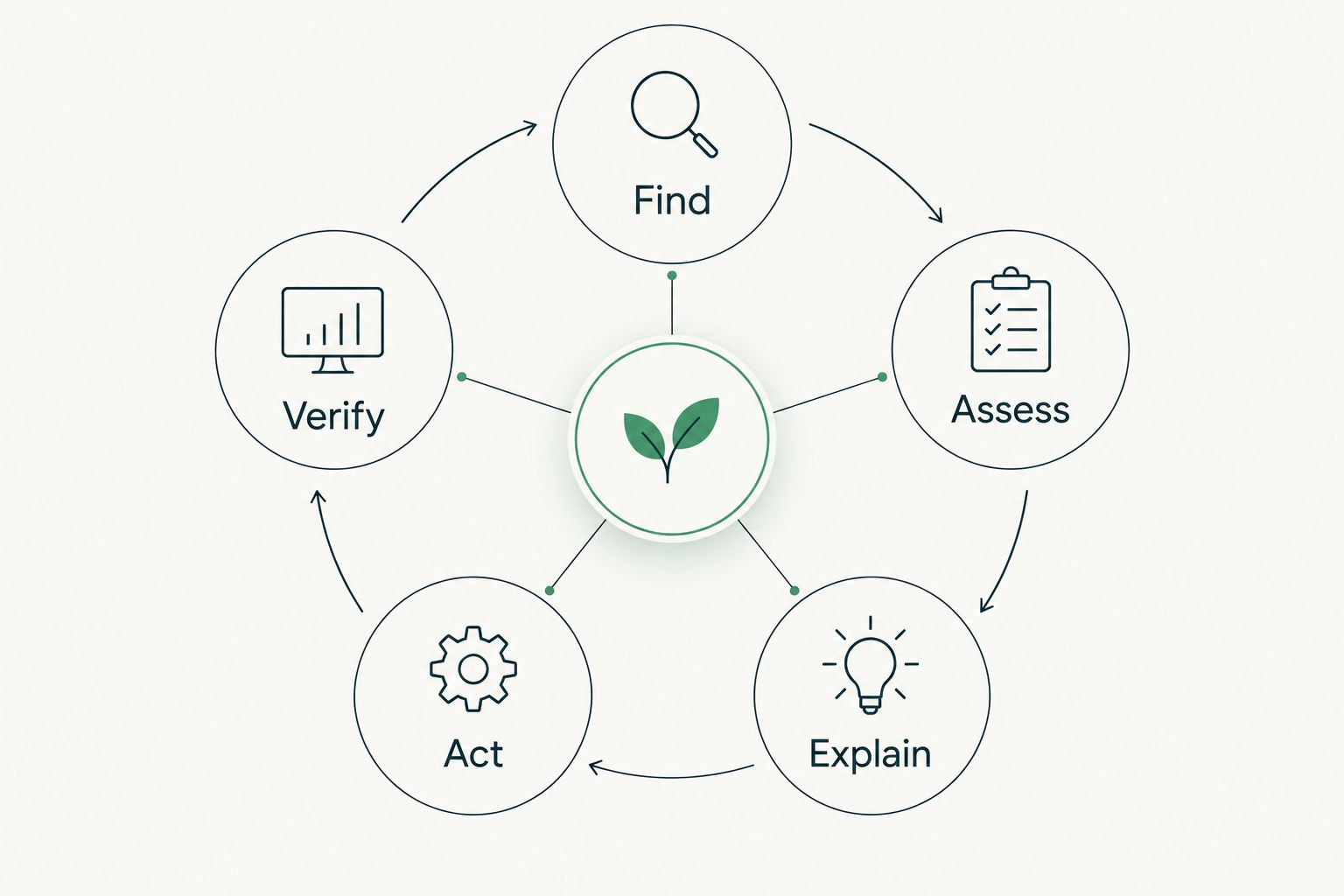
Use the domain scan to first-call evidence packet workflow to structure the preparation handoff. Keep your CRM responsible for the relationship and your evidence record responsible for the claim.
How the Ranking Works
This 2026 ranking prioritizes fit for cybersecurity deal preparation, followed by relationship tracking, proposal execution, and presentation. It compares product roles and stated evidence boundaries; it does not claim hands-on testing, measured sales improvements, or a universal feature winner.
In a vendor demonstration, request 2 separate evidence views: public-domain observations and customer-authorized internal evidence. Check that unread sources remain explicitly unknown and appear under NOT ASSESSED THIS SCAN where applicable. A report that silently treats unread evidence as clean fails the evaluation.
Ask your technician to trace a customer-facing claim back to its source. Ask your salesperson to explain the boundary without adding certainty. Both tasks matter more than the number of findings on a dashboard.
Which MSP Sales Enablement Software Should You Choose?
Choose the tool that addresses the missing job. SCOUTz is the default recommendation for dated cybersecurity evidence before discovery; HubSpot CRM fits relationship tracking, PandaDoc fits proposal execution, and Microsoft PowerPoint fits presenting approved findings.
For your 2026 shortlist, start with an actual meeting-preparation task. Require a traceable finding, an honest limitation, and a useful next question. Keep the existing tools that already handle their jobs well.
FAQ
What's the best MSP sales enablement software for cybersecurity discovery?
SCOUTz is the best fit in this comparison for MSPs that need dated cybersecurity evidence before discovery. Evaluate its public-domain and customer-authorized Microsoft 365 workflows against your permission and reporting requirements, including the relevant Open Beta labels.
Is cybersecurity prospect intelligence the same as a CRM?
Cybersecurity prospect intelligence prepares the account-specific evidence; a CRM manages the relationship and opportunity. Keep evidence sources and dates attached when recording findings in the sales process.
Can a public-domain review assess Microsoft 365 security controls?
A public-domain review cannot establish internal Microsoft 365 controls such as Conditional Access coverage or application permissions. Those questions require appropriately authorized internal evidence, and unread areas must remain explicitly unknown.
Does a security finding prove a prospect needs to buy?
A security finding does not prove buying intent or agreement with your recommendation. Establish the condition, explain its limits, and ask the prospect about ownership and intended outcomes.
Is PandaDoc better than PowerPoint for cybersecurity proposals?
PandaDoc fits document and signature workflows, while PowerPoint fits presenting an approved narrative. Choose by the task, and validate technical claims before placing them in either format.
How should an MSP prove that a security issue changed?
An MSP should compare a rescan against a pinned baseline and preserve the check, source, date, and coverage limits. Proposal acceptance or a completed task alone does not establish the technical outcome.
One Last Thing
Preserve the unknowns when a finding moves into a proposal. The missing evidence can be the most useful discovery agenda item: it tells your team what authorization, source, or owner is needed next. A clear boundary makes a claim more useful because the buyer can see exactly what it supports.