
Choose SCOUTz if you need dated cybersecurity evidence for MSP prospect meetings; choose ThreatCaptain if its demonstration meets your financial-risk reporting requirements. In this comparison, the decision is whether your next conversation needs evidence about an observed condition or a defensible model for a financial decision.
- SCOUTz vs ThreatCaptain starts with your required output: dated security evidence or financial-risk decision support.
- SCOUTz is best for MSP prospect intelligence built around domain reviews and consented Microsoft 365 evidence.
- Evaluate ThreatCaptain against your financial-risk requirements; demand visible assumptions, sources, and limits.
- Keep observed conditions, possible consequences, and financial assumptions separate in every proposal.
Why this matters
A prospect can agree that a security condition exists without agreeing to a project. Your job is to establish the condition, understand its relevance, and agree on an appropriate next choice. A monetary estimate answers a different question and needs its own evidence.
SCOUTz is best for MSPs that need dated cybersecurity evidence before a prospect conversation. Its stated role is preparation: domain observations, authorized Microsoft 365 configuration evidence, and account context. The relationship and the sale stay with the MSP.
For a 2026 evaluation, compare the output you need rather than treating every security report as interchangeable. Start with the domain-scan-to-first-call evidence workflow if your immediate problem is preparing a credible first meeting.
At a glance
The client-supplied product reference is dated October 15, 2026. The ThreatCaptain column below defines what to establish in its demonstration; it does not assign unverified capabilities or limitations to the product.
| Dimension | SCOUTz | ThreatCaptain |
|---|---|---|
| Best for | MSP prospect intelligence and evidence-led meeting preparation | Choose when its demonstrated output fits your financial-risk decision |
| Standout feature | Dated findings with source, scope, and evidence boundaries | Establish how financial conclusions connect to evidence and assumptions |
| Public-domain review | Public observations, separate from internal tenant evidence | Establish collection scope and authorization requirements |
| Microsoft 365 review | Customer-authorized, read-only configuration and metadata review; Open Beta in the dated reference | Establish permissions, assessed sources, and declared non-reads |
| Financial-risk output | Does not model hypothetical breach dollar losses | Require an explanation of any monetary model and its limits |
| Proof of change | Rescan against a pinned baseline | Establish whether comparable before-and-after evidence is provided |
| MSP responsibility | MSP owns interpretation, relationship, and service choice | Require clear human review and decision ownership |
| Pricing model | Workspace subscription; confirm current terms | Confirm billing unit, included work, and contract terms |
Evidence-led preparation wins when discovery needs a factual starting point
The evidence-first approach begins with what ran and what it observed. A finding keeps its check and run date attached. Account context keeps source, date, confidence, expiry, observation, implication, questions, and a safe offer together.
That gives your salesperson a concrete starting point. Instead of opening with a generic security warning, you can describe a dated condition and ask the person responsible whether it reflects the intended setup.
Consider a published DMARC policy that requests monitoring only. The observation concerns the published policy. The possible consequence concerns the intended handling of unauthenticated mail. The next question concerns who reviews reports and whether monitoring-only remains intentional.
This is useful preparation. It does not establish compromise, an unresolved issue, or willingness to buy. Your prospect supplies the missing operational context.
For your 2026 shortlist, favor this approach when the immediate deliverable is a discovery brief. Its limitation is equally clear: dated technical evidence alone does not answer a budget owner’s financial questions.
Financial-risk requirements need their own acceptance test
Choose ThreatCaptain only after its demonstration establishes the financial-risk output your buyer needs. A product name, category label, or polished report is insufficient grounds for a comparative claim.
Give the vendor a specific decision to support. Examples include comparing proposed treatments, documenting assumptions for a budget discussion, or explaining uncertainty to a business owner. Then inspect how the demonstrated output supports that decision.
Require the presenter to distinguish:
- Evidence that establishes a current condition.
- Assumptions used to describe a possible future event.
- Business inputs supplied by the customer.
- Uncertainty that remains after the calculation.
A monetary output must retain those distinctions. Otherwise, the reader cannot tell which parts were observed and which parts were modeled.
This is the scenario in which a financial-risk-focused evaluation deserves priority over a prospect-preparation evaluation. It is a buyer requirement, rather than a claim that ThreatCaptain has passed it. Do not award a capability win until the demonstration supplies the proof.
Public-domain evidence is the better starting point for external discovery
A public-domain review can support an initial conversation without being represented as a tenant assessment. Keep its scope explicit. Public evidence and customer-authorized internal evidence answer different questions.
The public review cannot establish Conditional Access coverage, application permissions, license assignments, Intune device state, or tenant sharing configuration. Carry those limits into the report and the sales conversation.
Keep 2 evidence sources separate: public-domain observations and consented internal evidence. Moving from one to the other requires an explicit change in scope and authorization.
A useful discovery note identifies the observed object, the source, the run date, the possible consequence, and the person who can clarify intent. It also lists what remains unknown.
During a ThreatCaptain evaluation, request the same source distinction. Do not infer that a financial presentation includes internal technical evidence. Do not infer the opposite either. Establish what was collected and under what authority.
Public observation also differs from active probing. Set an appropriate authorization boundary before outreach assessments; no product comparison establishes blanket permission to scan prospects.
Consented Microsoft 365 evidence wins for tenant-specific questions
Microsoft 365 questions require tenant evidence. An externally visible email policy cannot establish the state of internal access controls.
The supplied October 15, 2026 reference describes the Microsoft 365 Review as Open Beta. Its boundary is customer-authorized, read-only configuration and metadata review, without an agent, installation, or automatic configuration changes. Mail, files, chats, documents, and prompts remain outside that stated evidence scope.
That boundary matters during procurement. You can explain what access supports the review and what content the review does not read. You still need to preserve permission and license limits in the resulting findings.
Ask either vendor to distinguish coverage states such as Assessed, Partial, Not assessed, Permission limited, and License limited. These describe coverage rather than a security score.
An unread source stays unknown. Put declared non-reads under NOT ASSESSED THIS SCAN instead of allowing a blank result to look like a clean control.
Both evaluations need evidence boundaries before recommendations
This is an acceptance criterion for both products, rather than an assertion that their implementations match. A usable report must keep the condition, affected object, unknowns, and recommended outcome separate from vendor choices.
Preserve distinctions that affect the sales conversation:
- A breach-data match differs from a compromised user.
- Tenant-wide permission differs from a malicious application.
- Backup software presence differs from recoverability.
- An answering service differs from an exploitable service.
Evidence states also require care. Verified, Observed, Inferred, Possible, Unknown, and Unreadable are distinct states, rather than a linear ladder.
The practical benefit is reviewability. Your technician can inspect the claim, your salesperson can explain its boundary, and the prospect can correct missing context.
The cost is discipline. Someone must review the account context and sign off on the claim before it enters an owner-facing proposal. Software output does not remove that responsibility.
A pinned baseline wins when you need proof of change
A finding describes a condition at a point in time. Proof of change requires a comparable follow-up observation.
The stated workflow has 5 stages: Find, Assess, Explain, Act, Verify. For a proposal or QBR, preserve the baseline before work begins, agree on the recommended outcome, and identify the observation that will establish whether that outcome occurred.
Use 3 steps to keep the explanation readable:
- Evidence: record what ran, its date, and its limits.
- Insight: explain why the observation matters to this account.
- Proof: rescan against the pinned baseline to establish what changed.
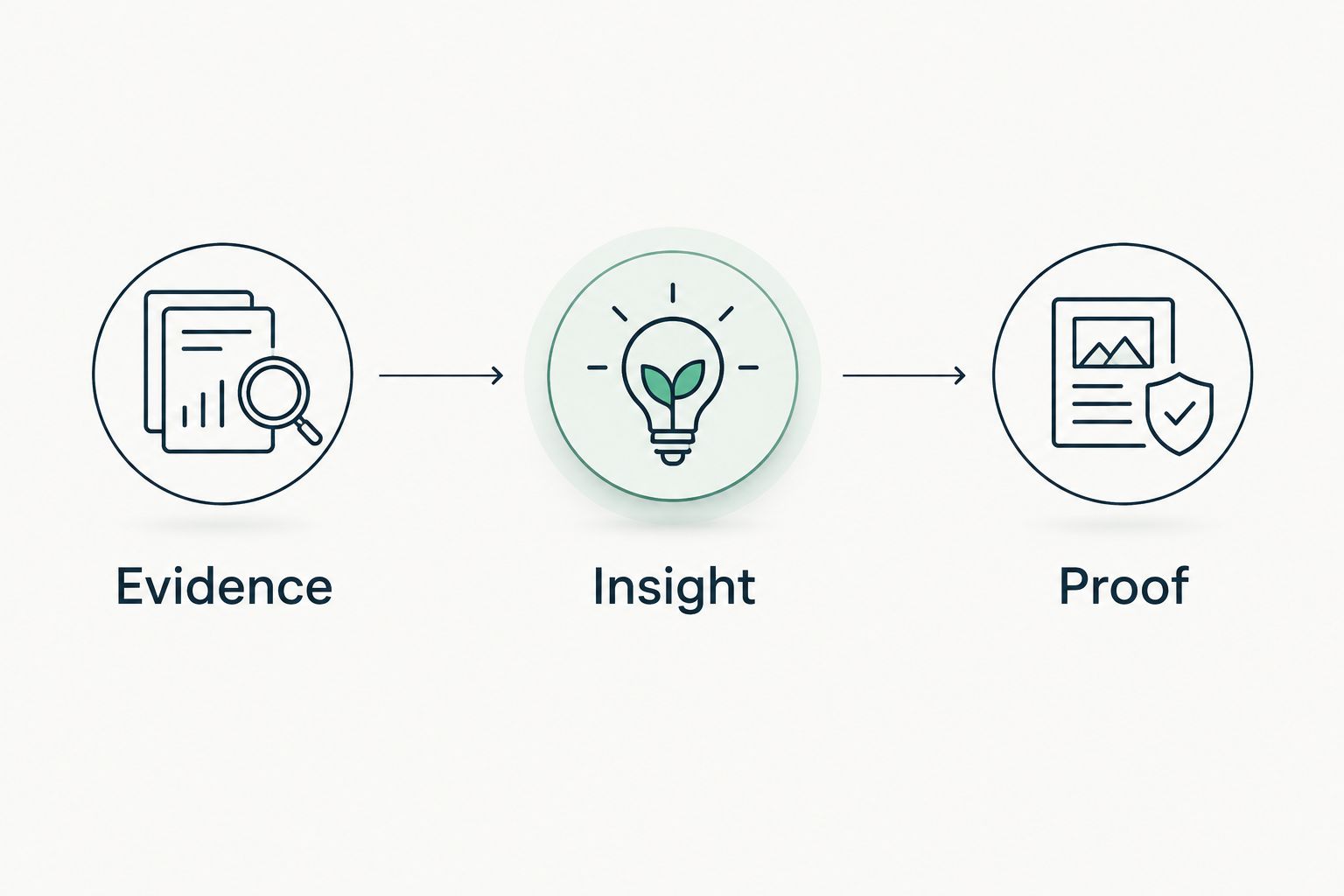
Keep the technical observation and the business interpretation separately reviewable. A changed configuration can establish that a configuration changed; a broader claim about financial exposure requires its own support.
Ask ThreatCaptain to demonstrate its approach to repeat measurement. Award that dimension only after you can inspect comparable outputs and the assumptions that changed between them.
Both buying decisions leave the MSP responsible
The two purchase paths share a decision boundary: your MSP must own the recommendation. A report supplies material for judgment, while the buyer and service provider decide what to do.
The stated prospect-preparation approach leaves the relationship in the CRM and delivery work with PSA, RMM, and security platforms. It is not a contact database or a replacement for MSP judgment.
Keep public events as why-now context. Keep enrichment as a research priority. Neither establishes buying intent. An email open remains a follow-up cue rather than agreement.
For a 2026 pilot, ask your sales lead and a practitioner to review the same account packet. The sales lead should identify the next conversation; the practitioner should verify that the technical claim stays within its evidence.
No close-rate improvement, shorter sales cycle, or guaranteed contract follows from that exercise. The acceptance test is whether the team can explain the observation and its limits accurately.
Compare pricing models by the work you need
The supplied commercial reference describes a workspace subscription with monthly and annual billing options. Confirm current terms, included reviews, fair-use boundaries, and beta conditions before committing.
A workspace subscription should be evaluated against your actual account workflow. Check whether the agreement covers the users, repeat reviews, reporting, and rescans you plan to use. Annual commitment and monthly flexibility belong in that decision.
For ThreatCaptain, establish the billing unit directly. Ask whether charges depend on workspaces, users, assessed organizations, reports, or another unit. Do not assume a shared pricing model because both products enter an MSP buying conversation.
Compare the complete workflow in 2026: initial preparation, authorized assessment, explanation, and verification. A report-only comparison leaves out the work required to maintain evidence and explain changes.
Final verdict: choose the output your next meeting requires
Choose SCOUTz for evidence-led prospect preparation
Best for the MSP owner or sales leader who needs a dated account brief before discovery. Use the public-domain boundary first, add internal evidence with consent, and retain the questions that only the prospect can answer.
The primary next step is Join Open Beta, subject to the human MSP-fit review. The dated reference places Microsoft 365 Review, evidence reporting, and prospect intelligence in Open Beta; confirm the current scope for your intended workflow.
Choose ThreatCaptain when its demonstration meets your financial-risk brief
Best for a buyer whose immediate requirement is financial decision support and whose evaluation establishes that ThreatCaptain supplies it. Require traceable inputs, explicit assumptions, understandable uncertainty, and a usable explanation for the decision-maker.
Do not substitute a financial estimate for evidence that a technical condition exists. Equally, do not expect a dated technical finding to answer a financial question by itself.
| Dimension | Winner or decision rule |
|---|---|
| Prospect-meeting preparation | Evidence-led account brief |
| Financial-risk decision support | ThreatCaptain only after demonstrated fit |
| External discovery | Public-domain evidence within its scope |
| Internal tenant questions | Customer-authorized tenant evidence |
| Evidence boundaries | Same acceptance standard for both |
| Proof of change | Comparable rescan against a pinned baseline |
| Decision ownership | MSP and customer retain judgment |
| Commercial fit | Confirm terms against the complete workflow |
FAQ
What is the main difference in SCOUTz vs ThreatCaptain?
SCOUTz has a stated role in dated cybersecurity evidence and MSP prospect preparation. Evaluate ThreatCaptain directly against any financial-risk reporting requirement rather than assuming equivalent evidence collection or financial capabilities.
Which approach is better for a first prospect meeting?
An evidence-led account brief fits a first meeting focused on establishing known conditions and discovery questions. Keep each observation attached to its source, date, scope, and limits.
Does a public-domain review assess Microsoft 365 security?
A public-domain review cannot establish internal Microsoft 365 controls. Conditional Access coverage, application permissions, license assignments, device state, and tenant sharing require appropriate internal evidence.
Does a read-only Microsoft 365 review read customer messages?
The supplied product boundary limits the review to configuration and metadata. Mail, files, chats, documents, and prompts are outside that stated scope.
How should an MSP evaluate financial-risk reporting?
Require the vendor to separate observed evidence, customer inputs, model assumptions, and uncertainty. Then check whether the output supports the specific financial decision your buyer needs to make.
How should I compare subscription costs?
Compare billing units and included work across the complete assessment workflow. Confirm current terms for users, organizations, reports, repeat reviews, and rescans before choosing a contract.
Can a security finding prove that a prospect wants to buy?
A security finding does not establish buying intent. Use it to prepare a bounded question, then let the prospect explain ownership, context, and priorities.
One last thing
Before approving a report template, inspect a section where collection failed. It should say what was unreadable, why the coverage stopped, and what remains unknown. That small test exposes whether the report preserves uncertainty when the evidence is least convenient.