
Yes, MSPs can offer free security assessments as a lead magnet when the offer has a defined scope, appropriate authorization, dated evidence and a useful next step. Offer an opt-in review after a prospect replies, distinguish public-domain observations from customer-authorized Microsoft 365 evidence, and explain what remains unassessed. A finding supports discovery; it does not establish a breach, an unresolved problem or buying intent.
- Can MSPs offer free security assessments as a lead magnet? Yes, with defined scope, appropriate authorization and clear evidence limits.
- SCOUTz fits MSPs that want dated cybersecurity prospect intelligence to prepare evidence-led sales conversations.
- Public-domain reviews cannot establish internal Microsoft 365 controls; tenant evidence requires customer authorization.
- Offer a specific next decision, preserve buyer choice and verify agreed changes against a pinned baseline.
Can MSPs offer free security assessments as a lead magnet?
Yes. Offer a bounded review that helps the prospect make a decision. State the assessed domain or tenant, permitted activity, evidence sources, deliverable and stopping point before work begins.
Public observation and active probing require different consideration. Use the guide to scanning a prospect’s domain before permission to frame that distinction, then obtain appropriate authorization for the actual activity. This article is educational guidance, not legal advice or blanket clearance to scan prospects.
Build the offer around these steps:
- Define the decision. Identify what the prospect wants to understand and who owns the answer.
- Agree the scope. Name the domain, evidence sources, authorized activity and exclusions.
- Present dated observations. Keep each condition attached to its check, affected object, source and run date.
- Agree the next action. Offer clarification, further authorized assessment, a scoped proposal or no action.
For a 2026 campaign, write these boundaries into the offer itself. A landing page that promises a security assessment should explain whether that means public email-security observations, an authorized tenant review or another explicitly scoped activity.
Why this matters
A report gives you material for a sales conversation. The prospect still needs to decide whether the condition matters, whether someone already owns it and whether your proposed work fits.
A monitoring-only DMARC policy illustrates the distinction. The published policy is evidence of the requested handling policy at the time observed. It does not establish compromise or explain why that policy was chosen.
Turn the observation into a question about ownership and intended outcomes. Ask who reviews reports and whether monitoring-only remains intentional. That creates a discovery conversation without assigning blame to the incumbent provider.
Public-domain review: best for an opt-in first conversation
A public-domain review fits a prospect who wants to discuss externally observable conditions before authorizing tenant access. Keep the scope tied to named public sources and distinguish public observation from active probing.
The benefit is a concrete starting point. The limitation is visibility: public-domain evidence cannot establish Conditional Access coverage, application permissions, license assignments, Intune device state or tenant sharing configuration.
Use the following comparison when deciding what to offer:
| Review option | Best for | Useful evidence | Boundary or drawback |
|---|---|---|---|
| Public-domain review | An opt-in conversation about externally observable conditions | Dated observations from named public sources | Cannot establish internal tenant controls |
| Customer-authorized Microsoft 365 review | Discovery about tenant configuration and metadata | Evidence available within approved permissions and coverage | Permission and license limits can leave areas unassessed |
| Rescan against a pinned baseline | Verifying an agreed change | A comparison of the same scoped condition over time | Does not establish improvement outside the assessed scope |
Describe the offer as a domain or email-security review when that is what you actually assess. Calling it a complete cybersecurity assessment expands the promise beyond the evidence.
Recommendation: start with the smallest review that answers the prospect’s question. Expand only after the prospect agrees that additional evidence is useful.
Microsoft 365 review: best for authorized tenant discovery
A Microsoft 365 review belongs after customer authorization. Explain the requested access, the evidence to be read and the limits before connecting to the tenant.
For SCOUTz Microsoft 365 reviews, the client’s October 15, 2026 product reference describes read-only configuration and metadata review, with no agent, installation or automatic configuration changes. It excludes mail, files, chats, documents and prompts. The same reference labels Microsoft 365 Review and Evidence Reports / Studio + Reports as Open Beta.
That boundary helps you describe the offer accurately. It does not remove the need to confirm the customer’s authority, agree scope or explain coverage limits.
Keep evidence state separate from coverage. Observed describes evidence; Permission limited describes why coverage is incomplete. Unknown and Unreadable must remain explicit, and declared non-reads belong under NOT ASSESSED THIS SCAN.
Recommendation: offer tenant review when an agreed discovery question requires internal evidence. Broader access should answer a defined question rather than make the lead magnet appear more substantial.
Why free security assessment scope varies
The useful scope depends on the decision and the evidence you are authorized to collect. These factors determine what belongs in the offer:
- Decision ownership. The domain owner, tenant administrator and business decision-maker can have different responsibilities.
- Evidence source. Public-domain observations answer different questions from customer-approved tenant evidence.
- Authorized activity. Permission for a discussion does not establish permission for every assessment method.
- Coverage limits. Permissions, licenses and unreadable sources affect what the review can establish.
- Existing context. A condition can be intentional, already assigned or changed since the observation.
- Verification scope. An agreed change needs a defined comparison point before you describe what changed.
For your 2026 offer, include exclusions beside the promised deliverable. A prospect should understand the boundary before accepting, rather than discover it in the report footer.
Move from assessment to an agreed sales action
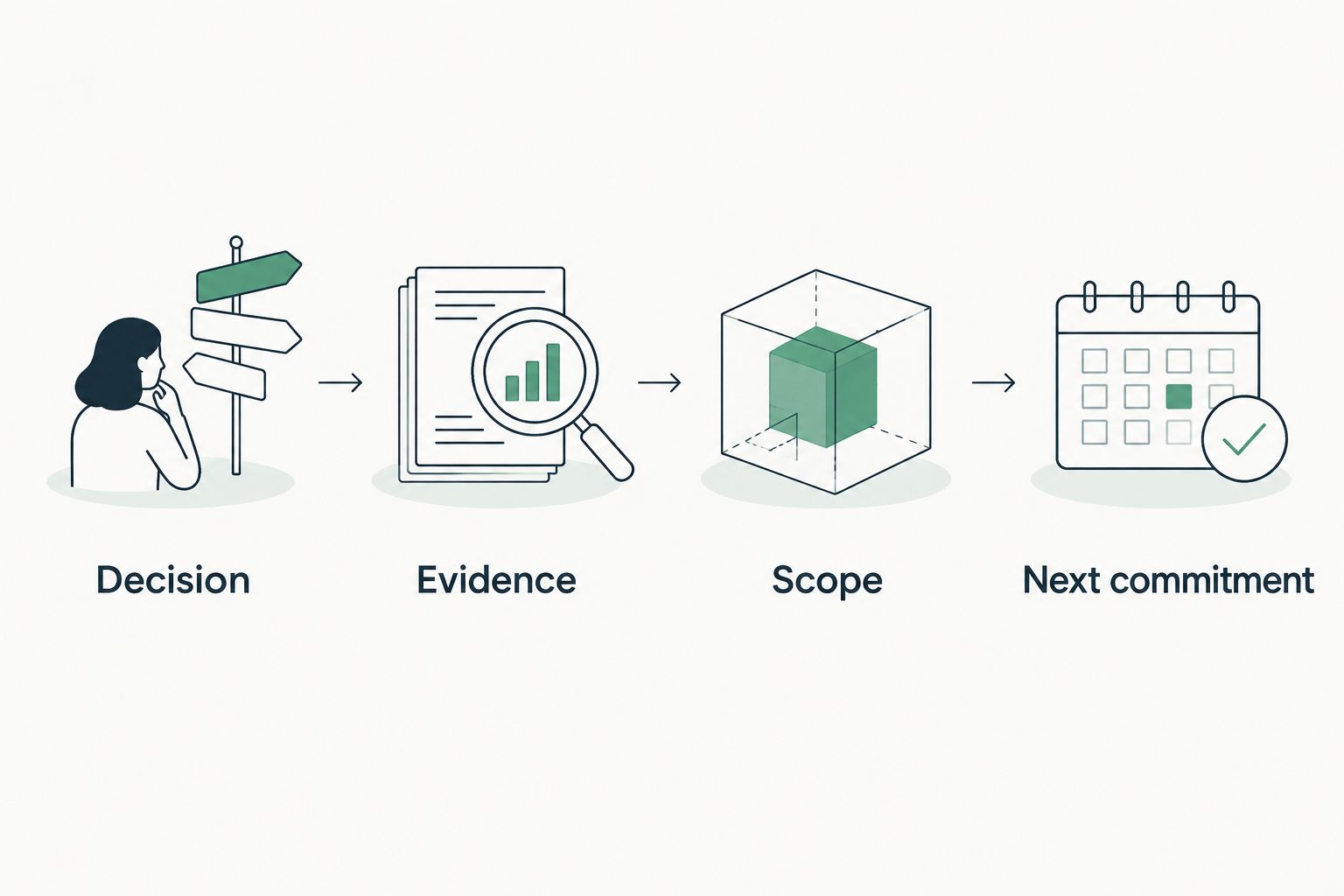
The SCOUTz Evidence-to-Agreement Framework organizes the conversation around 4 decisions: Find the decision, Bring the evidence, Build the scope and Earn the next commitment. The client approved this editorial framework on October 24, 2026. It is a conversation structure, not a validated close-rate intervention.
Decision
Find the business decision before presenting findings. Establish whether the prospect wants to review email-security ownership, understand a tenant configuration or decide whether further assessment is justified.
Illustrative dialogue, not a customer quote:
Before we review the domain evidence, let’s agree what you want to decide. We can clarify who owns email authentication and whether a deeper review would help.
This gives the meeting a purpose. If the prospect has no relevant decision or interest, preserve that answer rather than converting an observation into urgency.
Evidence
Bring the check and date with the condition. Separate what was observed from the possible consequence and from what remains unknown.
Illustrative dialogue, conditional on an actual monitoring-only DMARC finding:
The dated review observed a published DMARC policy requesting monitoring only. That does not establish compromise. Let’s confirm whether this remains your intended policy and who reviews the reports.
The consequence should stay proportional to the evidence. A condition observed earlier needs current context before you describe it as an unresolved problem.
Scope
Build the proposal around the agreed outcome. Keep the affected object, unknowns and recommended outcome separate from vendor selection.
Illustrative scope discussion:
The proposed work is to review the evidence, confirm intended policy and document an agreed next action. Any configuration change requires separate approval and a verification plan.
The MSP can recommend a service, process change, project, product or no action. Evidence informs that choice; it does not select the vendor automatically.
Next commitment
Earn a specific commitment that the buyer understands. Record the owner, agreed deliverable and next decision.
Illustrative follow-up script:
Today’s review identified a published policy to clarify. You agreed to confirm the owner and intended policy. After that, we can decide whether a scoped proposal is useful.
The assessment should end with an agreed decision or next action. Sending another report is useful only when it supports that agreement.
Handle objections without manufacturing urgency
Objections are opportunities to clarify scope and responsibility. Keep the buyer’s choices visible, including the choice to stop.
“Our current provider already handles this.”
Accept that explanation and confirm ownership. A public observation does not establish that the incumbent has neglected the condition.
Illustrative response:
Good. The useful next step is to confirm whether the observed policy is intentional and already being reviewed. Your current provider’s explanation belongs alongside the evidence.
“We do not want to grant tenant access.”
Respect the boundary. Explain what a public-domain review can establish and leave tenant controls unassessed.
Illustrative response:
We can keep the review within the agreed public-domain scope. Internal Microsoft 365 controls will remain unassessed, and the report will say so.
“Send the report and we will decide later.”
Send the agreed deliverable with its limits and a clear optional next step. An email open is a follow-up cue, not agreement or buying intent.
Illustrative response:
The report will include the sources, dates and coverage limits. If you want to discuss it, the next conversation can focus on ownership and whether further review is useful.
What should the assessment report include?
A prospect-facing report should let the reader trace each claim back to evidence. Preserve 2 evidence-source categories: public-domain observations and customer-authorized internal evidence.
Include these fields:
- Condition and object. State what was observed and which domain, account or configuration it concerns.
- Source and date. Identify the check, evidence source and run date.
- Evidence state. Distinguish Verified, Observed, Inferred, Possible, Unknown and Unreadable.
- Coverage. State Assessed, Partial, Not assessed, Permission limited or License limited as applicable.
- Possible consequence. Explain the relevant implication without declaring an incident.
- Owner and choice. Identify who should clarify the condition and which next action is being offered.
For verification, retain 1 pinned baseline for the agreed comparison. Record what ran again and what changed. A successful rescan of a scoped condition does not establish that the entire environment is secure.
Where SCOUTz fits
SCOUTz fits MSPs that want dated cybersecurity prospect intelligence to prepare evidence-led sales conversations. It supplies account context for discovery; the MSP remains responsible for interpretation, recommendations and the relationship.
The benefit is a shared evidence base for discussing a scoped next action. The limitation is equally important: public observations do not reveal internal controls, and authorized reviews remain subject to their assessed coverage. A scan does not close a deal.
For MSPs evaluating this workflow in 2026, Join Open Beta is the primary next step. Review SCOUTz to assess fit and confirm the current product scope and application process before making promises to prospects.
FAQ
Can MSPs offer free security assessments as a lead magnet?
Yes, MSPs can offer free security assessments with defined scope, appropriate authorization and clear evidence limits. Use an opt-in review to support a discovery decision rather than imply a breach or buying intent.
Can I scan a prospect before they reply?
Public observation and active probing require different consideration; there is no blanket permission established by this article. Offer outreach scans as opt-in courtesies after a reply and confirm authorization for the actual activity.
Can a domain review tell me whether Microsoft 365 is secure?
A public-domain review cannot establish internal Microsoft 365 controls. Conditional Access coverage, application permissions and tenant sharing configuration require appropriate internal evidence.
What should I say if a finding looks serious?
State the observed condition, source, date and limits before explaining a possible consequence. Do not turn a finding into a confirmed breach or an unresolved problem without supporting evidence.
Should the assessment include remediation?
Include remediation only when it is explicitly agreed and authorized within the scope. Separate the review, proposed changes and verification so the prospect understands each decision.
Does downloading a report mean the prospect wants to buy?
Downloading a report does not establish buying intent. An email open is a follow-up cue, and an agreed next action requires an explicit conversation.
How do I prove an agreed fix changed the finding?
Rescan the agreed condition against a pinned baseline and retain the check, source and dates. Describe the observed change within that scope without claiming that unassessed areas are secure.
One last thing
Write the report’s limits before writing the outreach message. If you cannot state what the assessment leaves unknown, the offer is not ready.
For your 2026 campaign, make that boundary part of the invitation. The prospect should know what they will receive, what remains unassessed and which decision the review is meant to support.