
Validate a security assessment tool's findings before a call by checking the original evidence, affected object, run date, collection permissions and limits, then matching each claim to what the evidence actually establishes. Recheck time-sensitive conditions through an authorized method, keep unread sources explicitly unknown, and bring a bounded observation plus a question instead of an accusation.
- How to validate a security assessment tool's findings before a call: inspect source evidence before accepting the summary.
- SCOUTz supports MSP sales preparation with dated cybersecurity evidence; the MSP remains responsible for the claim.
- Public-domain observations cannot establish internal Microsoft 365 configuration or prove a breach.
- Keep evidence state, assessment coverage and the buyer's next decision separate.
Why this matters
A finding can be accurate while the sales claim built around it is wrong. A published DMARC policy requesting monitoring does not establish compromised email, and an application's tenant-wide permission does not establish malicious activity.
Your pre-call review protects the distinction between evidence and interpretation. The claim you present must stay within the evidence you can show.
SCOUTz cybersecurity prospect intelligence is best for MSP owners and sales leaders preparing evidence-led prospect conversations. SCOUTz prepares the conversation; the relationship and the sale stay yours.
How to validate a security assessment tool's findings before a call
Use this sequence for your 2026 meeting-preparation checklist. Finish the evidence review before turning the finding into a slide, an outreach message or a proposed project.
1. Confirm the object
Match the finding to the exact domain, subdomain, tenant, application or account it describes. Record the identifier alongside the check name.
A parent-domain observation does not automatically describe every subdomain. An observation about an application also needs the specific application identity; a recognizable display name alone is insufficient context for a strong claim.
2. Inspect the source
Open the underlying evidence rather than relying on a score or generated explanation. Identify what ran, what returned and what the check was designed to establish.
For public-domain evidence, retain the observed record or response and its collection time. For customer-authorized Microsoft 365 evidence, retain the configuration or metadata source and the access scope used to read it. Keep message content, files, chats, documents and prompts outside that review.
3. Check the date
Keep the run date attached to the finding. A report generated in 2026 can still contain an older observation; the report's publication date does not refresh the evidence inside it.
Check whether the source includes an expiry or another freshness boundary. If the finding matters to your proposed next action, obtain an authorized fresh observation before describing it as current.
4. Separate evidence states
Keep Verified, Observed, Inferred, Possible, Unknown and Unreadable distinct. These labels describe different evidence conditions, rather than steps on a single certainty ladder.
An inference needs its supporting observations and reasoning. An unreadable source needs a stated limit. Neither becomes a confirmed finding because the report uses confident language.
5. Confirm coverage
Record whether the relevant area was Assessed, Partial, Not assessed, Permission limited or License limited. Coverage explains what the review reached; evidence state explains what an individual result supports.
Keep declared non-reads under NOT ASSESSED THIS SCAN. An unread source remains unknown, even when the rest of the report looks reassuring.
6. Approve the claim
Have the responsible practitioner compare the proposed wording with the evidence. Separate the observed condition, possible consequence, unknowns and recommended outcome.
Then identify the owner and the next choice. That choice can be further review, an agreed project, a process change or no action. A security finding does not decide the buyer's priorities for them.
Public-domain review versus authorized Microsoft 365 review
Choose the evidence route according to the question you need to answer. The distinction matters more than a combined score.
| Evidence route | Best for | Strength | Limit |
|---|---|---|---|
| Public-domain observation | Preparing questions about published domain and email-security conditions | Provides externally observable evidence without describing internal tenant configuration | Cannot establish Conditional Access coverage, application permissions, license assignments, Intune device state or tenant sharing configuration |
| Customer-authorized Microsoft 365 review | Preparing questions about tenant configuration and metadata | Supports discussion of the internal settings actually read | Depends on consent, permissions, licensing and assessment coverage; does not establish a breach from configuration alone |
Public observation and active probing also need separate treatment. Do not assume permission for an intrusive test because a prospect's domain is public. Agree to scope and authorization before expanding the assessment; legal requirements depend on the activity and jurisdiction.
SCOUTz's client-supplied editorial standard, dated October 15, 2026, describes read-only reviews without agents, installs or automatic configuration changes. The benefit is bounded evidence collection; the limitation is equally important: a review does not itself remediate a condition or establish incident history.
Why validation requirements vary
The claim determines the evidence burden. Use these factors to decide what must be checked before the call:
- Source access: Public records and consented tenant evidence answer different questions. Record the source beside the finding.
- Collection date: A changed configuration can invalidate an earlier observation. Preserve the original and distinguish it from a fresh result.
- Permissions: A collector unable to read a setting cannot establish that the control is absent.
- Object scope: Domain, tenant, application and account observations need their own affected-object identifiers.
- Claim severity: A claim of compromise requires evidence beyond a weak configuration or a breach-data match.
- Buyer context: A technically accurate condition can be intentional. Confirm the owner, intended state and existing work before proposing a change.
Avoid inventing a universal evidence-expiry period for your 2026 process. Set a review rule that reflects the source, the condition and the consequence of presenting stale information.
Turn evidence into an agreed next action
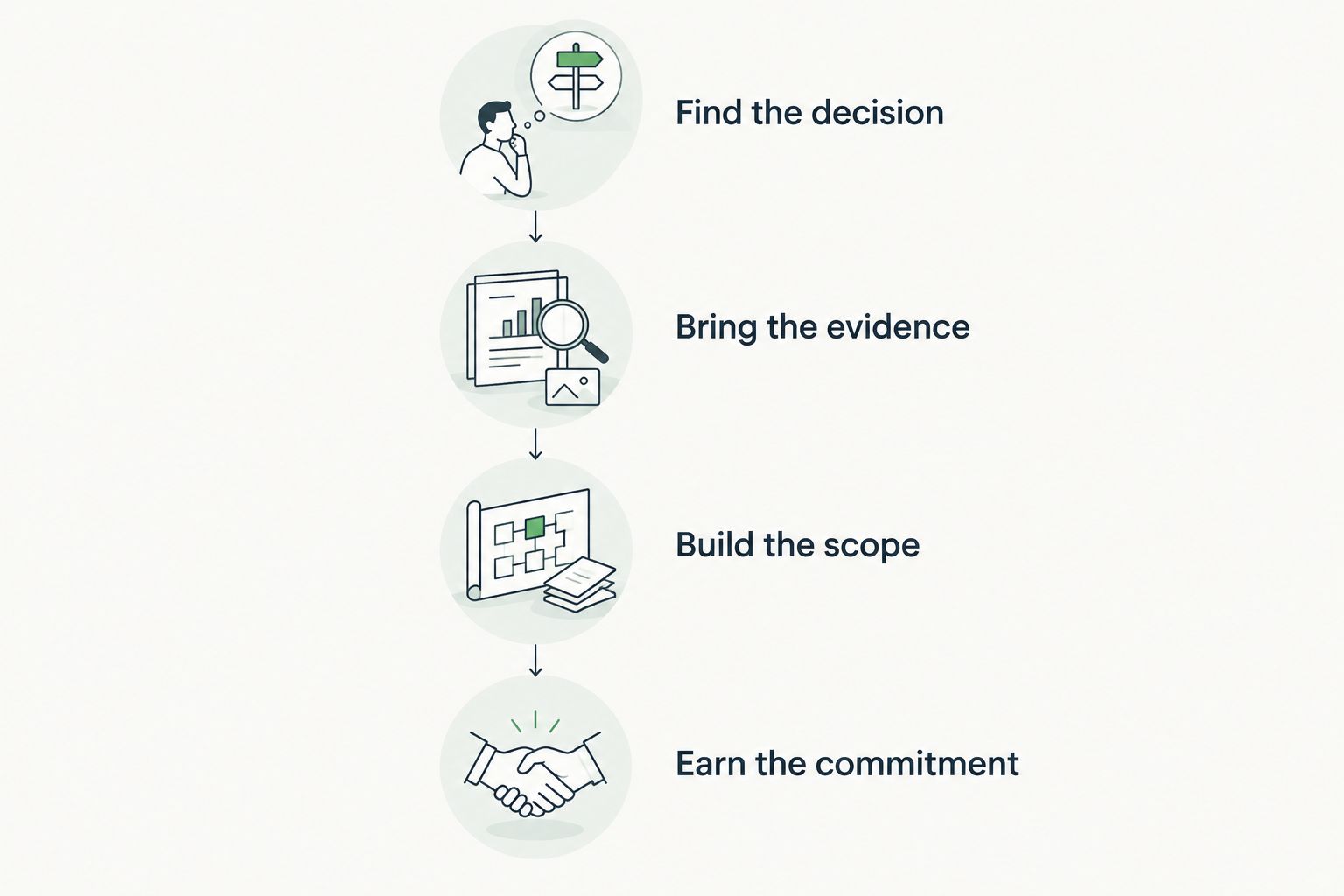
Use the SCOUTz Evidence-to-Agreement Framework to connect technical preparation to a buyer decision. This is a conversation framework, not a validated close-rate intervention.
Find the decision
Identify what the prospect needs to decide. For a monitoring-only DMARC policy, the decision could be whether to review intended enforcement and reporting ownership.
Do not begin with a product recommendation. First establish whether the condition is intentional and whether anyone already owns the work.
Bring the evidence
Show the observed policy, affected domain and actual collection date. State what the observation cannot establish, including whether abuse occurred or whether the prospect already has a planned change.
For your 2026 evidence packet, keep the check name and run date on the same page as the observation. A reader should not need a separate technical appendix to discover that the claim has limits.
Build the scope
Separate investigation from implementation. A review of reporting and intended policy is a different commitment from changing enforcement.
Keep the desired outcome independent of a vendor choice. The MSP can recommend a service, product, process, project or no change after the evidence and ownership are understood.
Earn the commitment
Ask for a specific next action that matches the unresolved question. An introduction to the domain owner, permission for a read-only tenant review or approval of a defined investigation is clearer than an open-ended promise to follow up.
Record what the buyer actually agreed to. An email open, report view or polite response does not establish buying intent.
An agreed investigation also needs an explicit testing boundary. When the buyer's question requires penetration testing, scope it separately from public observation and read-only configuration review; those activities answer different questions. Do not imply that a domain finding demonstrates an exploitable path.
Use a bounded conversation and follow-up
The following dialogue is illustrative. It demonstrates wording for an observed monitoring-only DMARC policy; it does not describe a real prospect, a live scan or a customer result.
Present the condition
MSP: The collected DMARC record requests monitoring only. The evidence packet includes the domain and collection date. That tells us the published policy at that time; it does not tell us whether anyone abused the domain.
Prospect: We already have someone managing email security.
MSP: Keep that owner involved. Before proposing a change, let's confirm whether monitoring-only remains intended and who reviews the reports.
This response preserves the existing relationship and makes the unknown explicit. It also gives the prospect a choice instead of converting a configuration observation into an emergency.
Handle a freshness objection
Prospect: That was fixed already.
MSP: Then the earlier observation needs a fresh check. With the agreed authorization, we can compare the new evidence with the dated baseline and record what changed.
Treat a correction as evidence to verify, not an objection to defeat. Preserve the earlier observation as historical context and withdraw any claim that it remains unresolved until the fresh evidence supports it.
Send a bounded follow-up
Use this illustrative structure after the meeting:
- Observation: Identify the condition, affected object, check and actual run date.
- Boundary: State what the evidence did not establish and which sources remained unread.
- Agreement: Record the owner's name or role only when confirmed, plus the action the buyer accepted.
- Scope: Describe the authorized review and the evidence needed for a decision.
- Proof: Define the baseline and the rescan needed to verify any agreed configuration change.
Keep speculative breach losses out of the message. The proposed work should stand on the observed condition, the buyer's stated priorities and an agreed outcome.
What should you do when findings conflict?
Conflicting findings require a source-level comparison before either becomes a sales claim. Check whether both tools assessed the same object, used comparable sources and ran under equivalent access conditions.
Different dates, permissions or check definitions can explain disagreement. Preserve both results and describe the unresolved difference rather than selecting the more alarming version.
For a 2026 proposal, include a disputed condition only as an investigation question until a practitioner resolves the evidence. Do not average incompatible platform scores into a new certainty claim.
Can sales present a finding without an engineer?
Sales can present an approved observation when the evidence packet includes its source, date, scope, limits and permitted wording. The salesperson should pause when the buyer asks for an interpretation beyond that approved boundary.
Use practitioner sign-off for consequential claims. Technical uncertainty belongs in a follow-up action, rather than an improvised answer that changes a possible consequence into an established incident.
FAQ
What's the first thing to check in a security assessment finding?
Check the original source evidence and the exact affected object before accepting the summary. Then confirm the check name, run date and collection limits.
Does a security finding prove that a prospect was breached?
A security finding does not establish a breach unless the underlying evidence supports that specific conclusion. Configuration weaknesses, breach-data matches and application permissions must remain separate from confirmed compromise.
Can a public-domain scan validate Microsoft 365 security settings?
A public-domain scan cannot establish internal Microsoft 365 settings such as Conditional Access coverage, application permissions or tenant sharing configuration. Those questions require customer-authorized evidence and explicit coverage boundaries.
How recent should evidence be before a prospect call?
Evidence must be recent enough to support the claim you intend to make. Check its actual collection date and expiry, then refresh consequential observations through an authorized method rather than assuming a universal freshness window.
What should I say when a collector cannot read a setting?
Say that the setting remains unknown and record the coverage limit. An unreadable or permission-limited source does not establish an absent control or a clean result.
How do I validate a finding that the prospect says is fixed?
Obtain an authorized fresh observation and compare it with the dated baseline. Keep the original result as historical evidence and describe only the change the comparison establishes.
Should I put the assessment score in my proposal?
Use a score only with its source, date, scope and limits attached. Keep the underlying conditions and agreed outcomes visible, and do not combine platforms into a single score.
One last thing
A corrected finding can become proof of completed work. Pin the original evidence, agree to the intended outcome and rescan against that baseline so the next conversation shows what changed.
For MSP teams evaluating SCOUTz cybersecurity prospect intelligence in 2026, Join Open Beta is the primary next step. The conversation still needs your judgment, the prospect's consent and an agreed decision.