Present security evidence in an MSP sales meeting by connecting a dated observation to the buyer's stated priority, explaining what it cannot establish and proposing a decision the right person can make. Show the supporting record when needed, then agree the work required to answer the remaining question.
- Present security evidence in an MSP sales meeting as a decision brief, not a list of frightening possibilities.
- SCOUTz cybersecurity prospect intelligence supplies dated evidence and audience-specific reports for MSP sales preparation.
- Use Evidence-to-Agreement: Find the decision, Bring the evidence, Build the scope, Earn the next commitment.
- Leave with an agreed question, decision owner and next action; a report presentation alone establishes none of those.
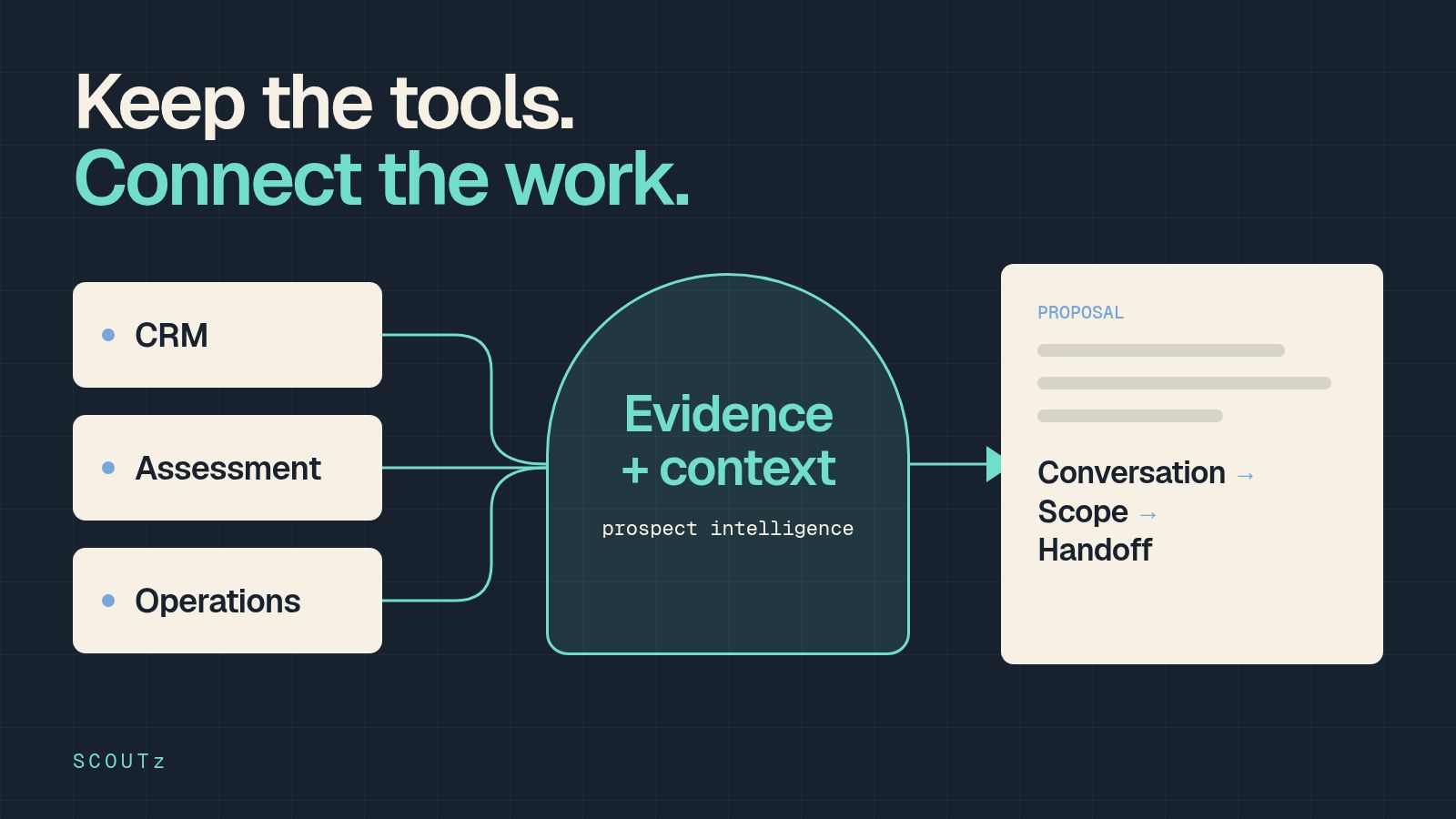
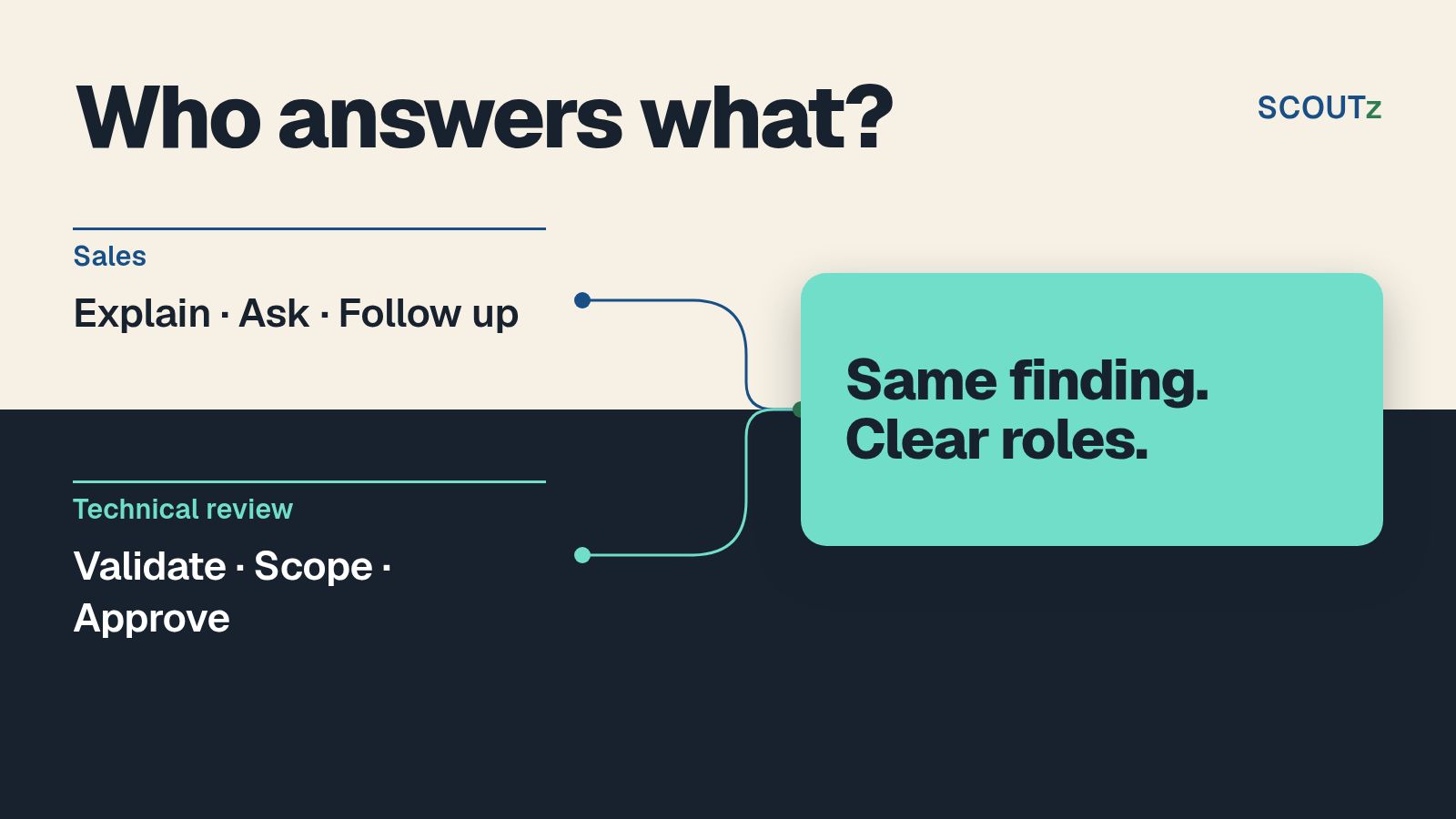
The SCOUTz report workflow separates seller preparation, operator evidence and client-facing reporting. Use those materials for their respective audiences. The presentation should help the owner evaluate your proposed work without making them inspect every technical record.
How to Present Security Evidence in an MSP Sales Meeting
Prepare a decision brief around a finding that matters to this account. Keep the supporting evidence available for a technical reviewer.
- Establish what the buyer wants to decide.
- Show the dated observation and identify its source.
- Explain the limits of the review.
- Ask who owns the condition and its intended state.
- Define any further investigation or work.
- Agree the next decision and its participants.
These six steps are a suggested meeting structure. They are not a measured sales intervention or a claim that every conversation needs the same sequence.
Why This Matters
A security finding establishes a condition within a particular scope. A proposal asks a buyer to commit resources. Your sales conversation has to connect the two through the outcome the buyer actually wants.
An owner asking for clearer accountability needs to understand responsibility and completion evidence. An operator evaluating a configuration needs source detail. Giving both people the same unfiltered report leaves the decision work unfinished.
This guide focuses on presenting the evidence. Discovery questions establish the buyer's priorities; the presentation shows how a specific observation informs the choice in front of them.
Prepare a Decision Brief Before Opening the Report
Start with the manual method: write a short brief using a verified record and the notes from discovery. The format works even before you choose reporting software.
| Brief Field | What to Put in It | What to Leave Out |
|---|---|---|
| Buyer priority | The outcome the buyer stated | An assumed fear or motive |
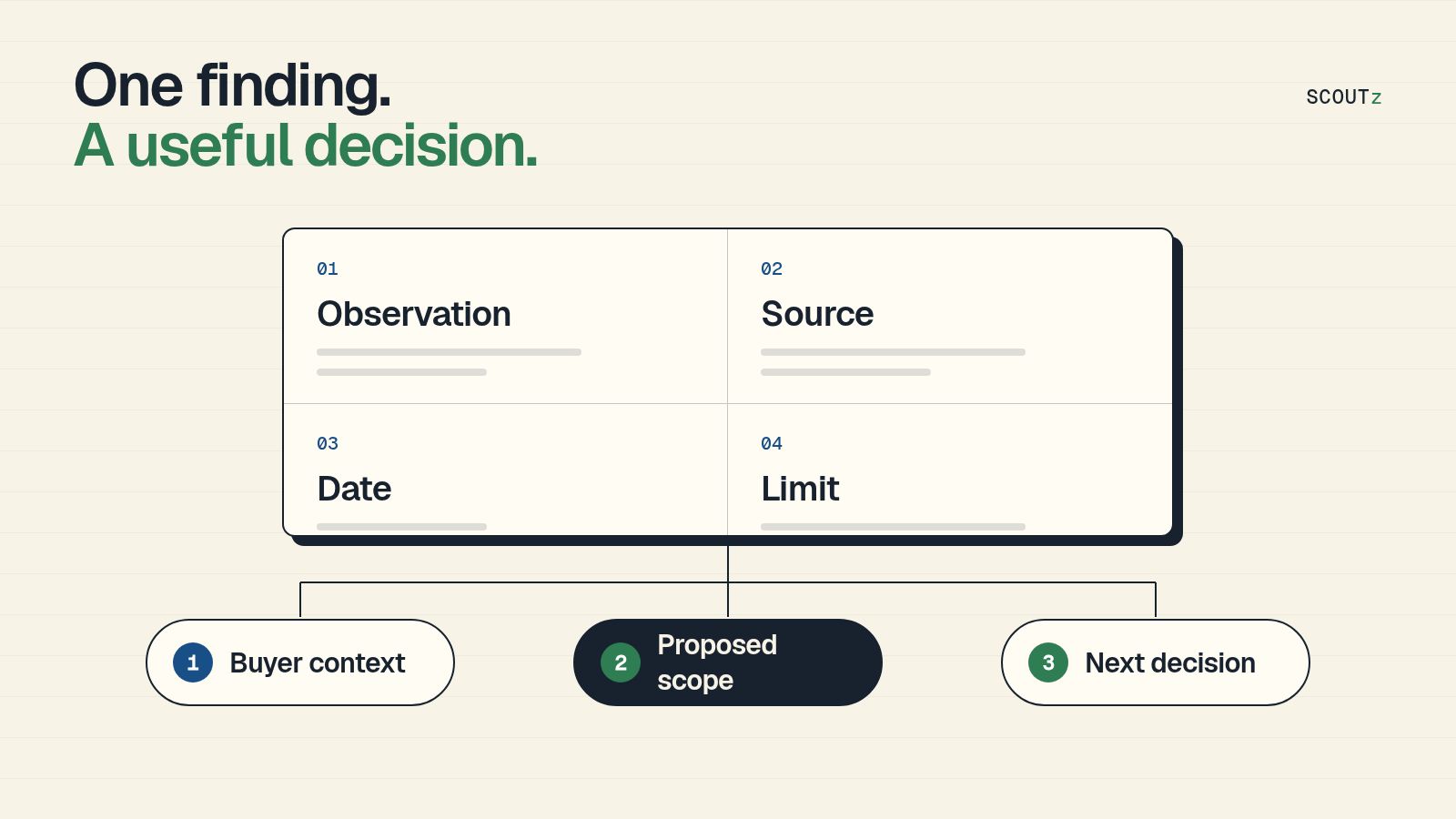
| Observation | The condition, source and run date | An invented incident |
| Boundary | What the source did not establish | An implied clean bill of health |
| Ownership question | Who confirms the intended state | An accusation against the incumbent |
| Proposed next action | The work needed to answer the question | An unrelated service bundle |
| Decision | Who evaluates the result | A vague request to move forward |
Write enough that a colleague can explain the recommendation without improvising. If your brief needs a catastrophic scenario to make the work sound relevant, return to discovery.
For a 2026 proposal, retain the version of the brief the buyer reviewed. Later changes to scope should remain distinguishable from the original recommendation.
Find the Decision Before Sharing the Screen
Confirm the purpose of the meeting in the buyer's language. Do this before showing a technical score or finding count.
Illustrative seller wording:
You asked for a clearer way to know whether agreed IT work is complete. I want to show one observation, confirm its context with you and decide whether a focused review would help. Is that still the decision we should work on?
If the buyer corrects the purpose, change the agenda. Do not keep presenting the prepared deck as though the correction never happened.
Capture the answer in the meeting notes. A statement such as needing completion evidence supports a different proposal from a request for an independent technical assessment. Both are legitimate, but they are not interchangeable.
The commercial aim is to establish a requirement you can responsibly satisfy. You still need a reason for each proposed deliverable.
Bring the Evidence With Its Boundary Attached
Present the observation and its limit together. Do not rely on a disclaimer at the end of the report to correct an exaggerated opening statement.
Illustrative training example: a public-domain review records a DMARC policy requesting monitoring only. The dated record shows the published policy at collection time. It does not establish why that policy was selected, whether an attack occurred or what internal Microsoft 365 controls are configured.
Suggested presentation:
The public record requests monitoring. The question is whether that remains the intended policy and who reviews the reporting. The record alone does not tell us those things.
Then stop and hear the answer. The prospect might have a documented transition underway. If that explanation resolves the question, update your recommendation rather than searching for another way to make the same observation alarming.
Use three visible evidence fields: condition, source and collection date. Keep the interpretation separate so a reviewer can challenge your reasoning without losing the underlying record.
Give Each Audience the Right Material
Choose depth according to the decision and the recipient's role. Keep the factual claim consistent across versions.
| Material | Best For | Strength | Limit |
|---|---|---|---|
| Decision brief | Owner evaluating the proposed outcome | Keeps the purchasing question visible | Does not replace technical evidence |
| Client-safe report | Buyer discussing findings and next steps | Provides an audience-appropriate explanation | Still requires context and review |
| Operator evidence | Technical reviewer checking the claim | Preserves investigation detail and provenance | Needs interpretation for an owner discussion |
Check every attachment before sharing. A document being useful to your seller does not mean it belongs in an owner-facing email.
SCOUTz cybersecurity prospect intelligence supports this separation with seller, operator and client reporting. Its First meeting and Win the deal Report Plays bundle material around those stages. The product page checked October 24, 2026, distinguishes current reports from a visual Report Studio still in validation.
Use an Agenda With a Decision at the End
The following 20-minute allocation is an illustrative planning aid, not a product runtime or observed sales benchmark.
| Time | Purpose | Expected Output |
|---|---|---|
| First 3 minutes | Confirm the buyer's priority | An agreed meeting purpose |
| Next 5 minutes | Present the relevant observation | Shared understanding of what is known |
| Next 7 minutes | Establish context and ownership | A resolved question or a bounded unknown |
| Final 5 minutes | Decide the next action | Named participants, purpose and timing |
Move time when the conversation requires it. A buyer's correction is more useful than completing the planned screen tour.
For your 2026 coaching, evaluate whether each section produced its expected output. A polished presentation can still end without a purchasing criterion or legitimate next step.
A Worked Presentation From Observation to Scope
This dialogue is illustrative training material. It describes no actual customer, incident or measured result.
Buyer: “Our provider sends reports, but I still do not know who owns the unfinished work.”
Seller: “Then accountability is the decision. This public record shows the email policy requested monitoring when collected. I cannot tell from it whether that state was intended or temporary.”
Buyer: “The provider said they were working on email authentication.”
Seller: “That is relevant context. Who can confirm the intended state and how completed work gets reported back to you?”
Buyer: “Our operations manager coordinates with them.”
Seller: “We can review the current plan with your operations manager before recommending anything. If the plan already answers the question, there is no reason to propose duplicate work.”
Buyer: “If it does not, what would you deliver?”
Seller: “A defined review, an agreed owner for any authorized next steps and an acceptance condition showing what completion means. Implementation would need its own agreed scope.”
The seller has connected evidence to the buyer's concern without claiming that the current provider failed. The next commitment answers an unresolved question rather than asking the buyer to accept an entire managed-service agreement prematurely.
Build the Proposal Around the Agreed Outcome
Translate the conversation into deliverables before choosing packages or vendors. Keep the acceptance condition visible.
For the example above, a proposed review could establish the intended policy, ownership and required completion evidence. The MSP must determine the actual work and access required for the account.
Record:
- The buyer's requested outcome.
- The observation supporting the review.
- The unresolved context.
- The authorized evidence sources.
- The proposed deliverable and exclusions.
- The person who accepts the result.
Separate review from implementation. Customer-authorized read-only Microsoft 365 evidence does not authorize a configuration change. Public-domain evidence does not establish internal tenant configuration.
If the buyer rejects a deliverable as irrelevant, remove it or explain its real dependency. A generic package is not evidence that every included service belongs in this engagement.
Handle Pushback Without Abandoning the Evidence
Objections help locate what still needs explanation. Respond to the specific question before returning to the report.
| Buyer Response | Suggested Seller Response | Decision to Resolve |
|---|---|---|
| Our provider knows about this | Who owns the plan, and can we confirm its intended outcome? | Whether a review adds anything |
| This looks technical | Let us connect it to the outcome you asked for. | Whether the work matters to the buyer |
| You cannot know our whole environment | Correct. Here is the assessed scope and what remains unknown. | Whether deeper authorized review is warranted |
| I only want a quote | We can define an offer, but these unknowns affect what we can responsibly commit to. | Whether assumptions are acceptable |
These are writing patterns. Replace them with wording that matches the buyer's actual statement and your delivery obligations.
Do not turn agreement with an observation into agreement with your proposal. They are separate decisions.
Earn a Next Commitment That Has a Purpose
Close by naming the unanswered question and the action needed to resolve it.
Illustrative close:
The open question is whether your current plan provides the ownership and completion evidence you want. Should we review that with your operations manager, or has today's discussion answered it?
If the buyer wants a review, confirm who attends and what the session will decide. If the buyer wants to stop, record that outcome.
Send a concise recap containing the dated observation, the buyer's context and the agreed action. Report-link openings do not establish that the buyer understood or accepted the recommendation.
For a 2026 opportunity review, separate a completed presentation, a technical review and accepted commercial terms. Combining them into one positive status hides where the decision actually stands.
FAQ
How should an MSP present security evidence in a sales meeting?
Connect a dated observation to the buyer's priority, state its limits and agree the next decision. Keep the technical source available for an appropriate reviewer.
Should an MSP show every finding in the first meeting?
Select findings relevant to the agreed decision. Preserve the full supporting evidence for technical review rather than forcing the owner to interpret every record.
What is the SCOUTz Evidence-to-Agreement Framework?
It is a conversation framework with four stages: Find the decision, Bring the evidence, Build the scope and Earn the next commitment. It organizes sales preparation without promising a measured sales gain.
Can a public-domain review establish internal Microsoft 365 security?
No. Public-domain observations and internal Microsoft 365 configuration evidence are separate scopes. Internal review requires customer-authorized access.
What should an MSP do if the current provider already has a plan?
Confirm the plan and whether it satisfies the buyer's requirement. Do not propose duplicate work merely to preserve the sales pitch.
What should the buyer receive after the presentation?
Send an audience-appropriate recap of the observation, its limits, the buyer's context and the agreed next action. Keep any commercial commitment separate and explicit.
One Last Thing
Ask a colleague to read the brief without the presentation. If they cannot distinguish the observation, the buyer's requirement and the proposed obligation, repair that separation before the next meeting.
Bring a real prospect to Join Open Beta and evaluate the reports against your own 2026 sales preparation.