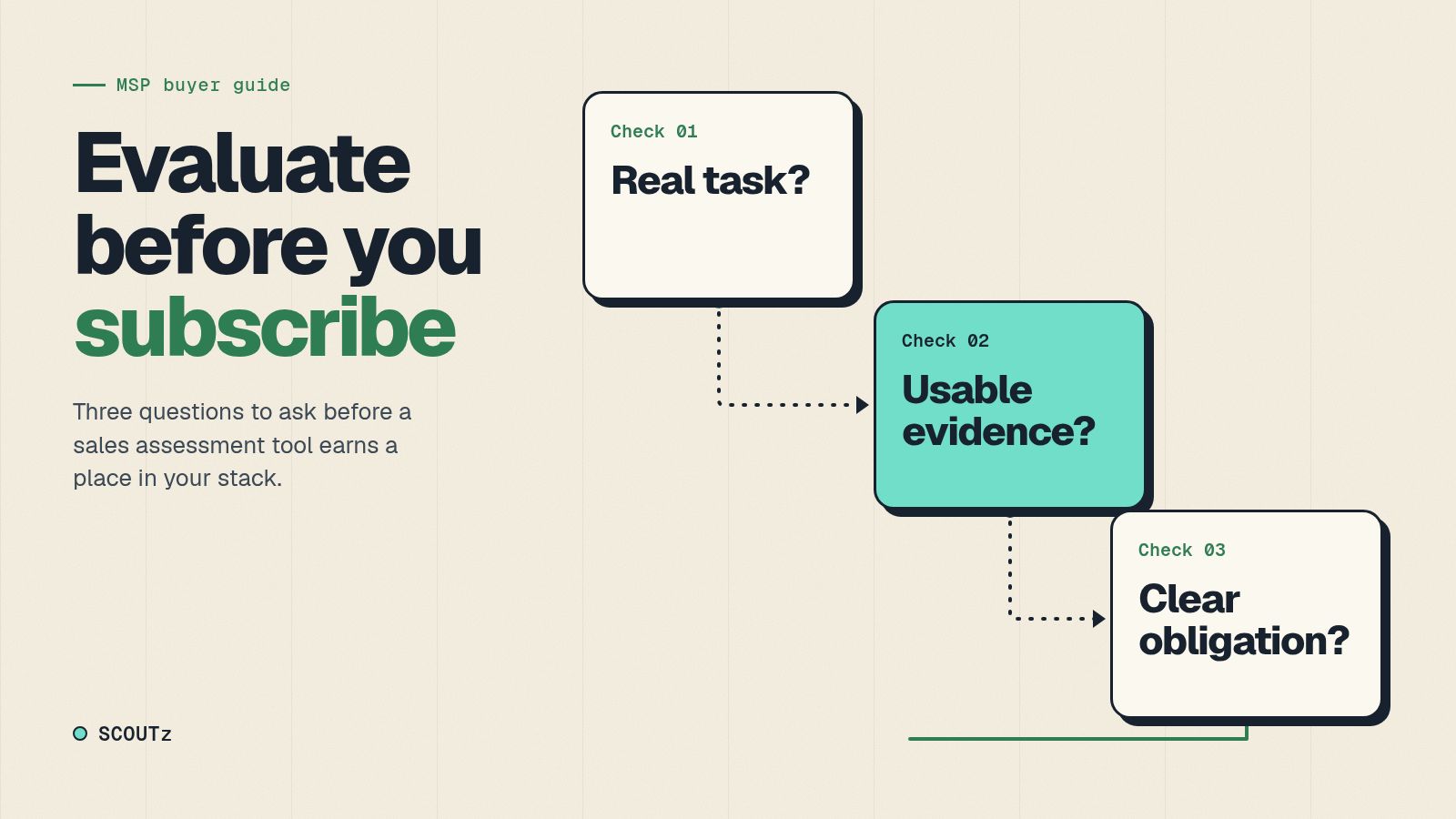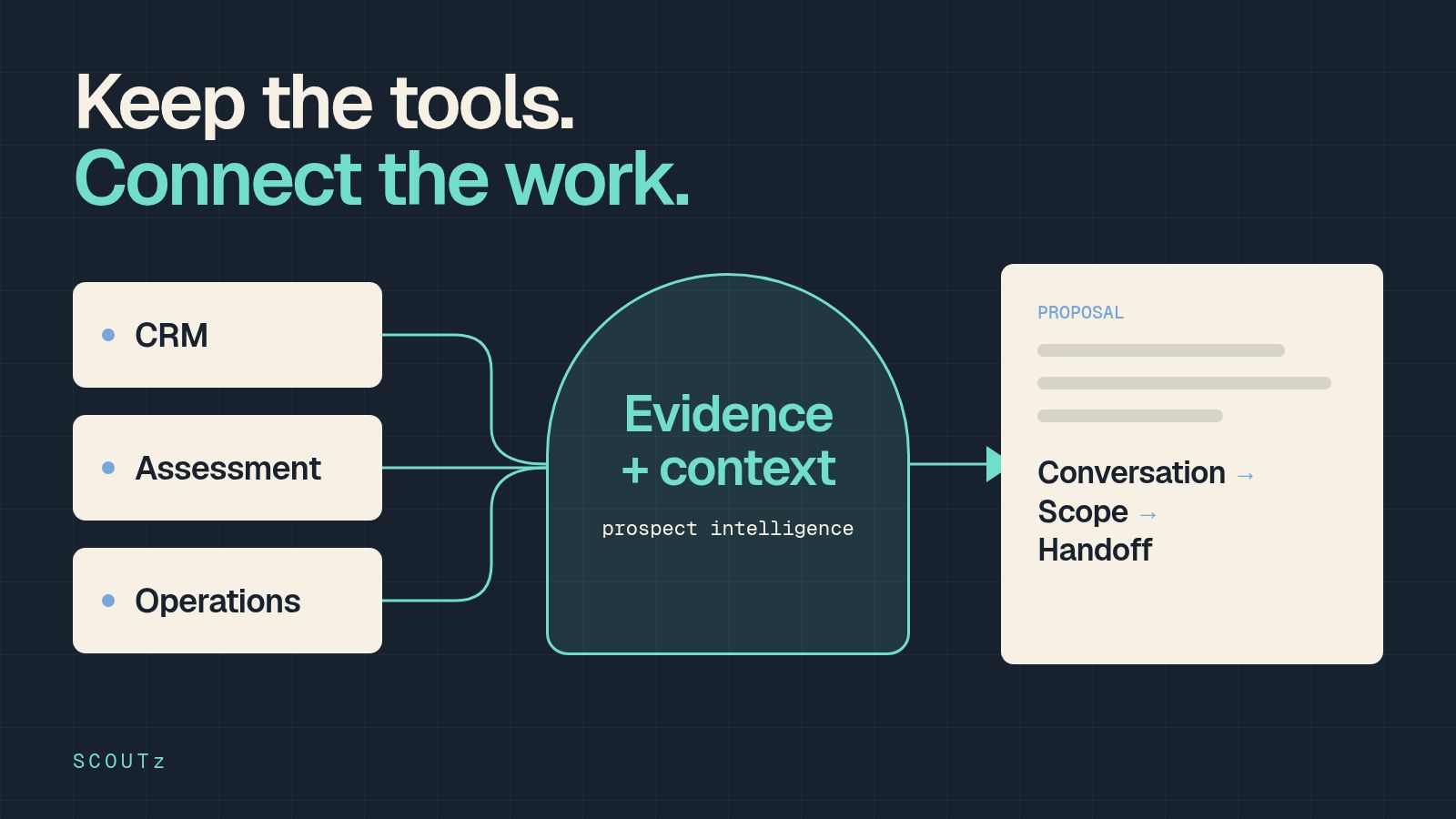
Prospect intelligence adds value when it connects the evidence your MSP collects to the account conversation, client explanation and work you need to propose. Evaluate the missing handoff before replacing tools you already trust. Another source of findings needs to justify its place through useful preparation your current process does not already provide.
- An MSP prospect intelligence workflow connects account research, dated evidence and buyer decisions.
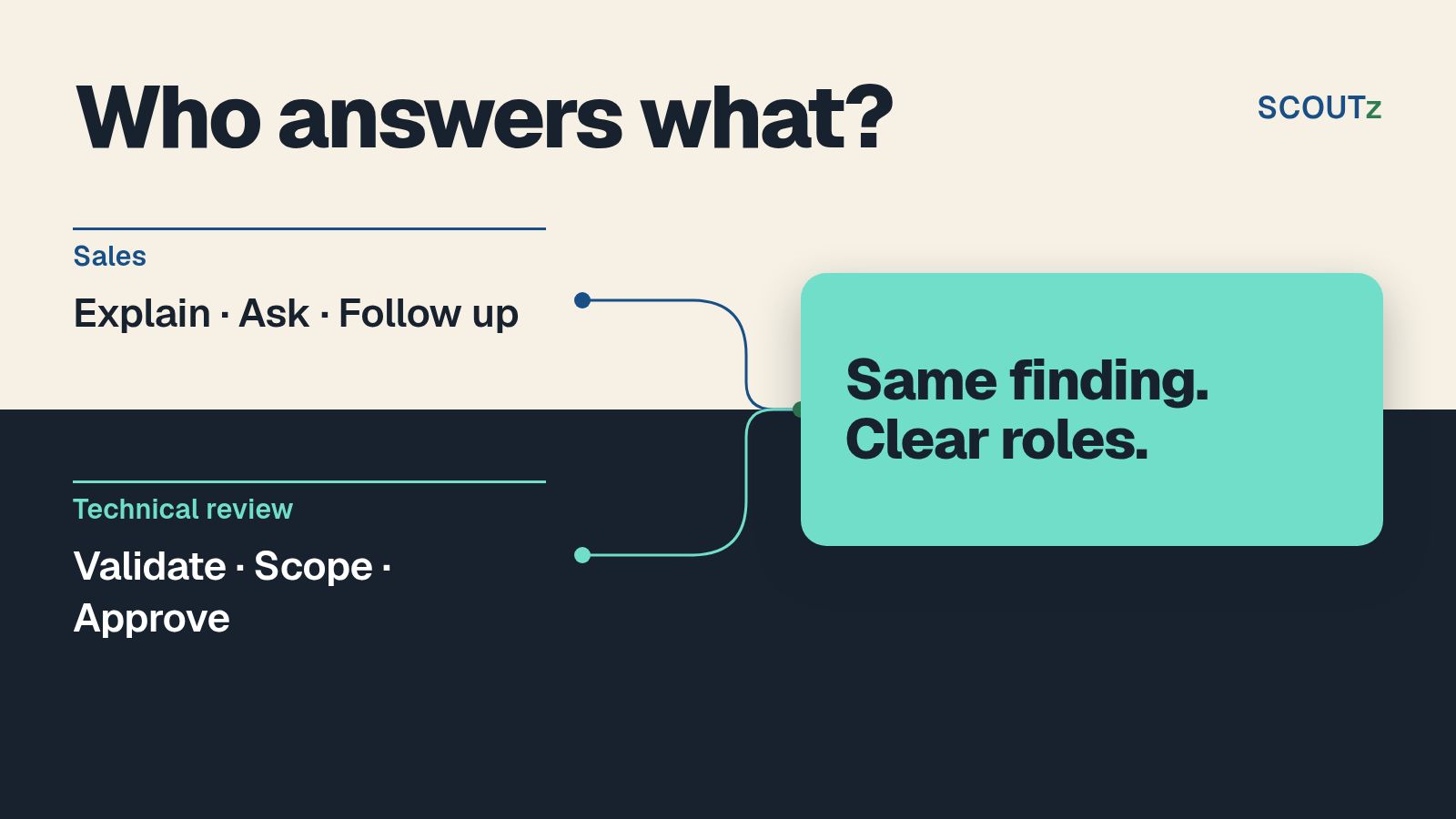
- SCOUTz supports preparation and reviewed reporting while your MSP owns the relationship and sale.
- Compare complete handoffs, including interpretation, presentation and proposed work.
- Keep existing tools when they already supply the needed evidence and usable outputs.
The SCOUTz reporting workflow gives you a concrete starting point for comparison: seller material, operator evidence, client reports and MSP-reviewed work plans. Evaluate those outputs against a preparation task, rather than assuming an overlapping check means the tools do the same job.
What Does Prospect Intelligence Add to Your MSP's Existing Tools?
Its value depends on the preparation and handoff your current process leaves unfinished. Existing assessment, administration and security tools can already provide useful evidence. A prospect intelligence product needs to connect that evidence to a relevant decision without overstating the condition or replacing your judgment.
| Job | Existing Capability to Inspect | Potential Gap to Evaluate |
|---|---|---|
| Relationship management | Account ownership and conversation history | Evidence missing from meeting preparation |
| Technical assessment | Covered checks and source records | Interpretation detached from buyer context |
| Tenant administration | Configuration and operational controls | Findings not prepared for a sales discussion |
| Client reporting | Existing executive or technical outputs | Repeated rewriting for different audiences |
| Proposal preparation | Scope, assumptions and acceptance conditions | Weak connection between evidence and deliverables |
| Delivery and verification | Authorized work and relevant repeat checks | Lost context between proposal and completed work |
The gaps are possibilities to test, not claims about every tool in those categories. Inspect your actual workflow before deciding what is missing.
Why This Matters
Your MSP can own adequate collection tools and still spend time rebuilding the explanation for a prospect meeting. It can also have a good reporting workflow already, in which case another subscription needs a narrower justification.
Compare the job, the source and the audience. A matching finding label does not establish equivalent scope. A different interface does not establish additional value.
The purchase question is whether useful work becomes easier to carry forward without losing its evidence. Measure that through your own evaluation rather than a general promise of efficiency.
Map the Current Workflow Before Adding Software
Begin manually. Choose a preparation task and list where its information originates, who reviews it and how it reaches the seller or account manager.
Record the route from the original observation into discovery, a client explanation, proposed scope and the delivery handoff. Include the documents and messages people use outside the main application.
Capture:
- The source of the observation.
- The collection date and assessed scope.
- The technical reviewer.
- The person preparing the client explanation.
- The unresolved customer question.
- The destination for the agreed next action.
This map distinguishes a collection gap from a presentation or ownership gap. Choose the next step based on the gap you actually find.
Respect What Your Existing Tools Already Do
Keep a useful evidence source when it answers the relevant question. Avoid discarding operational coverage simply because another product presents the information differently.
Tenant administration and security platforms can do work that prospect preparation does not replace. A proposal document can hold commitments that an assessment report does not establish. A CRM records the relationship even when supporting evidence lives elsewhere.
| Approach | Best For | Strength | Limit |
|---|---|---|---|
| Existing tools with a reviewed manual brief | Teams with suitable sources and an effective process | Preserves familiar collection and judgment | Requires consistent handoff discipline |
| Internal presentation templates | Teams with stable evidence and repeated meeting needs | Standardizes explanation and scope fields | Still needs source updates and review |
| Prospect intelligence workflow | Teams needing connected research, reports and preparation | Keeps account context near the evidence and next action | Needs evaluation against existing coverage and operating effort |
No approach removes the need to review claims. A template can repeat an unsupported interpretation as consistently as a sound one.
Compare Evidence Scope Before Comparing Finding Counts
Read what each method actually inspected. Public-domain observations, client-consented cloud configuration and operational monitoring answer different questions.
A public record can establish a published domain condition. It cannot establish internal Microsoft 365 policy coverage, application permissions or tenant sharing configuration. An internal review can also be partial because of authorization, licensing or unreadable sources.
Retain the distinction between observation and inference. The state of a configuration does not by itself establish an attack, buying intent or the need for a particular project.
SCOUTz cybersecurity prospect intelligence connects public-domain research with client-consented, read-only Microsoft 365 assessment. Its internal review covers configuration and metadata rather than message bodies, files, chats, documents or prompts. Your evaluation should preserve those boundaries.
Compare useful outputs within equivalent scope. More finding types do not establish better coverage for the buyer's actual question.
Test What Happens Between Finding and Proposal
Take a reviewed observation and follow it through your current process. Then inspect the proposed workflow against the same decision and audience.
You need to see how the material supports a question, what context the customer must supply and which work your MSP would be prepared to offer. Keep the delivery obligation separate from the initial finding.
The SCOUTz Evidence-to-Agreement Framework supplies a practical sequence:
- Find the decision the buyer needs to make.
- Bring the evidence relevant to that decision.
- Build the scope around confirmed needs and unresolved questions.
- Earn the next commitment required to move forward.
This is a conversation framework. It is not evidence that using it increases your close rate or makes every assessment a sales opportunity.
Record where the proposed workflow helps and where your team still rebuilds the material. The comparison should include review work rather than stopping when a PDF downloads.
Work Through an Existing-Tools Example
The following is an illustrative evaluation scenario, not a customer case study or product performance result.
An MSP already has configuration evidence and a reliable technical reviewer. Its seller receives a detailed export but must ask the reviewer to explain the account context before every discovery meeting.
The owner identifies the missing job as preparation continuity. The evaluation asks whether a seller brief, appropriate client report and evidence reference can carry that context into the meeting.
If an internal template and a clearer handoff solve the problem, the MSP can retain its existing process. If the team still repeats account research and rewrites the explanation, a connected preparation workflow earns evaluation.
The technical collection remains valuable in both cases. The decision concerns the additional handoff, not an unsupported claim that an existing platform lacks reports or useful checks.
Make Provenance Part of the Demonstration
Ask to trace a claim to the source, collection date and assessed scope. A clear explanation becomes more useful when your reviewer can inspect how it was formed.
Then check the limit. Evidence the review could not read should remain unknown, unreadable or not assessed as appropriate. It should not disappear into a positive summary.
Use the same traceability test for public data you collect yourself. Access to a source is only part of the work; your team must interpret it, check relevance and prepare an appropriate explanation.
During evaluation, inspect:
- Where the observation originated.
- What the review established at collection time.
- What remains outside its coverage.
- Who approved the interpretation.
- How new customer context changes the next action.
SCOUTz cybersecurity prospect intelligence is relevant to this evidence-to-conversation job. Your team still needs to verify the account-specific claim before sharing it.
Keep Relationship and Delivery Systems in Their Roles
Choose an owner for the next action in your CRM or existing opportunity process. Keep technical source material available to authorized reviewers without copying every record into every system.
This guide assumes no native synchronization or automatic ticket creation. A reviewed manual handoff is a legitimate starting method when your team can identify the account, evidence reference and responsible person.
Delivery systems remain responsible for the operational work you assign to them. A proposed work plan is planning material your MSP reviews. It does not authorize a configuration change or establish that the work was performed.
A rescan can support a comparison within its covered checks. It does not replace continuous monitoring or prove the status of systems outside that scope.
Compare the Effort and Commercial Obligation
Evaluate collection, interpretation, client preparation, follow-up and handoff as separate tasks. Record actual effort so a benefit in one stage does not conceal additional work elsewhere.
Inspect the configured commercial terms alongside the operating process. Usage limits, services, implementation effort and cancellation conditions affect the decision. Keep changing prices and offers on the vendor's current terms rather than an old comparison document.
Define a success condition your team can verify. Examples include being able to trace the client explanation to the source, prepare the agreed discovery question or carry the scope rationale into delivery.
These are suggested evaluation criteria. They do not establish time savings, return on investment or additional client contracts until your own records support those claims.
Know When Keeping the Existing Workflow Is Right
Keep the current approach when your sources answer the relevant questions, your seller can use the reviewed output and your delivery team understands the proposed obligation.
A new product also needs a realistic operator. If nobody owns evidence review or customer follow-up, another report will not assign that responsibility for you.
Wait when the desired capability is still a roadmap item or when you cannot evaluate an appropriate account. Assess what the product supplies today.
The SCOUTz reporting page checked October 25, 2026, separates current reports and Report Plays from the visual Report Studio still in validation. It also distinguishes supported rescan comparisons from a promise of continuous monitoring.
Decide What You Are Actually Buying
Write the purchase rationale as a task, an audience and an output. That makes it possible to revisit the decision later without relying on the original sales demonstration.
For example, the rationale can be to prepare account-specific discovery material whose claims the seller and operator can both inspect. It should not be to obtain a guaranteed stream of signed clients from a scan.
Your MSP's next client agreement remains its own commercial outcome. A useful preparation product can support the work without taking ownership of the relationship, recommendation or sale.
FAQ
What does prospect intelligence add to existing MSP tools?
It can connect account research, dated evidence and audience-specific preparation. The added value depends on which handoff your current workflow leaves unfinished.
Should an MSP replace existing assessment tools?
Keep tools that provide appropriate evidence and operational coverage. Evaluate replacement only against a defined job and equivalent scope.
Can an MSP build its own prospect brief?
Yes. A reviewed manual brief can retain the source, date, scope, customer question and next action. Evaluate whether your team can maintain that process effectively.
Does a larger finding count mean a better tool?
No. Compare the relevant checks, sources, coverage and usable outputs. A count alone does not establish fitness for your buyer's question.
Does SCOUTz replace the CRM or delivery platform?
No. The CRM retains relationship ownership and delivery tools run operational work. SCOUTz supports evidence preparation, reports and work plans your MSP reviews.
Does a work plan mean revenue has been won?
No. A work plan describes proposed actions. Scope approval, delivery authorization and signed commercial terms remain separate decisions.
One Last Thing
Have the delivery reviewer explain why the proposed work belongs in the engagement. If the rationale disappeared between the finding and the handoff, that is the gap to repair.
Bring your existing process to Join Open Beta. Compare SCOUTz against the task your team actually needs to complete.