MSP salespeople can use reviewed security reports to prepare discovery and explain agreed findings without an engineer presenting every page. They still need a clear escalation route for technical interpretation, missing evidence and implementation commitments. Evaluate whether the report supports that division of responsibility before expecting it to remove engineering work.
- Security reports for MSP salespeople need a review process and a clear technical escalation route.
- SCOUTz separates seller preparation, client reports and operator evidence.
- Sales can explain approved observations without inventing causes or implementation promises.
- Test seller usability on real material before assuming engineering effort disappears.
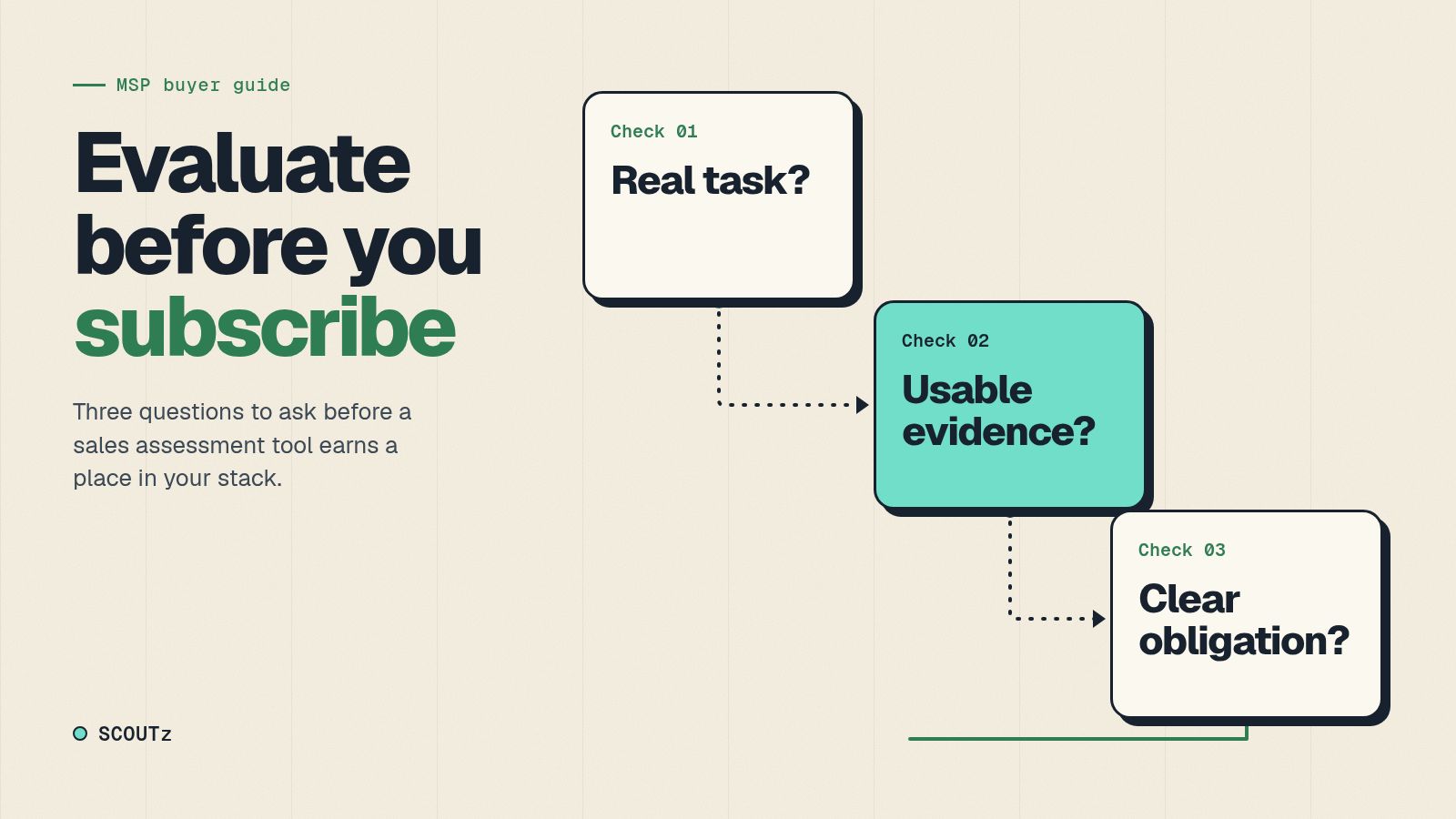
The SCOUTz report workflow separates material by audience. That separation gives your MSP a practical evaluation task: establish whether the seller can use the approved client material while the technical reviewer can trace the same claim to its evidence.
Can MSP Salespeople Use Security Reports Without an Engineer?
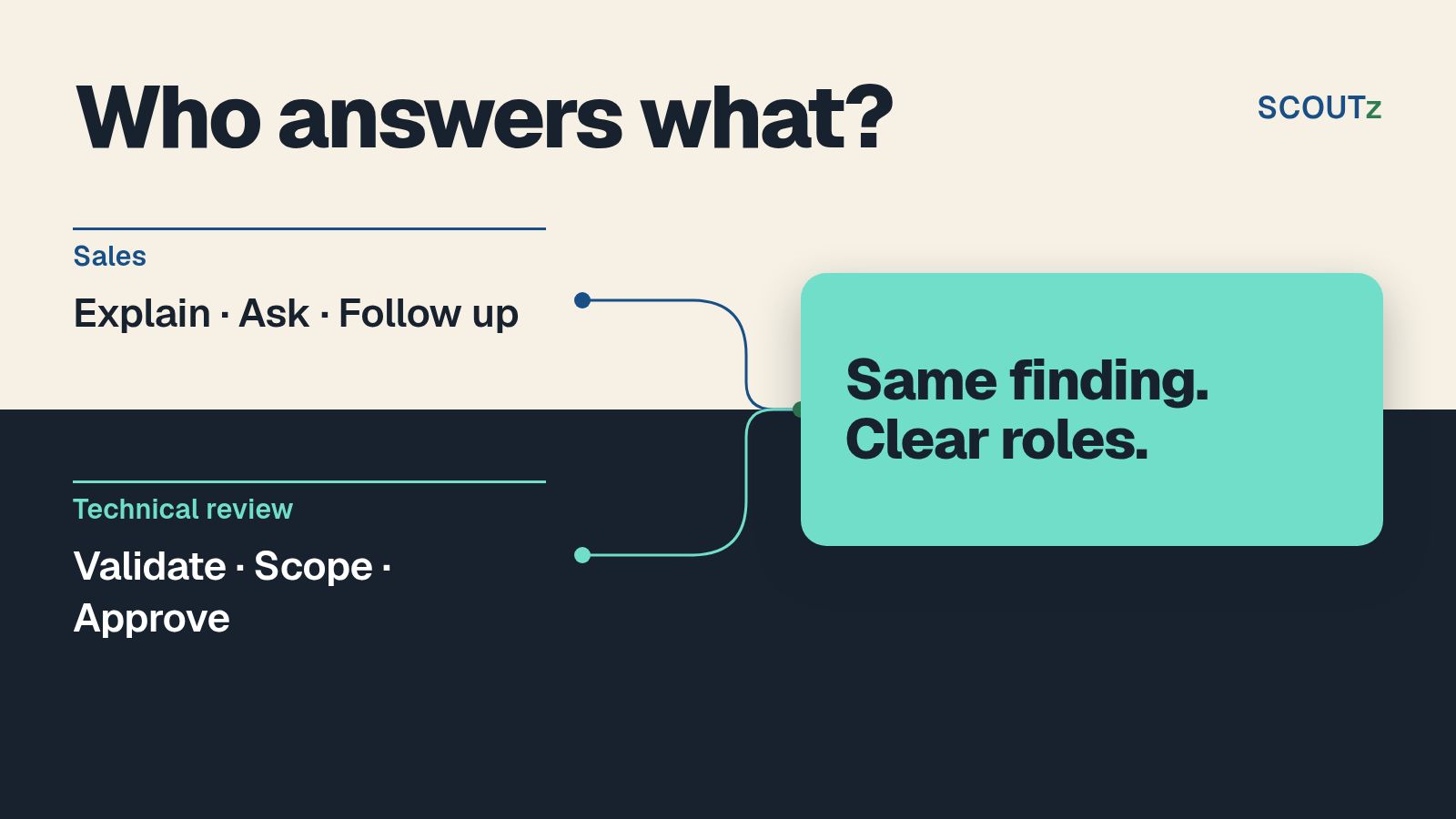
A salesperson can lead the conversation when the approved claim and its limits are clear. An engineer remains responsible for technical judgments assigned to that role. Neither person should have to reconstruct what the other meant.
| Seller Task | Suitable Seller Responsibility | Escalate When |
|---|---|---|
| Prepare discovery | Read the reviewed brief and identify the intended question | Account identity or source relevance is uncertain |
| Explain a finding | State the approved observation, date and boundary | The buyer asks for an unsupported conclusion |
| Establish context | Ask who owns the condition and its intended state | The answer changes the technical interpretation |
| Discuss next steps | Describe a reviewed assessment or scope option | Access, implementation or effort needs a technical commitment |
| Follow up | Record the buyer's response and agreed action | New evidence contradicts the material |
This is a suggested operating boundary. Your MSP must assign responsibilities according to its people, services and review obligations.
Why This Matters
When every report needs to be rewritten for the seller, generating the report is only part of the work. Your evaluation needs to include the translation between technical evidence and a conversation someone can conduct responsibly.
The opposite problem also matters. A seller can deliver a confident presentation while overstating what the evidence establishes. Usability requires both comprehension and accuracy.
The right test is whether the seller can explain the finding without changing its meaning. A shorter document or simpler vocabulary does not settle that question.
Start With a Manual Handoff
Take a finding your technical team already understands. Prepare a brief describing the condition, its source, collection date, boundary and question for the buyer. This gives you a baseline before evaluating another reporting product.
Ask the seller to explain the finding back to the reviewer. Record where the wording changes, where assumptions enter and where technical support is genuinely necessary.
Use these fields:
- The observation the review established.
- The source and collection date.
- The condition or object involved.
- The scope the review did not assess.
- The customer context still needed.
- The next action the seller is authorized to discuss.
This exercise evaluates the handoff. It does not require a live prospect presentation, new scan or access to an unapproved customer environment.
Evaluate the Seller Brief and Client Report Separately
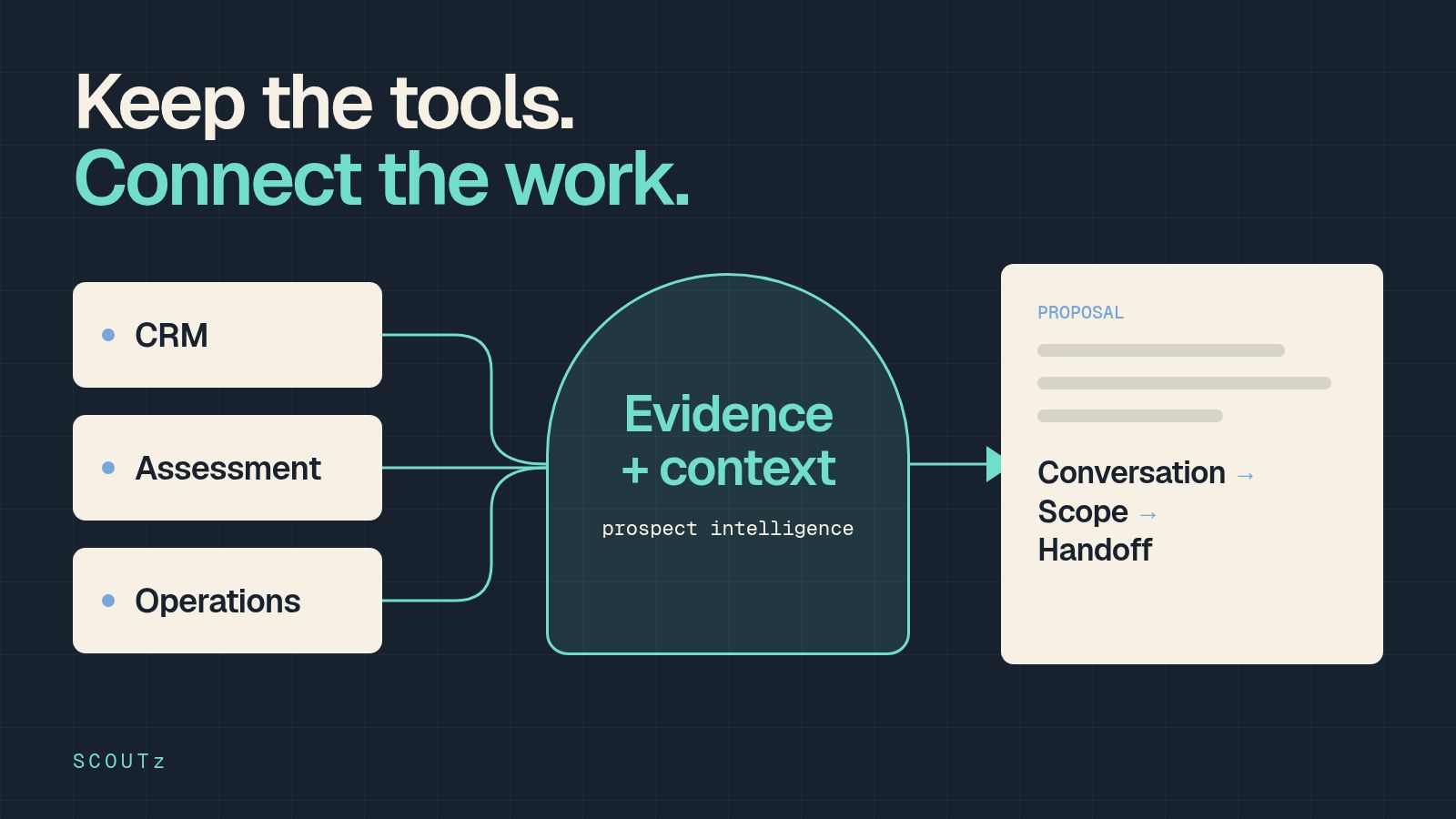
A seller needs preparation context that does not always belong in the client attachment. A business owner needs a useful explanation of the condition and decision. Your operator needs enough detail to inspect the technical reasoning.
| Material | Best For | Strength | Limit |
|---|---|---|---|
| Seller brief | Preparing the account conversation | Connects context, questions and objections | Contains preparation material that needs audience review |
| Client report | Explaining the reviewed finding to the buyer | Keeps the observation and decision readable | Cannot replace all technical investigation |
| Operator evidence | Checking source, scope and interpretation | Supports a traceable technical review | Requires the appropriate technical knowledge |
Inspect the same finding across the materials. The client version can be shorter, but it must preserve the limits that affect the buyer's decision.
SCOUTz cybersecurity prospect intelligence supplies these different reporting roles. Its reports are preparation material your MSP reviews. The seller still confirms which explanation applies to the current buyer.
Define What a Seller Can Say
Give the seller an approved observation rather than a general warning about security. Attach the scope so the seller can recognize when the buyer's question goes beyond it.
For example, a public-domain review can record a published email policy. It does not establish internal Microsoft 365 policy coverage or prove an attack occurred.
The seller can explain what was recorded and ask who confirms the intended state. The seller should refer an internal-control question to the appropriate review rather than guessing from the public record.
A usable brief keeps the language specific:
| Evidence Element | Suitable Explanation |
|---|---|
| Observation | The published policy requested monitoring when collected |
| Boundary | The public record does not establish the internal tenant controls |
| Context needed | The responsible person must confirm the intended policy |
| Proposed next step | Review the existing plan before recommending a change |
These statements are an illustrative training example. Use account-specific claims only when the evidence supports them.
Set an Escalation Route That Keeps the Conversation Moving
A seller needs a way to acknowledge an unanswered question without losing responsibility for follow-up. Define who receives technical questions and what context accompanies them.
Include the buyer's exact question, the finding reference, its date and the answer the team needs to validate. An escalation consisting only of a forwarded report forces the reviewer to infer the problem.
Suggested seller wording for an MSP's end-customer conversation:
The review does not establish that point. I will take your question to the technical reviewer and return with the evidence or explain what remains unassessed.
This is illustrative dialogue, not a customer quotation. The seller owns the follow-up and should avoid committing to investigation or delivery work outside the agreed scope.
If the question changes the proposed engagement, update the scope before continuing. Keeping the meeting moving does not require an immediate answer to every technical question.
Run a Seller-Usability Test Before Buying
Use reviewed sample material and a scenario relevant to your sales process. Let the seller prepare from the material rather than receiving a separate explanation for every paragraph.
Ask the seller to identify the observation, the limit and the next question. Then introduce a reasonable challenge, such as a buyer saying the current provider already has a plan.
Record whether the seller:
- Finds the relevant evidence reference.
- Preserves the distinction between observed and unknown.
- Asks for context before assigning fault.
- Recognizes a question requiring technical review.
- States the next action without promising an unscoped project.
These are suggested readiness criteria. They are not a certification, measured product outcome or substitute for your MSP's training process.
Repeat the exercise after corrections. A workflow the seller can use only while the vendor narrates it has not yet passed the team-operated test.
Work Through a Buyer Challenge
The following dialogue is illustrative material for an MSP speaking with its end customer. It is not SCOUTz acquisition copy or a reported customer interaction.
Buyer: “Our provider is already working on this. Your report makes it look like they missed something.”
Seller: “The observation describes the published state when collected. We have not established why it was selected. Who can confirm the intended state and current plan?”
Buyer: “Our operations manager can explain it.”
Seller: “Then that is the right person to include before recommending work. If the plan answers your requirement, we should record that.”
Buyer: “Can you guarantee your proposed change fixes the issue?”
Seller: “We need the technical reviewer to confirm the required work and acceptance condition before making that commitment.”
The seller has used the report without impersonating the engineer. The reviewer receives a specific question, and the buyer has a legitimate next action.
Keep Assessment Access Separate From Change Approval
Your seller needs to explain the review boundary when requesting participation from a client. Internal Microsoft 365 evidence requires client-consented access.
SCOUTz uses read-only configuration and metadata evidence for that review. It does not read message bodies, files, chats, documents or prompts, and it does not change configurations on its own.
Read-only access describes the product boundary. Your MSP still needs the appropriate authorization, customer context and handling of the output. A permission-limited source remains permission limited rather than becoming a clean result.
Keep change approval separate. A customer agreeing to a review has not approved every later recommendation or implementation step.
Inspect What Still Requires Engineering
List the questions that remain technical after the reporting workflow is in place. This gives the owner a realistic picture of operating effort.
Technical review can still be needed to resolve contradictory evidence, establish control coverage, validate dependencies, define implementation and estimate delivery work. Buyer context can change the priority even when the underlying observation is correct.
Measure the actual review and correction effort during evaluation. Compare similar tasks and preserve the quality standard. Moving a difficult question out of the report does not eliminate the work.
SCOUTz cybersecurity prospect intelligence is relevant when your team needs a consistent route from evidence to seller and client material. If your existing handoff already works, the product needs to demonstrate additional value through your own evaluation.
Distinguish Current Reports From a Future Interface
Evaluate the reports and workflow the product supplies today. A visual prototype can explain a direction without proving that the interface is operational for your team.
The SCOUTz reporting page checked October 25, 2026, distinguishes current reports and Report Plays from the visual Report Studio still in validation. Base your evaluation on the available reports and evidence coverage.
The Win the deal Report Play keeps findings and proposed next steps together for scope discussions. Its name describes the workflow, not an assurance that a buyer will sign.
Carry the Same Truth Into the Proposal
After discovery, retain the buyer's confirmed requirement and technical answers alongside the original evidence. Your seller should be able to explain why each proposed deliverable belongs in the scope.
The SCOUTz Evidence-to-Agreement Framework organizes this transition: Find the decision, Bring the evidence, Build the scope and Earn the next commitment. Treat it as a working conversation method rather than a validated sales-performance model.
A report does not complete the proposal. Your team must define the work, exclusions, authorization requirements and acceptance condition. When those commitments depend on further investigation, keep that dependency visible.
FAQ
Can an MSP salesperson present security findings without an engineer?
Yes, when the observations and limits have been reviewed and an escalation route exists. Technical interpretation and implementation commitments still need the appropriate reviewer.
What makes a security report usable for salespeople?
A usable report preserves the observation, source, date and limits while making the next buyer question clear. Test that the seller can explain it accurately.
Should sellers send the technical report to every client?
Choose material appropriate to the recipient and purpose. Operator evidence and seller preparation can contain detail that does not belong in the client attachment.
Does simpler reporting eliminate engineering work?
No. Interpretation, scope validation and technical delivery planning remain responsibilities your MSP must assign. Measure actual effort instead of assuming it disappears.
What should a salesperson do when the buyer challenges a finding?
Record the challenge and inspect its context with the appropriate reviewer. Correct or withdraw the claim when the evidence no longer supports it.
Does a report opening mean the prospect agreed?
No. An opening records activity. It does not establish comprehension, agreement or acceptance of a proposal.
One Last Thing
Ask the technical reviewer and seller to explain the same finding separately. Differences in their answers show the handoff that still needs work.
Bring your sales and technical roles to Join Open Beta. Evaluate the reports against a real preparation task before changing your team process.