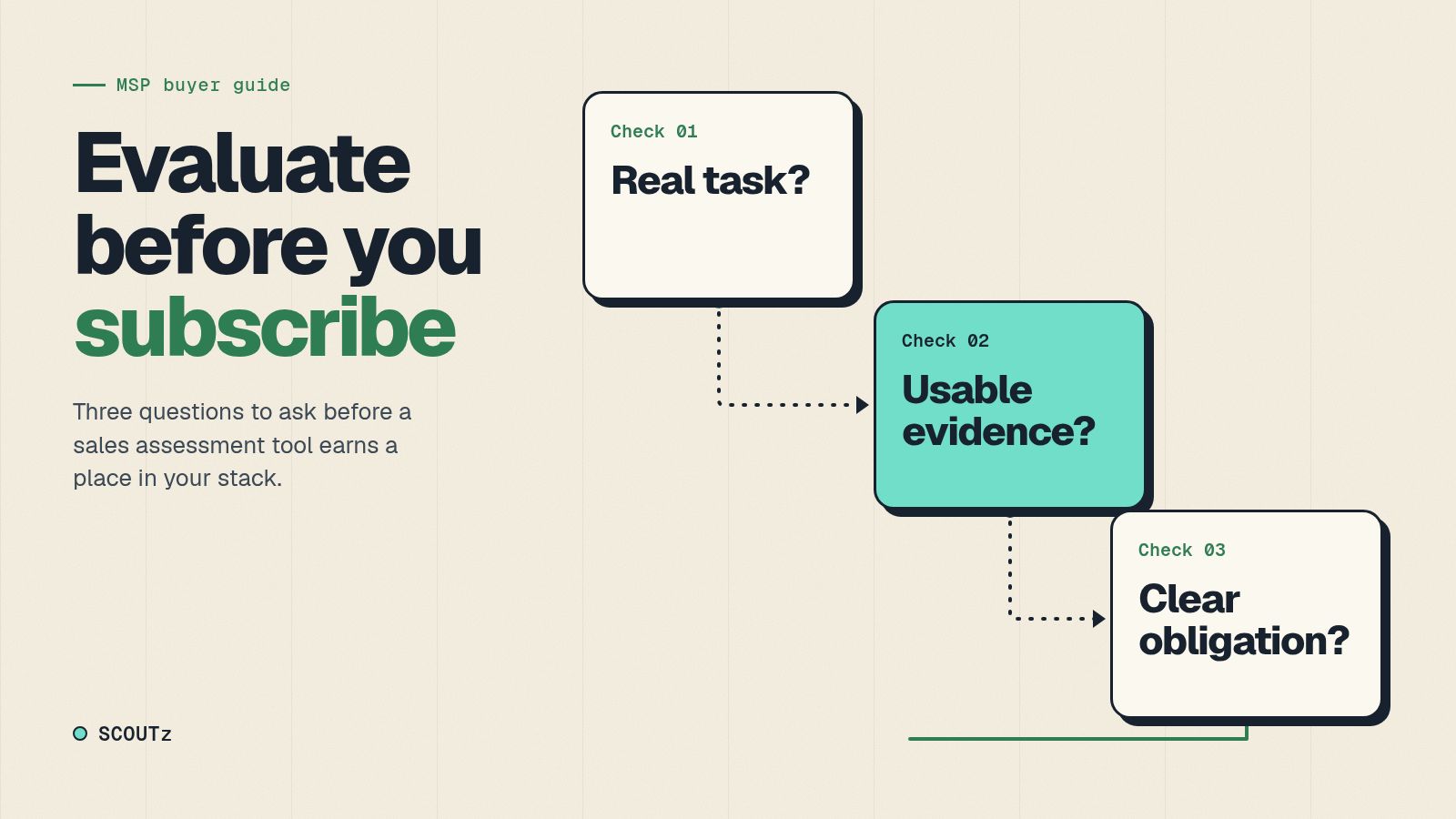
Buy an MSP sales assessment tool when it fills a defined gap in work your team already needs to do. Evaluate it against a real opportunity, including the effort to review its evidence and prepare a useful conversation. A promised future client is not a sound basis for a recurring obligation.
- Evaluate an MSP sales assessment tool against an existing workflow, not a promised pipeline.
- SCOUTz supports evidence preparation, client reporting and MSP-reviewed work plans.
- Measure review effort separately from signed business.
- Keep your existing process when another subscription adds no useful work.
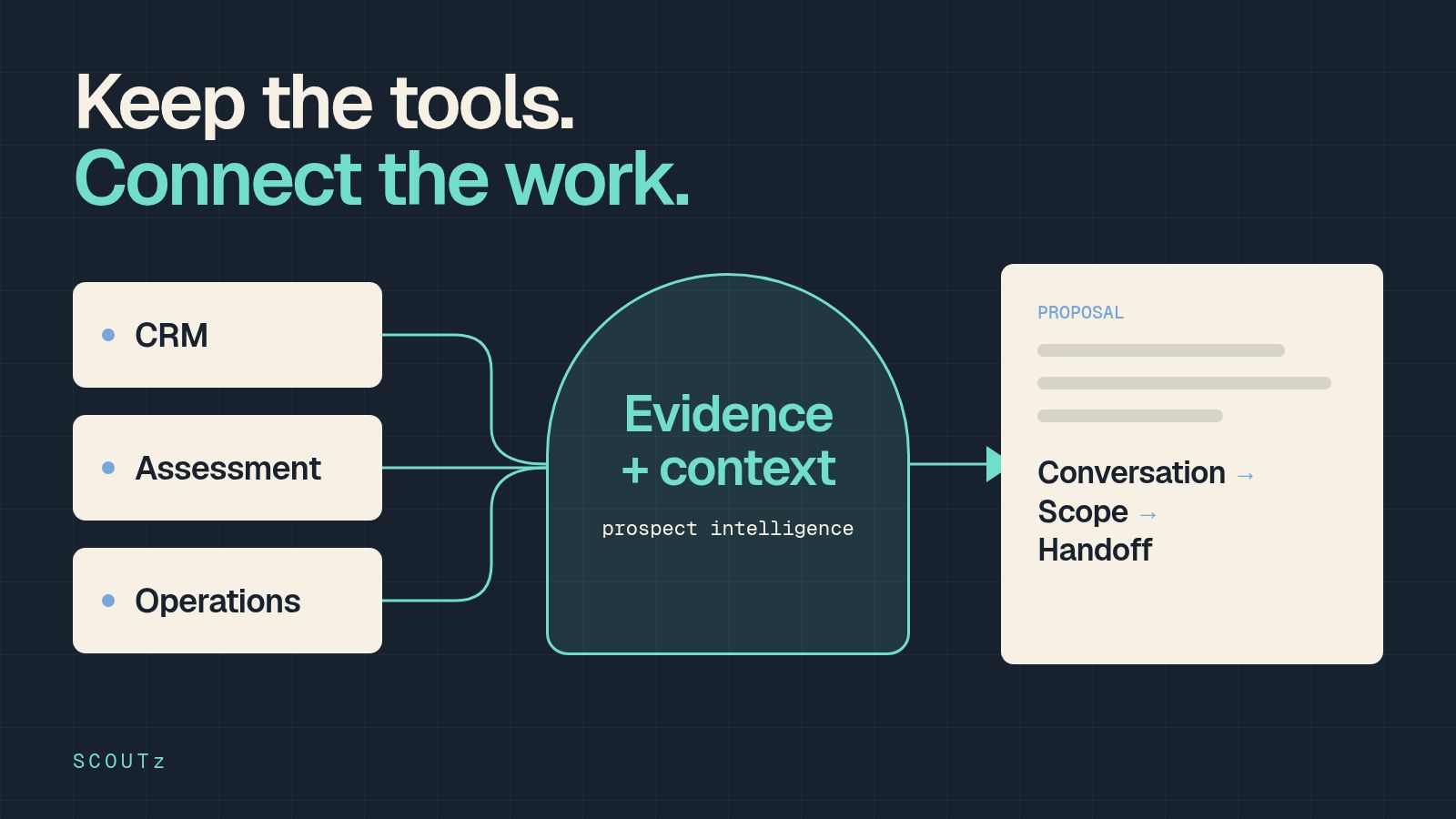
The SCOUTz reporting workflow shows the job to evaluate: moving from dated observations to material for sellers, technical reviewers and clients. Start with the decision your MSP needs to make, rather than the number of checks a demonstration displays.
Should Your MSP Buy a Sales Assessment Tool Before Winning Clients?
Evaluate the workflow before relying on future revenue to justify it. Your team needs a real task, an appropriate account and an owner who can judge the output. A tool can pass the preparation test before a sale closes, but that does not establish commercial return.
| Current Situation | Appropriate Evaluation | Reason to Wait |
|---|---|---|
| A prospect meeting is booked | Prepare the evidence and discovery brief | Nobody can review the claims before the meeting |
| A proposal needs technical clarification | Test whether the material supports the disputed scope | The underlying requirement is undefined |
| An account review is approaching | Inspect the dated evidence and relevant comparison | The buyer expects monitoring the review does not provide |
| Your team wants more leads | Establish whether contact discovery or meeting preparation is missing | You expect an assessment tool to supply a guaranteed pipeline |
These are suggested decision criteria. They predict neither the number of clients your MSP will acquire nor the revenue those clients will generate.
Why This Matters
You pay for software regardless of whether a prospect signs. Your evaluation must distinguish the work the product performs from the relationship work your team still owns.
A report can be technically useful while contributing little to your sales process. The missing piece might be account qualification, proposal writing, access to the decision-maker or a service offer the buyer wants. Buying another collection method does not resolve each of those problems.
Purchase readiness begins with a named task and a responsible person. Define both before choosing an evaluation account.
Identify the Gap in Your Current Process
Write down what happens between a booked meeting and a proposal your team can explain. Use the process you actually follow, including documents, spreadsheets and existing tools.
Separate evidence collection from interpretation, client presentation and scoping. Those activities can involve different people and different costs. A polished report still needs customer context.
Record the work that gets repeated:
- Researching the organization and verifying its domain.
- Checking the source and collection date of an observation.
- Explaining the finding to the seller.
- Preparing an audience-appropriate report.
- Resolving unknowns before writing scope.
- Carrying the agreed work into delivery.
Choose the gap you want to test. If the gap is finding appropriate people to approach, evaluate that separately from preparing security evidence for an existing conversation.
Select a Real Evaluation Task
Use an opportunity your team understands well enough to assess the result. Confirm relevant permissions before any internal review. You can also begin by inspecting anonymized sample material without initiating collection.
Avoid choosing a dramatic example solely because it produces a long report. The output needs to answer a question your seller or technical reviewer actually encounters.
A suitable task has an intended audience, a legitimate question and an available reviewer. Record what would count as a usable result before the demonstration. This keeps the evaluation from changing whenever the vendor shows another feature.
| Evaluation Field | Record |
|---|---|
| Task | The meeting or review your MSP needs to prepare |
| Audience | Seller, technical operator, client owner or account manager |
| Existing method | How the work is completed today |
| Evidence boundary | Sources and systems the review can assess |
| Success condition | The output your team needs to use |
| Decision owner | The person who will approve or decline the purchase |
A vendor demonstration helps explain the workflow. Your own team still needs to establish whether it can operate the process under normal working conditions.
Inspect the Same Finding Across the Workflow
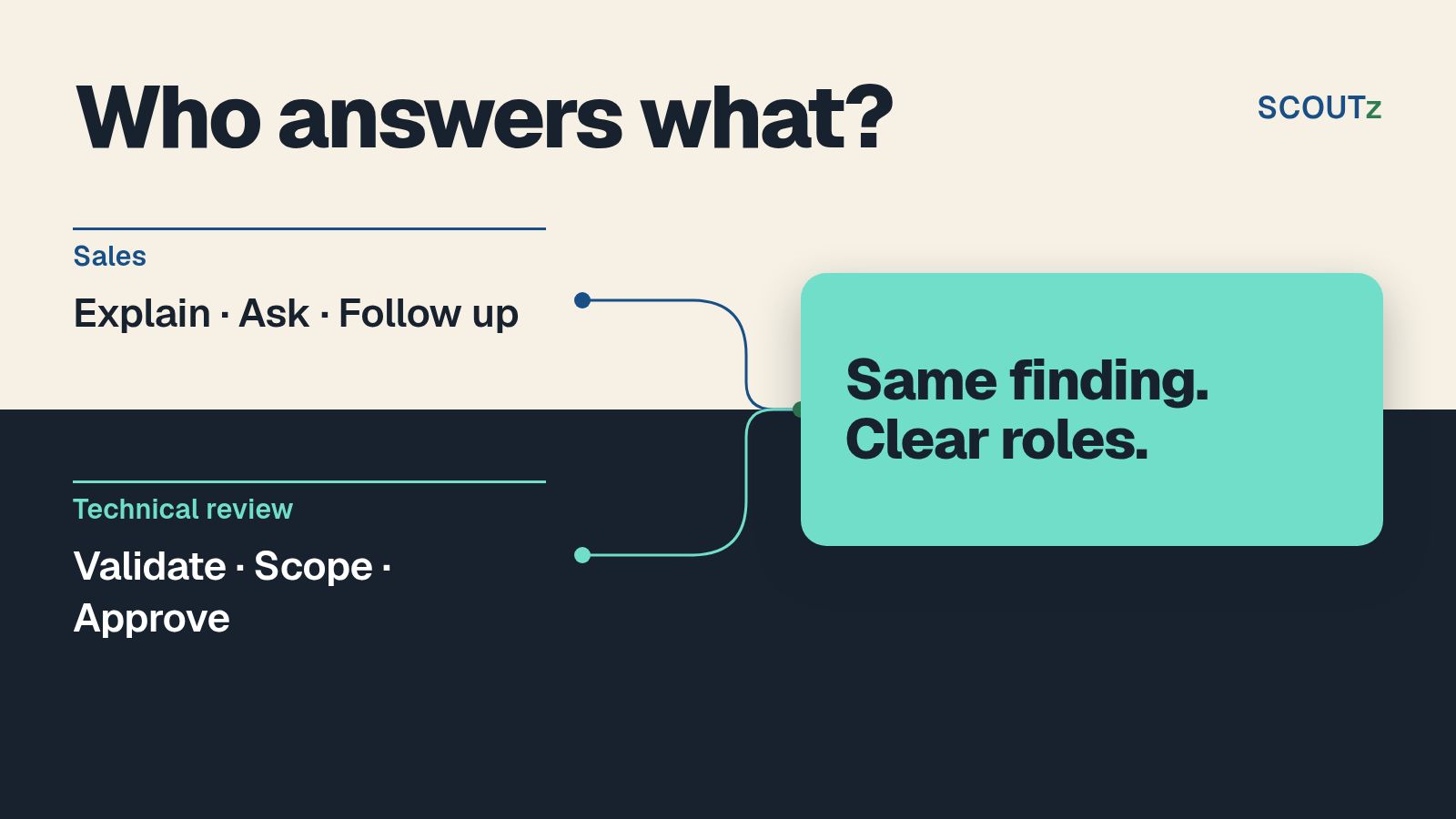
Ask to follow a finding from its source into the material your seller and client receive. The claim should remain consistent as the level of detail changes.
Start with the observation, its date and the collection scope. Then inspect the explanation and proposed next action. Your technical reviewer should distinguish the recorded condition from an interpretation that needs customer context.
SCOUTz cybersecurity prospect intelligence supports this handoff through seller preparation, operator evidence and client reports. Public-domain review and client-consented Microsoft 365 review cover different evidence. Public records cannot establish internal tenant controls.
Use the evaluation to inspect those boundaries. Customer-authorized Microsoft 365 review uses read-only configuration and metadata access. It does not read message bodies, files, chats, documents or prompts, and review access does not authorize configuration changes.
Measure Effort Before Claiming Savings
Record the time your team actually spends collecting, reviewing, correcting and presenting the material. Keep the task and coverage comparable with your existing process.
A faster collection step can create more review work. A shorter report can omit evidence your technical reviewer needs. Assess the complete handoff rather than the most impressive moment in the demonstration.
Use your own records for:
- Preparation and review time per completed task.
- Claims returned for correction.
- Questions the seller cannot answer from the material.
- Additional evidence needed before proposing work.
- Work required to make the report suitable for its audience.
These are evaluation measures, not promised improvements. Keep counts alongside any calculated rates so a small sample remains visible.
Assign repeated work to its actual owner. Research performed by a seller and interpretation performed by an engineer both belong in the comparison. A subscription that moves work between people has not necessarily reduced the total obligation.
Separate Software From Enablement and Services
Identify what your subscription supplies and what requires training, coaching or additional delivery work. A program can be valuable because of its people and operating discipline as well as its software.
Ask who reviews the output, helps your seller interpret it and prepares client-facing material. Establish what your team must learn before using the workflow without vendor assistance.
| Evaluation Route | Best For | Strength | Limit |
|---|---|---|---|
| Sample-report review | Checking language and evidence structure | Requires no account-specific collection | Does not test your operating process |
| Guided evaluation | Learning the intended workflow | Makes questions and responsibilities visible | Assistance can conceal your ongoing effort |
| Team-operated task | Testing readiness for normal use | Shows where your own handoffs work | Requires appropriate access and reviewer capacity |
Ask the vendor to make assistance explicit. Judge the complete offer rather than attributing a coached result entirely to the application.
Read the Purchase Obligation Before the Decision
Review the current agreement and commercial terms directly. This guide leaves changing subscription prices and promotional conditions on the current offer page.
Establish the billing unit, included usage, fair-use boundaries, minimum commitment and cancellation process. Identify any onboarding, services or usage-dependent charges in the configured offer. A question about a possible fee does not establish that the fee exists.
SCOUTz publishes its current workspace offer and evaluation conditions on its pricing page. Confirm the approved start point, provisioning process and paid-conversion conditions before applying.
Fair use matters when assessing scale. Normal preparation for your own prospects and clients differs from bulk or automated list scanning. Avoid building a process around an entitlement the agreement excludes.
Keep Commercial Outcomes Separate
A report generated, a link opened and a prospect attending a meeting are different events. None establishes an accepted proposal.
For your MSP's downstream sales process, record qualified conversations, agreed reviews, proposals and signed client agreements separately. For the software purchase, record whether your team could complete its intended preparation task.
You can reject an unusable workflow without waiting for a lost sale. You can recognize useful preparation without claiming that it caused a contract.
SCOUTz prepares evidence and work context. Your MSP qualifies the opportunity, confirms business relevance, scopes the engagement and owns the sale.
A separate distinction applies when your MSP becomes a software customer. Your subscription is the vendor's commercial outcome. Your own client's contract is your commercial outcome. Keep the records and evaluation criteria separate.
Use a Worked Purchase Decision
The following scenario is illustrative, not a customer case study or measured result.
An MSP has a prospect meeting booked. Its seller relies on an engineer to assemble source notes, explain observations and help write the meeting brief.
The owner sets a bounded evaluation: inspect a reviewed finding, prepare the seller's question and produce material appropriate for the buyer. The engineer records corrections and unresolved evidence. The seller records where additional explanation is required.
The tool earns consideration if the workflow is usable and the obligation fits the business. If the team must rebuild everything, the purchase needs a different justification. If there is no relevant opportunity or reviewer capacity, waiting is legitimate.
The prospect's eventual choice remains separate. Useful reporting cannot make an unsuitable service offer appropriate.
Set a Clear Keep, Change or Stop Decision
Conclude against the success condition you wrote at the start. Enthusiasm does not replace the outcome you agreed to inspect.
Keep the product when the task is useful, evidence is reviewable and your team can operate the process responsibly. Change the workflow when a specific handoff prevents use. Stop when the product duplicates adequate work or depends on a capability outside the current offer.
Document remaining uncertainty. A future roadmap item should stay outside your assumptions about what the product supplies today.
Include a readiness record for the person who will operate the workflow after purchase. Identify the training still required, the technical reviewer and the first appropriate task. This prevents the evaluation from becoming an isolated exercise that nobody repeats.
FAQ
Should an MSP buy assessment software before winning clients?
Only when it supports a defined task the MSP can evaluate responsibly. Future client revenue should not be treated as guaranteed funding for the subscription.
How should an MSP evaluate a sales assessment tool?
Compare a real preparation task with the existing method. Inspect evidence, report usability, review effort and the purchase obligation.
Does a useful report prove the software will win business?
No. Preparation quality and signed client agreements are separate outcomes. Track both without assuming the report caused the sale.
Should a salesperson evaluate the product alone?
Include the seller and an appropriate technical reviewer. The seller tests usability while the reviewer checks claims and evidence boundaries.
What if the existing tools already do the job?
Keep the existing workflow when it supplies adequate evidence and usable outputs. Another subscription needs a specific incremental purpose.
What should an MSP check before paid conversion?
Read the configured offer, usage boundaries, commitment, billing and cancellation process. Resolve unclear terms before accepting the obligation.
One Last Thing
Keep the corrections required during evaluation. They reveal the judgment your team must supply after the demonstration ends.
Bring an appropriate real workflow to Join Open Beta. Evaluate SCOUTz cybersecurity prospect intelligence against the preparation you already need to complete.