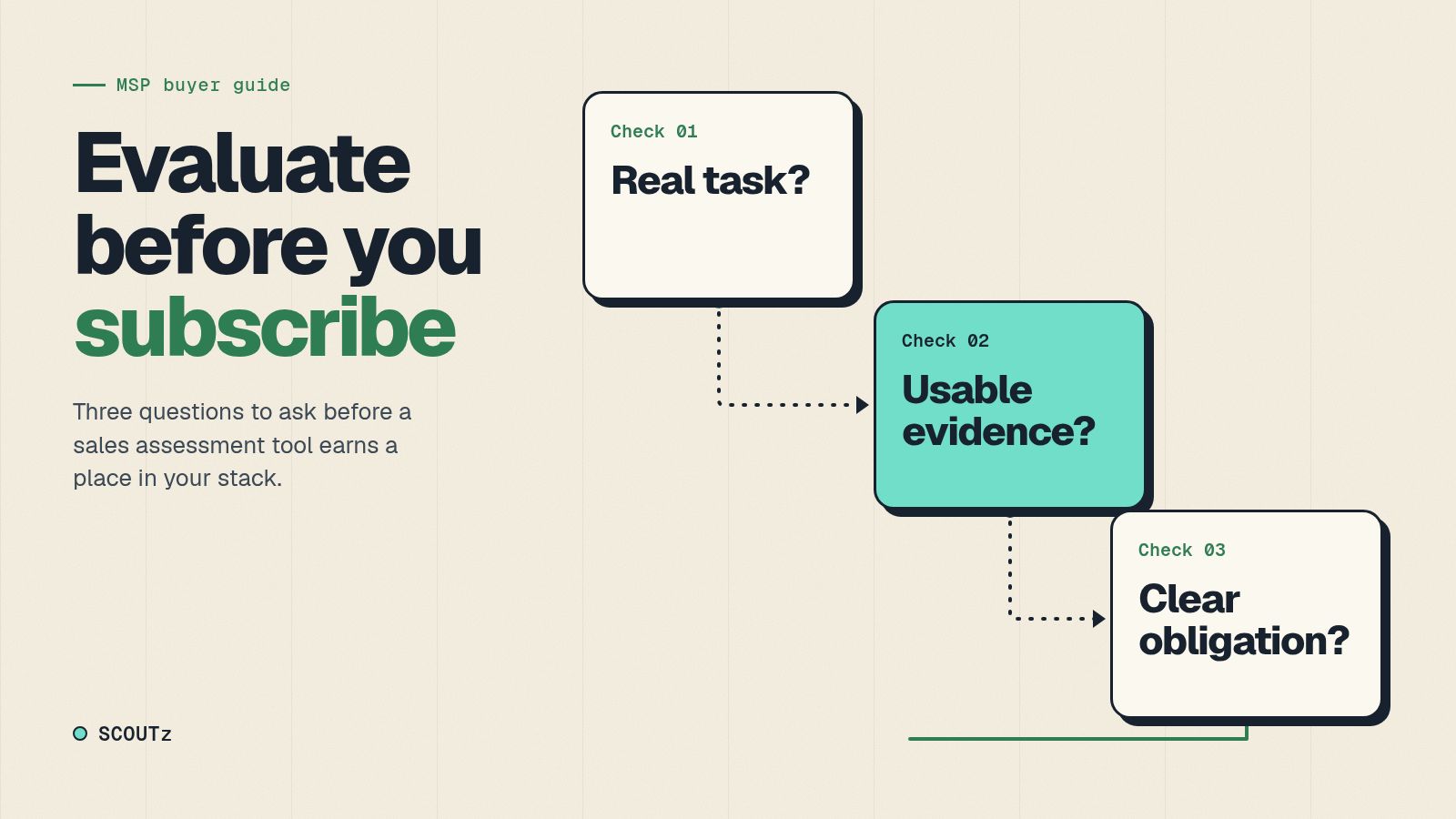
Good MSP sales discovery questions establish what the buyer wants to change, connect that priority to evidence and secure an agreed next decision. Bring a finding the prospect can inspect, then ask about its relevance before proposing work. A useful discovery call ends with a decision owner and a reason for the next meeting.
- MSP sales discovery questions should connect evidence, buyer priorities and the next agreement.
- SCOUTz prepares dated cybersecurity prospect intelligence for MSP discovery; the MSP owns the recommendation and sale.
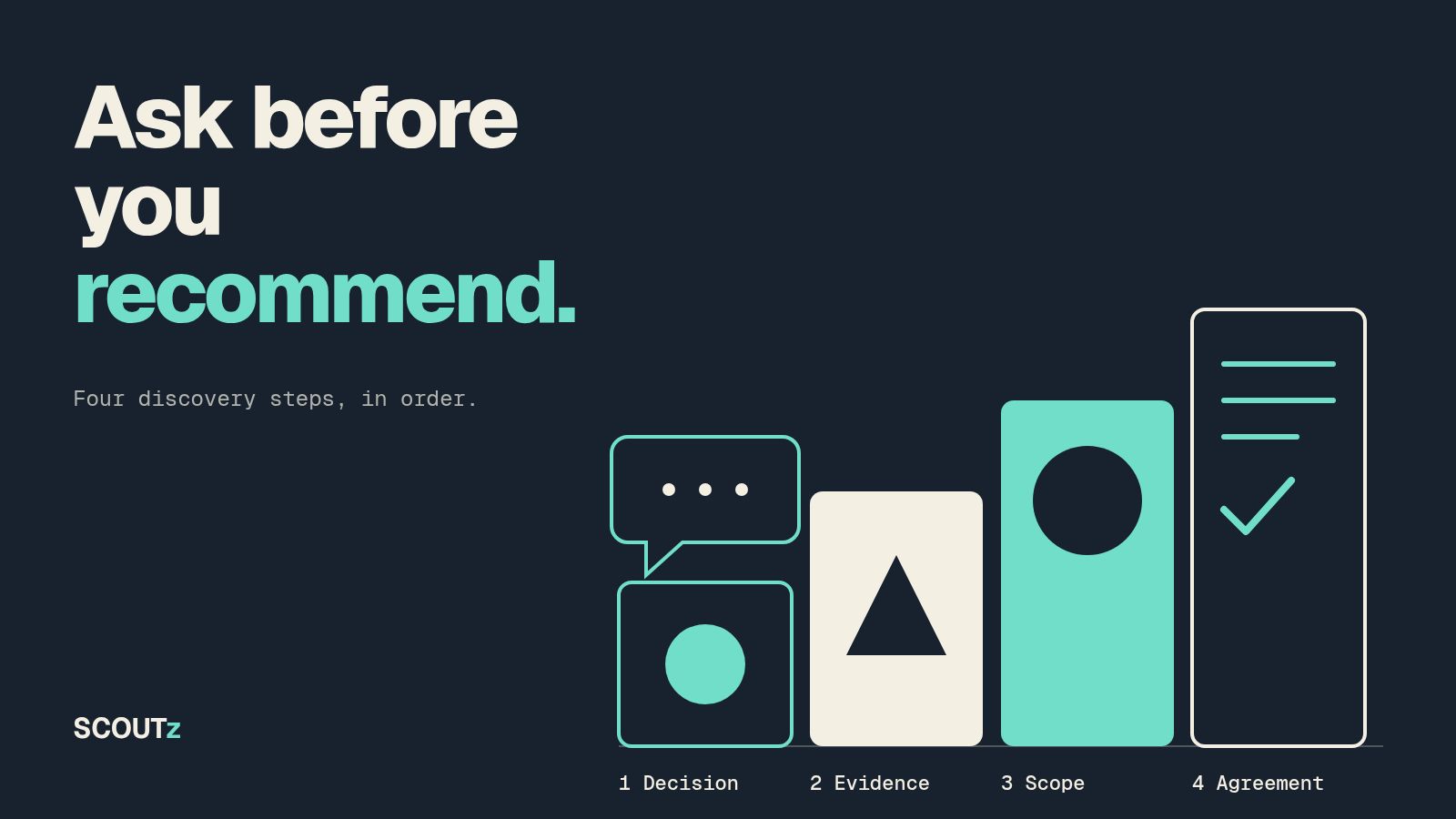
- Use Evidence-to-Agreement: Find the decision, Bring the evidence, Build the scope, Earn the next commitment.
- A public-domain observation starts a question; internal Microsoft 365 evidence requires customer authorization.
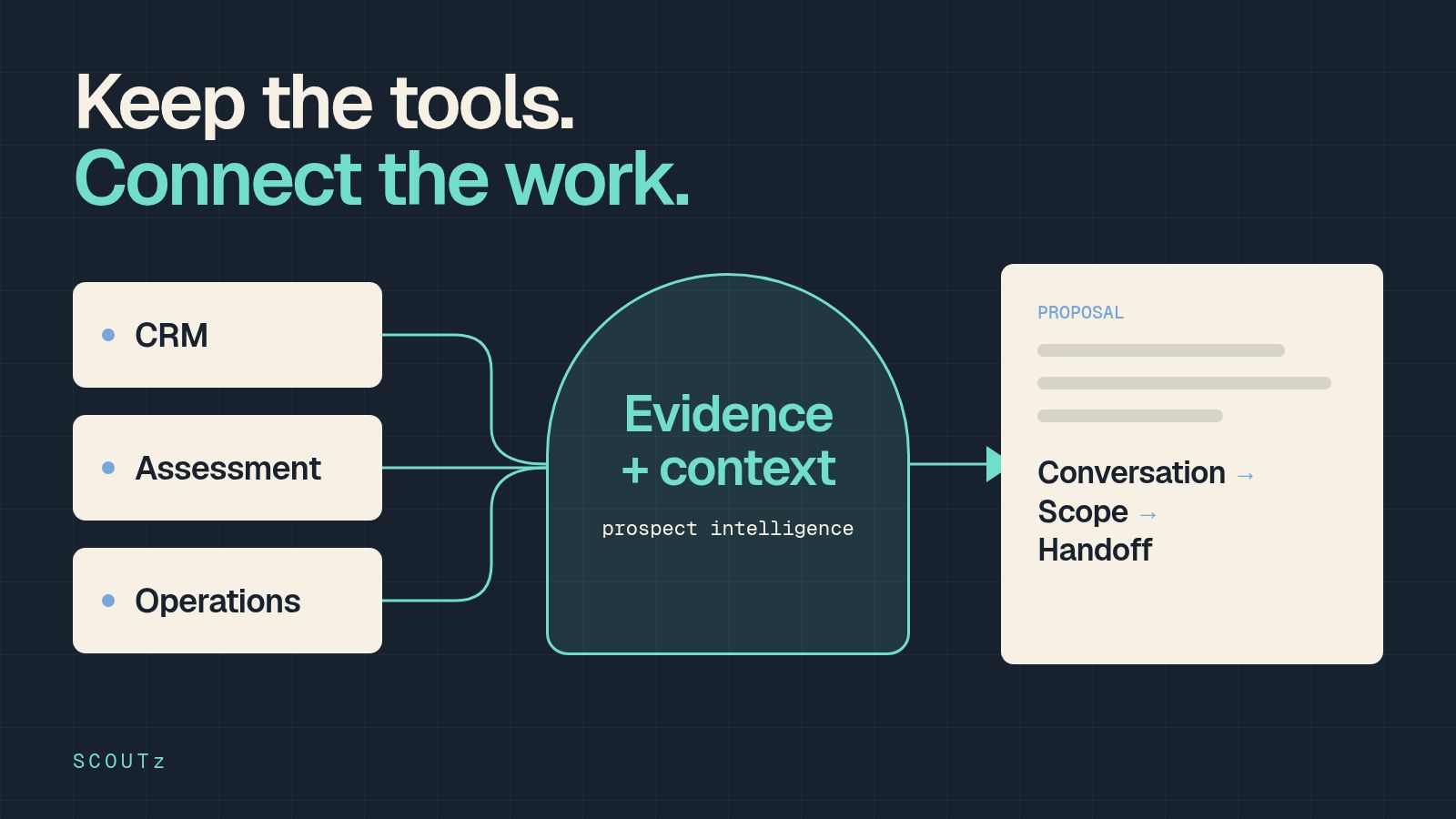
The SCOUTz reporting workflow supplies First meeting and Win the deal Report Plays. Use the available reports to prepare a conversation around a real account, rather than build an intimidating list of everything that might go wrong.
Why This Matters
A booked meeting is access to a conversation. It is not agreement that the prospect needs a replacement provider or a particular service. Your discovery work must establish that connection.
The sales opportunity is to make the next decision easier to evaluate. Show the owner what is known, invite their context and explain the work needed to answer what remains open. This guide applies SCOUTz's Evidence-to-Agreement Framework to that task; it is a conversation method, not a validated psychological model or a measured sales-performance claim.
MSP Sales Discovery Questions That Build the Next Agreement
Use four stages in order. Each stage produces something you can record, rather than a nod you can interpret optimistically.
| Stage | Discovery Question | Record Before Advancing |
|---|---|---|
| Find the decision | What prompted you to take this meeting, and what would you want to change? | A priority stated by the buyer |
| Bring the evidence | Does this dated observation connect to that priority? | Relevance confirmed, rejected or unresolved |
| Build the scope | What would we need to establish before recommending work? | A bounded review and its authorization |
| Earn the next commitment | Who should join the review, and what will we decide? | An owner, purpose and agreed timing |
These are suggested questions, not customer quotations. Adapt the wording to the account and leave room for a genuine answer that ends the opportunity.
Find the Decision Before You Diagnose the Environment
Open with the reason the buyer accepted the meeting. Avoid assuming that every owner is frightened, dissatisfied or ready to switch. An owner can be checking alternatives while remaining happy with the current provider.
Illustrative opening:
Before we discuss services, what made this conversation worth taking? If we leave with one useful decision, what should it be?
If the owner mentions having to chase IT updates, explore accountability. If the owner mentions expansion, explore what the next stage requires. Use their language rather than assigning a hidden motive.
Follow with questions such as:
- Which responsibility currently falls back on you?
- What should your provider keep you informed about?
- What works well enough that you want to preserve it?
- Who else will judge whether a change is worthwhile?
- What would make staying with the current arrangement reasonable?
The last question matters commercially. It establishes the alternative your proposal must beat, including doing nothing. A buyer's answer can reveal that your recommended project is unnecessary.
Bring One Finding Into the Conversation
Choose a finding relevant to the stated priority. Retain its check, source, run date and coverage limits. You are demonstrating preparation, not staging a surprise audit.
Illustrative 2026 training scenario: a dated public-domain review records a DMARC policy requesting monitoring only. The record establishes the published policy at collection time. It does not establish a successful impersonation attack or the state of internal Microsoft 365 controls.
Illustrative seller wording:
The published policy requests monitoring. That can be intentional. Who owns reviewing the reports, and does monitoring still match your intended approach?
The answer creates the next branch. If the owner confirms an intentional migration with an accountable operator, do not manufacture a problem. If ownership is unclear, propose resolving that question with the right person.
Prepare three evidence fields for the meeting: the observation, its boundary and the question it supports. Add business relevance only when the owner or a reliable account source establishes it.
Respond to “We Already Have an IT Guy” Without Attacking Them
An incumbent relationship is useful context. Ask what the buyer expects to keep and what they are willing to evaluate.
Illustrative response:
Understood. What does that arrangement do well, and what prompted you to meet with us? We can evaluate the specific question without assuming you need to replace anyone.
If the owner says everything works and no review is wanted, acknowledge the answer. If the owner wants clearer reporting or project support, investigate that job separately from replacement managed services.
Use the evidence to define a limited conversation with the incumbent when the buyer wants that. A published record does not establish that the existing provider made an error. Ask for the intended state, current owner and explanation before making a recommendation.
The commercial distinction is concrete: you are offering a useful evaluation, not requiring the buyer to admit their current decision was wrong. Keep the replacement question open until the buyer defines a reason to consider it.
Build the Scope With the Buyer
Turn the relevant question into a review that can answer it. Name the source needed, who approves access and what the deliverable will support.
For internal Microsoft 365 questions, use customer-authorized read-only configuration and metadata evidence. Public-domain observations cannot establish Conditional Access coverage, internal application permissions or tenant sharing configuration. The stated review boundary excludes message bodies, files, chats, documents and prompts.
Illustrative scope wording:
We have established the public observation. Your next question concerns the internal control. If you want to investigate it, we should agree the authorized review, its limits and who will evaluate the result before we quote implementation.
The review does not authorize a configuration change. Separate discovery access from later delivery approval.
Before writing the proposal, record:
- The buyer's requested outcome.
- The question still unanswered.
- The evidence source required.
- The customer-authorized scope.
- The reviewer and decision owner.
- The outcome that would justify further work.
A Worked First-Meeting Conversation
This is an illustrative training dialogue, not a customer incident or product-result claim. The seller has a dated public observation and no internal tenant evidence.
Buyer: “We have someone for IT. I mainly want to stop chasing updates.”
Seller: “Which updates are you having to chase?”
Buyer: “Whether agreed security work was actually completed.”
Seller: “Then let's make completion visible. This public review recorded a monitoring-only DMARC policy. I cannot tell from that whether a change was intended. Who can confirm the plan and how you receive evidence of completed work?”
Buyer: “Our operations lead works with the provider. I don't know the current plan.”
Seller: “Would a review with your operations lead help establish the intended policy, the current owner and what completion evidence you need?”
The seller has not established a deficiency. The seller has connected the owner's reporting concern to a verifiable decision. If the operations lead supplies a satisfactory plan, the appropriate outcome can be no additional work.
In your 2026 call coaching, inspect that transition. The quality test is whether the next review has a legitimate purpose, not whether the buyer said yes repeatedly.
Earn the Next Commitment With a Clear Agenda
Ask for the smallest action that answers the open question. That can be sharing the relevant scope, introducing the technical owner or arranging an authorized review. It must be a conscious agreement.
Illustrative close:
We have one unresolved question about ownership and completion evidence. Should we review it with your operations lead, or is there no reason to investigate further right now?
If the buyer chooses a meeting, define the decision before the invitation goes out. Suggested agenda: confirm the observation, establish the intended state, agree whether any work is needed. Send the evidence appropriate to the audience.
Three readiness checks help: the right person is invited, the question is explicit and the next decision is named. A calendar booking without those conditions is activity, not proof that the opportunity progressed.
Use the Right Evidence for Each Audience
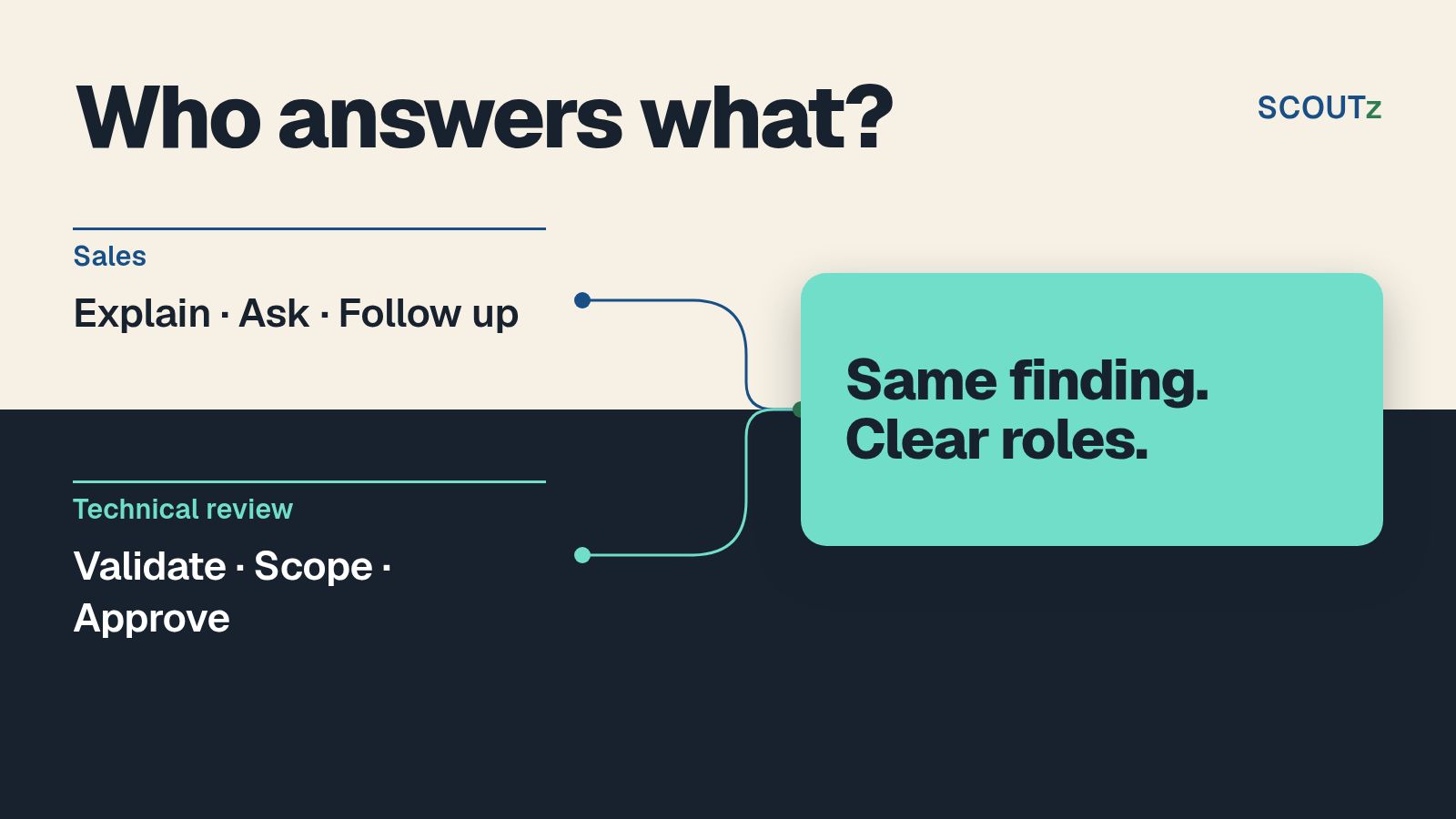
The business owner needs an explanation of the condition and a decision. The technical reviewer needs a route back to the source. Keep the truth consistent while adjusting the depth.
SCOUTz cybersecurity prospect intelligence supports that preparation with dated domain observations and customer-authorized Microsoft 365 evidence. The client-safe and operator reports serve different audiences. Review what each recipient should see before sharing.
The reporting page checked October 24, 2026, distinguishes current reports and Report Plays from a visual Report Studio still in validation. Build your workflow around the available reports. The Win the deal label describes a reporting stage; the MSP remains responsible for the sale.
Discovery Questions to Leave Out
Remove questions that already contain an unsupported verdict. “How much would three days offline cost?” is not a finding about this account. “Why hasn't your provider fixed this?” assumes fault and an agreed requirement.
Replace them with evidence-seeking questions:
| Loaded Question | More Useful Question |
|---|---|
| You know this could shut you down, right? | Which business process would this condition affect, if any? |
| Your provider missed this, didn't they? | Who owns this setting, and what is its intended state? |
| Can we agree you need to fix it now? | What evidence would make a change worthwhile? |
| You're ready to move forward, yes? | What remains unresolved before you can decide? |
These replacements leave the buyer room to disagree. That makes the answer usable when you decide whether to pursue the opportunity.
Coach the Call Using What the Buyer Actually Said
For a 2026 discovery review, compare the meeting notes with the buyer's own stated priority. Record the source of each claim: observed evidence, buyer explanation or seller hypothesis.
An effective call record contains the current arrangement, the desired outcome, unresolved evidence, required participants and agreed next step. Do not report a higher probability of closing merely because the seller presented a report.
Carry those records into the proposal. When the buyer asks why a service is included, your team should be able to trace it back to the agreed outcome rather than a generic package. That is the practical purpose of Evidence-to-Agreement.
FAQ
What are good MSP sales discovery questions?
Good MSP sales discovery questions establish the buyer's priority, test relevant evidence, define the scope needed to answer unknowns and agree the next decision. Record the buyer's answers rather than interpreting politeness as agreement.
What is the SCOUTz Evidence-to-Agreement Framework?
It is a four-stage conversation framework: Find the decision, Bring the evidence, Build the scope and Earn the next commitment. It organizes discovery and proposal preparation without claiming a measured increase in sales.
How should an MSP respond when a prospect already has an IT provider?
Ask what works, why the prospect accepted the meeting and whether a specific question needs review. Do not infer provider failure from a public-domain observation.
Should an MSP bring a security report to discovery?
Bring a reviewed report when it supports the buyer's question. Preserve the source, run date, coverage and limitations, and select the version appropriate to the audience.
Does a public-domain review establish internal Microsoft 365 security?
No. Internal Microsoft 365 configuration questions require appropriately authorized evidence. Unread sources must remain explicitly unknown.
What should happen after an MSP discovery call?
Agree the decision owner, the unresolved question and the action required to answer it. A technical review, proposal discussion or decision to stop can each be an appropriate next step.
One Last Thing
A buyer's correction is useful discovery. If the evidence is irrelevant or the current provider has an adequate plan, update your recommendation. A repeatable 2026 sales method needs that exit, otherwise it is only a pitch with extra questions.
Bring a real prospect to Join Open Beta and evaluate SCOUTz against the preparation work for your next meeting.