Investigate spf too many dns lookups by preserving the published SPF record, tracing every evaluated DNS-querying term, and checking where evaluation exceeds the 10-term limit. Count nested evaluations, record the sending IP and lookup time, and separate a reproducible SPF permerror from an untested warning about possible lookup depth.
- An spf too many dns lookups warning needs an evaluation trace, not a count of visible include statements.
- SPF permits 10 evaluated DNS-querying terms; nested includes share that limit.
- Public DNS evidence cannot establish tenant configuration, message delivery, or compromise.
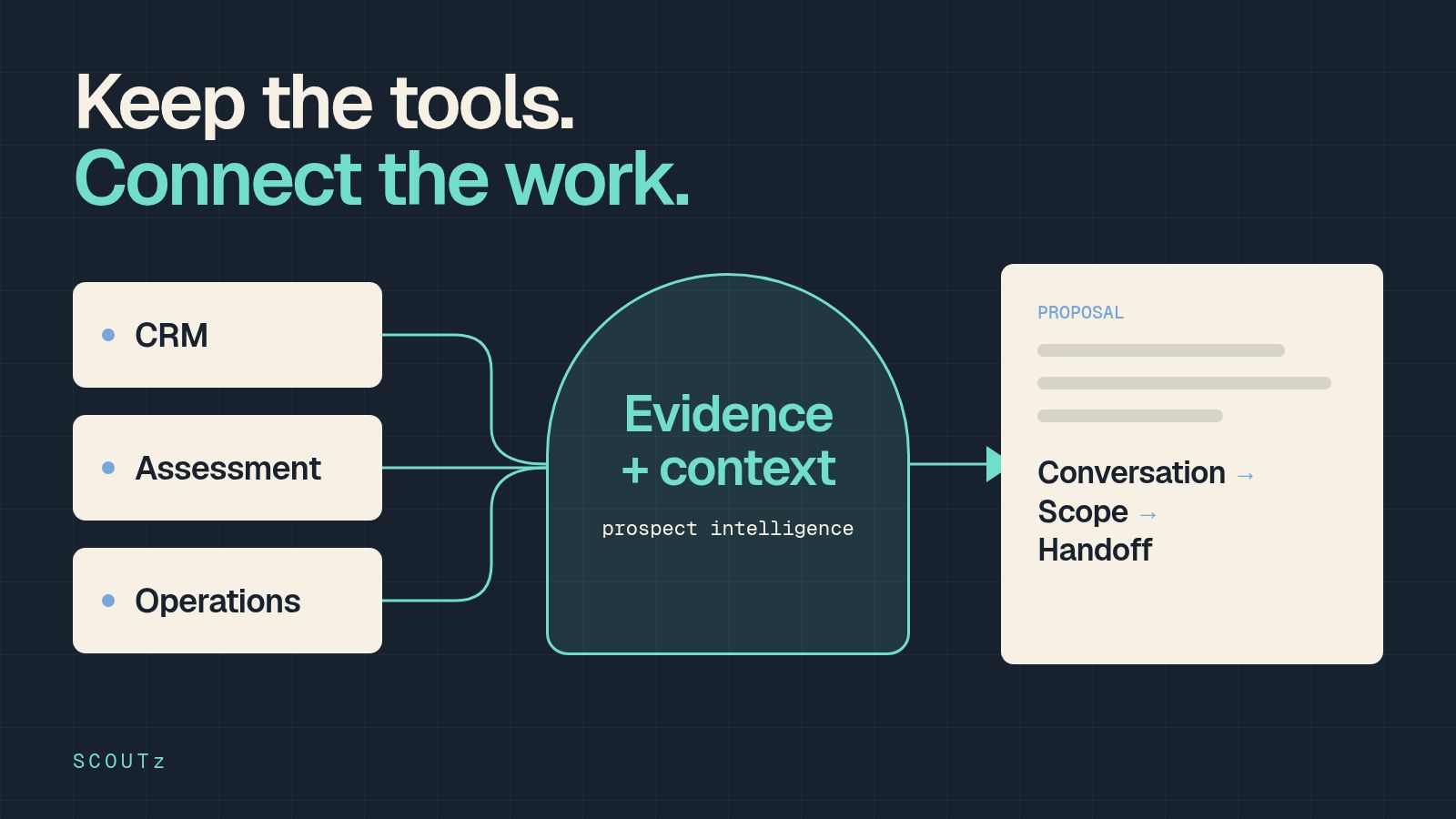
- SCOUTz cybersecurity prospect intelligence supports MSP meeting preparation; the MSP owns interpretation and the next action.
Why this matters
An SPF lookup-limit finding gives you a configuration condition to investigate. It does not establish that every message fails authentication or that the prospect has an unresolved incident.
For an MSP, the useful deliverable is a dated explanation: which domain was evaluated, which path exceeded the limit, what remains unknown, and who can authorize a change. Keep SPF in the wider email-authentication picture described in whether an SPF, DKIM, and DMARC checker is enough to assess email risk.
Your 2026 review should preserve the evaluation path, not just the warning label. A later DNS change can make an earlier result impossible to reproduce without the original evidence.
How do you investigate SPF too many DNS lookups without guessing?
Start with the domain actually used for SPF evaluation. SPF normally checks the SMTP MAIL FROM identity; an empty reverse-path uses the HELO identity. The visible From address alone does not identify the SPF policy being evaluated.
The governing reference is RFC 7208, published in April 2014. Its Section 4.6.4 defines the limit on DNS-querying terms; Section 4.6.1 explains evaluation order. Those rules remain the basis for this 2026 investigation workflow.
1. Preserve the starting evidence
Record the queried domain, exact TXT response, collection time with timezone, resolver, and observed DNS errors. Preserve the SPF record beginning with v=spf1, including its mechanism order and any redirect modifier.
Record whether you evaluated a real sending IP or inspected the policy structure only. Without that distinction, a possible lookup-limit path becomes an unsupported claim about actual mail.
There must be 1 applicable SPF policy record for the domain. Multiple TXT strings within a single DNS record are different from multiple SPF policy records; retain the response structure so you can distinguish them.
2. Trace evaluated terms, including nested records
SPF limits evaluated DNS-querying terms to 10 terms across the evaluation, including nested SPF processing. The relevant terms are include, a, mx, ptr, exists, and redirect when reached.
Do not count only the terms visible in the starting record. An include can lead to another policy containing further DNS-querying mechanisms, and those evaluations consume the same budget.
Keep each term beside its parent record, position, and result. This turns a flat warning into a trace that another practitioner can inspect.
3. Follow evaluation order for the sending IP
SPF mechanisms are evaluated in order. A matching mechanism ends evaluation, so a term later in the policy is not automatically reached for every sender.
Separate a structural warning from a reproduced failure. A tool that explores possible branches answers a different question from an evaluator running the policy for a specified IP address and identity.
A record containing a deep include tree is not proof that every sender exceeds the limit. Identify the path that reaches the excess term.
4. Separate lookup limits from DNS failures
Exceeding the 10-term limit produces permerror. A transient DNS failure can produce temperror; these results need different investigation paths.
RFC 7208 also recommends limiting void lookups, meaning DNS responses with no relevant answers or NXDOMAIN, to 2 void lookups. Keep void-lookup evidence separate from the main term count, and record the evaluator's behavior rather than treating every DNS error as the same finding.
An unreadable DNS response remains unreadable. It cannot support a clean result.
5. Reproduce with an independent evaluation
Run a second evaluation against the same identity and sending IP. Preserve both timestamps and compare the records each evaluator received.
If the results differ, inspect DNS responses, evaluation order, caching, and evaluator diagnostics before choosing a conclusion. A second warning without a trace does not resolve the disagreement.
6. Name the owner and the next choice
Identify who controls authoritative DNS and who owns each sending service. Ask those owners to confirm whether the listed services remain authorized and whether the observed sender is expected.
Then propose the smallest supported action: confirm an obsolete dependency, correct a documented policy error, or investigate an unavailable DNS dependency. A sales report should distinguish the proposed change from approved work.
What counts toward the SPF lookup limit?
The limit concerns evaluated terms that cause DNS queries, rather than a simple total of packets sent to a resolver. DNS caching does not remove the protocol's term limit.
| SPF element | Counts toward the 10-term limit? | Investigation detail |
|---|---|---|
include | Yes, when evaluated | Follow the referenced SPF record and its evaluated nested terms. |
a | Yes, when evaluated | Preserve the expanded target and address-query results. |
mx | Yes, when evaluated | Preserve MX processing and relevant address results; additional RFC limits apply. |
ptr | Yes, when evaluated | RFC 7208 discourages its use; preserve the trace if present. |
exists | Yes, when evaluated | Record the expanded query name and DNS result. |
redirect | Yes, when reached | Follow it only when evaluation reaches the redirect. |
ip4, ip6, all | No | These mechanisms do not themselves require DNS queries. |
A TXT record's length is a separate concern. Shortening the text without changing the evaluated dependency path does not demonstrate that you fixed the lookup problem.
Which investigation method should you use?
Use complementary evidence sources. Each method answers a different part of the investigation, and each has a boundary.
| Method | Best for | Strength | Limitation |
|---|---|---|---|
| Manual DNS trace | Explaining policy dependencies | Shows the records and paths behind a finding | Requires careful handling of nesting, macros, and evaluation order |
| SPF evaluator | Reproducing a result for an identity and IP | Applies evaluation logic and exposes diagnostic results | Quality depends on implementation and the inputs supplied |
| Authorized message-header review | Connecting policy evidence to a real message | Shows the receiving system's reported authentication outcome | Describes that message and receiver, not all sending paths |
For a 2026 prospect review, begin with dated public DNS evidence. Request message headers through an agreed process when a real-message outcome matters; preserve only the information needed for the review.
Why SPF lookup results vary
A result belongs to an evaluation context. Keep these factors attached to the finding:
- The identity evaluated: MAIL FROM and HELO can use different domains and policies.
- The sending IP: an early match can stop evaluation before later dependencies are reached.
- Nested dependencies: a provider's referenced policy can change independently of your client's starting record.
- DNS timing: cached responses and changes during propagation can expose different record versions.
- Query responses: empty answers, NXDOMAIN, and transient failures have different meanings.
- Evaluation scope: structural inspection and sender-specific evaluation answer different questions.
Do not explain a disagreement by declaring one tool wrong before comparing its inputs and trace. Preserve the difference as an open investigation item until the evidence resolves it.
How should an MSP turn the finding into evidence, insight, and proof?
Use a short sequence: Observe, Trace, Confirm, Change, Verify. Keep the technical evidence separate from the business interpretation.

Evidence: state what ran
Describe the condition, affected domain, collection time, sending identity, test IP, and evaluator result. Attach the evaluated path and distinguish returned records from failed or unreadable responses.
Label the observation accurately. A reproduced permerror supports a claim about that evaluation; a structural warning supports a narrower claim about the policy path inspected.
Insight: explain the possible consequence
An SPF permerror means the receiver could not complete SPF evaluation successfully under the applicable rules. It does not, by itself, establish message rejection, failed DMARC, or compromise.
Ask the mail owner to confirm the sending service, intended authorization, and any observed delivery symptoms. Keep the possible consequence separate from a claim of actual business impact.
Proof: rescan against the baseline
Preserve the approved change, then repeat the original evaluation and relevant authorized sender tests. Compare the result with the pinned baseline.
For a 2026 handoff, include the before-and-after records and timestamps. A changed DNS record is evidence of a configuration change; a successful repeated evaluation is evidence about the tested path.
What should you change after confirming the problem?
Confirm ownership before removing an include. An unfamiliar sending service can still be active, and a quiet service can still support an important workflow.
Remove obsolete authorization only after the responsible owner confirms it is obsolete. Check provider documentation before replacing a dependency or altering its intended use.
Treat SPF flattening as a maintenance decision. Replacing DNS-based dependencies with explicit addresses can reduce lookup demand, but it creates responsibility for keeping those addresses aligned with provider changes. Do not replace a maintained dependency with a one-time address snapshot and call the work complete.
Splitting mail streams across subdomains is another architectural choice, not an automatic repair. Each relevant sending identity needs an appropriate policy, and DMARC alignment still needs review.
In 2026 change records, retain the authorized sender inventory alongside the SPF baseline. That inventory explains why each dependency remains.
Where SCOUTz fits in the review
SCOUTz cybersecurity prospect intelligence is for MSPs preparing evidence-led prospect conversations. Public-domain observations support discovery; they do not establish internal Microsoft 365 configuration or prove a prospect is ready to buy.
Customer-authorized Microsoft 365 evidence has a separate boundary: read-only configuration and metadata, excluding mail, files, chats, documents, and prompts. An SPF investigation based on public DNS does not establish Conditional Access coverage, application permissions, or tenant sharing settings.
SCOUTz prepares the conversation. The relationship and the sale stay yours. Join Open Beta is the primary next step for interested MSPs; use the current application route presented on SCOUTz.
FAQ
What does SPF too many DNS lookups mean?
SPF too many DNS lookups means an evaluation exceeds the limit of 10 evaluated DNS-querying terms. Confirm the identity, sending IP, nested path, and evaluator result before describing which mail is affected.
Does every include count as only one SPF lookup?
An evaluated include consumes a DNS-querying term, and evaluated terms inside its referenced policy also count toward the shared limit. Counting visible includes in the starting record misses nested processing.
Do ip4 and ip6 mechanisms count toward the SPF lookup limit?
The ip4 and ip6 mechanisms do not count toward the DNS-querying-term limit because they do not themselves require DNS queries. Replacing provider dependencies with addresses still requires an accurate, maintained authorization policy.
Will an SPF lookup error make every email fail DMARC?
An SPF lookup error does not establish that every email fails DMARC. A message can pass DMARC through a valid, aligned DKIM signature even when SPF does not provide an aligned pass.
Can I delete an SPF include that I do not recognize?
Confirm the include's owner and purpose before deleting it. Remove authorization only after the responsible owner verifies that the sending service is no longer required.
Can public DNS show whether a Microsoft 365 tenant is secure?
Public DNS cannot establish Microsoft 365 tenant security. Conditional Access, application permissions, license assignments, device state, and tenant sharing configuration require appropriate authorized evidence.
How do I prove an SPF lookup issue was fixed?
Repeat the original evaluation against the pinned baseline and test relevant authorized sending paths. Preserve the changed records, timestamps, identities, sending IPs, and results so the claim stays limited to what was verified.
One last thing
A green result for one sender does not clear every sender. SPF can stop at an early match, leaving a problematic later path untouched.
Keep your 2026 verification tied to the authorized sender inventory. Ask the owner to confirm that inventory before calling the review complete.