Scale MSP prospecting without hiring more salespeople by standardizing account research, evidence briefs, qualification and handoffs before increasing outreach. Reuse the structure while researching each account separately. Measure whether the workflow produces useful buyer decisions with the people you have, rather than assuming more reports mean more qualified opportunities.
- Scale MSP prospecting without hiring more salespeople by making research and handoffs repeatable before increasing outreach.
- SCOUTz cybersecurity prospect intelligence supports dated account evidence; your CRM retains relationship and opportunity ownership.
- Reuse brief fields, review rules and meeting preparation, while keeping each account's evidence distinct.
- Track preparation effort, qualified conversations and agreed next steps without claiming a guaranteed capacity gain.
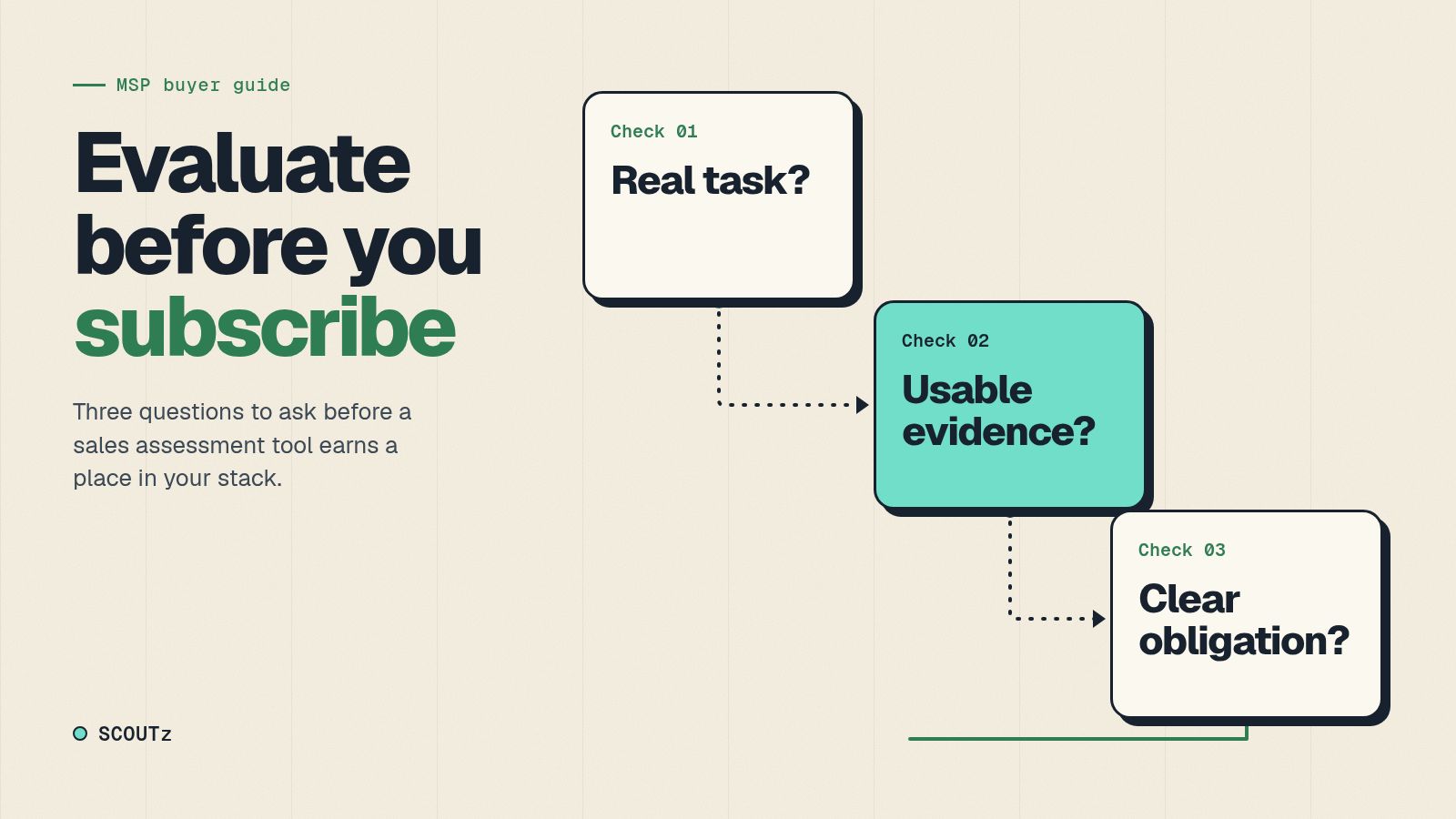
The SCOUTz report workflow provides seller preparation and audience-specific reporting. Use it within a process your team can already describe. Adding another tool to an undefined handoff does not decide who qualifies the account or follows up with the buyer.
How to Scale MSP Prospecting Without Hiring More Salespeople
Begin with a shared definition of a research-ready account and a meeting-ready brief. Then assign an owner to each transition.
- Define which accounts merit research.
- Use the same brief fields for every account.
- Separate observations from assumptions about the buyer.
- Review the claims before using them in outreach.
- Carry the brief into discovery and proposal preparation.
- Measure rework and opportunity progression before adding volume.
These six steps are an operating design, not a forecast of additional leads or a substitute for adequate staffing. If delivery capacity or customer follow-up is already constrained, increasing prospecting can make those constraints worse.
Why This Matters
The repeatable part of prospecting is the preparation process. The variable part is the account: its situation, priorities, responsible people and reason to consider change.
When research lives in separate notes, the meeting owner must reconstruct what the researcher meant. When a finding gets copied without its source or boundary, a cautious observation can become an unsupported sales claim.
The goal is to preserve the reasoning across roles. A team member should understand why an account was selected, what the evidence establishes and what question to ask next without repeating the entire investigation.
Define the Work Before Automating It
Write down the current route from account selection to meeting handoff. You can do this manually in a shared document before changing systems.
| Stage | Required Input | Human Decision | Usable Output |
|---|---|---|---|
| Account selection | Your service criteria | Whether the business fits | A research-ready account |
| Research | Verified organization and domain | Which sources are relevant | A dated evidence brief |
| Review | Observation and boundary | Whether the claim is supportable | Approved conversation material |
| Outreach | Relevant question and suitable contact | Whether and how to approach | A legitimate invitation to discuss |
| Discovery | Buyer context | Whether there is a reason to proceed | An agreed next decision |
| Proposal | Defined requirement | What you can responsibly deliver | A scoped commercial offer |
Identify where information gets retyped or rediscovered. Fix that specific handoff before assuming you need greater sending volume.
For your 2026 process, describe the minimum acceptable output at each stage. A completed task is useful only if the next person can act on it.
Choose Accounts Using Service Fit
Define eligibility around the work your MSP can deliver. Geography, service requirements and organizational fit can shape that choice when supported by reliable information.
Avoid inventing a private operating problem from a public event. A business opening a location supplies research context; it does not establish dissatisfaction with its provider or an approved technology budget.
Useful selection fields include:
- Organization and verified domain.
- Fit with your actual service scope.
- Public source supporting the research trigger.
- Relevant business role to approach.
- Known reason the account is unsuitable.
- Research owner and next review point.
An unknown field stays unknown. If account identity is uncertain, resolve it before attaching findings to a prospect.
The decision to exclude an account is productive work. A repeatable process needs a clear stop condition as well as a path to outreach.
Build a Brief That Another Seller Can Use
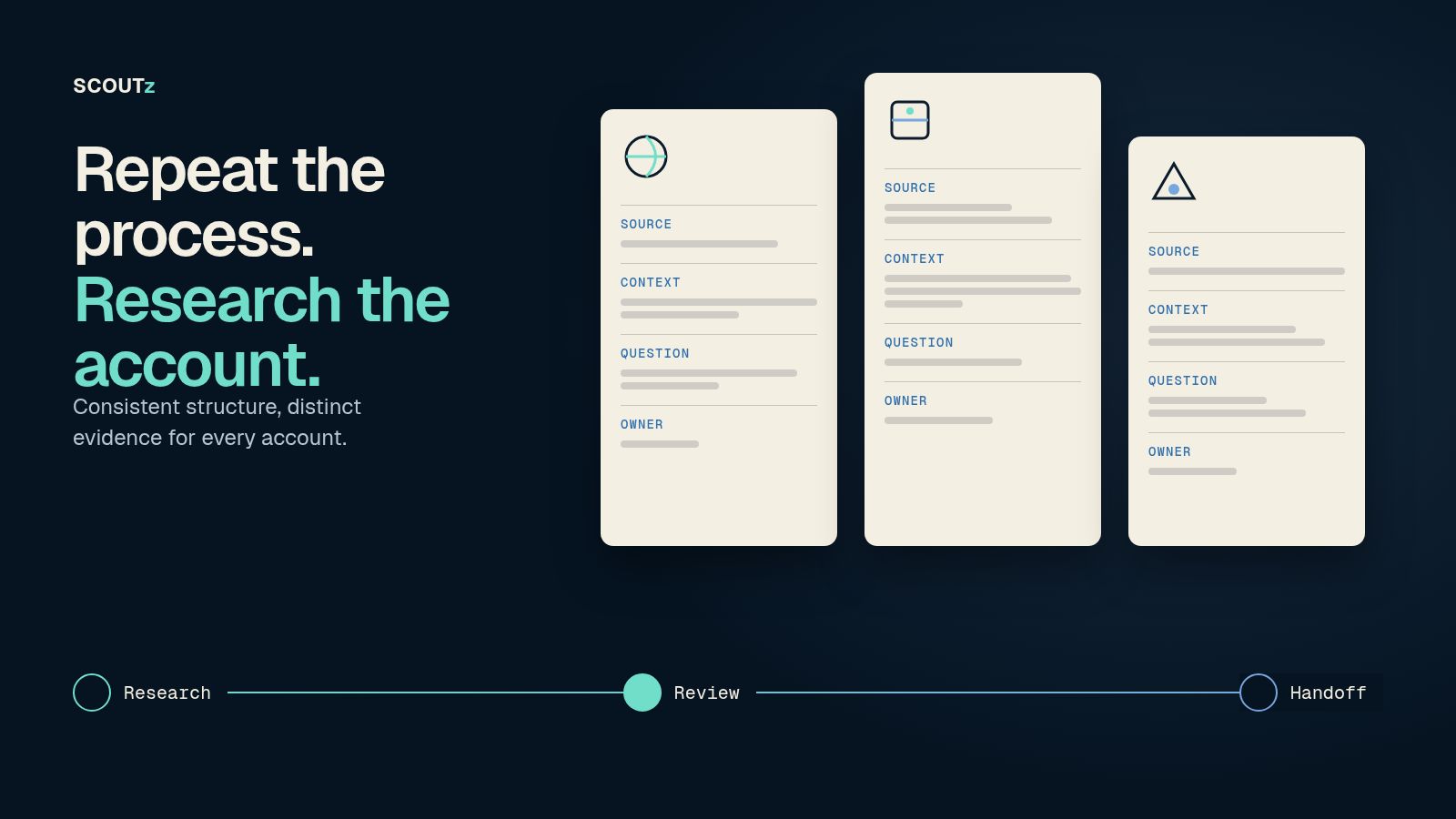
Give every account the same evidence fields, while writing its content from that account's sources. This is the reusable unit of prospecting.
| Field | What Belongs There | Example of a Mistake |
|---|---|---|
| Observation | What the source showed | Describing an inference as a fact |
| Provenance | Source and collection date | Copying a claim without its origin |
| Boundary | What was not assessed | Treating unread evidence as clean |
| Business context | Verified event or buyer statement | Assuming a public event proves intent |
| Hypothesis | A question worth testing | Declaring the buyer's motive |
| Conversation ask | A relevant invitation | Inventing urgency |
| Owner | Who reviews and follows up | Leaving shared notes unassigned |
A seller should be able to locate the source without asking the researcher to recreate the work. Keep interpretations visibly separate from observations.
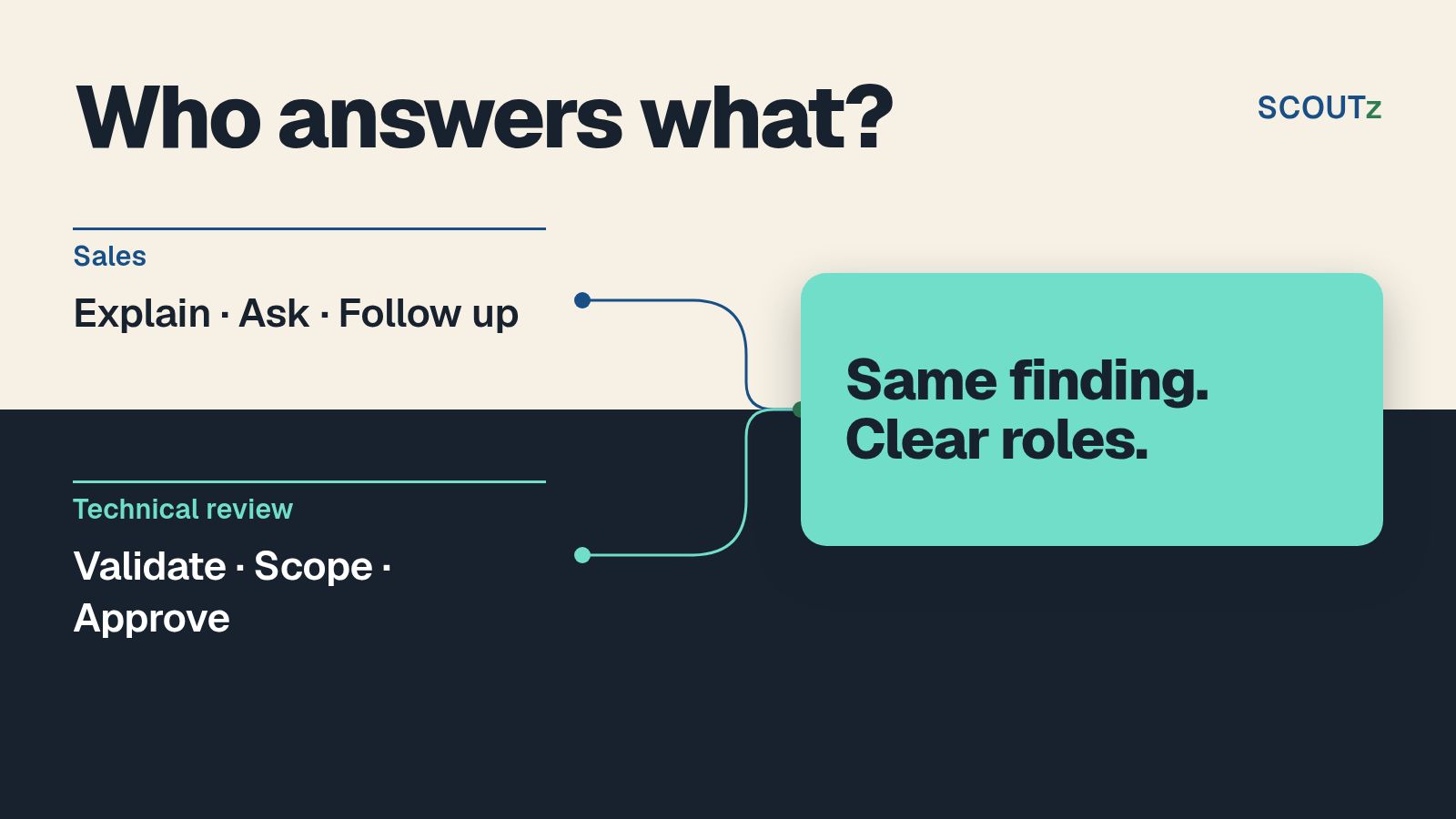
SCOUTz cybersecurity prospect intelligence supports seller briefs and technical evidence. The product supplies preparation material; the MSP still validates the account context and chooses the relationship action.
Use a Human Review Gate Before Outreach
Check that the claim matches the source and the recipient. This review can be brief when the underlying record is clear, but it must remain a real decision.
A public-domain observation does not establish internal Microsoft 365 settings. A breach-data match does not establish account compromise. A public event does not establish buying intent.
Before releasing a brief, confirm:
- The observation belongs to the intended organization.
- The source and run date are retained.
- The wording preserves coverage limits.
- The proposed question is relevant to the account.
- The recipient should receive the attached material.
- The outreach follows your applicable obligations and opt-out process.
Offer an outreach scan as an opt-in courtesy after a reply. Do not use the absence of a product permission gate as blanket legal clearance for every collection method or jurisdiction.
Work the Same Brief Through Evidence-to-Agreement
The SCOUTz Evidence-to-Agreement Framework provides four transitions: Find the decision, Bring the evidence, Build the scope and Earn the next commitment. Use the brief as continuity between them.
Before a conversation, the account's possible priority is a hypothesis. During discovery, replace that hypothesis with the buyer's stated requirement. Then retain the observation that supports a relevant scope discussion.
If the buyer explains that the issue is already resolved, update the record. Do not leave an old interpretation available for another seller to repeat.
For a 2026 handoff, the brief should distinguish the research question from the buyer's answer. This difference determines whether the next meeting is discovery, technical validation or proposal review.
The framework organizes the process. It does not validate a psychological profile or establish a measured improvement in close rates.
A Worked Research-to-Meeting Handoff
This is an illustrative training example. It is not a customer story or an observed productivity result.
A researcher identifies a business that fits the MSP's service scope. A public source supplies a reason to investigate its business context. A dated domain review produces an observation that needs an ownership question, not an incident claim.
The researcher records the observation, its source, the boundary and a suggested invitation. A reviewer removes wording that implies the buyer has an unresolved security failure.
Illustrative invitation after an appropriate conversation has begun:
We can prepare a public-domain review as a courtesy if it would help your planning. It would show the observations available from that scope and the questions that still need your context. Would that be useful?
The prospect accepts and later says the main concern is knowing whether agreed work is complete. The meeting owner now carries that buyer statement into discovery.
Illustrative internal handoff:
The owner wants clearer completion evidence. The public observation needs confirmation of its intended state. Review that with the responsible person before proposing implementation. Internal Microsoft 365 controls have not been assessed.
The seller has a purposeful starting point without inheriting a fabricated diagnosis. There is still no accepted proposal or guaranteed sale.
Keep the CRM and Evidence Workflow Distinct
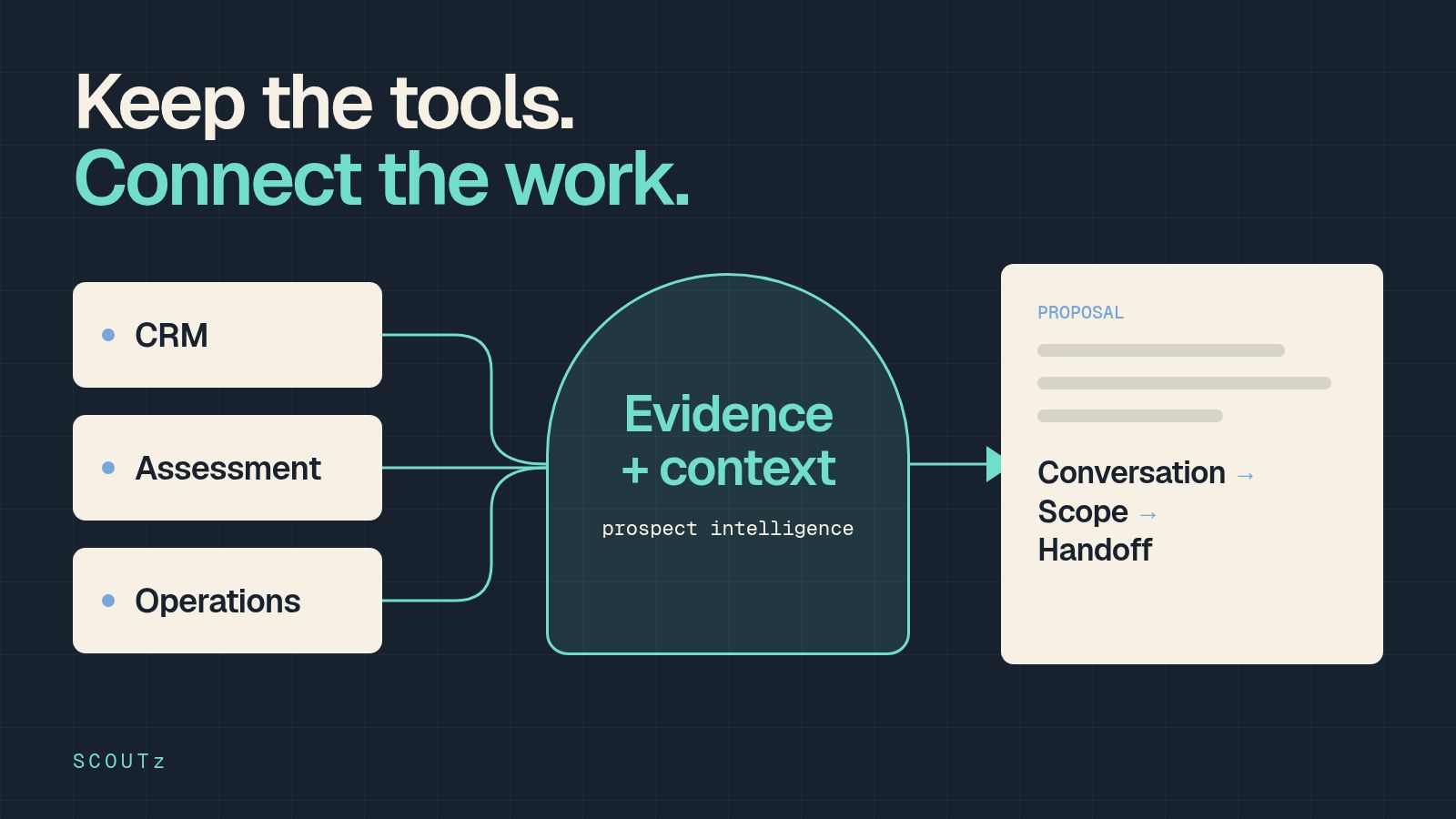
Use your CRM for relationship ownership, contact history and opportunity decisions. Keep source material and report versions available through the workflow you actually use.
This guide does not assume a native connection or automatic synchronization between systems. A manual handoff can be appropriate if the responsible person and reference are clear.
| Working Method | Best For | Strength | Limit |
|---|---|---|---|
| Shared research document | Establishing the process manually | Makes fields and review rules explicit | Requires consistent version and owner discipline |
| CRM opportunity record | Tracking the relationship and next action | Preserves commercial ownership | Does not itself establish technical evidence |
| SCOUTz reports and briefs | Preparing dated security and account evidence | Separates audiences and evidence scopes | Does not replace qualification or relationship judgment |
Choose the method according to the job. Copying every technical detail into a contact record is not necessary if the source remains accessible to the right reviewer.
Measure Capacity With Your Own Records
Establish a baseline before declaring that the process supports more prospecting. Use actual work records from comparable periods and keep definitions unchanged.
Suggested measures include preparation minutes per account, briefs returned for correction, meetings accepted, buyer-qualified conversations and agreed next steps. None is a substitute for signed customers and the delivery capacity to serve them.
Keep calculation rules explicit:
- Preparation minutes per account equals recorded research and review time divided by completed briefs.
- Rework share equals briefs returned for correction divided by reviewed briefs.
- Agreed-next-step share equals qualified conversations with a recorded buyer agreement divided by qualified conversations.
These are suggested measurements, not account results or industry benchmarks. Track counts alongside percentages so a small sample does not look conclusive.
For your 2026 review, compare like-for-like account types and stages. A simpler research queue can reduce preparation time without proving that the workflow improved.
Fix the Bottleneck Before Adding Volume
If briefs repeatedly fail review, improve source handling and training. If meetings repeatedly reopen basic context, improve the handoff. If qualified buyers do not reach a next decision, inspect the actual objection.
Do not call every stalled opportunity a lead-quality problem. A missing technical reviewer, unsuitable offer or unresolved budget constraint requires a different response.
Set your next research volume from the team's actual review and follow-up capacity. This guide supplies no universal quota or claimed tool runtime.
If the process remains overloaded after rework is reduced, the staffing decision remains open. Standardization cannot remove every legitimate task or guarantee that hiring is unnecessary.
FAQ
How can an MSP scale prospecting without hiring more salespeople?
Standardize account selection, research briefs, claim review and meeting handoffs before increasing outreach. Measure the resulting work and buyer progression with your own records.
What belongs in an MSP prospect brief?
Include the account identity, dated observation, source, boundary, relevant business context, discovery question and responsible owner. Separate assumptions from buyer-confirmed requirements.
Does a public business event prove buying intent?
No. It provides research context. The buyer must confirm whether it creates a relevant need or decision.
Does SCOUTz replace an MSP's CRM?
No. SCOUTz prepares cybersecurity evidence and prospect context. The CRM retains relationship and opportunity ownership.
Should MSP prospecting be fully automated?
Keep human decisions where account fit, technical claims, recipient suitability and buyer context need judgment. This workflow describes no automatic outreach or native synchronization.
How should an MSP measure prospecting capacity?
Record preparation time, rework, qualified conversations and agreed next steps using stable definitions. Evaluate those measures alongside signed customers and delivery capacity.
One Last Thing
A handoff is ready when the next person can explain both the reason to investigate and the reason to stop. That is a stronger quality test than whether every brief field contains text.
Bring your next account brief to Join Open Beta and evaluate the workflow against your team's 2026 preparation process.