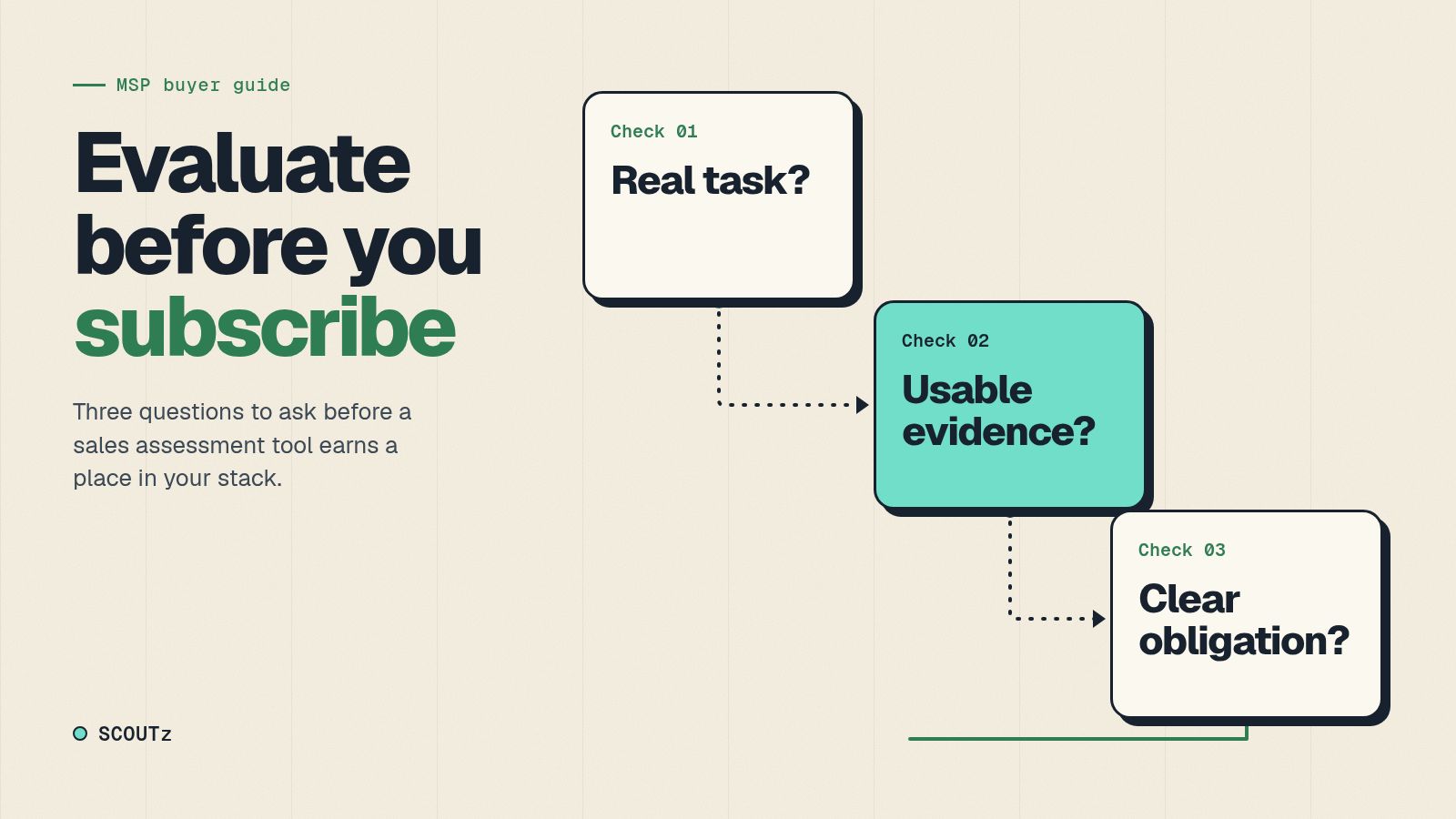
Network vulnerability scanning is not necessary before every MSP sales pitch. A first meeting can establish business priorities using buyer-provided information and clearly scoped public observations; deeper technical claims require appropriate evidence. Propose an authorized assessment when an unresolved purchasing or delivery question genuinely needs it, rather than making scanning a condition of every conversation.
- Network vulnerability scanning is not necessary before every sales pitch; match the review to the unresolved decision.
- Public-domain observations do not establish internal network vulnerabilities or Microsoft 365 configuration.
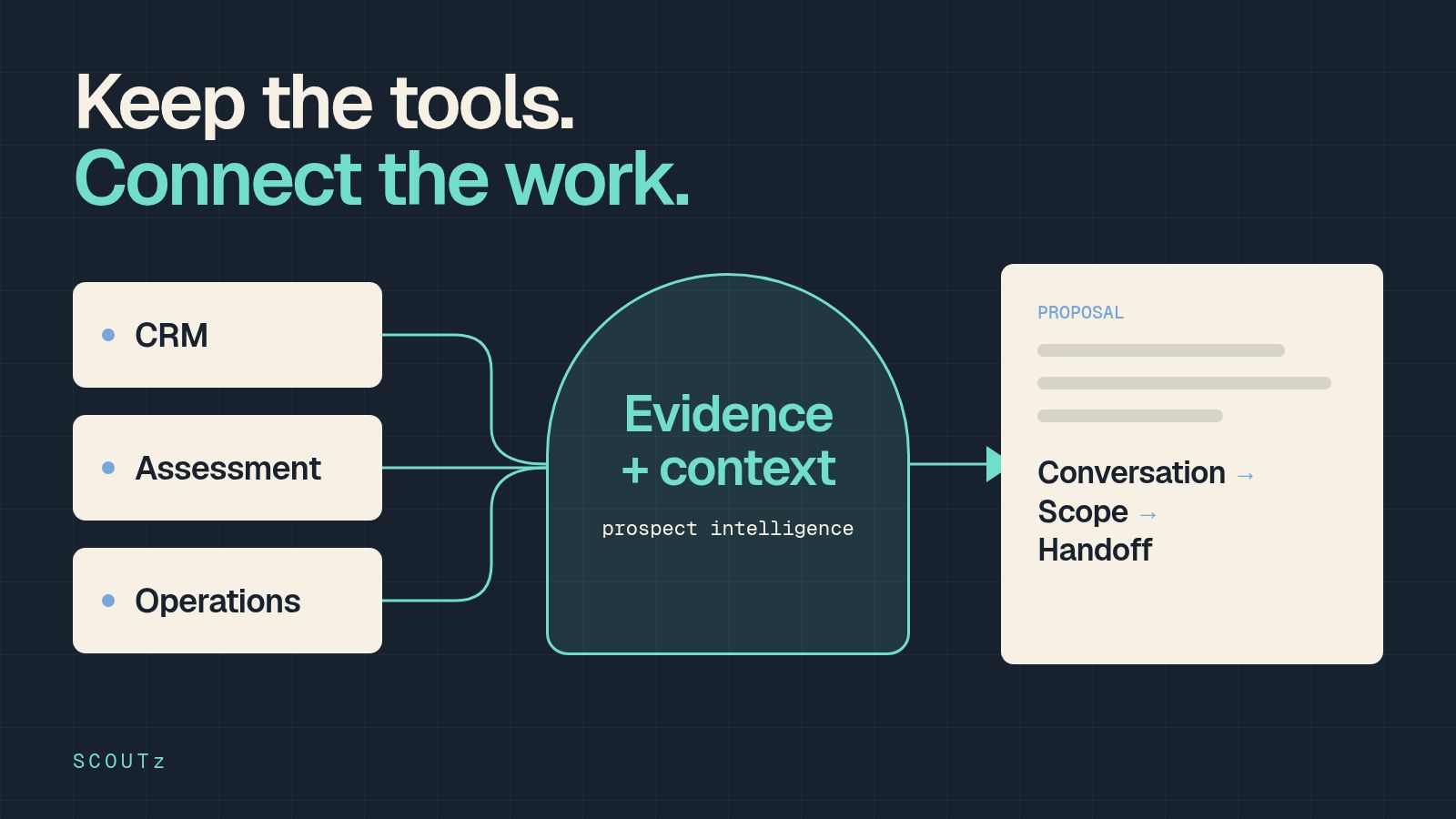
- SCOUTz cybersecurity prospect intelligence prepares dated evidence for MSP conversations; the MSP selects the next assessment.
- Agree authority, scope, permitted techniques and stop conditions before active technical testing.
The SCOUTz report workflow supports first-meeting preparation and scope discussions with dated findings and audience-specific reports. Use that evidence within its limits. A report about one scope cannot answer questions about systems the review never assessed.
Is Network Vulnerability Scanning Necessary Before a Sales Pitch?
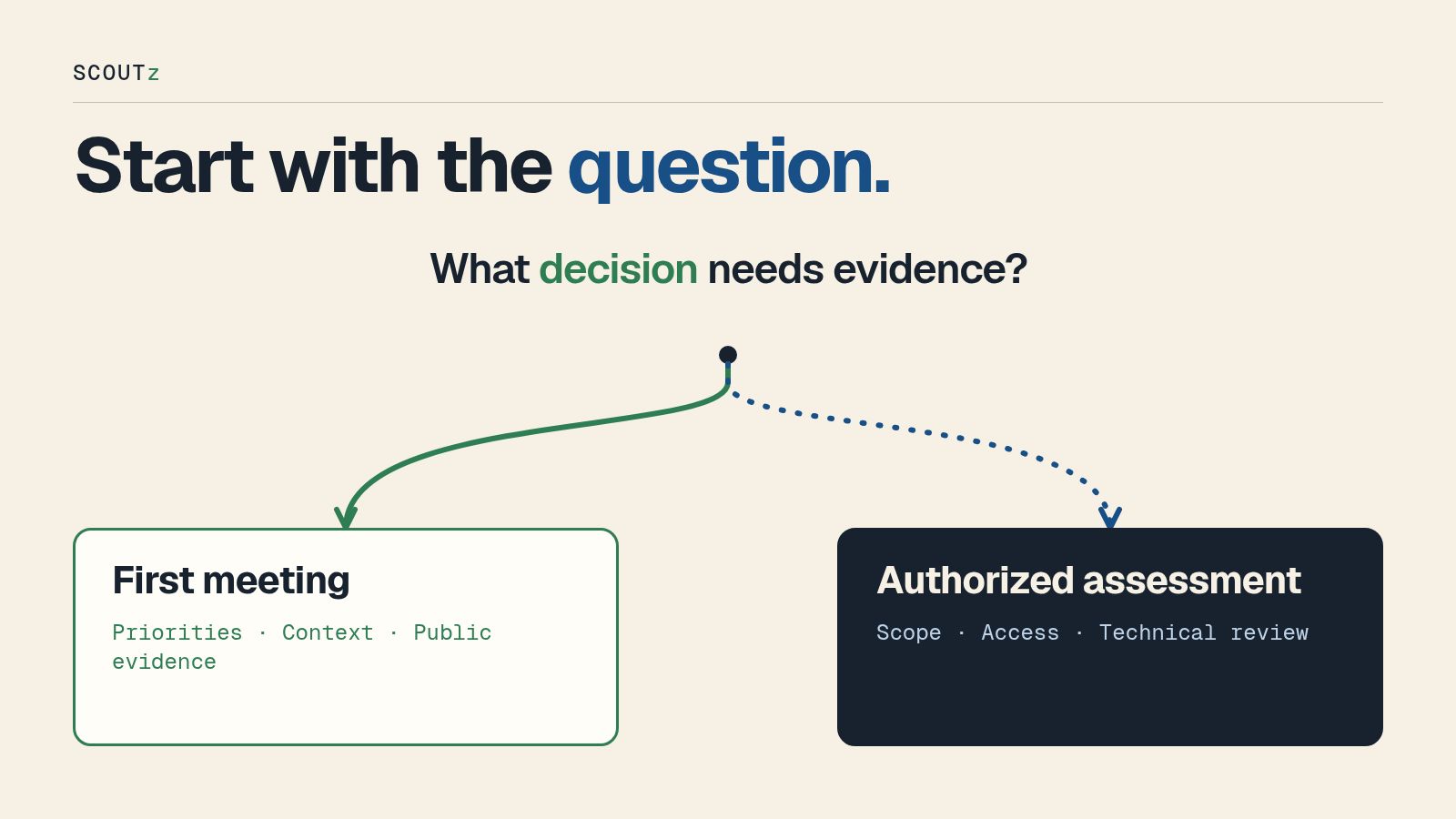
Choose the review according to the decision in front of the buyer. The first decision can be whether a deeper assessment is warranted.
| Situation | Suitable Starting Point | What Still Needs Resolving |
|---|---|---|
| The owner wants to explore service fit | Discovery and buyer-provided context | Whether either party has a reason to proceed |
| A public observation needs explanation | Dated domain evidence and an ownership question | Intended state and business relevance |
| The buyer asks about internal Microsoft 365 controls | Customer-authorized configuration review | Coverage, access and interpretation |
| The proposed service depends on network conditions | Appropriately authorized technical assessment | Agreed assets, methods and acceptance criteria |
| The buyer wants proof of exploitable access | A separately scoped validation exercise | Whether and how that testing is authorized |
These are decision categories, not interchangeable products. Do not label public-domain research a network vulnerability assessment merely because both activities appear in a sales process.
Why This Matters
An MSP needs enough information to make a responsible offer. The required evidence depends on the promise being made.
A conversation about reporting expectations does not require proof of every internal control. A fixed implementation commitment based on unknown systems needs its assumptions resolved or explicitly bounded.
This distinction protects the sales conversation and the eventual delivery agreement. It prevents a narrow observation from becoming a much broader technical promise.
Start With the Business Decision
Ask what the buyer needs to decide before selecting a collection method. The answer might concern changing providers, commissioning a limited review or leaving the current arrangement alone.
Illustrative opening:
Before asking for technical access, I want to understand the decision. Are you evaluating a new service relationship, trying to answer a specific configuration question or looking for an independently scoped assessment?
A buyer evaluating fit can discuss outcomes, responsibilities and service expectations. A buyer seeking technical assurance needs a defined assessment that can support the requested conclusion.
Use three preparation fields: the requested decision, the evidence already available and the remaining unknown. Write those before promising access requirements or a delivery time.
For a 2026 proposal, retain the assumptions that shaped the offer. Unknown conditions should remain visible until appropriate evidence resolves them.
Separate Public Observations, Cloud Review and Network Testing
Different evidence sources answer different questions. Match the claim to the source rather than blending them into a single security verdict.
| Evidence Scope | Best For | Strength | Limit |
|---|---|---|---|
| Public-domain review | Preparing relevant questions about observable domain conditions | Supports a bounded first conversation | Does not establish internal network or tenant state |
| Customer-authorized Microsoft 365 review | Evaluating covered configuration and metadata | Provides internal evidence within granted access | Unread or permission-limited areas remain unknown |
| Network vulnerability assessment | Investigating agreed network assets for covered weaknesses | Supports technical review of the defined environment | Does not establish every system's security or every exploit path |
SCOUTz cybersecurity prospect intelligence distinguishes public-domain evidence from customer-authorized Microsoft 365 evidence. Internal configuration and metadata review excludes message bodies, files, chats, documents and prompts under the stated product boundary.
Do not present that boundary as a network scanning service. Select any further technical assessment according to your actual capabilities and agreement with the customer.
Use Public Evidence to Earn the Right Review
A dated public observation can support a useful question without proving a security incident.
Illustrative training example: a domain review records an email policy requesting monitoring only. The observation establishes the published state at collection time. The intended policy, accountable owner and internal configuration remain separate questions.
Suggested seller wording:
This record shows the published policy when collected. It does not tell us whether that is intentional. Who can confirm the intended approach before we recommend any work?
The prospect might provide a satisfactory explanation. If so, record it and reconsider whether further investigation adds value.
If the question remains open, define the review needed to answer it. Do not escalate automatically from a public-domain finding to a broad internal scan.
Offer an outreach review as an opt-in courtesy after a reply. The absence of a product permission gate for public-source review does not establish blanket legal clearance for every method, asset or jurisdiction.
Set Rules Before Active Testing
NIST's Rules of Engagement glossary, checked October 24, 2026, describes guidelines and constraints established before a security test that authorize defined activities. Use that planning principle: the authorized activity must be clear before work begins.
This guide is a sales workflow, not a legal opinion. Establish the appropriate authorization and contractual requirements with qualified advisers where needed.
Before active testing, agree:
- Who can authorize the specified activity.
- Which assets are included and excluded.
- Which techniques are permitted.
- When testing can run.
- Who receives findings and handles sensitive material.
- Who can stop the activity and how incidents are escalated.
The buyer's ownership claim about a domain does not automatically settle authority over every hosted or third-party system. Resolve unclear boundaries before proceeding.
A meeting invitation, a purchase order for another service or a report download is not a substitute for the authorization needed for the proposed test.
Apply Evidence-to-Agreement to Assessment Scope
The SCOUTz Evidence-to-Agreement Framework has four stages: Find the decision, Bring the evidence, Build the scope and Earn the next commitment. For pre-sales assessment, the next commitment can be an appropriately authorized review rather than a managed-service contract.
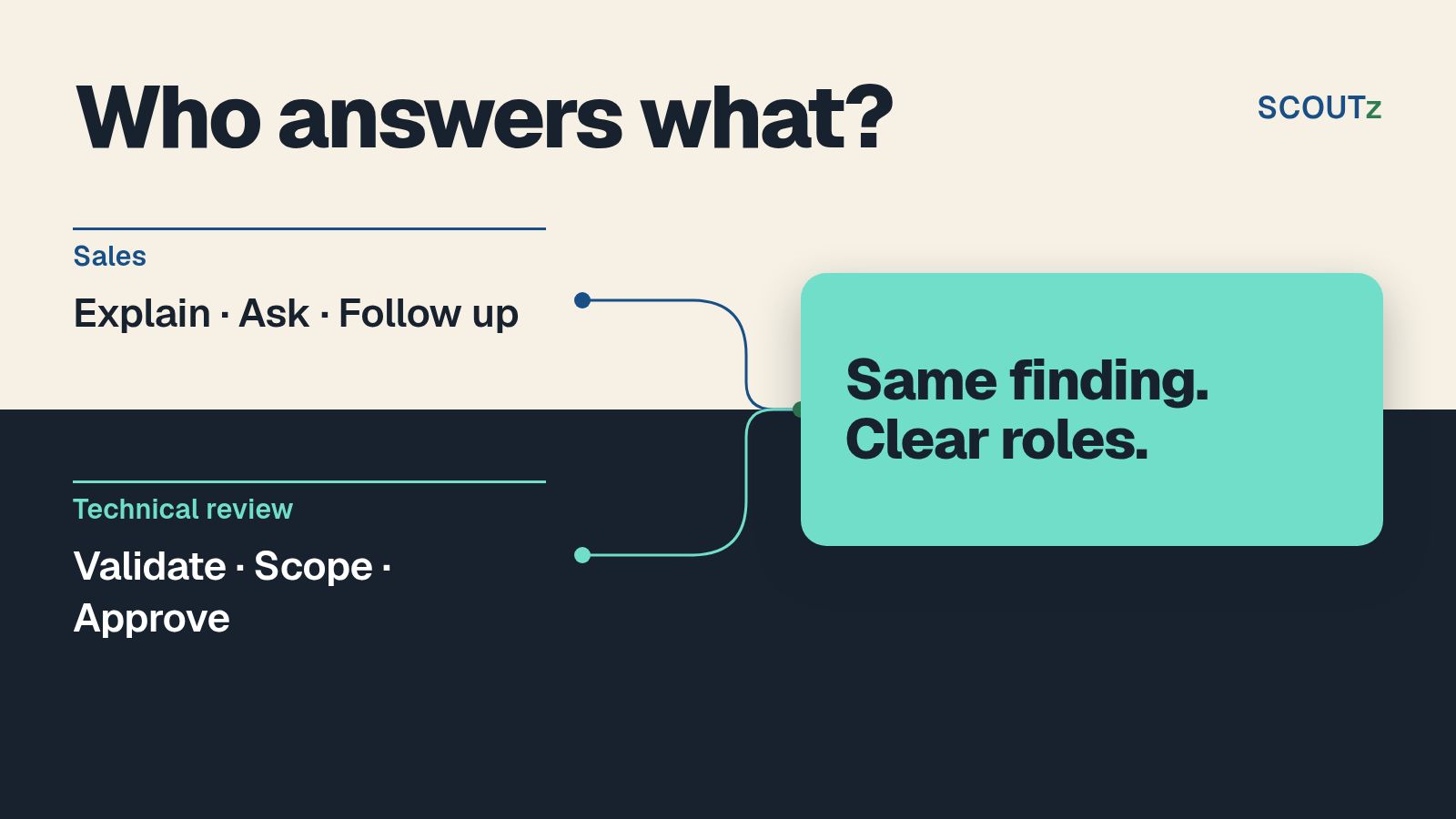
Find the decision: define what the buyer needs to know. Bring the evidence: show the relevant observation and its limit. Build the scope: identify what must be inspected to answer the unknown. Earn the next commitment: agree who approves and evaluates that work.
Do not use a request for limited access to expand the engagement silently. If the question changes, revisit the scope before collecting more evidence.
For a 2026 technical handoff, preserve the requested conclusion and the permitted method together. That gives the reviewer a basis for saying the evidence is insufficient instead of filling the gap with an assumption.
A Worked Conversation About Scanning
This dialogue is illustrative. It describes no actual customer environment or security result.
Buyer: “Do you need to scan our network before you can tell us whether you can help?”
Seller: “We can discuss service fit without that. Before recommending technical work, we need to establish what you want the review to answer.”
Buyer: “I want to know whether our current reporting gives us enough oversight.”
Seller: “Then start with the reporting requirement and the evidence you already receive. If a specific internal condition needs validation, we can define a separate authorized review.”
Buyer: “We also need to understand our Microsoft 365 configuration.”
Seller: “That is a separate evidence scope. We should agree the configuration questions, authorized access and coverage limits. A public-domain report cannot answer them.”
Buyer: “And if you find something?”
Seller: “We review the observation and its context with you, then agree whether any action is needed. Review access does not authorize a configuration change.”
The seller has kept the opportunity moving without overclaiming what can be established in the first meeting. The next step is commercially useful because it supports the buyer's decision.
Respond When a Buyer Refuses Access
Respect the refusal. Ask whether the decision can be answered from existing customer-provided evidence or a narrower review.
Illustrative response:
We can continue discussing your requirements without access. We cannot confirm the unassessed conditions. If those conditions determine our delivery obligation, we need to resolve them or define an offer that does not depend on assuming their state.
That is a scope boundary, not a pressure tactic. The buyer can choose not to proceed.
Avoid presenting unknown controls as absent. Also avoid treating lack of observed findings as a positive assurance about areas you did not assess.
For your 2026 sales review, distinguish refusal of access from rejection of the service. The buyer may accept a different next step, or there may be no appropriate offer under the available evidence.
Define the Assessment Deliverable Before the Fee Discussion
Write down what the buyer will receive and what conclusion the evidence can support. Keep assessment, implementation and verification as distinct obligations.
A useful assessment description identifies the question, covered sources, limitations, reviewer and acceptance condition. Include a route for correcting account context before the recommendation becomes a project plan.
| Commitment | Clarify in the Scope |
|---|---|
| Collection | Sources and assets that will be examined |
| Interpretation | Who reviews the observations and limitations |
| Reporting | Which audience receives which material |
| Recommendations | How proposed actions relate to the buyer's outcome |
| Implementation | Whether any changes are included or separately agreed |
| Verification | Which repeat check can demonstrate the relevant change |
Do not promise that a rescan verifies work outside the repeated check's coverage. A retained baseline is useful only when its scope and comparison remain meaningful.
If the assessment does not establish a need for additional work, report that result honestly. An assessment engagement should not depend on finding a reason to sell implementation.
Leave the Meeting With a Specific Agreement
Name the question still open and the person who can resolve it. Avoid ending with a generic request to send everything.
Suggested close:
The remaining decision is whether the defined review can answer your Microsoft 365 configuration question. Should we agree that review with the authorized owner, or do you want to leave it unassessed?
Then record the decision, the approved scope if any and the next action. Do not infer agreement from a shared report opening.
SCOUTz reporting checked October 24, 2026, includes First meeting and Win the deal Report Plays while distinguishing a visual Report Studio still in validation. Use the available material to support the scope conversation without promising an unverified feature.
FAQ
Is network vulnerability scanning necessary before an MSP sales pitch?
No. A first meeting can establish priorities and service fit without a network assessment. Use an appropriately authorized assessment when the unresolved technical question requires it.
Is a public-domain review a network vulnerability assessment?
No. A public-domain review covers its stated observable sources. It does not establish the condition of unassessed internal systems.
Can an MSP assess Microsoft 365 without customer authorization?
Internal Microsoft 365 configuration review requires customer-authorized access. Public-domain observations cannot establish the tenant's internal configuration.
What should an MSP agree before active scanning?
Agree appropriate authorization, assets, permitted methods, timing, reporting and stop conditions before testing. Unclear third-party or hosted-system boundaries need resolution too.
What if the prospect declines technical access?
Respect the refusal and explain what remains unknown. Continue only with an appropriate evidence source or an offer whose obligations do not assume unassessed conditions.
Does assessment access authorize remediation?
No. Review access and permission to change configuration are separate. Implementation requires the appropriate agreed scope and approval.
One Last Thing
A responsible assessment can end with a recommendation to do nothing further. Keep that outcome available when you define the engagement, before either party has an incentive to turn every observation into a project.
Bring a real discovery question to Join Open Beta and evaluate the preparation workflow against your own 2026 opportunities.