
A Microsoft 365 security review takes as long as its agreed scope, customer authorization, evidence collection and human interpretation require; scan runtime alone does not define completion. Budget separately for explaining findings, agreeing the next action and verifying any later changes, because those activities extend beyond collecting tenant evidence.
- How long does an M365 security review take? Define the deliverable before committing to a completion date.
- SCOUTz Microsoft 365 reviews support MSP sales preparation with customer-authorized configuration and metadata evidence.
- Separate collection completion, report readiness and remediation verification in your schedule.
- Unread evidence stays unknown; permission-limited coverage belongs in the report.
Why this matters
An MSP owner needs a date the prospect can rely on. A completed collection job and a client-ready recommendation are different deliverables, so attaching the same deadline to both creates confusion.
For your 2026 review process, define the finish line before scheduling the meeting. The Microsoft 365 scan-to-sales-ready evidence workflow connects technical collection with the preparation required for a prospect conversation.
Promise a defined deliverable, with named dependencies, rather than an unsupported turnaround time. That gives your sales lead something concrete to communicate and your technical reviewer something concrete to approve.
How long does an M365 security review take?
The duration depends on what you agree to deliver and when the required evidence becomes readable. Use these 5 stages to build a schedule rather than treating the review as a single scan.
- Define the scope and completion criteria.
- Obtain customer authorization for tenant evidence.
- Collect the agreed evidence and record coverage limits.
- Interpret the findings and prepare the client-safe explanation.
- Agree the next action and any separate verification work.
Record an owner and a completion condition for every stage. The authorization owner and technical reviewer need explicit handoffs; otherwise, a review can remain open without anyone knowing what must happen next.
| Milestone | Completion condition | What remains outside it |
|---|---|---|
| Scope agreed | Customer and MSP accept the evidence sources and deliverable | Authorization and collection |
| Collection complete | Agreed sources are assessed or their limits are recorded | Interpretation and client discussion |
| Report ready | A reviewer approves findings, boundaries and recommended outcomes | Buyer agreement and implementation |
| Review delivered | Customer receives the explanation and next choices | Remediation unless separately scoped |
| Change verified | A rescan is compared with a pinned baseline | Broader security guarantees |
Use these milestones in your 2026 statement of work. If the customer needs a report before a meeting, work backward from report approval, including the authorization and evidence dependencies that must precede it.
A deadline should also explain what happens when a source remains unreadable. Agree whether the deliverable will be a partial review with explicit exclusions or whether the review must wait for the required access.
Public-domain review: useful context with a narrower boundary
A public-domain review and a customer-authorized Microsoft 365 review answer different questions. Keep their deliverables separate even when you present them in the same meeting.
| Review option | Best for | Useful evidence | Main limitation |
|---|---|---|---|
| Public-domain review | Preparing external domain and email-security questions | Publicly observable domain conditions, with source and run date | Cannot establish internal tenant configuration |
| Customer-authorized Microsoft 365 review | Discussing tenant-specific configuration with permission | Read-only configuration and metadata evidence within assessed coverage | Depends on consent, readable sources and permission or license limits |
Public-domain observations can support a conversation about a published DMARC policy. They cannot establish Conditional Access coverage, application permissions, license assignments, Intune device state or tenant sharing configuration.
Use the public review to prepare questions, then use authorized tenant evidence to answer questions within its scope. Public observation is not blanket authorization for active probing. Agree the activity and its boundaries before work begins.
This distinction also protects your schedule. A public observation does not complete a promised tenant review, even when it gives the sales team useful material for an initial discussion.
Customer-authorized review: define what finished means
For a Microsoft 365 review, specify the tenant, intended evidence sources, authorized access and recipient of the report. Also identify the person who can resolve access questions.
SCOUTz Microsoft 365 reviews use customer-authorized, read-only configuration and metadata evidence. The review does not read mail, files, chats, documents or prompts, and it makes no automatic configuration changes.
That boundary is useful for explaining the engagement. It also limits the conclusions: configuration evidence must support a configuration claim, rather than becoming an assertion about content or an incident.
Keep evidence state separate from coverage. Observed and Inferred describe different kinds of claims; Partial and Permission limited describe limits on the assessment. Neither set is a simple progression toward a clean bill of health.
Your completion checklist should cover 3 evidence fields for every finding: source, run date and limits. Keep the affected object, unknowns and recommended outcome attached as well.
A report can be complete within an agreed partial scope. It must say which sources were unread, including declared non-reads under NOT ASSESSED THIS SCAN, so the recipient can see the boundary without reconstructing it from technical logs.
Why Microsoft 365 security review time varies
These factors change the work required or the point at which a useful deliverable becomes possible:
- Scope determines the questions the review must answer. A meeting-preparation brief and a detailed remediation scope require different deliverables.
- Customer authorization determines when internal evidence collection can begin. Identify the approving person before committing to a delivery date.
- Permission coverage determines which sources are readable. Record restricted sources explicitly instead of interpreting silence as an absent problem.
- License coverage determines whether the intended evidence is available within the authorized review. Keep license-limited coverage visible.
- Interpretation requires a person to approve the claim and its boundary. An observation needs context before it becomes a client recommendation.
- Verification adds a separate evidence step when the engagement includes changed settings. Compare the rescan with the pinned baseline before claiming the observed condition changed.
For 2026 proposals, put these dependencies beside the delivery commitment. A vague allowance for complexity gives the customer less useful information than a named authorization dependency or a clearly excluded evidence source.
Avoid using finding counts as a turnaround estimate. A count describes a roster or output within a particular layer; it does not establish how long approval, explanation or customer decisions will take.
Build a schedule around evidence, insight and proof
Use a short operational sequence that keeps technical work and customer decisions connected. These are planning stages, not measured turnaround benchmarks.
Scope
Write the decision the review should support. Examples include agreeing a tenant review, clarifying ownership of a configuration or preparing a bounded remediation proposal.
Name the deliverable and its exclusions. A report intended for an MSP sales meeting needs a clear business explanation, while the technical reviewer still needs the underlying evidence and limits.
Consent
Identify who authorizes tenant access and who can address permission questions. Record the agreed read-only scope before collection.
Keep public-domain observations separate from consented internal evidence. A prospect's domain being publicly visible does not establish consent for every assessment activity.
Collect
Record what ran, when it ran and which sources were assessed. Preserve unreadable and unassessed sources as explicit coverage limits.
Evidence collection finishes when the agreed collection conditions are met or their exceptions are documented. That milestone does not mean the client explanation has passed review.
Interpret
Separate the observed condition from its possible consequence. Then identify the owner and offer a choice that fits the evidence.
For example, a tenant-wide application permission establishes a permission condition. It does not establish that the application is malicious or that a user is compromised.
Agree
Present the finding, boundary and recommended outcome. Ask the customer to choose the next action, including further investigation, a scoped change, acceptance of the condition or no action.
If a change is approved, define how you will verify it. Proof is a rescan against a pinned baseline, with the comparison limited to the evidence actually assessed.
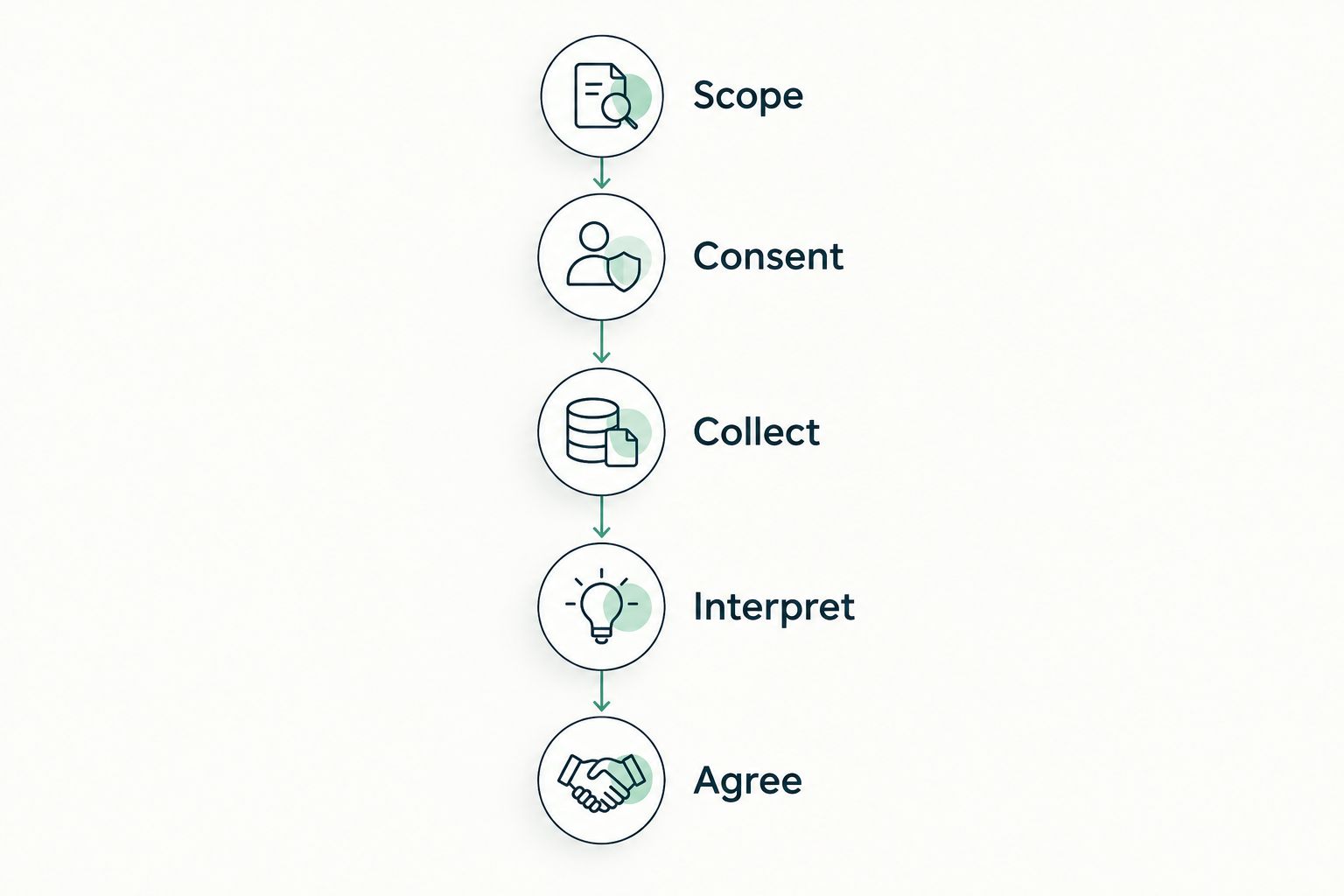
This sequence gives each handoff a purpose. Your technical reviewer approves the claim; your account owner carries that approved claim into the customer discussion.
Turn the completed review into an agreed next action
Use the SCOUTz Evidence-to-Agreement Framework: Find the decision, Bring the evidence, Build the scope, Earn the next commitment. It is a conversation framework, not a proven close-rate intervention.
Start with the customer's decision. Then bring the dated condition, explain its limits and separate the recommended outcome from a particular vendor or service.
An illustrative follow-up can stay direct without inventing urgency:
The review identified the condition shown in the attached evidence. The report includes the source, run date and coverage limits. Please confirm the responsible owner and whether you want further investigation, a scoped change or no action at this stage.
That is illustrative wording, not a customer quotation or an account result. Replace the general wording with the actual approved finding before sending it.
If a prospect asks for the full proposal immediately, distinguish the evidence already collected from questions still requiring investigation. Build the proposal around agreed outcomes and exclusions instead of silently expanding the review.
SCOUTz is best for MSPs preparing sales conversations with dated cybersecurity evidence. Its boundary matters: SCOUTz prepares the conversation. The relationship and the sale stay yours.
The client's October 15, 2026 product reference identifies Microsoft 365 Review as Open Beta. For MSPs evaluating this workflow, the primary next step is Join Open Beta; use SCOUTz to review the product and entry options. Confirm current scope before making a customer commitment.
Does a completed scan mean the review is finished?
A completed scan establishes a collection milestone. The review still needs interpretation and delivery if those are part of the agreed scope.
Before marking the review finished, confirm that the report states its evidence dates, exclusions, approved claims and next choices. A dashboard status cannot substitute for that agreement.
Can remediation be included in the same deadline?
Remediation can sit within the engagement when you explicitly scope implementation and verification. Give those activities their own completion conditions.
A read-only review does not itself make configuration changes. Keep approval, implementation ownership and the verification rescan visible in the schedule.
FAQ
How long does an M365 security review take from authorization to report?
The duration depends on the agreed evidence scope, readable sources and human review required. Set separate milestones for collection completion and report approval rather than treating scan runtime as the delivery commitment.
Can a Microsoft 365 security review be completed without tenant access?
A public-domain review cannot establish internal Microsoft 365 tenant configuration. Customer-authorized internal evidence is needed for conclusions about assessed tenant settings.
Does a read-only Microsoft 365 review read employee emails?
SCOUTz Microsoft 365 reviews assess configuration and metadata, not mail, files, chats, documents or prompts. Keep that boundary explicit in the authorization and report.
What happens when the review cannot read a source?
An unread source remains unknown and its coverage limit belongs in the report. A missing read does not establish that a control is present, absent or correctly configured.
Is a Microsoft 365 security review the same as remediation?
A security review and remediation have separate completion criteria. The review establishes evidence and recommendations; implementation requires an agreed scope, and verification requires a rescan against the pinned baseline.
What should an MSP promise before the review starts?
Promise a defined deliverable with named dependencies and exclusions. Specify the evidence scope, authorization owner, report reviewer and treatment of unread sources.
Can the report prove that a tenant has not been breached?
A configuration and metadata review does not prove that a tenant has never been breached. Keep every conclusion within the evidence source, assessment date and coverage actually achieved.
One last thing
Put the evidence run date beside the customer meeting date in your 2026 preparation checklist. Those dates answer different questions: when the condition was observed and when the customer will discuss it.
Before presenting, check whether the finding needs a fresh read. An older observation remains historical evidence; it does not automatically establish an unresolved condition today.