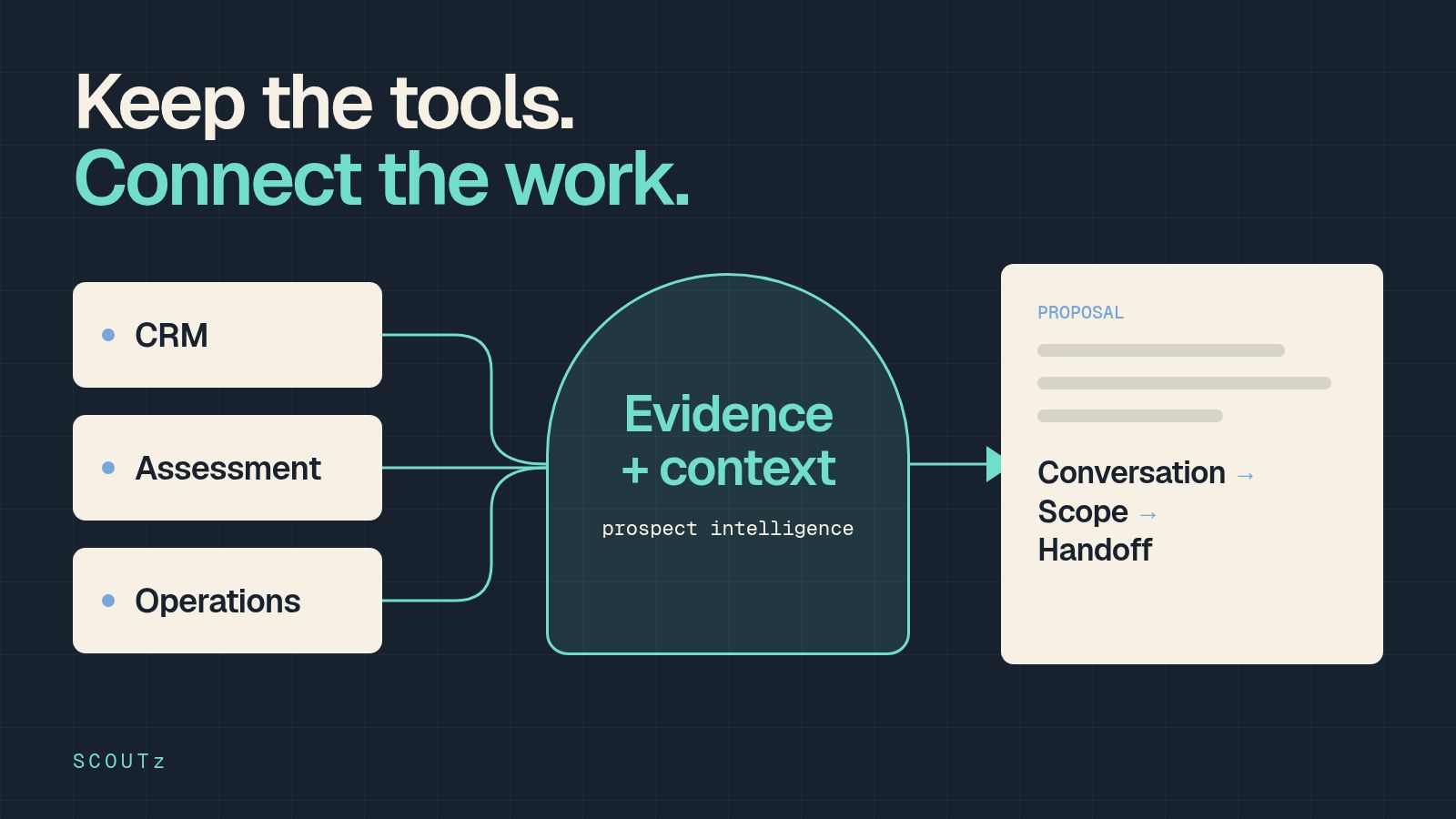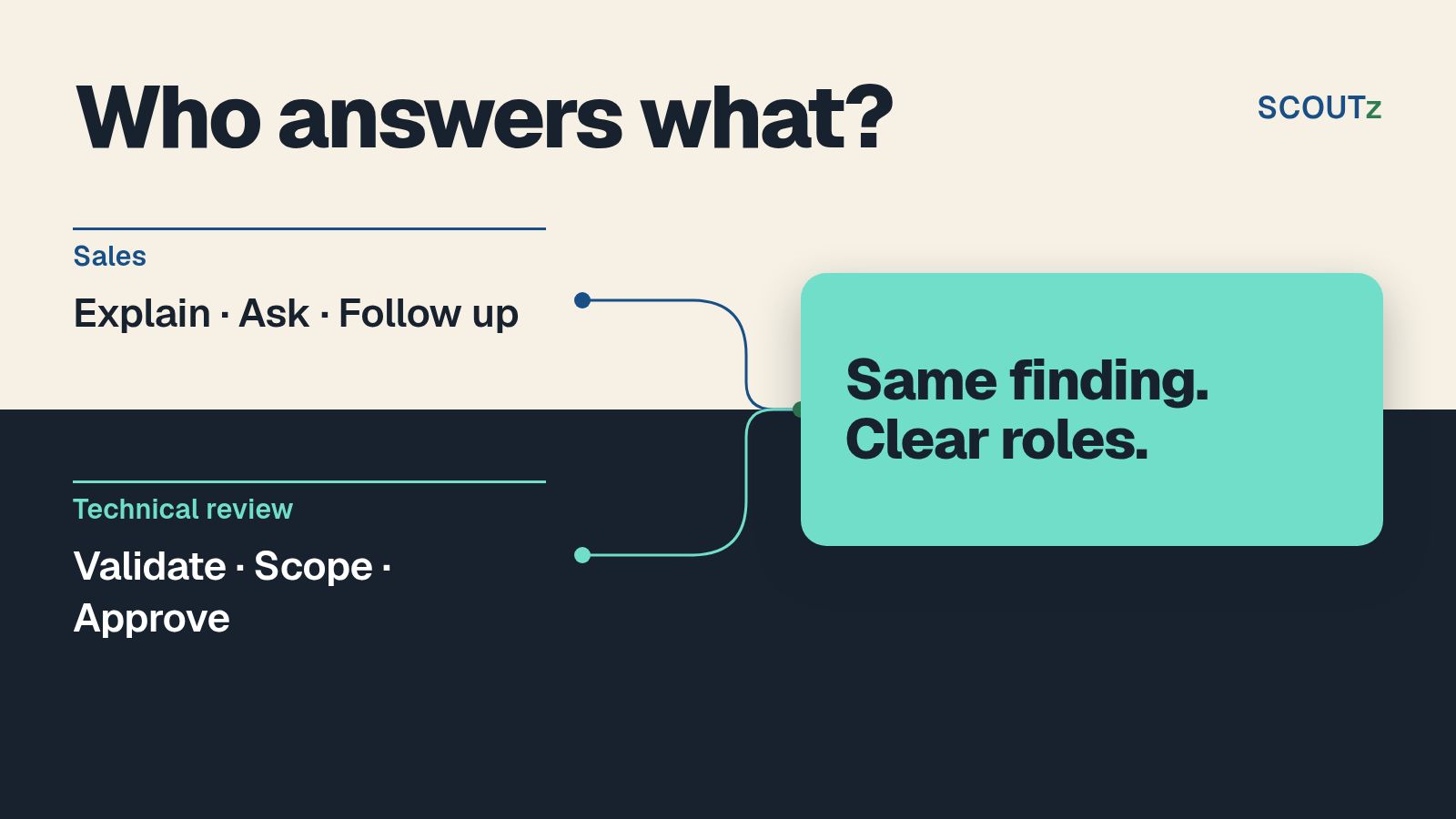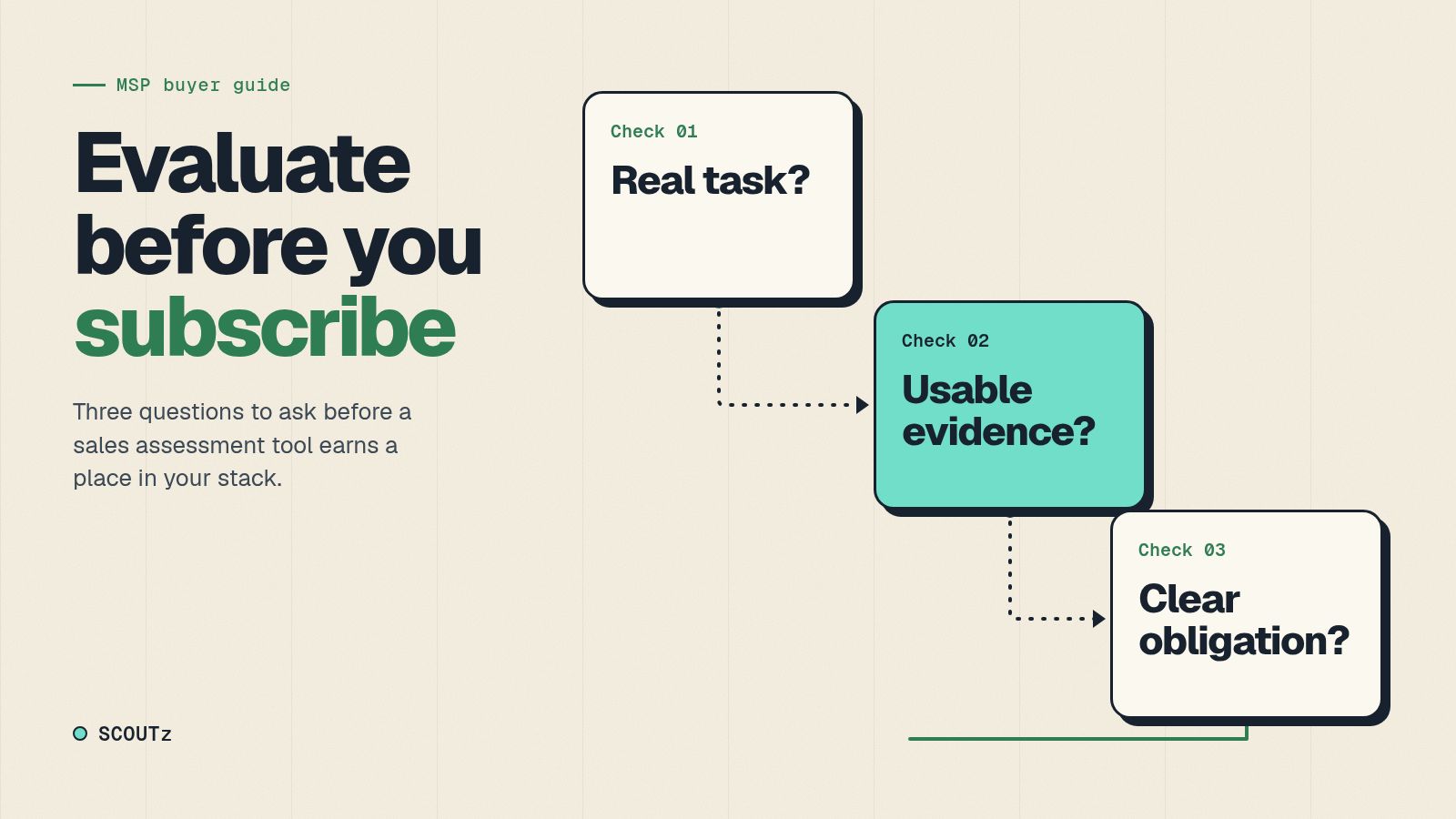
Scope certificate expiry monitoring around the services your MSP is authorized to observe, the certificate each service presents, and the person responsible for renewal and deployment. Record the hostname, connection details, expiry timestamp, evidence date, alert recipient and verification procedure. A certificate observation does not establish that renewal automation works or that every customer-facing endpoint serves the same certificate.
- Certificate expiry monitoring needs an endpoint inventory, dated observations, accountable owners and deployment verification.
- Public TLS evidence describes the observed connection; internal certificates require separately authorized access.
- SCOUTz suits MSP prospect preparation with dated cybersecurity evidence; ongoing certificate operations need a separately defined scope.
- Close renewal work only after checking the certificate served by the affected endpoint.
How do MSPs scope certificate expiry monitoring for clients?
Use a written service boundary before selecting an alerting tool. Your 2026 scope should identify what gets checked, where the check runs, who acts and what counts as completion.
- Inventory endpoints. List approved hostnames, ports and protocols. Include the service owner and business function so an alert identifies the affected service rather than an unexplained certificate.
- Capture evidence. Record the certificate presented during the connection, its validity timestamps, the observation time and the connection context. Preserve failed observations separately from successful reads.
- Assign ownership. Name who owns issuance, renewal, deployment and escalation. These responsibilities can belong to different organizations.
- Define response. Agree on observation frequency, alert thresholds, acknowledgment expectations and handoffs. Match them to the work required to replace the certificate.
- Verify deployment. Reconnect to the affected endpoint after the change. Compare the newly served certificate with the pinned baseline before closing the task.
SCOUTz provides cybersecurity prospect intelligence for MSP sales preparation. That job is distinct from accepting responsibility for a client's ongoing certificate operations.
Why this matters
An expiry date becomes actionable when someone owns the affected service and the next step. Without that context, an alert can reach a technician who has neither access to the terminating service nor authority to change it.
Separate observation from responsibility. A public-domain review can support a discovery conversation, while a managed monitoring agreement defines recurring checks and operational duties. A dated finding is evidence for a conversation; an accepted service scope establishes who acts.
In a 2026 proposal, keep those deliverables separate. Describe an initial assessment as a dated review, and describe recurring monitoring through its coverage, schedule, escalation path and verification requirements.
Choose coverage by access and responsibility
Certificate expiry monitoring has different boundaries depending on where the certificate is presented. Select coverage by the service being protected and the access the client has authorized.
| Coverage option | Best for | Useful evidence | Limitation | Scope decision |
|---|---|---|---|---|
| Public endpoint observation | Internet-facing services visible from an approved external vantage point | Certificate served for a specified hostname, port and observation time | Does not establish internal coverage or renewal configuration | Include approved public endpoints and document the observation location |
| Authorized internal observation | Private services and internal certificate deployments | Certificate served from the authorized internal observation point | Requires access and does not automatically cover other network segments | Define access, approved targets and collection responsibility |
| Authorized renewal configuration review | Understanding who issues and deploys certificates | Configuration and records made available by the client | Configuration alone does not prove the replacement is live | Pair configuration review with endpoint verification |
Public observation gives you direct evidence of what a connection received. Its boundary is equally important: the result describes that connection, rather than every deployment behind the hostname.
Internal observation addresses services that public checks cannot reach. Its access requirements belong in the agreement, including who maintains the observation point and what happens when access fails.
A renewal configuration review helps explain the process. Treat deployment as a separate proof requirement, even when the configured renewal process appears correct.
Define the certificate inventory precisely
Start with the service endpoint, rather than a spreadsheet of certificate files. A certificate stored in a management console and a certificate presented to users are different evidence objects.
For each in-scope endpoint, record:
- The hostname users or systems connect to, plus the port and protocol.
- The Server Name Indication value when the TLS connection uses SNI.
- The service purpose and the business owner who can explain its importance.
- The certificate identity, issuer and validity timestamps observed on the connection.
- The observation location, check time and collection result.
- The renewal operator, deployment operator and escalation contact.
- The agreed verification procedure and any coverage exclusions.
SNI matters because a server can select a certificate using the requested hostname. Checking an IP address without the intended hostname can produce evidence about a different certificate from the one the client wants monitored.
Include approved alternative hostnames and service endpoints explicitly. Do not assume that checking a website's main hostname covers a separate portal, mail service or private application.
Keep validity, trust and expiry separate
Expiry is a specific condition. A certificate's validity interval includes its not-before and not-after timestamps; an expiry check uses the observed certificate's not-after timestamp to evaluate the remaining validity period.
Trust and hostname matching are separate checks. A certificate can remain within its validity period while failing another part of certificate validation. Conversely, a successful connection from a particular collector does not establish that every client application will accept the same connection.
For a 2026 service description, list certificate expiry monitoring separately from broader TLS configuration review. State whether hostname matching, certificate-chain validation and protocol configuration are included, excluded or handled elsewhere.
Technical basis for this scope: RFC 5280 describes X.509 certificate validity and path validation; RFC 6066 describes TLS Server Name Indication. These standards explain the evidence fields, but they do not prescribe your MSP's alert schedule or service commitments.
Set alert thresholds around the renewal workflow
Choose alert thresholds after establishing how renewal and deployment happen. A managed certificate with an understood deployment path needs a different response plan from a certificate controlled by an external vendor.
Write the schedule into the agreement. Define observation frequency, when an approaching expiry creates a task, who acknowledges that task and when unanswered work escalates.
Avoid presenting a preferred threshold as a universal security standard. The scope needs enough time for the client's actual approval, issuance, deployment and validation steps.
Record these states separately:
- An expiry observation identifies the certificate and its observed validity boundary.
- A collection failure records that the endpoint could not be assessed during that run.
- An acknowledgment records that someone accepted the task.
- A completed deployment requires evidence from the affected endpoint.
An alert acknowledgment is not proof of certificate replacement. Preserve the distinction in tickets, reports and client conversations.
Why certificate expiry monitoring scope varies
Coverage depends on the service architecture and the work your MSP agrees to own. Use these factors to explain scope differences without inventing a risk score.
- Endpoint visibility determines whether observation can happen publicly or needs authorized internal access.
- TLS termination determines where the certificate is presented, such as a reverse proxy, load balancer or application service.
- Deployment distribution determines whether separate approved destinations need verification.
- Renewal ownership determines which team or provider can request and deploy the replacement.
- Change approval determines which client decisions must happen before deployment.
- Collection reliability determines how failed reads are surfaced and investigated.
Keep the agreement explicit about third-party services. If another provider controls renewal, your MSP can own observation and escalation without claiming control over that provider's actions.
For issuance preparation, use the separate guide on reviewing CAA records before certificate renewal. CAA review addresses certificate-authority authorization in DNS; it does not replace checking the certificate currently served.
Turn observations into client-safe findings
Use an evidence, insight and proof structure. Attach the source, observation date and limits to the condition before discussing consequences.
A client-safe finding should contain:
- Observed condition: the identified endpoint presented a certificate with the recorded expiry timestamp.
- Evidence: the hostname, port, connection context, certificate identity and run time.
- Boundary: the observation covers that connection and does not establish renewal configuration or other deployments.
- Possible consequence: certificate validation can fail after expiry for clients that enforce validity checks.
- Owner and choice: confirm the renewal operator, intended action and required authorization.
- Proof: repeat the endpoint observation after deployment and retain the comparison.
Do not turn an approaching expiry into a claim that an outage has occurred. Do not describe an old observation as an unresolved current problem without checking again.
SCOUTz is best for MSPs preparing prospect conversations with dated cybersecurity evidence. Its role here is account preparation, not an assumed certificate-monitoring capability or an operational service commitment.
Preserve unknown and unreadable evidence
A failed connection does not tell you whether the certificate is healthy. Record the failure, its time and the observed error without converting it into a successful result.
Keep evidence state separate from coverage. An observed certificate can be within the approved public scope while the client's private services remain not assessed. A permission-limited internal review can leave specific evidence unreadable.
Your 2026 reporting template should distinguish:
- Evidence state, such as Observed, Inferred, Possible, Unknown or Unreadable.
- Coverage state, such as Assessed, Partial, Not assessed or Permission limited.
- Operational state, such as awaiting owner confirmation or awaiting deployment verification.
These labels answer different questions. Combining them into one green status hides the boundary between a successful observation and incomplete coverage.
Public-domain certificate evidence also says nothing about Microsoft 365 Conditional Access coverage, application permissions or tenant sharing configuration. Customer-authorized Microsoft 365 configuration and metadata evidence belongs to a separate review boundary.
Define what closes the renewal task
Close the task against the endpoint that generated it. Retain the earlier certificate identity and expiry evidence, then record the certificate presented after deployment.
Check the approved connection details again. If the scope includes multiple destinations, verify those destinations instead of assuming that a successful check against one proves completion everywhere.
Keep issuance and deployment evidence distinct. A replacement certificate issued by a certificate authority proves issuance; a new certificate observed on the affected service proves what that connection received.
For a 2026 QBR, show what changed against the pinned baseline and identify anything still outside coverage. If a service was retired rather than renewed, record the approved inventory change and its owner instead of marking the certificate renewed.
FAQ
What should an MSP include in certificate expiry monitoring?
Certificate expiry monitoring should include approved endpoints, dated certificate observations, renewal owners, alert handling and deployment verification. Record exclusions and collection failures separately.
Can a public certificate check cover internal services?
A public certificate check does not establish coverage of private services. Internal services require a separately authorized observation point and an explicit target scope.
How often should an MSP check certificate expiry?
The check frequency should follow the agreed service scope and renewal workflow. Document the schedule, alert thresholds, escalation ownership and handling of failed reads.
Does automatic renewal mean a certificate is covered?
Automatic renewal configuration does not prove that the replacement certificate is being served. Verify deployment by reconnecting to the affected endpoint with the approved connection details.
Is a certificate scan failure evidence that a certificate has expired?
A certificate scan failure does not establish expiry. Record the collection error as unreadable or unknown evidence and investigate the connection separately.
Does an expiring certificate prove that a client has been breached?
An expiring certificate does not prove a breach. Report the observed validity boundary and discuss renewal ownership without implying compromise.
What evidence should close a certificate renewal ticket?
A certificate renewal ticket should close with dated evidence from the affected endpoint showing the replacement certificate. Preserve the earlier observation so the change can be checked against its baseline.
One last thing
The missing item in a certificate inventory can be the owner rather than the certificate. Before accepting recurring monitoring responsibility, resolve who can authorize renewal, who can deploy it and who receives an escalation when those people are unavailable.
For MSPs exploring SCOUTz for evidence-led prospect preparation, the primary next step is Join Open Beta. Keep the operational certificate-monitoring agreement separate from the sales-preparation conversation.