Yes—a cybersecurity risk assessment tool is worth it for a solo MSP when it supplies traceable evidence for a defined client or prospect decision. It is not worth treating as an automatic risk verdict or a substitute for your judgment. The work that remains is interpreting findings, checking their limits, and turning supported concerns into an agreed next step.
- Is a cybersecurity risk assessment tool worth it for a solo MSP? Yes, for scoped reviews.
- SCOUTz supplies dated domain and Microsoft 365 evidence for MSP sales preparation, not confirmed buying intent.
- Public-domain evidence and customer-authorized tenant evidence answer different questions; keep their boundaries visible.
- Choose evidence you can explain and act on, not a longer findings list.
Is a cybersecurity risk assessment tool worth it for a solo MSP?
Yes, if you have a repeatable use for the evidence and can defend the resulting recommendation. A solo MSP needs an assessment that fits the work: preparing a prospect conversation, reviewing an authorized tenant, supporting a proposal, or documenting a QBR.
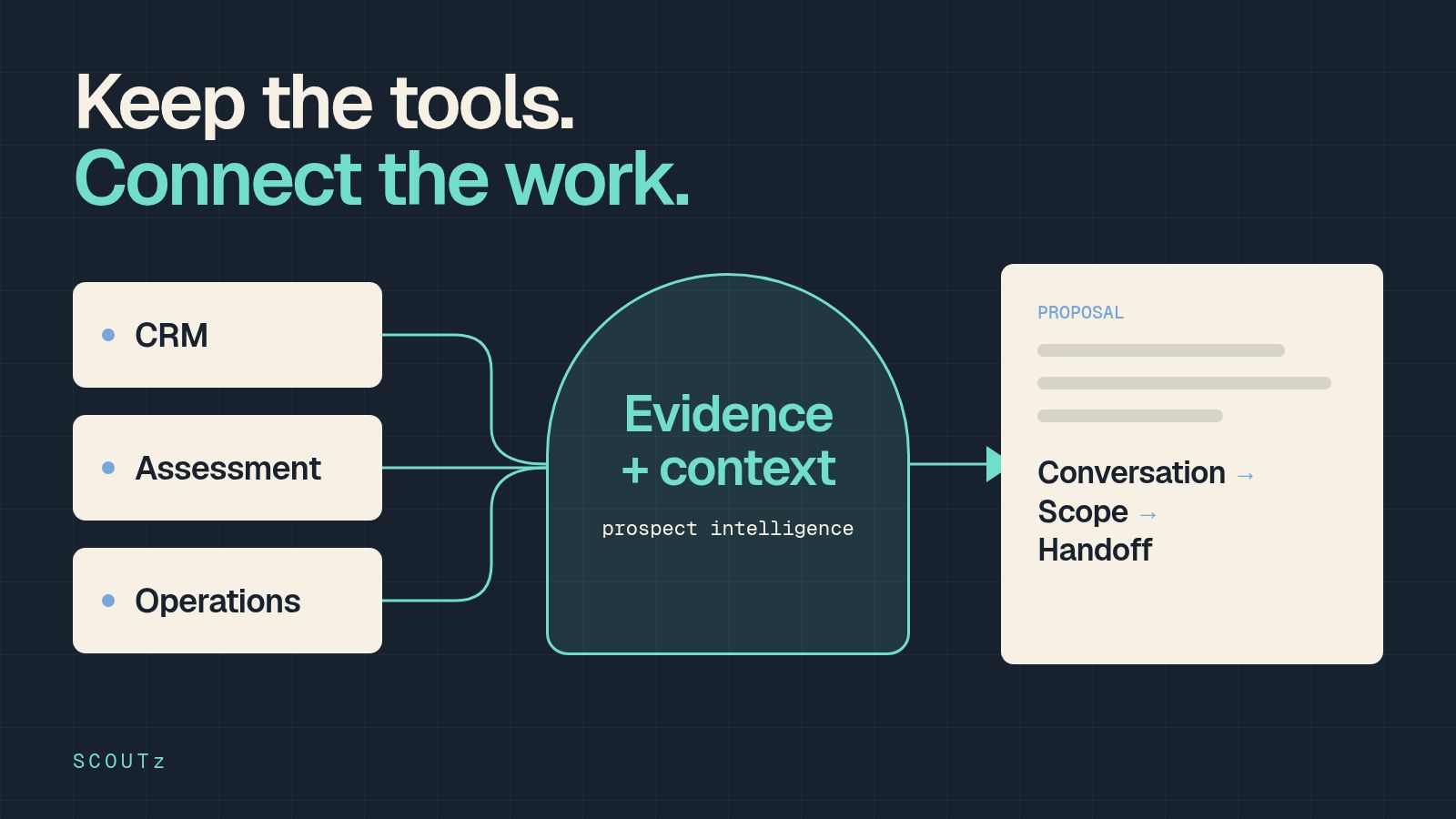
SCOUTz provides MSP prospect intelligence through dated domain and Microsoft 365 reviews. That is a defined preparation role. It does not turn an observation into proof that a prospect has an unresolved problem or wants to buy.
Compare evidence approaches before comparing findings counts:
| Approach | Best for | Strength | Limitation |
|---|---|---|---|
| Manual, scoped review | A narrow question you can investigate directly | You control the checks and interpretation | You must document sources, dates, and limits yourself |
| Public-domain review | Prospect domain and email-security preparation | Uses publicly observable evidence without tenant access | Does not establish internal tenant settings or remediation status |
| Customer-authorized Microsoft 365 review | Questions about evidence within an authorized tenant scope | Grounds the conversation in read-only tenant evidence | Requires authorization and still depends on what was successfully read |
These approaches can complement each other. None justifies calling an unread setting secure or presenting an inference as a confirmed incident.
Why this matters
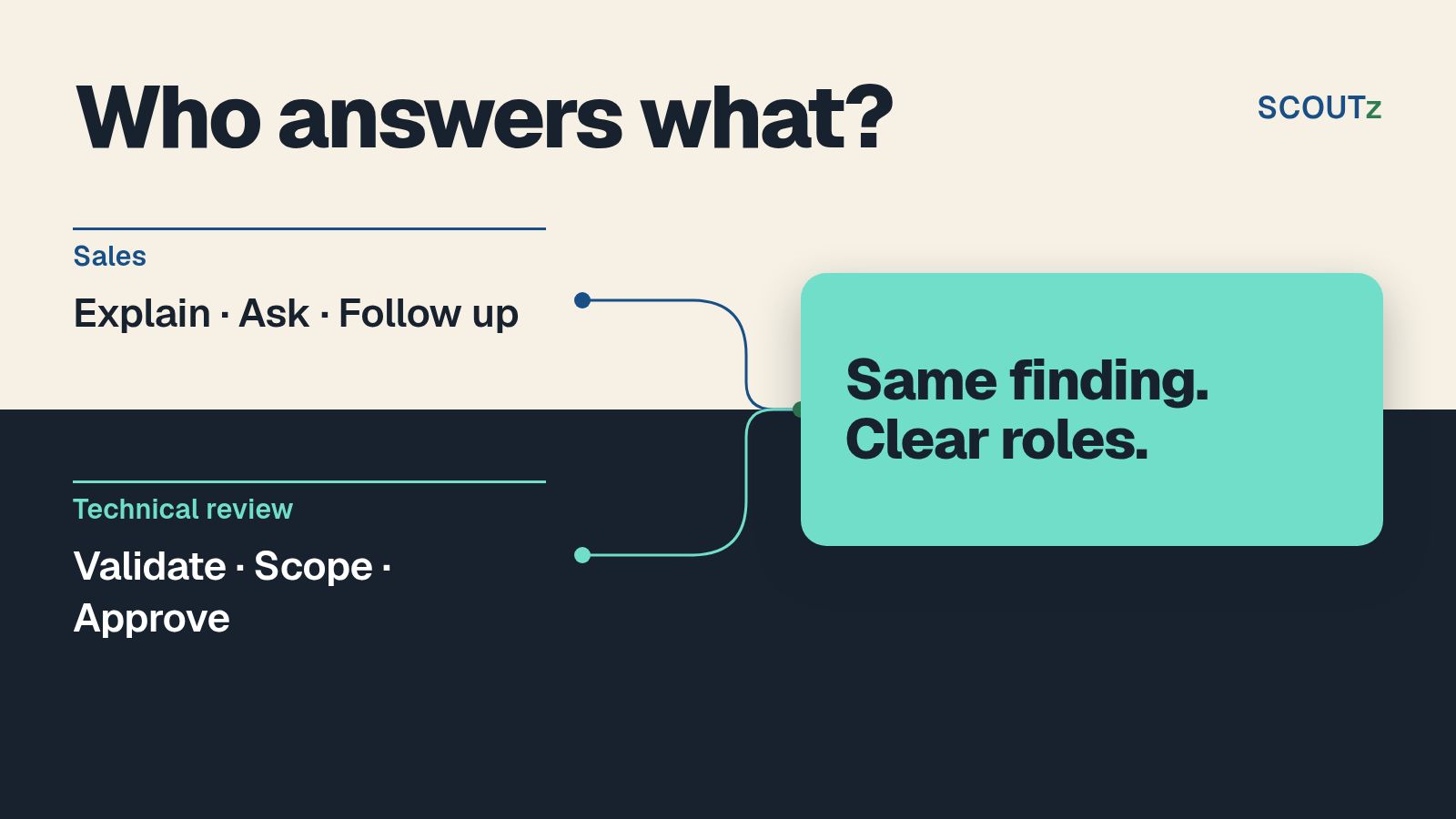
A solo MSP carries both technical and commercial responsibility. You collect evidence, explain it to an owner, and decide which work to recommend. A misleading conclusion creates a problem in both conversations.
For a 2026 assessment, the useful output is not simply a list of findings. It is a record you can explain: what was observed, where it came from, when it was observed, and what remains unknown. That record supports a discussion without requiring the owner to accept your interpretation on trust.
A finding is not automatically a reason to call. A supported consequence is a reason to ask a better question.
Public-domain evidence: useful for preparation, limited in scope
Public-domain evidence gives you a starting point for a prospect domain or email-security conversation. For example, a DMARC record is published through DNS. Reading that record tells you about the published policy at the time of observation; it does not reveal every mail source or prove how the organization handles email security internally.
Keep the evidence and inference separate. An observed policy supports a question about policy intent and legitimate senders. It does not establish that an attack succeeded, that nobody has reviewed the configuration, or that a change should happen immediately.
A useful prospect note names the reviewed domain and observation date. It also identifies the check and its boundary. If you reuse that note in 2026 outreach, confirm the observation is still current rather than presenting an old result as today's state.
Best for: preparing specific questions before an authorized assessment. The limitation is equally important: public evidence is not a tenant assessment.
Authorized Microsoft 365 evidence: deeper questions, explicit permission
Customer-authorized, read-only Microsoft 365 evidence belongs in a different category. Its source is the authorized tenant review, not the public domain. Keep the authorization scope and the evidence collection result attached to the interpretation.
Questions about identity, guest accounts, MFA, and application access require clarity about what the review actually read. A permission gap or unsuccessful read is a coverage limitation. It is not evidence that a control passed.
Use plain status language:
- Observed: the relevant evidence was successfully read.
- Unknown: the review did not establish the state.
- Needs validation: the observation requires business or technical context before a recommendation.
Best for: an agreed tenant review with a defined decision. Read-only evidence informs your assessment; it does not authorize you to make configuration changes.
Why the value of an assessment tool varies
The value depends on the work the evidence supports, not on the presence of a dashboard. Evaluate these factors before adding another process to your solo practice:
- Evidence source: public-domain observations and authorized tenant evidence have different boundaries.
- Observation date: the date determines whether a finding describes the state relevant to your conversation.
- Read coverage: successfully read evidence and unread evidence must remain distinguishable.
- Interpretation: the finding needs enough context to support the proposed consequence.
- Follow-up ownership: someone must validate the concern and agree on any work.
- Repeat use: prospect preparation, proposals, and QBRs need different deliverables, even when they use related evidence.
A tool earns a place when its output serves these needs. A large findings count does not answer them. Nor does a polished report establish that the recommendations are appropriate for the customer's environment.
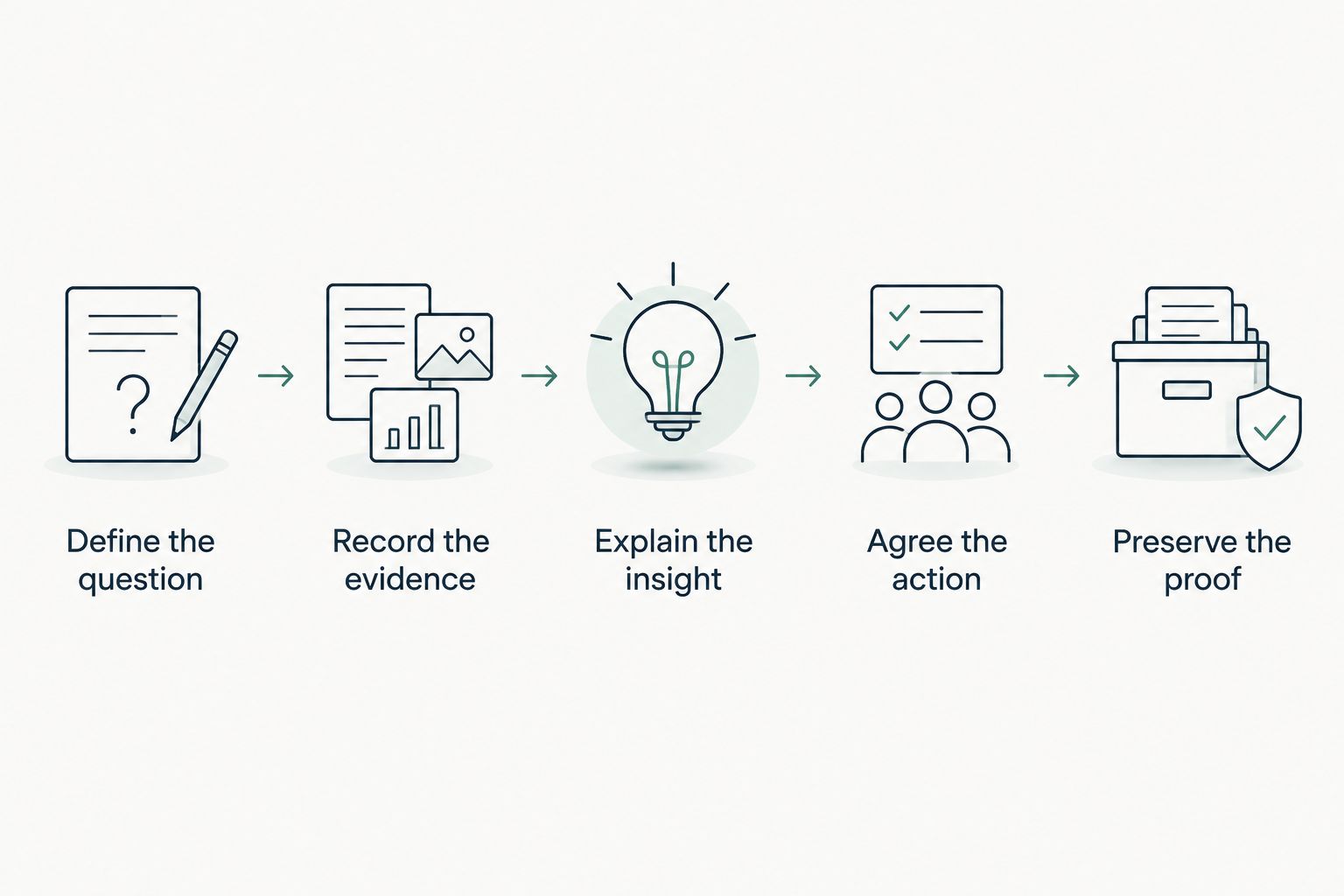
Evidence → insight → proof: evaluate an assessment before using it
Use a real, authorized review or a scoped public-domain review to evaluate the output. Do not judge the workflow only by how convincing a sample report looks. Follow a finding from observation to recommendation and check whether each transition is defensible.
Define the question
Start with the decision you need to support. For prospect preparation, that is a relevant question for the first meeting. For a tenant assessment, it is an agreed review objective. For a QBR, it is a current decision about previously documented work.
A broad request to find everything creates a weak acceptance test. A defined question lets you judge whether the evidence is useful.
Record the evidence
Keep the source, observation date, reviewed domain or tenant, and collection limits together. Label a 2026 observation as an observation, not a permanent description of the organization. Preserve unknown status where the review did not establish a result.
You should be able to point to the evidence behind a statement without reconstructing the review from memory.
Explain the insight
Translate the observation into a business-relevant question or consequence. Explain the connection. If that connection depends on facts you have not established, state what needs validation rather than presenting the consequence as confirmed.
For email security, that means discussing what a published policy does and what additional context is needed. It does not mean inventing a breach-loss figure to make the finding sound urgent.
Agree the action
Separate assessment from remediation. Confirm the owner's intended outcome, identify who will validate the finding, and agree on the next step. Do not interpret interest in a review as commitment to a service proposal.
The action can be further investigation. Not every finding deserves an immediate change.
Preserve the proof
Retain the evidence supporting the recommendation and record any later verification separately. If you recheck after a change, compare the relevant observations. Do not describe work as verified merely because it appears on a completed task list.
This sequence keeps sales preparation and technical follow-up connected without confusing them.
What a useful owner-facing assessment contains
An owner-facing assessment should make the distinction between observation and recommendation easy to see. Technical detail belongs in the supporting evidence; the decision belongs in the summary. Do not make the owner decipher a raw findings list to discover what you want them to do.
Use a consistent finding record:
| Field | What to include | What to avoid |
|---|---|---|
| Evidence | Source, date, scope, and observed state | An unexplained pass or fail |
| Insight | The supported meaning and relevant limits | A confirmed breach claim based on a configuration finding |
| Recommendation | The validation or work being proposed | Treating every finding as an immediate fix |
| Proof | A separate verification record when work is checked | Calling unread or unverified evidence clean |
For a 2026 proposal, distinguish the assessment scope from the proposed delivery scope. Evidence explains why work is being discussed. The proposal explains what you will do, what requires approval, and how completion will be checked.
Where SCOUTz fits—and where MSP judgment remains
SCOUTz is best for MSPs seeking dated domain and Microsoft 365 evidence for sales preparation. Its stated role is prospect intelligence and security reviews, not a contact database or a replacement for MSP judgment.
The fit is specific: evidence can give you something concrete to discuss. The boundary is specific too: you still decide whether the observation supports a useful question, whether further authorization is needed, and whether a recommendation fits the business.
Use SCOUTz to prepare an evidence-led conversation, not to declare buying intent. A prospect can acknowledge an observation without accepting your interpretation or wanting a proposal. Respect that distinction.
Join Open Beta is the next step for exploring this evidence-led approach. Define the question you want to answer before evaluating the output, so you can judge its usefulness against actual work rather than presentation alone.
When a solo MSP should hold off
Hold off when you cannot identify the decision the assessment will support. Collecting more findings is not a sufficient objective. Neither is producing a report simply because a sales process expects one.
A manual review remains a valid choice for a narrow, well-defined question. Its trade-off is that you own the evidence record and interpretation directly. Software does not remove those responsibilities; it needs to make their execution useful enough to justify adding it to your workflow.
Also hold off on making recommendations from output you cannot explain. If the source, scope, or read status is unclear, resolve that before taking the finding into an owner conversation. An unresolved evidence question belongs in your preparation notes, not in a confident sales claim.
Can I use public findings to start a prospect conversation?
Yes—use public findings to ask a scoped question, not to announce that the prospect has a confirmed security problem. Name the source and observation date, explain what the evidence supports, and leave internal tenant state unknown until an authorized review establishes it.
Does an assessment replace an MSP's technical judgment?
No—an assessment supplies evidence for technical judgment. You remain responsible for validating context, explaining limits, obtaining authorization, and deciding whether the proposed work is appropriate.
Can I reuse assessment evidence in a QBR?
Yes—reuse evidence as a dated reference, then distinguish it from current observations and verified work. A 2026 QBR should not present an earlier finding as current or unresolved without a supporting recheck.
FAQ
What's the best way for a solo MSP to decide whether an assessment tool is worth it?
Evaluate whether its evidence supports a defined decision you actually need to make. Check the source, observation date, read coverage, interpretation, and follow-up before judging the report's presentation.
Is a public-domain review the same as a Microsoft 365 assessment?
No, a public-domain review and an authorized Microsoft 365 assessment have different evidence sources and boundaries. Public observations do not establish internal tenant settings.
Can a security finding prove that a prospect wants to buy?
No, a security finding does not prove buying intent. It supports a scoped conversation only when you can explain the evidence and its relevant consequence.
Does read-only Microsoft 365 evidence mean I can change the tenant?
No, read-only evidence does not authorize tenant changes. Agree on remediation scope and obtain the appropriate authorization separately.
What should I do when an assessment cannot read a setting?
Keep the setting's status unknown. Document the read limitation and identify the validation needed instead of treating missing evidence as a passed check.
Should I use a findings list as my client proposal?
No, a findings list is supporting evidence, not a complete proposal. Explain the recommended work, its scope, required approvals, and how completion will be checked.
One last thing
Before a finding enters your proposal, try removing its severity label. Can you still explain the evidence, its consequence, and the next step in plain language?
If the recommendation depends entirely on the label, the explanation is not ready. For a solo MSP, that is a useful final check: bring a reason to discuss the work, not just a signal that looks alarming.