
Best overall for MSP sales preparation: SCOUTz. Best for Microsoft 365 posture review: Microsoft Secure Score. Best for a structured assessment worksheet: CISA CSET. This 2026 guide compares five security assessment tools for construction firm clients by the evidence each produces and the decisions it supports.
- SCOUTz leads the best security assessment tools for construction firms shortlist for MSP prospect intelligence and meeting preparation.
- Microsoft Secure Score supports tenant posture review; Nmap supports authorized network discovery.
- CISA CSET structures assessment questions; Wireshark examines captured network traffic.
- Keep public-domain observations separate from customer-authorized Microsoft 365 evidence.
- Choose tools by the agreed scope, then verify changes against a dated baseline.
Why this matters
A construction firm's assessment should answer a business question. You might need to review email authentication, explain subcontractor access, establish an office network inventory, or scope a Microsoft 365 configuration review. Those are different jobs.
Start by confirming the firm's actual systems and workflows. Ask who approves payment-detail changes, who administers collaboration access, and who owns equipment at each site. These are discovery questions, not assumptions about an individual contractor.
SCOUTz is best for MSPs that need dated cybersecurity evidence before a construction prospect meeting. A packet capture or network inventory serves a different purpose. Keep those distinctions visible when you recommend the next engagement.
What makes the best security assessment tools for construction firms
Use these six criteria for your 2026 shortlist:
- Evidence provenance: The output identifies the source, affected object, check and collection date.
- Permission boundaries: Public observations remain separate from authorized tenant access, active scanning and packet capture.
- Coverage disclosure: Unknown, unreadable and unassessed areas stay visible.
- Decision relevance: Findings support a specific question about ownership, scope or an intended control.
- Repeatability: You can preserve a baseline and compare later evidence against it.
- Delivery fit: The tool's output suits either an owner conversation, a technical investigation or a structured assessment.
A longer findings list does not automatically produce a better recommendation. Prefer evidence you can explain, qualify and verify over a total that mixes unrelated platforms or assessment methods.
Security assessment tools at a glance
| Rank and tool | Best for | Standout capability | Key limitation |
|---|---|---|---|
| 1. SCOUTz | Prospect meeting preparation | Dated public-domain and consented Microsoft 365 evidence | Internal evidence requires authorization; several workflows carry beta status |
| 2. Microsoft Secure Score | Microsoft 365 posture review | Microsoft security recommendations tied to supported configurations | A posture score does not establish complete coverage or prove security |
| 3. CISA CSET | Structured assessment planning | Guided evaluation through assessment questions and selected requirements | Answers need supporting evidence and knowledgeable participants |
| 4. Nmap | Authorized network discovery | Host and service discovery within an agreed target scope | Discovery alone does not confirm exploitability or business impact |
| 5. Wireshark | Focused traffic investigation | Packet-level inspection of captured communications | Visibility depends on capture position, encryption and traffic collected |
The five tools occupy distinct use-case slots. This is a selection guide for 2026, not a claim that every construction client needs all five.
1. SCOUTz: best security assessment tool for prospect preparation
SCOUTz provides cybersecurity prospect intelligence for MSPs, including domain reviews and customer-authorized Microsoft 365 reviews. Its job is to prepare a conversation with dated evidence and account context. The relationship and the sale stay with the MSP.
For a construction prospect, start with an agreed question. An email-security review can support a discussion about the firm's domain, while an authorized tenant review can support questions about Microsoft 365 configuration. Public Domain Review cannot establish Conditional Access coverage, application permissions, license assignments or tenant sharing configuration.
SCOUTz pros
- Separates public-domain observations from consented internal evidence.
- Uses read-only reviews, with no agent, install or automatic configuration changes.
- Limits Microsoft 365 evidence to configuration and metadata, excluding mail, files, chats, documents and prompts.
- Supports an evidence-to-conversation workflow rather than treating findings as buying intent.
SCOUTz cons
- Public evidence cannot establish the firm's internal tenant posture.
- The October 15, 2026 client reference labels Microsoft 365 Review and several reporting and intelligence workflows Open Beta.
- A finding still needs MSP review, owner context and an agreed next action.
Best for: MSP owners and sales leaders preparing discovery, evidence-led proposals and follow-up reviews.
Verdict: Buy for the preparation use case only after validating fit through the Open Beta process.
2. Microsoft Secure Score: best security assessment tool for tenant posture
Microsoft Secure Score provides a view of security posture and recommended improvements across supported Microsoft services. Use it when the construction firm authorizes tenant review and you need to examine Microsoft-specific recommendations.
Keep the recommendation, affected configuration and verification method together. For example, an identity recommendation should lead to a review of the relevant settings and scope. A score alone does not establish that every user, application or access path has the intended protection.
Microsoft Secure Score pros
- Provides Microsoft-specific improvement recommendations.
- Gives administrators a common reference for discussing supported tenant controls.
- Helps organize follow-up configuration review.
Microsoft Secure Score cons
- Does not cover every construction business system or network asset.
- Requires appropriate access to review tenant information.
- A higher score is not proof that a breach cannot occur.
Best for: Authorized Microsoft 365 assessments where the MSP will inspect the underlying settings.
Verdict: Buy into the workflow for tenant review; hold any security conclusion until the relevant configuration is verified.
3. CISA CSET: best security assessment tool for structured evaluation
CISA's Cyber Security Evaluation Tool, or CSET, helps organizations evaluate their cybersecurity posture through structured questions and selected standards or requirements. Use it to organize a facilitated assessment with the people responsible for systems and processes.
For a construction client, first establish which operations belong in scope. Office administration, project collaboration and connected operational equipment need different questions. Do not assume that every contractor operates industrial control systems or has the same contractual obligations.
CISA CSET pros
- Gives a facilitated assessment a defined question structure.
- Supports discussion across technical and business owners.
- Helps organize gaps against the selected assessment requirements.
CISA CSET cons
- Questionnaire answers need corroboration through records or technical evidence.
- The assessment depends on the chosen scope and participants' knowledge.
- It does not replace a targeted configuration review or network investigation.
Best for: MSPs facilitating a documented assessment with construction firm leadership and system owners.
Verdict: Buy into the method when the client needs a structured evaluation; skip it as a substitute for technical verification.
4. Nmap: best security assessment tool for authorized network discovery
Nmap discovers hosts and services on specified network targets. It helps an MSP establish what responds within an approved scope before deciding whether deeper investigation belongs in the engagement.
For a construction firm with separate office and site networks, confirm ownership and authorization for each target. A shared address, supplier-managed device or temporary connection does not automatically belong in the client's approved scan scope.
Nmap pros
- Supports targeted host and service discovery.
- Produces technical output that an engineer can review and preserve.
- Helps establish a repeatable discovery scope for later comparison.
Nmap cons
- An answering service does not establish an exploitable service.
- Results depend on network visibility, filtering and scan options.
- Active probing requires scope, authorization and operational care.
Best for: Engineers performing authorized discovery before a scoped network assessment.
Verdict: Buy into the workflow after written scope approval; skip unsolicited active probing as a sales shortcut.
5. Wireshark: best security assessment tool for traffic investigation
Wireshark captures and analyzes network packets. Use it when a specific investigation requires traffic evidence, such as examining connection behavior from an approved capture point.
It is a specialist investigation tool rather than a default first-meeting assessment. Agree on the purpose, capture location, handling rules and retention before collecting traffic. Captures can contain sensitive information.
Wireshark pros
- Provides detailed visibility into captured network communications.
- Supports protocol-level troubleshooting and investigation.
- Lets an engineer preserve evidence for a defined technical question.
Wireshark cons
- Only shows traffic available at the capture point.
- Encryption limits what packet contents reveal.
- Interpretation and secure handling require technical skill.
Best for: Technicians investigating a specific, authorized network communication issue.
Verdict: Buy into the investigation workflow when packet evidence answers the question; skip it for broad prospect qualification.
How this shortlist is ranked
The 2026 ranking prioritizes evidence provenance, permission boundaries, coverage disclosure, decision relevance, repeatability and delivery fit. The default use case is an MSP preparing a construction prospect conversation, which puts conversation-ready evidence first.
The order changes with the assignment. Tenant posture puts Microsoft Secure Score ahead of packet analysis. A network discovery engagement puts Nmap ahead of an assessment questionnaire. No hands-on benchmark or measured sales-performance comparison is claimed here.
Turn assessment evidence into an agreed scope
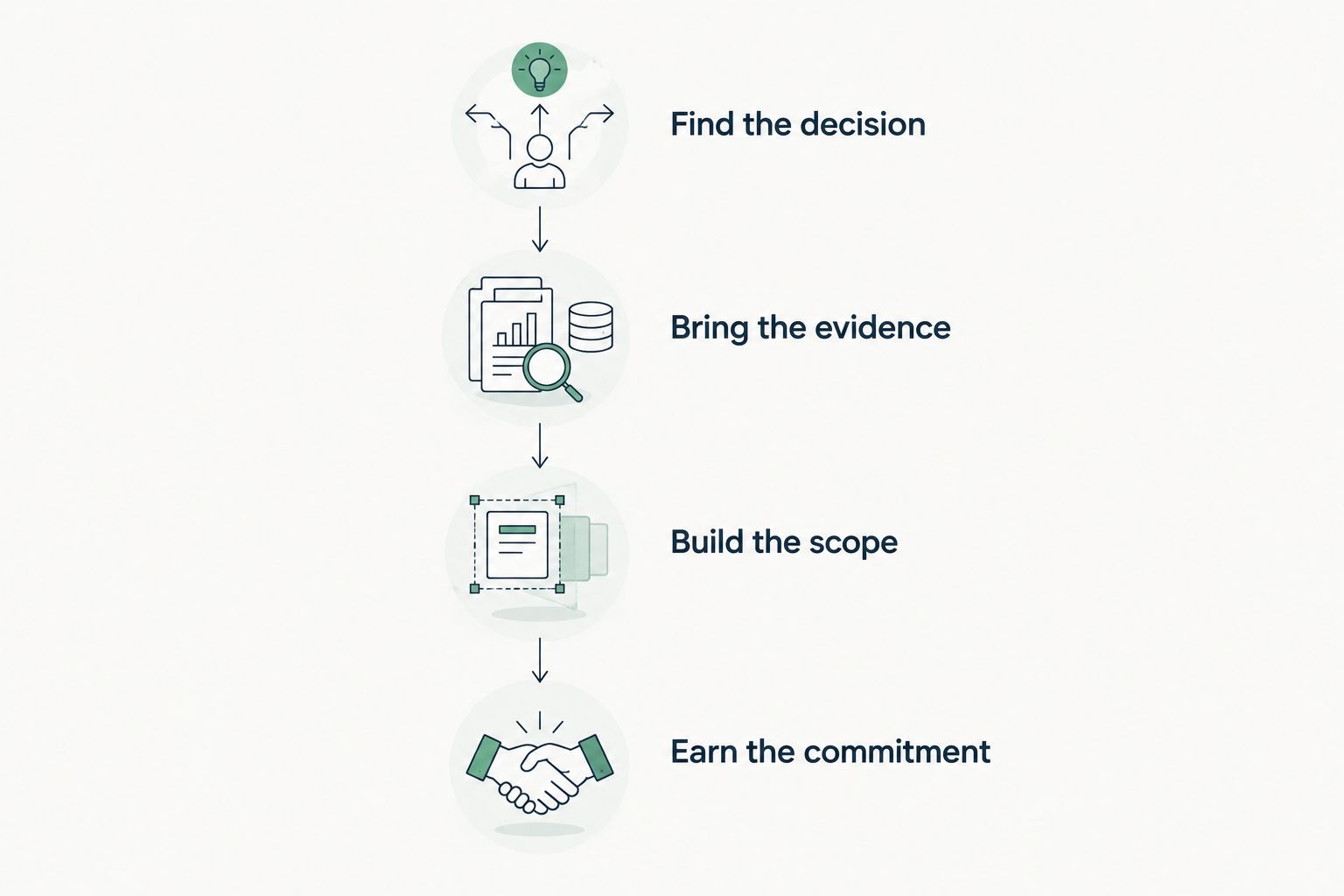
Use the SCOUTz Evidence-to-Agreement Framework to move from a finding to a buyer-approved next action. It has 4 steps: find the decision, bring the evidence, build the scope and earn the next commitment. It is a conversation framework, not a proven close-rate intervention.
Find the decision
Identify the decision owner and the question the review must answer. For a construction business, that might concern responsibility for email authentication or access to shared project information. Confirm the workflow before assigning a consequence.
Bring the evidence
Attach the check, source and run date. State the condition, then the boundary. A published DMARC policy requesting monitoring supports a question about intended enforcement; it does not prove compromise or an unresolved problem.
Build the scope
Offer a bounded choice. That can be a domain configuration review, a customer-authorized tenant review, or no change after confirming the condition is intentional. Keep the recommended outcome separate from the vendor or service selected.
Earn the commitment
Agree on the owner, deliverable and next decision. Preserve a baseline before changes, then rescan the same scope to establish what changed. Proof requires a comparable result.
Illustrative conversation and follow-up
The following is hypothetical dialogue, not a customer result or a live finding.
MSP: The dated domain result shows a monitoring-only DMARC policy. That tells us the published policy request. It does not establish whether a message was fraudulent. Who reviews the reports, and is monitoring still the intended setting?
Client: Our current provider handles that.
MSP: Keep that ownership in place. With your approval, the next step is to confirm the intended policy and document the authorized senders before proposing a change.
A follow-up should record the observation, its limits, the responsible owner and the agreed action. Use 2 evidence streams when appropriate: public-domain observations and separately authorized internal evidence. Never merge their coverage into one security conclusion.
Which security assessment tool should you choose?
Choose SCOUTz for MSP prospect preparation when the job is to bring dated cybersecurity evidence into a construction firm's sales conversation. Add a tenant, questionnaire, discovery or traffic tool only when the agreed scope calls for that evidence.
Make Join Open Beta the next step for evaluating the preparation workflow. For a product walkthrough, book a demo. Validate the relevant workflow and its status before including it in a client proposal.
For your 2026 evaluation, request an example that separates observed conditions, unknowns, affected objects and recommended outcomes. Reject any interpretation that converts an unread source into a clean result.
FAQ
What's the best security assessment tool for construction firm clients?
SCOUTz is the best fit in this shortlist for MSP prospect preparation. Microsoft Secure Score, CISA CSET, Nmap and Wireshark serve different assessment jobs, so select the tool against the agreed scope.
Can a public-domain review assess a construction firm's Microsoft 365 tenant?
A public-domain review cannot establish internal Microsoft 365 configuration. Conditional Access coverage, application permissions, license assignments and tenant sharing configuration require separately authorized internal evidence.
Is Microsoft Secure Score enough for a complete security assessment?
Microsoft Secure Score is not a complete assessment of a construction firm's systems and processes. Review the underlying configurations and document which applications, networks and workflows remain outside scope.
Do MSPs need permission before scanning a construction client's network?
MSPs should establish authorization and written scope before active network probing. Public observation and active probing are different activities, and legal requirements depend on the activity and jurisdiction.
Does a monitoring-only DMARC policy prove an email compromise?
A monitoring-only DMARC policy does not prove an email compromise. Confirm the policy's intended purpose, reporting ownership and authorized senders before recommending enforcement changes.
What should an MSP include in a construction security proposal?
Include the dated observation, affected object, evidence limits, responsible owner and proposed outcome. Define the authorized work and the evidence that will verify completion, while preserving the client's choice.
Can these tools guarantee that an MSP will win the client?
These tools cannot guarantee a signed client or improved sales performance. Evidence supports preparation and scope decisions; the MSP remains responsible for the relationship and sale.
One last thing
A better-looking score can distract from an unchanged scope. Before presenting improvement, confirm that the baseline and rescan covered the same objects, permissions and checks. Otherwise, a coverage change can masquerade as a security change.
Keep the original evidence packet. Your strongest proof is a documented before-and-after comparison with the limits still attached.