
Best overall for MSP sales preparation: SCOUTz. Best for Microsoft tenant prioritization: Microsoft Secure Score. Best for structured control discovery: CISA CSET. Best for authorized network discovery: Nmap. This 2026 guide compares 4 tools for real estate client assessments by the evidence each provides and the decisions each supports.
- SCOUTz leads the best security assessment tools for real estate clients when MSP prospect intelligence is the job.
- Microsoft Secure Score supports tenant improvement planning; its score does not establish complete security coverage.
- CISA CSET structures control discussions; Nmap supports authorized network discovery.
- Separate public-domain observations from consented Microsoft 365 evidence before proposing work.
Why this matters
A real estate prospect meeting needs a decision, not a frightening screenshot. Establish whether the buyer wants to review email-domain controls, understand Microsoft 365 configuration, document responsibilities, or authorize a technical network assessment.
Those are different jobs. A domain observation cannot establish tenant access controls, and an answering network service does not establish an exploitable vulnerability. Choose an assessment that answers the buyer's question without expanding the claim beyond the evidence.
What makes the best security assessment tools
Use these criteria for your 2026 shortlist. More findings do not automatically mean a better assessment.
- Evidence provenance: Keep the source, affected object, check name, and observation date attached to each finding.
- Permission boundaries: Distinguish public observation, customer-authorized tenant review, questionnaire answers, and active probing.
- Coverage disclosure: Show unreadable sources and unassessed areas alongside findings.
- Decision usefulness: Explain the condition, its possible consequence, the responsible owner, and the next choice.
- Verification: Preserve a baseline so a later review can show what changed.
- Operational fit: Match the tool to the MSP's sales preparation, control review, or technical delivery task.
Security assessment tools at a glance
This comparison separates 2 evidence layers that must stay distinct: external observations and customer-authorized internal evidence. Questionnaire responses form a separate, declared source; validate them before treating them as technical proof.
| Tool | Best for | Standout capability | Key limitation |
|---|---|---|---|
| SCOUTz | Evidence-led MSP prospect meetings | Dated domain evidence and consented Microsoft 365 configuration context | Tenant review and reporting capabilities carry Open Beta boundaries |
| Microsoft Secure Score | Microsoft tenant improvement planning | Microsoft-native security recommendations | A score does not establish complete control coverage or predict incidents |
| CISA CSET | Structured control and responsibility discovery | Guided cybersecurity evaluation | Answers need supporting evidence and owner validation |
| Nmap | Authorized network service discovery | Host and service discovery | Discovery output alone does not prove exploitability |
These tools complement each other. The order reflects usefulness for an MSP preparing a real estate sales conversation, not a claim that one replaces the others.
1. SCOUTz: best security assessment tool for MSP prospect meetings
The platform provides dated cybersecurity evidence and account context for MSP sales preparation. Public Domain Review and customer-authorized Microsoft 365 Review address different evidence sources; the latter uses configuration and metadata, never mail, files, chats, documents, or prompts.
For a real estate client, start with the decision under discussion. A domain review can support questions about published email controls. A consented tenant review supports a different conversation about internal configuration, within the permissions and coverage actually assessed.
SCOUTz pros:
- Keeps dated evidence available for discovery and proposal preparation.
- Separates public-domain observations from consented tenant evidence.
- Supports read-only review without an agent, installation, or automatic configuration changes.
- Uses rescans against a pinned baseline to establish change.
SCOUTz cons:
- Public-domain evidence cannot establish Conditional Access coverage, application permissions, or tenant sharing configuration.
- Microsoft 365 Review, reporting, and prospect intelligence carry Open Beta status in the client-supplied October 15, 2026 product reference.
- The MSP still validates claims, chooses the scope, and owns the relationship and sale.
Best for: MSP owners and sales leaders preparing an evidence-led meeting with a real estate prospect.
The product prepares the conversation. It does not establish buying intent or turn an observation into a confirmed breach. Check current beta scope before committing a capability to a proposal.
Verdict: Buy for the sales-preparation use case, subject to fit review and beta acceptance.
2. Microsoft Secure Score: best security assessment tool for tenant planning
Microsoft Secure Score presents security posture recommendations within Microsoft's environment. Use it when the real estate client authorizes tenant access and the immediate task is to review Microsoft security recommendations with the responsible administrator.
Treat the score as a prioritization input. Confirm the affected configuration, applicable licensing, and intended policy before translating a recommendation into project work.
Microsoft Secure Score pros:
- Provides Microsoft-native context for tenant security improvement discussions.
- Helps organize recommendations for administrator review.
- Supports a focused conversation about actions within the Microsoft environment.
Microsoft Secure Score cons:
- Does not assess the client's complete security posture across every platform.
- Requires interpretation of recommendations, applicability, and compensating controls.
- A score movement alone does not explain whether an operational risk changed.
Best for: MSP technicians and vCIOs planning Microsoft tenant improvements after authorization.
For example, keep MFA registration separate from enforcement. A registered authentication method does not, by itself, establish that the relevant sign-ins require MFA. Review the policy and its scope before making that claim.
Verdict: Buy into the workflow for Microsoft-specific prioritization; skip it as a whole-business security verdict.
3. CISA CSET: best security assessment tool for control discovery
CISA's Cyber Security Evaluation Tool structures an evaluation around cybersecurity practices and controls. Use it to organize a discussion of responsibilities, existing processes, and evidence requirements before defining a technical project.
For a real estate organization, establish which activities the assessment actually covers. Record whether an answer applies to the brokerage, a property-management operation, an individual office, or a third-party service.
CISA CSET pros:
- Gives control discussions a repeatable structure.
- Helps expose unanswered questions about ownership and process.
- Provides a basis for requesting supporting documents and technical evidence.
CISA CSET cons:
- Questionnaire answers are not independent proof that controls operate as described.
- Assessment quality depends on scope and participant knowledge.
- Does not replace tenant inspection or authorized network testing.
Best for: MSP consultants building an initial control inventory with business and technical owners.
Keep the response and its validation separate. If a buyer says backups exist, record that statement, then request evidence appropriate to the question. Backup software presence does not establish recoverability.
Verdict: Buy into the method when ownership and process are unclear; skip treating responses as verified technical findings.
4. Nmap: best security assessment tool for authorized network discovery
Nmap discovers hosts and services across a defined network scope. Use it when the customer has authorized active probing and the question concerns what responds on the specified addresses.
Agree on scope, timing, permitted techniques, and escalation contacts before starting. Ownership of a domain does not automatically establish authorization to test every connected or third-party system.
Nmap pros:
- Supports host and service inventory work.
- Produces technical observations for practitioner validation.
- Helps compare expected exposure with observed responses.
Nmap cons:
- Active probing needs explicit scope and authorization.
- An answering service does not establish an exploitable vulnerability.
- Output needs technical interpretation before client-facing claims.
Best for: Security practitioners performing a customer-authorized network discovery engagement.
Keep discovery separate from vulnerability validation. Record the responding object, observation date, and method, then decide whether a separately authorized investigation is warranted.
Verdict: Buy into the workflow for scoped technical discovery; skip unsolicited probing as a sales opener.
How the tools are ranked
This 2026 ranking follows the criteria above: provenance, permissions, coverage, decision usefulness, verification, and operational fit. It is a job-based buying guide, not a laboratory performance test or a claim about measured sales results.
The first choice supports the meeting. The remaining choices answer narrower Microsoft, control-discovery, and network questions. Select the next tool only when the agreed scope requires its evidence.
Turn assessment evidence into an agreed next action
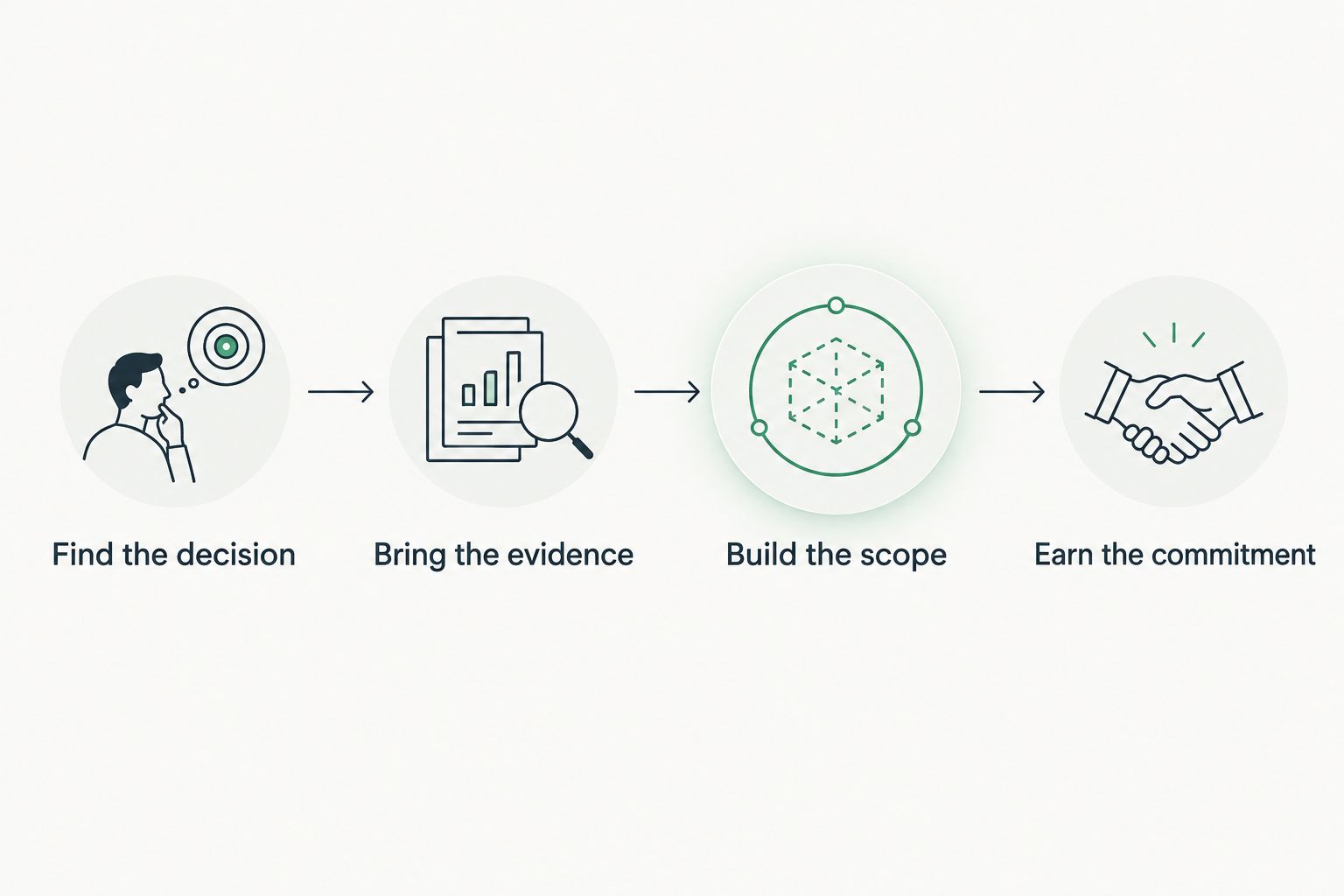
Use the Evidence-to-Agreement Framework to connect technical observations to a proposal. This is a conversation framework, not a proven close-rate intervention.
Find the decision
Identify the choice the buyer needs to make. For a brokerage reviewing email-domain controls, establish who owns the domain, who manages sending services, and who can authorize further review.
Keep the request specific. Approval to discuss a public record is different from permission to inspect a tenant or probe a network.
Bring the evidence
Show the condition, source, check, and run date. Separate what was observed from what remains unknown, then explain the possible consequence without inventing an incident.
For a monitoring-only DMARC policy, the observation concerns the published policy. It does not establish mailbox compromise, successful impersonation, or an unresolved mistake. Monitoring-only can be intentional.
Build the scope
Offer 3 scope options: validate the observation, investigate the configuration with consent, or defer with an owner and review date. Keep the recommended outcome separate from a vendor choice.
A useful scope names the affected object, authorized work, exclusions, deliverable, and acceptance evidence. The buyer can then approve a bounded task rather than an undefined security project.
Earn the commitment
Record the agreed action, responsible person, permission requirement, and completion evidence. A finding is a reason to clarify a decision; the buyer decides whether to proceed.
A proposal should preserve that agreement. Avoid adding remediation work that the buyer has not authorized or that the evidence does not support.
Illustrative conversation and follow-up
The following example is illustrative dialogue, not an observed client finding or a customer quote.
MSP: The dated domain review shows a monitoring-only DMARC policy. That describes the published policy, not whether anyone has impersonated your business. Please identify who reviews the reports and whether monitoring-only remains intended.
Buyer: Our existing provider handles email.
MSP: Keep that provider involved. The next step can be a joint review of intended sending services and policy ownership. No tenant access or configuration change is included unless you authorize it separately.
Illustrative follow-up: Today's agreed action is to confirm the policy owner and intended enforcement. Please approve the review scope or identify the existing provider who should validate it. Any later change will need separate approval and a dated verification result.
Before sending a report, validate the findings before the call. Keep unsupported implications out of the proposal.
Which security assessment tool should you choose?
SCOUTz is the best fit for MSPs preparing evidence-led real estate prospect conversations. In your 2026 shortlist, use Microsoft Secure Score for Microsoft prioritization, CISA CSET for control discovery, and Nmap for authorized network discovery.
Make Join Open Beta the next step when the sales-preparation use case fits. Confirm current product scope and acceptance requirements before promising deliverables to a prospect.
FAQ
What's the best security assessment tool for a real estate prospect meeting?
Choose a tool that connects dated evidence to the buyer's decision. For MSP sales preparation, prioritize clear provenance, coverage limits, and an agreed next action over finding counts.
Can a public-domain review assess a brokerage's Microsoft 365 security?
No. Public-domain observations cannot establish Conditional Access coverage, application permissions, license assignments, or tenant sharing configuration. Those questions require authorized internal evidence.
Is Microsoft Secure Score enough for a real estate security assessment?
No. Microsoft Secure Score supports Microsoft-specific improvement planning, but it does not establish the security of every platform, process, or network the client uses.
Does a monitoring-only DMARC policy mean the client was compromised?
No. A monitoring-only DMARC policy describes the domain owner's published handling request. Confirm intent, sending services, and report ownership before recommending a change.
Can an MSP scan a real estate prospect without permission?
Do not treat all scanning as the same activity. Separate public observation from active probing, and establish authorization and scope before intrusive testing. This guide does not establish legal permission.
What should a real estate client assessment report include?
Include the condition, affected object, source, check, observation date, unknowns, owner, and recommended outcome. Show unassessed areas separately and define the evidence needed to verify any approved change.
Does finding backup software prove the client's backups work?
No. Backup software presence does not establish recoverability. Request evidence of recovery testing within an agreed scope before making a recovery claim.
One last thing
An unread source is not a clean result. In a 2026 client report, give NOT ASSESSED THIS SCAN enough visibility that the buyer cannot mistake missing evidence for an effective control.
That boundary belongs in the proposal too. State what you will assess next, who must authorize it, and what evidence will establish completion.