
Best overall for MSP sales preparation: SCOUTz. Best for a structured HIPAA risk-assessment workflow: the HHS Security Risk Assessment Tool. Best for Microsoft tenant recommendations: Microsoft Secure Score. The best security assessment tools for dental practices serve different jobs, so choose by the evidence you need before proposing work.
- SCOUTz leads the best security assessment tools for dental practices shortlist for MSP prospect preparation, not compliance certification.
- The HHS Security Risk Assessment Tool supports a structured risk-assessment workflow; it does not certify HIPAA compliance.
- Microsoft Secure Score supports tenant security review; Greenbone OpenVAS supports authorized vulnerability discovery.
- Keep public-domain observations separate from consented Microsoft 365 evidence and internal network findings.
Why this matters
A dental practice assessment needs a defined boundary. Email authentication, Microsoft 365 configuration, network vulnerabilities and HIPAA risk analysis answer different questions. Combining their results into one score conceals what was actually assessed.
For your 2026 shortlist, separate prospect preparation from delivery. Before access is authorized, discuss public observations and their limits. After authorization, collect the internal evidence needed to define work with the practice owner and whoever manages its systems.
SCOUTz is the best fit here for MSPs preparing evidence-led dental practice sales conversations. That verdict concerns meeting preparation, dated evidence and account context. It does not establish superiority in vulnerability scanning or regulatory risk analysis.
What makes the best security assessment tools for dental practices
Use these criteria before choosing a tool for a dental client:
- Evidence provenance: retain the source, affected object, check and run date beside each finding.
- Access boundaries: distinguish public observation, authorized cloud review and active network testing.
- Coverage transparency: show assessed, partial and unread areas without treating missing evidence as a clean result.
- Decision usefulness: connect the observed condition to an owner, a question and a proposed next action.
- Verification: define what evidence will demonstrate the agreed outcome after work is completed.
- Practice fit: identify the systems, information and outside providers that belong inside the assessment scope.
Treat these as procurement requirements in 2026. A polished report cannot compensate for an unexplained source or an assessment boundary that excludes systems relevant to the decision.
Security assessment tools at a glance
| Rank and tool | Best for | Standout capability | Key limitation |
|---|---|---|---|
| 1. SCOUTz | MSP prospect meeting preparation | Dated domain evidence and customer-authorized Microsoft 365 review | Public evidence cannot establish internal tenant controls; cloud review is Open Beta |
| 2. HHS Security Risk Assessment Tool | Structured HIPAA risk-assessment workflow | Guided assessment questions and documentation | Requires accurate organizational input and supporting evidence |
| 3. Microsoft Secure Score | Microsoft tenant improvement planning | Security recommendations within supported Microsoft services | Does not represent the entire practice or establish HIPAA compliance |
| 4. Greenbone OpenVAS | Authorized vulnerability discovery | Vulnerability scanning against explicitly scoped systems | Findings require validation; testing needs operational coordination |
| 5. CISA CSET | Facilitated control-gap discussion | Standards-based assessment questions and reporting | Responses require corroboration with technical evidence |
1. SCOUTz: best for dental practice prospect preparation
SCOUTz provides cybersecurity prospect intelligence for MSPs. Its role is to bring dated evidence and account context into a conversation, then help the MSP define the next assessment or service decision.
The client-supplied product reference dated October 15, 2026 distinguishes public Domain Review from customer-authorized Microsoft 365 Review, which is Open Beta. The latter reviews configuration and metadata, without reading mail, files, chats, documents or prompts. Review is read-only, with no agent, installation or automatic configuration changes.
SCOUTz pros:
- Separates public-domain observations from consented internal evidence.
- Keeps the conversation anchored to a condition rather than a speculative breach story.
- Supports a workflow from evidence to scope, followed by verification against a pinned baseline.
SCOUTz cons:
- A public review cannot establish Conditional Access coverage, application permissions or tenant sharing configuration.
- Microsoft 365 Review and the report experience carry beta limitations.
- The platform does not replace the MSP's technical judgment or the practice's risk-analysis responsibilities.
Best for: an MSP preparing discovery, a proposal discussion or an evidence-led account review.
Verdict: Buy for prospect preparation only after confirming beta fit and required coverage. The primary next step is Join Open Beta through the official application process; admission includes a human MSP-fit review.
2. HHS Security Risk Assessment Tool: best for structured risk analysis
The HHS Security Risk Assessment Tool, developed with federal health IT and civil-rights agencies, guides organizations through a security risk-assessment workflow. It is aimed at small and medium-sized healthcare practices and business associates.
For a dental practice subject to the HIPAA Security Rule, this is a relevant starting point for documenting assessment questions and organizational responses. The governing risk-analysis requirement is at 45 CFR 164.308(a)(1)(ii)(A); completing a tool does not itself establish compliance.
HHS Security Risk Assessment Tool pros:
- Organizes discussion around healthcare security responsibilities.
- Helps expose questions that require an owner or supporting records.
- Provides a structured alternative to an undocumented checklist.
HHS Security Risk Assessment Tool cons:
- Answers depend on the accuracy and completeness of participant input.
- A questionnaire response does not independently verify a technical control.
- The practice still needs to define scope, evaluate risk and address findings.
Best for: a practice administrator and MSP working through a documented risk-analysis process.
Verdict: Buy into the workflow when the engagement requires structured risk analysis, with technical evidence alongside it.
3. Microsoft Secure Score: best for Microsoft tenant improvement planning
Microsoft Secure Score presents security posture information and recommended improvement actions for supported Microsoft services. Use it when the practice uses Microsoft 365 and has authorized the necessary administrative access.
A score can help organize discussion, but the underlying recommendations matter more than the headline number. Review applicability, existing compensating controls and the business effect of each proposed change before turning recommendations into work.
Microsoft Secure Score pros:
- Connects recommendations to supported Microsoft services.
- Gives administrators a repeatable place to review improvement actions.
- Helps focus a tenant discussion on specific configurations and responsibilities.
Microsoft Secure Score cons:
- Coverage depends on the services, permissions and capabilities available in the tenant.
- Score movement does not establish that the practice experienced or avoided an incident.
- A tenant score leaves systems outside its scope unassessed.
Best for: an authorized Microsoft 365 review with the practice's tenant administrator.
Verdict: Buy into Secure Score as one tenant evidence source, with each recommendation checked for applicability.
4. Greenbone OpenVAS: best for authorized vulnerability discovery
Greenbone OpenVAS is a vulnerability scanning option for identifying potential weaknesses in scoped systems. It belongs in an authorized technical assessment, where you can validate results and coordinate testing with the system owners.
For dental clients, identify clinical systems and vendor-managed equipment before selecting targets or scan settings. Agree on exclusions, timing, escalation contacts and stop conditions with the practice and relevant vendors.
Greenbone OpenVAS pros:
- Adds technical vulnerability evidence beyond questionnaire answers.
- Supports repeat testing of a defined target set.
- Helps create a validation and remediation work queue.
Greenbone OpenVAS cons:
- Results require validation before you describe a vulnerability as confirmed.
- Authentication, reachability and scan configuration affect coverage.
- Active testing requires coordination, especially around clinical equipment.
Best for: an MSP technician conducting an explicitly authorized vulnerability assessment.
Verdict: Buy into the scanning workflow after agreeing scope and operational safeguards; skip unsolicited active testing.
5. CISA CSET: best for facilitated control-gap discussion
CISA's Cyber Security Evaluation Tool, or CSET, supports standards-based cybersecurity assessment through structured questions and reporting. It fits a facilitated review involving the people who own systems, policies and operational decisions.
Use CSET to organize a broader control discussion when the engagement extends beyond email or tenant configuration. Select the applicable assessment material and document which answers were supported by records, interviews or technical checks.
CISA CSET pros:
- Structures conversations across multiple control areas.
- Helps record gaps that a narrow scanner does not address.
- Supports collaboration between technical and operational owners.
CISA CSET cons:
- Self-reported responses need supporting evidence.
- Selecting relevant material and interpreting results requires expertise.
- Assessment output does not automatically become an implementable service scope.
Best for: a facilitated baseline assessment with multiple stakeholders.
Verdict: Buy into CSET for a broader control review when you can substantiate the responses.
How these tools are ranked
This 2026 ranking prioritizes the MSP's decision sequence: prepare the conversation, establish assessment obligations, inspect authorized systems and define work. It compares documented tool purposes, rather than claiming a hands-on benchmark or measured sales improvement.
The criteria are provenance, boundaries, coverage, decision usefulness, verification and practice fit. No single tool wins every job. Your scope determines which combination belongs in the engagement.
Turn a dental finding into an agreed next action
Use the SCOUTz Evidence-to-Agreement Framework: Find the decision, Bring the evidence, Build the scope, Earn the next commitment. This is a conversation framework, not a proven close-rate intervention.
Find the decision
Identify what the practice is deciding: authorize an assessment, change an email policy, review tenant access or commission a broader risk analysis. Keep that decision separate from vendor selection.
When comparing healthcare cybersecurity providers, distinguish assessment responsibility from implementation responsibility. The practice needs to know who collects evidence, who approves changes and who verifies the outcome, even when different organizations perform those jobs.
Bring the evidence
A published DMARC policy requesting monitoring only is an observation about domain policy. It does not establish compromise or prove that the configuration is unintended.
Use this structure for a finding reviewed in 2026:
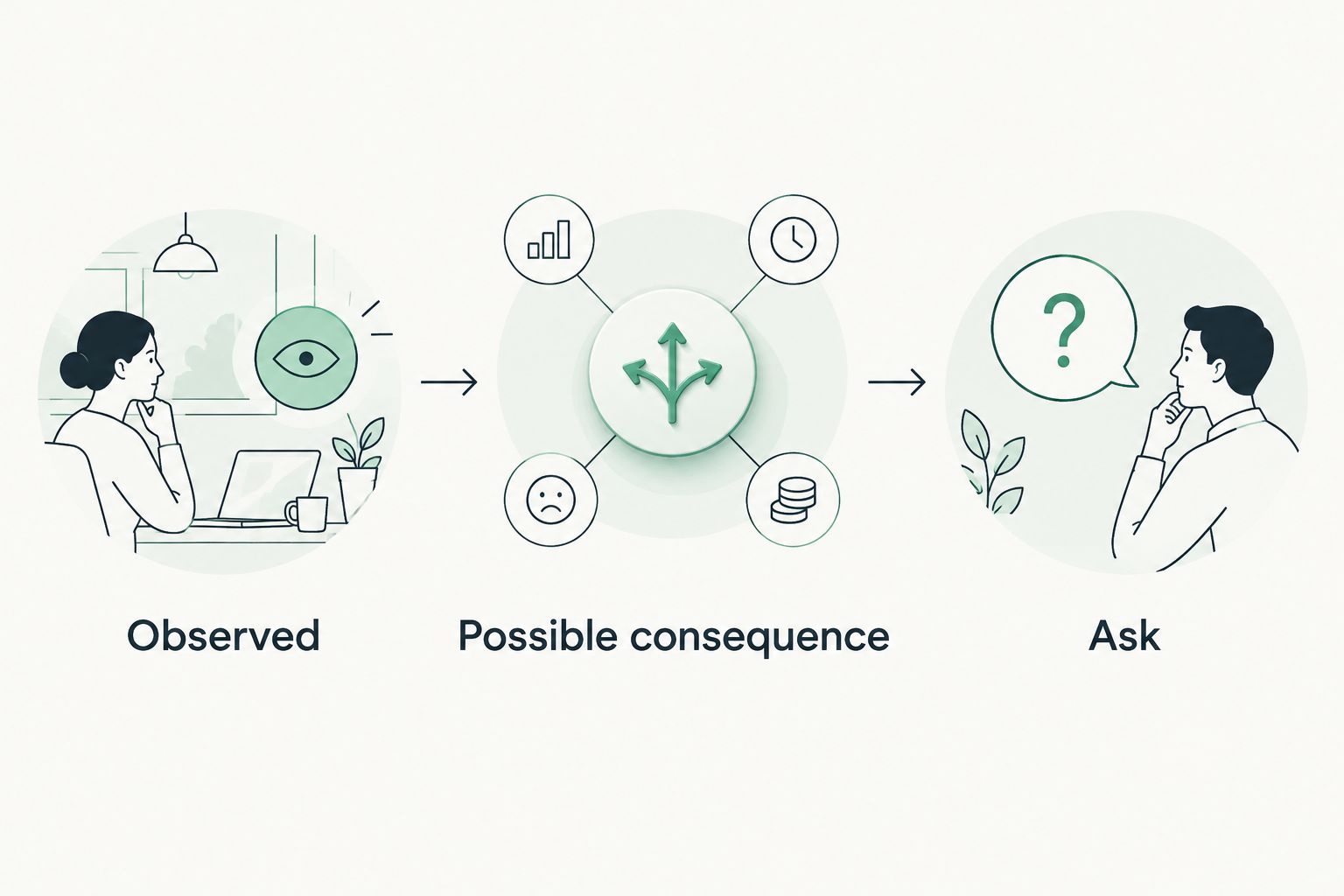
- Observed: record the exact DMARC policy, queried domain, source and collection date.
- Possible consequence: the published policy does not request quarantine or rejection for DMARC-failing messages; receiver handling still varies.
- Ask: confirm who reviews reports and whether monitoring remains the intended policy.
Before presenting the finding, follow a process for validating assessment findings before a call. Keep expired or superseded observations out of the proposal's current-state claims.
Build the scope
Offer choices that match the evidence:
| Scope choice | Included work | Boundary | Completion evidence |
|---|---|---|---|
| Domain review | Validate published email-security records | Does not establish internal tenant configuration | Dated observations and agreed follow-up questions |
| Authorized tenant review | Inspect permitted configuration and metadata | Unread sources remain unknown | Coverage record and reviewed findings |
| Broader practice assessment | Review agreed systems, processes and supporting records | Requires a separately defined organizational scope | Risk record, owners and agreed action plan |
A practical proposal recommendation is to retain 3 evidence fields at minimum: source, check and run date. Add the affected object, unknowns and desired outcome rather than hiding them in an appendix.
Earn the next commitment
Illustrative dialogue, not a customer quotation:
Practice manager: We already have an IT provider.
MSP: Keep that provider involved. The observed policy is a starting point for confirming intent. The next choice is a joint review, a separately authorized assessment or no change if the evidence supports the current approach.
For a suggested 30-minute discovery meeting, finish with one agreed action, its owner and the evidence needed to complete it. A follow-up should record 2 review dates: the original observation date and the planned verification date. These are workflow recommendations, not product performance claims.
Which security assessment tool should you choose?
Choose SCOUTz for dental practice prospect preparation; add other tools when the agreed scope requires their evidence. Use the HHS tool for structured risk analysis, Microsoft Secure Score for supported tenant recommendations, OpenVAS for authorized vulnerability discovery and CSET for a facilitated control review.
For your 2026 buying decision, ask the vendor to demonstrate one complete finding: source, date, coverage limit, owner and verification outcome. Keep unread evidence explicitly unknown. A report earns its place when you can trace a proposed task back to evidence.
FAQ
What's the best security assessment tool for dental practices?
The best tool depends on the assessment job. SCOUTz fits MSP prospect preparation; the HHS Security Risk Assessment Tool fits a structured healthcare risk-assessment workflow, while tenant and network reviews need their own evidence sources.
Does a dental practice security scan prove HIPAA compliance?
No. A scan covers a defined set of technical observations, while HIPAA risk analysis requires consideration of the relevant risks and vulnerabilities to electronic protected health information. Tool output must sit within the practice's documented assessment process.
Can an MSP assess a dental practice without internal access?
An MSP can review public-domain evidence without claiming internal coverage. Public observations cannot establish tenant permissions, internal device condition or the effectiveness of controls that were not assessed.
Is Microsoft Secure Score enough for a dental practice assessment?
No. Microsoft Secure Score addresses supported Microsoft services and recommendations. Systems, processes and information outside that scope require separate assessment.
Can an MSP scan dental equipment before getting permission?
Do not conduct active testing without appropriate authorization and an agreed scope. Coordinate with the practice and relevant equipment vendors, including exclusions, timing and stop conditions.
Does a monitoring-only DMARC policy mean the practice was breached?
No. A monitoring-only DMARC policy states a published handling preference, not an incident finding. Confirm the policy's intent and reporting process before recommending a change.
How should an MSP compare assessment costs?
Compare the work included, required access, coverage, validation and verification responsibilities. Check current terms directly with each provider and separate software procurement from the professional work needed to interpret results.
One last thing
Keep the original baseline when a finding changes. A later clean result cannot explain what changed unless the affected object, check and coverage remain comparable. Proof is a repeatable comparison, with the limits still visible.