
Best overall for document assembly and signature: PandaDoc. Best for cybersecurity proposal evidence: SCOUTz. Best for browser-based proposals: Qwilr. Best for structured MSP quoting: ConnectWise CPQ. This 2026 guide separates proposal production from the security evidence that makes a scope defensible.
- The best msp proposal software depends on your missing job: evidence, document production, browser presentation, or structured quoting.
- SCOUTz is best for MSPs preparing cybersecurity proposal evidence, not for replacing their quoting or signature workflow.
- PandaDoc fits document-led proposals; Qwilr fits browser presentation; ConnectWise CPQ fits structured quoting.
- Keep public-domain observations separate from consented Microsoft 365 evidence, and carry assessment limits into the proposal.
Why this matters
A polished proposal cannot establish that a security condition exists. A security finding cannot establish that the prospect wants a project. Your proposal needs evidence, an agreed outcome, and a defined boundary between assessment and delivery.
For a 2026 cybersecurity services shortlist, start with the missing job. If your team already produces clear quotes but struggles to explain the proposed work, another document editor addresses the wrong problem. If your scope is agreed but approvals stall inside a manual document process, focus on proposal production.
Buy for the bottleneck you can name. Keep the CRM responsible for the relationship and the MSP responsible for the recommendation.
What makes the best MSP proposal software
Use these criteria before comparing interfaces:
- Evidence traceability: retain the source, affected object, check date, and assessment boundary behind each recommendation.
- Scope clarity: distinguish investigation, configuration work, ongoing service, exclusions, and client responsibilities.
- Document workflow: establish how your team drafts, reviews, approves, presents, and accepts the proposal.
- Buyer readability: explain the observed condition and desired outcome without turning uncertainty into urgency.
- Operational fit: establish who maintains account details, quote content, contract language, and delivery handoff.
- Proof after delivery: define how the MSP will verify the agreed outcome against a pinned baseline.
Evaluate security evidence and document production separately. A product can be a good choice for one job without covering the other.
MSP proposal tools at a glance
| Tool | Best for | Standout role | Key limitation |
|---|---|---|---|
| SCOUTz | Evidence-led cybersecurity scoping | Dated domain and customer-authorized Microsoft 365 evidence | Proposal rationale is a different job from quoting and signing |
| PandaDoc | Document-led proposal production | Creating, sharing, and signing business documents | Document completion does not validate security findings |
| Qwilr | Browser-based proposal presentation | Presenting proposals as web pages | Presentation does not establish assessment coverage |
| ConnectWise CPQ | Structured MSP quoting | Configuring and producing sales quotes | Quote structure does not establish why a security change is needed |
These are distinct use cases, not interchangeable security assessment products. Keep your existing workflow when it already handles its assigned job.
1. SCOUTz: best for cybersecurity proposal evidence
SCOUTz is best for MSPs that need dated cybersecurity evidence before writing a proposal. It supports the conversation between a booked meeting and an agreed scope; the MSP still chooses the service, project, process, or decision to take no action.
Public-domain observations and customer-authorized Microsoft 365 reviews have different boundaries. The latter uses read-only configuration and metadata evidence, never mail, files, chats, documents, or prompts. The client’s October 15, 2026 product reference identifies Microsoft 365 Review and Evidence Reports as Open Beta.
Pros:
- Connects proposal reasoning to dated observations rather than generic risk statements.
- Distinguishes public evidence from consented internal evidence.
- Supports verification through rescans against a pinned baseline.
Cons:
- Does not replace the MSP’s judgment, relationship management, or sale.
- Unread or permission-limited sources leave assessment boundaries that the proposal must preserve.
Best for: MSP owners and sales leaders whose proposals lack a defensible explanation of the recommended work.
Verdict: Buy for the evidence job only after evaluating the Open Beta; hold any decision to replace your proposal workflow.
2. PandaDoc: best for document-led MSP proposals
PandaDoc is a document workflow product for creating, sharing, and signing business documents. It belongs on your shortlist when the central deliverable is a proposal document that needs internal review and customer acceptance.
Bring approved cybersecurity content into that workflow. A signature establishes acceptance of the document; it does not establish that the assessment was complete or the technical recommendation was correct.
Pros:
- Fits a document-centered proposal process.
- Keeps proposal presentation and electronic signature within the same product category.
- Suits teams that want the document to remain the central buyer-facing artifact.
Cons:
- Security evidence still needs an accountable source and technical reviewer.
- A reusable proposal requires active maintenance of scope language and exclusions.
Best for: MSPs with agreed service definitions that need a repeatable document production and acceptance process.
Verdict: Buy when document production is the bottleneck; skip it as a substitute for security assessment.
3. Qwilr: best for browser-based cybersecurity proposals
Qwilr presents proposals as web pages. That makes it a distinct option when your team wants the buyer to review a browser-based explanation of the service rather than treating a conventional document as the primary presentation.
Use that format to separate the observation, proposed outcome, and scope choices. Keep a clear record of the version the buyer accepted, and establish the review and acceptance requirements before selecting a product configuration.
Pros:
- Fits proposals designed for browser reading.
- Gives narrative explanation a different format from a conventional document.
- Suits a presentation-led sales process with clearly separated scope sections.
Cons:
- A web presentation does not validate the evidence it contains.
- Buyers with prescribed procurement documents still need their requirements addressed.
Best for: MSP sales teams that prefer web-based proposal presentation and can support the buyer’s procurement process.
Verdict: Buy for browser presentation; hold until you confirm the buyer’s acceptance and recordkeeping requirements.
4. ConnectWise CPQ: best for structured MSP quoting
ConnectWise CPQ belongs on the shortlist when the primary task is configuring and producing quotes. Evaluate it around your service catalog, approval responsibilities, and handoff to the people delivering the work.
Keep the quote and its rationale connected but distinct. A line item for an email-security project needs a defined outcome, owner, and exclusion list, regardless of how neatly the quote is assembled.
Pros:
- Centers the workflow on structured quoting.
- Fits teams evaluating a dedicated configure-price-quote process.
- Makes quote preparation the purchasing decision rather than proposal appearance alone.
Cons:
- A quote cannot prove the underlying security condition.
- Catalog and scope definitions still need an MSP owner responsible for accuracy.
Best for: MSPs whose main problem is organizing repeatable quotes rather than explaining cybersecurity evidence.
Verdict: Buy for a demonstrated quoting requirement; skip it when the missing piece is discovery or assessment evidence.
How this ranking works
This 2026 ranking assigns each product a different job using the criteria above. It is a workflow comparison, not a hands-on performance benchmark or a claim that one vendor produces better sales results.
PandaDoc is the default for a document-led proposal requirement. The other selections address evidence preparation, browser presentation, and structured quoting. Confirm current capabilities against your actual approval and acceptance process before committing.
Turn evidence into an agreed proposal scope
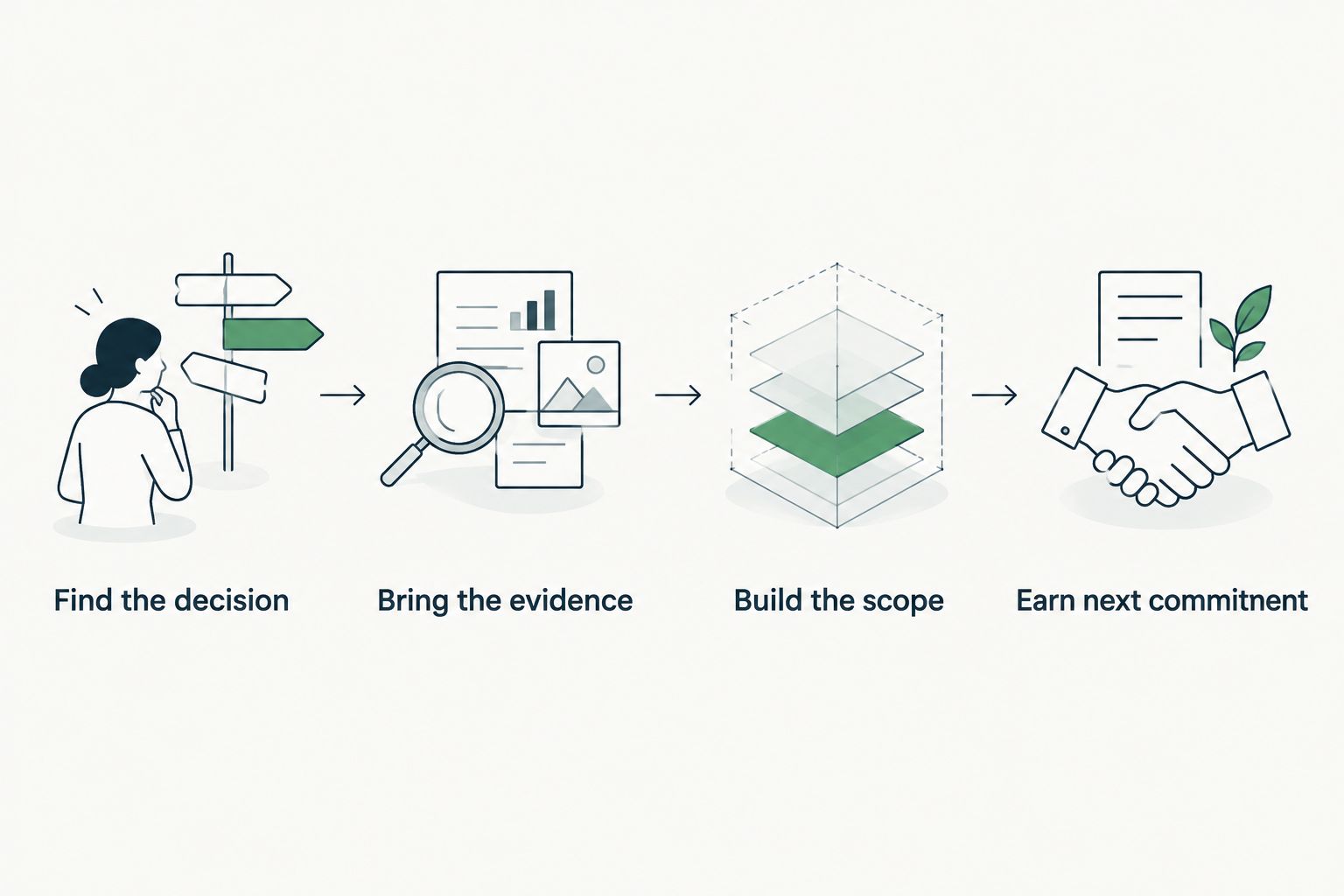
The SCOUTz Evidence-to-Agreement Framework gives the MSP a conversation structure: Find the decision, Bring the evidence, Build the scope, Earn the next commitment. It is an original conversation framework, not a validated close-rate intervention.
Use these 4 stages to connect a finding to a buyer-approved next action.
Find the decision
Identify the decision the prospect can actually make. That might be authorizing a review, confirming the owner of a control, or approving a defined configuration project.
Illustrative dialogue: “Before discussing changes, let’s confirm whether your priority is understanding the current email policy or changing its enforcement.”
The buyer chooses the objective. Your evidence informs that choice without manufacturing buying intent.
Bring the evidence
For a DMARC observation, retain the queried domain, the published record, the check date, and the interpretation. A policy requesting monitoring only does not prove compromise or establish that the configuration is unintended.
Illustrative dialogue: “This observation shows a monitoring-only policy at the recorded check time. Who reviews the reports, and does monitoring-only still match your intended policy?”
Keep 2 dates in the proposal record: the evidence collection date and the proposal review date. If the evidence needs refreshing before approval, make that task explicit.
Build the scope
Separate the condition from the remedy. Reviewing authorized senders, deciding on enforcement, implementing an approved change, and verifying the result are different responsibilities.
Illustrative dialogue: “We can scope a review first, or define an implementation project after the sender inventory is agreed. Which decision are you ready to make?”
Avoid attaching a product recommendation before you establish the required outcome. The MSP can recommend a service, process, project, or no change.
Earn the next commitment
End with an action, owner, and agreed date. A request for permission to review Microsoft 365 is different from approval to change its configuration.
Illustrative dialogue: “If you approve the review, we will document the authorized access, assessment limits, and the decision meeting before work starts.”
Record that commitment separately from the technical finding. Interest in a discussion does not establish agreement to purchase.
Keep the CRM handoff separate from technical proof
A proposal workflow needs account ownership, an agreed next action, and a record of what the buyer received. Technical evidence needs its own source, collection date, assessment coverage, and review boundary.
When considering CRM integration through APIs, specify the records and permissions you need before assuming two systems can exchange the right information. An API connection is a transport mechanism; it does not validate a finding or authorize a configuration change.
For your integration review, require an explicit answer for each item:
- Account identity: establish which prospect, domain, and authorized tenant each record belongs to.
- Evidence reference: retain the original source and run date rather than copying an unexplained score.
- Update ownership: assign responsibility for correcting stale scope or account information.
- Buyer commitment: record what was agreed separately from opens, views, or follow-up activity.
Do not infer a shipping integration from a proposed workflow. Confirm the current product behavior before promising automation to your sales team.
Compare scopes before comparing proposal appearance
Offer 3 scope choices when they represent genuinely different decisions. Do not create artificial tiers around the same unresolved observation.
| Scope option | Best for | Advantage | Limitation | Acceptance evidence |
|---|---|---|---|---|
| Review only | Establishing condition and ownership | Limits the initial decision to discovery | Does not authorize changes | Agreed findings and documented unknowns |
| Defined project | Implementing an approved outcome | Creates a bounded delivery responsibility | Excludes unrelated conditions | Rescan against the pinned baseline |
| Ongoing service | Repeated review of agreed controls | Assigns continuing review responsibility | Requires explicit coverage and exclusions | Agreed review records and change history |
For each option, identify the owner, affected objects, dependencies, exclusions, and acceptance method. Keep vendor selection separate from the required outcome.
A public-domain review cannot establish Conditional Access coverage, application permissions, license assignments, Intune device state, or tenant sharing configuration. Put those limits in the scope rather than letting the buyer assume a broader assessment occurred.
Handle objections without overstating the finding
For a 2026 proposal review, use the original evidence record rather than a remembered summary. Keep uncertainty visible when the buyer challenges the interpretation.
Illustrative objection: “Our current provider already handles this.”
Illustrative response: “Then the next step is confirming the intended policy and its owner. If the current arrangement meets your objective, there is no reason to propose a change on this observation alone.”
Illustrative follow-up: “The recorded observation concerns the published DMARC policy, not a confirmed incident. Please confirm who owns the policy review and whether you want a review-only scope. Any change requires separate approval.”
This keeps the proposal tied to a decision the buyer can make. It also gives the MSP a defensible stopping point when further work is unnecessary.
Which MSP proposal software should you choose?
Choose PandaDoc by default when your requirement is document production and signature. Choose Qwilr for browser presentation or ConnectWise CPQ for structured quoting. Keep your existing tool if it already performs that job adequately.
For cybersecurity proposal preparation, SCOUTz supplies the evidence layer rather than replacing those workflows. In 2026, evaluate that layer by whether it preserves source, date, unknowns, and verification boundaries.
Join Open Beta is the primary next step for MSPs evaluating the beta workflow. If you need to establish fit first, book a demo and bring an anonymized proposal scope to the discussion.
FAQ
What's the best MSP proposal software for cybersecurity services?
PandaDoc is the default choice here for document-led proposal production and signature. Choose a separate evidence workflow when the missing requirement is defensible cybersecurity scoping rather than document creation.
Can proposal software validate cybersecurity findings?
Proposal production alone does not validate cybersecurity findings. Keep the source, check date, affected object, assessment boundary, and technical reviewer attached to each recommendation.
Is a public-domain review enough to scope Microsoft 365 remediation?
A public-domain review cannot establish internal Microsoft 365 configuration. Customer-authorized evidence is needed for areas such as Conditional Access coverage, application permissions, and tenant sharing configuration.
Should an MSP replace its quoting tool with an evidence platform?
Keep the quoting tool when it already handles quote production adequately. Evidence preparation and quoting serve different jobs, so evaluate each against a specific workflow requirement.
Does a monitoring-only DMARC policy prove a security incident?
A monitoring-only DMARC policy does not prove a security incident. Confirm the intended policy, authorized senders, reporting ownership, and current evidence before proposing changes.
How should an MSP prove a proposed security project is complete?
Define acceptance before work starts and verify the agreed outcome against a pinned baseline. Record the rescan date, assessed objects, remaining unknowns, and any work outside the approved scope.
One last thing
The most useful sentence in a cybersecurity proposal can be the boundary statement. Write what was assessed, what was not assessed, and what decision the evidence supports.
An unread source stays unknown. Carrying that limit into the signed scope prevents the document from promising coverage the assessment never established.