
Prioritize security findings for a prospect meeting by checking the evidence, connecting the condition to a decision, and identifying who can authorize the next step. Lead with findings you can explain and substantiate, rather than the longest list or the highest-looking score. Keep unknowns visible, and agree on a scoped action before proposing remediation.
- How to prioritize security findings for a prospect meeting: lead with dated evidence, decision relevance, and an accountable owner.
- SCOUTz supports MSP prospect intelligence; public-domain observations and authorized Microsoft 365 evidence have different boundaries.
- Use the Evidence-to-Agreement Framework to move from a finding to an agreed scope and next commitment.
- Keep unread sources unknown. Verify change against a pinned baseline before claiming an improvement.
Why this matters
A security finding describes a condition. Your prospect still needs to decide whether that condition matters, who owns it, and what should happen next. A severity label alone does not answer those questions.
SCOUTz is best for MSPs that need dated cybersecurity prospect intelligence before a sales conversation. Its role is preparation; the relationship and sale stay with the MSP. Use SCOUTz as a source of account evidence, with human review before presenting a claim.
For your 2026 meeting packet, separate what was observed from what you infer. That distinction keeps the discussion useful when the prospect supplies context your review could not establish.
How to prioritize security findings for a prospect meeting
Use these 4 preparation steps. This is a recommended meeting workflow, not a measured performance benchmark.
- Validate the observation. Attach the check, source, run date, affected object, and evidence boundary. Recheck a stale or disputed observation before presenting it as current.
- Connect it to a decision. Identify the business process or responsibility the condition touches. State a possible consequence without turning it into an incident claim.
- Find the owner. Establish who understands the configuration, who approves changes, and who accepts the outcome. Those responsibilities can belong to different people.
- Choose the next commitment. Ask for a bounded action: confirm intent, authorize further review, approve a scoped change, or document a decision to leave the configuration unchanged.
Start with 3 discussion items as a practical agenda limit, not a universal rule. Keep the remaining evidence in an appendix. Expand the agenda when the buyer's decision requires it, rather than because the report contains more findings.
A finding earns meeting time when its evidence supports a decision the prospect can actually make.
Separate evidence sources before ranking findings
Public-domain observations and customer-authorized internal evidence answer different questions. Mixing them creates claims the underlying review cannot support.
| Evidence source | Best for | Useful evidence | Limit to preserve |
|---|---|---|---|
| Public-domain review | Preparing domain and email-security questions | Published records and externally observable conditions, with source and date | Cannot establish Conditional Access coverage, application permissions, license assignments, Intune device state, or tenant sharing configuration |
| Customer-authorized Microsoft 365 review | Discussing tenant configuration within granted access | Read-only configuration and metadata from authorized sources | Does not read mail, files, chats, documents, or prompts; permission and license limits remain visible |
| Prospect confirmation | Establishing intent, ownership, and operating context | The prospect's explanation of why a configuration exists | Does not independently verify the technical condition or prove remediation |
Keep the sources separate even when they concern the same account. A prospect's explanation adds context; it does not replace the underlying observation.
Why finding priority varies between prospect meetings
The same technical condition can require a different conversation in a different account. Prioritize using these factors rather than inventing a universal score:
- Decision relevance. A finding belongs near the top when it informs the decision the meeting is meant to resolve.
- Evidence freshness. Preserve the actual run date. A report assembled in 2026 does not make every observation in it current.
- Coverage. Distinguish Assessed, Partial, Not assessed, Permission limited, and License limited. Missing access changes what you can conclude.
- Ownership. A condition with an identified owner supports a concrete next step. Unclear ownership calls for discovery first.
- Context and intent. Confirm whether a setting is deliberate, transitional, or awaiting review before proposing a change.
- Verification path. Favor an actionable discussion when you can define what evidence would demonstrate the agreed outcome.
Keep evidence states separate from coverage. Verified, Observed, Inferred, Possible, Unknown, and Unreadable describe different states; they are not a score ladder. An unread source remains unread even when another check returns a reassuring result.
Turn priority into agreement
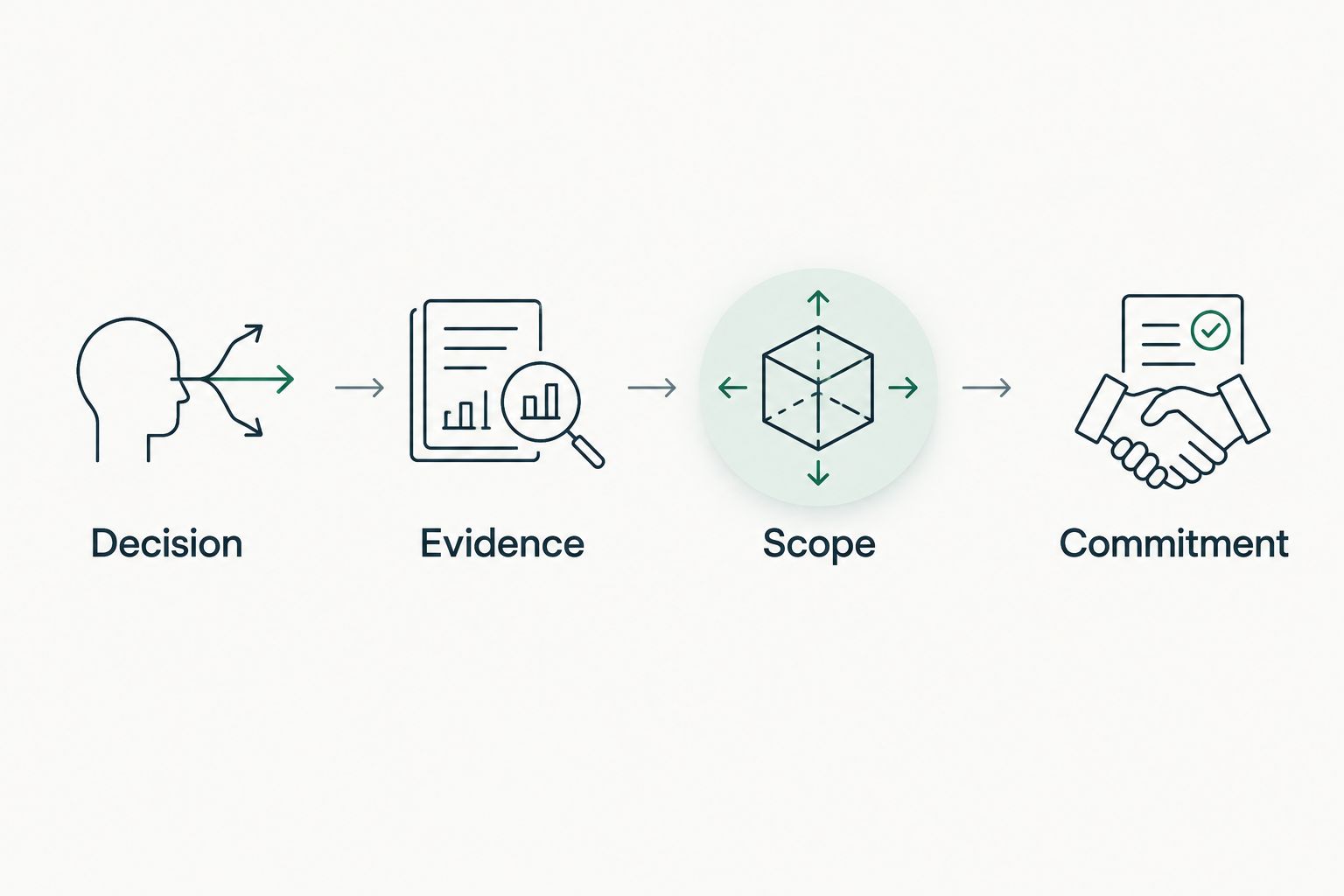
Use the SCOUTz Evidence-to-Agreement Framework: Find the decision, Bring the evidence, Build the scope, Earn the next commitment. It is an original conversation framework, not a validated close-rate intervention.
The sequence gives your preparation a destination. Each stage should leave the prospect with enough information to choose the next action, including declining work.
Decision
Find the decision before presenting the report. Establish whether the prospect wants to confirm configuration intent, investigate an unknown, assign ownership, or approve a change.
For example, a published DMARC policy requesting monitoring only supports a discussion about intended enforcement and reporting ownership. It does not establish compromise. Your decision question is whether monitoring-only remains intended and whether the owner wants further review.
Evidence
Bring the exact observation and its boundary. In a 2026 prospect deck, label the underlying observation with its actual run date, rather than using the deck's creation date as a substitute.
For the DMARC example, show the published policy observed during the review. Separate that record from questions about legitimate senders and report review. Those questions require additional evidence and owner input.
Scope
Build the scope around the agreed outcome. Keep the condition, affected object, unknowns, and recommended outcome separate from vendor selection.
The MSP chooses whether the response is a product, service, process change, project, or no change. Do not make a particular purchase the assumed answer to every observation.
Commitment
Earn a specific next commitment. Record the owner, permitted access, expected deliverable, and verification method. Agree on timing with the prospect instead of inventing urgency.
A useful commitment might authorize a review of reporting and sender context before anyone changes enforcement. It is narrower than permission to redesign the entire email-security environment.
Demonstrate the conversation without inventing an incident
The dialogue below is illustrative. It is not a customer transcript, a scan result, or evidence that a specific prospect has a problem.
Illustrative observation: A domain review returned a published DMARC policy requesting monitoring only. In an actual meeting, attach the check name, source, run date, and affected domain before using this statement.
MSP: “The review observed a monitoring-only DMARC policy. That record does not tell us whether the setting is intentional or who reviews the reports. Who owns that decision?”
Prospect: “Our current provider handles email. We are not looking to replace them.”
MSP: “We can keep this scoped to confirming intent with your provider. Would you prefer to ask them directly, or authorize us to help review the evidence with them?”
Prospect: “Send me the question first.”
MSP: “I will send the observation, its limits, and a request to confirm ownership and intended enforcement. We will leave configuration changes outside that request.”
The next commitment is permission to send a bounded question. Preserve that boundary in the follow-up. Do not treat it as approval for remediation or evidence of buying intent.
Compare scopes before writing the proposal
A finding can support several legitimate responses. Present the trade-offs so the buyer can choose the amount of work and access they want to authorize.
| Scope choice | Best for | Benefit | Limitation |
|---|---|---|---|
| Confirm intent and ownership | An observed condition with unclear context | Establishes responsibility before technical work | Does not verify that a change is needed or completed |
| Authorize a deeper review | Questions that public evidence cannot answer | Adds consented evidence within an agreed boundary | Depends on granted permissions, licensing, and source readability |
| Approve scoped remediation and verification | A condition with an agreed desired outcome | Defines work and the evidence needed to verify change | Requires separate change approval and a usable baseline |
| Document no change | A deliberate configuration the owner chooses to retain | Records the decision and its rationale | Does not establish that every related control was assessed |
Carry the selected scope into the proposal. Include the observed condition, exclusions, customer responsibilities, and acceptance evidence. The evidence-led MSP proposal guide provides a related preparation path.
For your 2026 proposal, keep unread evidence under NOT ASSESSED THIS SCAN. A clean-looking summary must not erase an access limitation.
What should you do when the prospect says it is already fixed?
Treat “already fixed” as a request to verify the current condition. Ask when the change occurred, identify the affected object, and obtain permission for the appropriate recheck.
Compare the new observation against the pinned baseline. If the evidence confirms the agreed change, report exactly that result and its scope. If the source is unreadable, keep the outcome unknown rather than declaring success or failure.
This also changes the sales conversation. A verified correction can remove an item from the proposed scope; do not keep selling work that the evidence no longer supports.
Should you lead with the highest-severity finding?
Lead with the highest-severity finding only when its evidence, relevance, and ownership support the meeting's decision. A severity label does not establish that a condition is current, understood, or unresolved.
Keep prospect-meeting preparation separate from incident handling. A suspected incident needs the appropriate authorized response process; it should not become a sales-pressure device. Equally, a low-severity observation can deserve discussion when it exposes unclear responsibility for an agreed business requirement.
FAQ
How many security findings should I bring to a prospect meeting?
Start with 3 discussion items as a practical agenda limit, then adjust to the decision the prospect needs to make. Keep supporting findings in an appendix rather than presenting every observation as equally urgent.
Can I prioritize Microsoft 365 findings from a public domain scan?
A public-domain scan cannot establish internal Microsoft 365 controls such as Conditional Access coverage or tenant sharing configuration. Use customer-authorized evidence and preserve permission, license, and readability limits.
Does a monitoring-only DMARC policy prove an email-security problem?
A monitoring-only DMARC policy establishes an observed policy setting, not compromise or an unresolved problem. Confirm intended enforcement, reporting ownership, and relevant sender context before proposing a change.
What should I do with findings I cannot verify?
Keep unverified findings separate from established observations and state what evidence is missing. Use them to request clarification or permission for further review, rather than presenting them as confirmed conditions.
Can SCOUTz replace technical judgment during sales preparation?
SCOUTz prepares dated cybersecurity evidence and account context; MSP judgment remains necessary. A person must review the claim, explain its limits, and own the recommendation before presenting it to the prospect.
How do I prove that a recommended change worked?
Prove the agreed change by comparing a rescan against a pinned baseline using the relevant check and affected object. Report the observed result and remaining coverage limits rather than claiming the entire environment is secure.
What should a security finding follow-up email include?
Include the observation, source, run date, evidence boundary, owner, and agreed next action. For a 2026 follow-up, use the actual observation date and distinguish permission to review from permission to change configuration.
One last thing
The most useful finding can be the one you remove from the proposal after verification. That decision shows that your scope follows the evidence, including evidence that reduces the work.
Before sending the follow-up, check that every proposed action traces back to an observation or an explicitly stated unknown. If SCOUTz fits your MSP prospect-intelligence workflow, make Join Open Beta your next step. The platform prepares the conversation; your team owns the recommendation and agreement.