
Yes, dark web monitoring data can support an MSP sales pitch when you present a dated match, explain its limits, and ask for an authorized next step. A breach-data match does not establish a currently compromised account, an unresolved security problem, or buying intent; your pitch must keep those claims separate.
- Can dark web monitoring data be used in a sales pitch? Yes, as bounded evidence for an authorized review.
- A breach-data match does not prove that an account remains compromised or that credentials still work.
- Keep source dates, observation dates, unknowns, and the proposed next action attached to every finding.
- SCOUTz prospect intelligence fits MSP sales preparation; the MSP retains responsibility for the conversation and sale.
Why this matters
A frightening slide can overstate what the evidence supports. If your source establishes an address match, a claim about active account access exceeds the evidence. The commercial task is to turn that limited observation into a useful decision without manufacturing urgency.
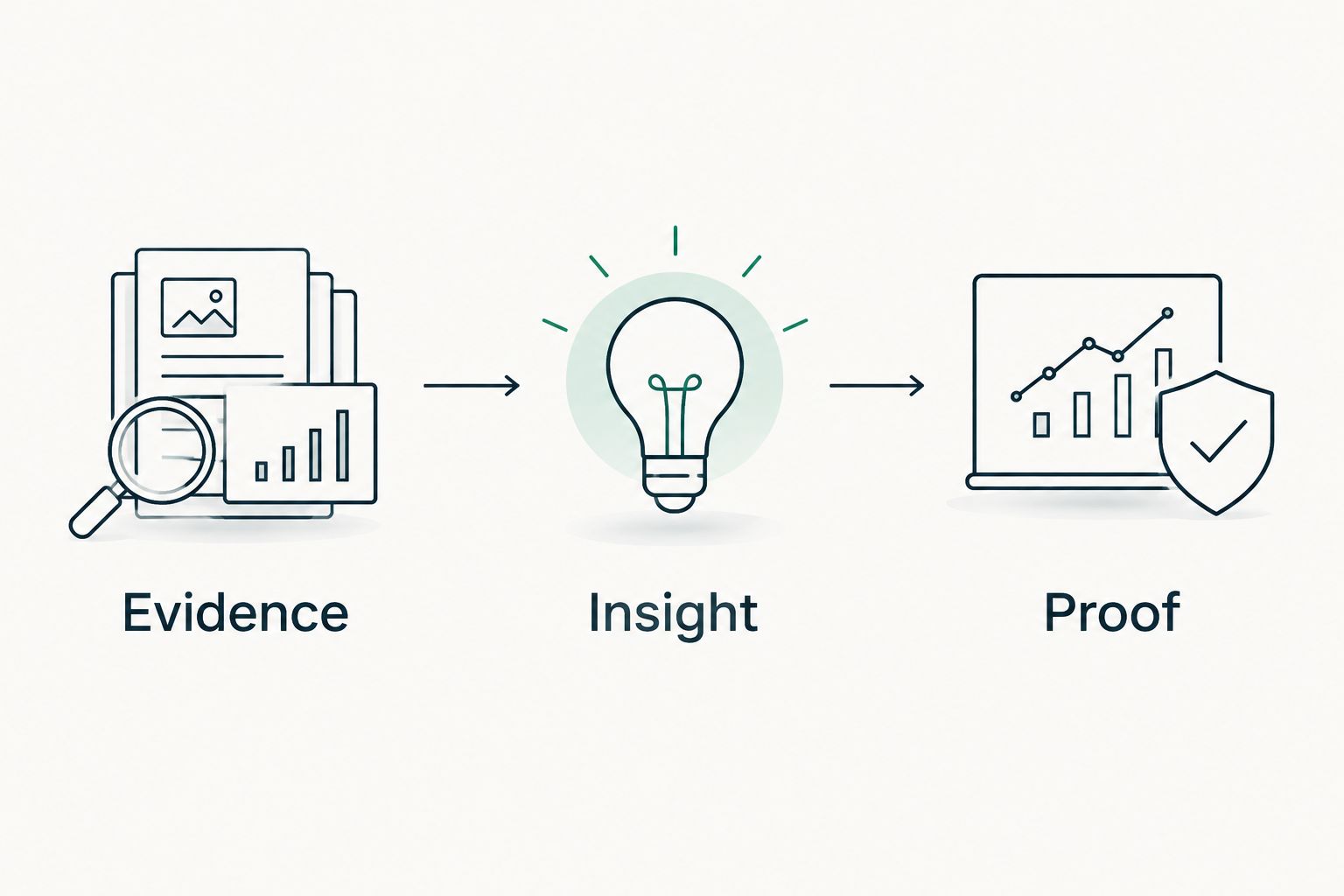
SCOUTz describes this discipline as Evidence · Insight · Proof. For a 2026 sales conversation, apply it literally: identify what the source returned, explain the question it raises, and agree on how to verify the relevant condition. A historical exposure and a present-day control assessment answer different questions.
Can dark web monitoring data be used in a sales pitch?
Use dark web monitoring data to propose verification, not to announce a breach. Start with a source-backed observation and end with a choice the prospect can accept, narrow, or decline.
Use this sequence before presenting a finding:
- Identify the source. Record the provider or dataset reference, what was matched, and what the source actually claims. Distinguish a domain match from a match to a particular business account.
- Attach the dates. Keep the reported incident date, provider observation date, and your retrieval date separate. When a date is unavailable, mark it unknown.
- State the boundary. Say whether current account status, credential validity, and subsequent remediation remain unknown. Never test exposed credentials to strengthen a sales claim.
- Identify the owner. Ask who is authorized to review identity security and whether an existing provider has already addressed the observation.
- Offer a bounded next step. Propose a consented review with named evidence, exclusions, an owner, and an agreed decision point.
Your packet should contain 6 fields: condition, affected object, source and dates, unknowns, responsible owner, and proposed outcome. That is a preparation checklist, not a security score.
Which evidence supports which sales claim?
A useful comparison separates evidence sources by the job each can do. None establishes every part of an account's security posture.
| Evidence option | Best for | Useful contribution | Limitation |
|---|---|---|---|
| Breach-data match from a monitoring provider | Opening a verification discussion | Shows the association reported by that source | Does not establish current credential validity, compromise, or unresolved exposure |
| Public-domain review | Preparing questions about externally observable conditions | Records public-domain observations at a stated time | Cannot establish internal Microsoft 365 controls |
| Customer-authorized Microsoft 365 review | Reviewing in-scope configuration and metadata | Supports questions about controls visible through the approved permissions | Permission and license limits leave parts of the environment unassessed |
Keep public-domain evidence separate from customer-authorized internal evidence. A domain review cannot establish Conditional Access coverage, application permissions, license assignments, Intune device state, or tenant sharing configuration.
A Microsoft 365 configuration review also has limits. Configuration and metadata are distinct from mail, files, chats, documents, and prompts. Do not present permission to review configuration as permission to read content.
For a 2026 proposal, write those boundaries into the scope before asking for access. The prospect should understand what the review will read and what it will leave unknown.
Why the usefulness of dark web monitoring data varies
The same apparent match can support different conversations. Review these factors before deciding whether it belongs in a pitch:
- Source provenance. A finding needs an attributable source and a clear description of what the provider reported. An unexplained screenshot is insufficient context.
- Date clarity. Separate when an event reportedly occurred from when the provider observed it and when you retrieved it. Retrieval in 2026 does not make the underlying event recent.
- Account relevance. Establish whether the affected identifier belongs to the organization and whether the responsible owner considers it relevant today.
- Evidence coverage. A match cannot fill gaps in tenant visibility. Unreadable or unassessed sources stay explicitly unknown.
- Remediation context. Ask whether the organization already investigated the observation. The source alone does not establish an unfinished task.
- Decision ownership. Identify who can authorize review and choose an action. A technical contact and a purchasing decision-maker can have different responsibilities.
These factors govern the strength of your claim. They do not justify turning uncertainty into a more alarming headline.
Turn the finding into evidence, insight, and proof
Evidence
State the condition your source supports. For example, describe an identifier reported in a breach dataset without adding a claim about successful access.
Keep 3 dates distinct wherever available: the reported event date, the provider's observation date, and your retrieval date. If the source supplies only one, preserve the other dates as unknown rather than copying that date into every field.
Insight
Explain the decision the observation raises. The useful question is whether the account remains relevant and whether the owner wants to verify the related controls.
Use evidence states deliberately. Observed, Inferred, Possible, Unknown, and Unreadable are different descriptions, not steps on a severity ladder. Coverage is separate: an assessment can be Partial or Permission limited without proving that a control is absent.
Proof
Define what would verify the agreed outcome. A later configuration review or rescan can support a specific control claim against a pinned baseline; it cannot prove that a historical dataset has disappeared or that an account was never misused.
In your 2026 evidence packet, separate the observed condition from the recommended outcome and the vendor choice. The prospect can choose a process change, a service, a project, further investigation, or no action. Your finding should remain accurate whichever choice follows.
Move from a finding to an agreed sales action
The SCOUTz Evidence-to-Agreement Framework has 4 stages: Find the decision, Bring the evidence, Build the scope, and Earn the next commitment. It is a conversation framework, not a proven close-rate intervention.
Find the decision
Establish what the prospect wants to decide before displaying sensitive details. You need an accountable owner and a relevant business question, not agreement with an alarming interpretation.
Illustrative seller wording: “The source reports an address match. Before we review the detail, who owns identity-security decisions, and has this observation already been investigated?”
This opening leaves room for an existing provider to have completed the work. It also avoids making the prospect defend an incident you have not established.
Bring the evidence
Present the source, dates, matched object, and limitations together. Redact sensitive identifiers in meeting materials and avoid placing credential material in a sales deck.
Illustrative seller wording: “This is the provider's reported match. We have not established that the account is active, that any credential remains valid, or that unauthorized access occurred.”
Have a person approve the claim before presentation. A polished explanation does not improve the underlying evidence.
Build the scope
Offer 2 scope choices that answer different questions. Keep the smaller choice genuinely useful rather than using it as a route to an automatic upsell.
| Scope choice | Best for | Intended output | Boundary |
|---|---|---|---|
| Evidence clarification | A prospect checking relevance with an existing owner | An agreed record of the source, dates, account relevance, and known handling | Does not establish current tenant configuration |
| Authorized configuration review | A prospect seeking visibility into specified Microsoft 365 controls | Dated configuration observations, coverage limits, and recommended outcomes | Does not establish a breach or provide a full incident investigation |
Write the expected deliverable before naming a product. The prospect's question determines the review, and the MSP chooses the appropriate service or process.
Earn the next commitment
Ask for a specific permission or decision. A sensible next commitment names the owner, the evidence to review, the intended output, and the follow-up point.
Illustrative follow-up script: “We discussed a reported address match with current account status still unknown. Please confirm whether your existing provider will review it or whether you want us to scope an authorized configuration review. We will agree the access boundaries before proceeding.”
That script advances a decision without treating an email response as buying intent. An email open is only a follow-up cue.
Handle objections without escalating the claim
If the prospect says the finding is old, accept the distinction between a historical record and a current condition. Ask whether the responsible owner has already assessed it. Do not relabel retrieval time as incident time.
If the prospect says an existing provider handled it, ask what decision remains. When nothing remains to assess, close the finding-based conversation rather than implying unfinished remediation.
If the prospect declines access, preserve that boundary. Offer a written explanation of the source and unknowns, or end the review. Declined permission is not evidence of a security problem.
Keep outreach separate from assessment permission
Permission to have a sales conversation does not automatically authorize a tenant review, active probing, or credential testing. Distinguish public observation from active assessment and establish the permitted scope before proceeding.
For outreach in 2026, offer a review as an opt-in courtesy after a reply. Report emails need appropriate sender identity and opt-out handling; review the separate guidance on emailing an unsolicited security report before designing that workflow.
This is sales-preparation guidance, not legal clearance for scanning or data use. Obtain appropriate advice for your proposed activity, jurisdiction, and data-handling arrangements.
Where prospect intelligence fits
SCOUTz cybersecurity prospect intelligence is best for MSPs preparing evidence-led sales conversations. It supplies dated cybersecurity evidence and account context through domain and customer-authorized Microsoft 365 reviews.
The fit has a boundary: prospect intelligence supports preparation; it does not establish buying intent or replace an incident investigation. The relationship and sale stay with the MSP.
The client-provided October 15, 2026 product reference labels Microsoft 365 Review as Open Beta. Join Open Beta is the next step for MSPs evaluating that workflow; confirm the current scope before relying on a review for a proposal.
FAQ
Can dark web monitoring data be used in a sales pitch?
Yes, dark web monitoring data can support an MSP sales pitch when the source, dates, limits, and proposed next step remain explicit. Use a match to request verification rather than to declare a breach.
Does a breach-data match mean a prospect has been hacked?
A breach-data match does not establish that the prospect is currently compromised. Account relevance, credential validity, subsequent remediation, and unauthorized access require separate evidence.
Should I show exposed passwords during an MSP sales meeting?
Do not show exposed passwords in a sales meeting. Present a redacted observation with its source and limits, and keep sensitive material out of sales decks.
Can a public-domain review show whether Microsoft 365 MFA is enforced?
A public-domain review cannot establish internal Microsoft 365 control coverage. Assess relevant configuration through a customer-authorized review and disclose permission or license limits.
What should I do if the prospect says the finding was already fixed?
Ask the responsible owner what was reviewed and whether any decision remains. Do not claim an unresolved problem from a historical match alone.
Can I test leaked credentials before approaching a prospect?
Do not test leaked credentials to strengthen a sales pitch. A source match does not authorize account access; agree a legitimate assessment scope separately.
What should the next step be after presenting a dark web finding?
The next step should be an agreed decision, such as owner clarification or a scoped, authorized review. Name the evidence, access boundaries, deliverable, and responsible owner before proceeding.
One last thing
Successful verification does not require the historical match to disappear. Define proof around the outcome you actually agreed to assess, such as a documented configuration condition or a confirmed handling decision. Otherwise, an unchanged dataset can keep generating the same sales alarm after the relevant work is complete.