
Yes. MSPs can check Microsoft 365 guest risk before a client signs a managed services agreement, provided an authorized customer representative approves the internal review; public-domain evidence alone cannot establish guest access, tenant sharing configuration or Conditional Access coverage.
- Can MSPs check Microsoft 365 guest risk before a client signs? Yes, with customer-authorized tenant evidence.
- Public-domain observations cannot establish Microsoft 365 guest access or tenant sharing configuration.
- SCOUTz supports evidence-led MSP sales preparation; findings still require scope, dates, coverage limits and human judgment.
- Agree on an owner and next action before turning a guest-access observation into proposal scope.
Why this matters
A guest account is a starting point for investigation. Its presence does not establish inappropriate access, compromise or a problem that remains unresolved. Your prospect needs to understand what was observed, why it matters to their collaboration needs and what decision follows.
For a 2026 presales review, separate permission to assess from commitment to buy. The customer can authorize a bounded review before selecting an MSP, while retaining control over access and any proposed changes. The distinction between Microsoft 365 external sharing and a data leak is essential to that conversation.
A useful guest review ends with an agreed decision, supported by dated evidence. A list of alarming account names does not meet that standard.
Can MSPs check Microsoft 365 guest risk before a client signs?
Yes, through an authorized review with explicit boundaries. Use this sequence before collecting internal tenant evidence:
- Identify the customer representative authorized to approve the review.
- Record the tenant, review purpose, permitted sources and intended recipients.
- Explain the requested permissions and read-only boundary before consent.
- Collect only the approved configuration and metadata available to the review.
- Attach the source, check, run date and coverage limits to each observation.
- Review the interpretation with the customer before proposing work.
A managed services signature and assessment authorization serve different purposes. Record the assessment authorization separately when the commercial agreement is still under discussion. Have the customer identify who can approve it; a meeting invitation is not authorization.
Choose the evidence path that fits the decision
| Review path | Best for | Useful evidence | Limitation |
|---|---|---|---|
| Public-domain review | Preparing an initial domain or email-security conversation | Publicly observable domain conditions | Cannot establish internal guest access, license assignments or tenant sharing configuration |
| Customer-authorized Microsoft 365 review | Preparing a tenant-specific guest-access discussion | Approved configuration and metadata that the review successfully reads | Conclusions depend on permissions, licensing, coverage and collection date |
Public evidence helps you prepare relevant questions without treating the prospect as an assessed tenant. Authorized internal evidence supports more specific questions, but consent does not make every source readable or every conclusion certain.
Keep public observation separate from active probing. This workflow is assessment guidance, not blanket legal clearance for scanning prospects.
What should an MSP examine in an authorized guest review?
Start with the customer's decision. An MSP assessing whether external collaboration has an accountable owner needs different evidence from an MSP investigating a particular access concern.
For each source below, confirm that it falls within authorization and was actually read. These are review questions, not a claim that any particular collector returns every field.
Guest identity and business ownership
Identify the guest object under discussion and ask who sponsors the relationship. Establish whether the external person still needs collaboration access and who can approve its continuation.
An unfamiliar guest name is not proof of an unauthorized identity. Record an unconfirmed owner as Unknown until the customer supplies evidence. Avoid recommending deletion solely because the sales team does not recognize the account.
Access and collaboration context
Where authorized evidence is available, examine the relevant membership, assignment or sharing configuration. Keep the affected object attached to the finding.
A guest directory object does not, by itself, establish every resource that person can access. Equally, a readable tenant-level setting does not prove that a particular document was shared or accessed. State the boundary of the evidence you have.
Authentication and policy coverage
Review the applicable authentication and access-policy evidence only where the approved sources support it. Distinguish a policy's existence from its applicability to the guest population being discussed.
For a 2026 assessment, record the collection date alongside the policy evidence. If you cannot establish effective coverage, say so. Registration information alone does not settle whether an access requirement is enforced.
Activity and lifecycle evidence
Use available activity metadata within its stated coverage. Record the observation window and any limitations before interpreting apparent inactivity.
Missing or unread activity is not evidence that an account is unused. Ask the business owner to confirm the collaboration need before proposing a lifecycle change. Business context belongs beside the technical observation, not in a footnote.
Why guest-risk conclusions vary
Guest-risk conclusions vary because the evidence answers different questions. Keep these factors visible in the report:
- Authorization scope determines which tenant sources the customer permits you to examine.
- Permission limits determine which approved sources the review can actually read.
- License limits affect which evidence is available for the assessment.
- Collection dates and observation windows limit what the evidence establishes about time.
- Business ownership determines whether continued collaboration has an accountable sponsor.
- Resource and policy context determines whether an observed setting applies to the guest under discussion.
Do not collapse these factors into a claim that the tenant is safe or unsafe. A specific configuration observation supports a specific discussion. It does not establish the tenant's entire security condition.
Keep evidence state separate from coverage
Use evidence states to describe the claim: Verified, Observed, Inferred, Possible, Unknown or Unreadable. These are distinct meanings, not a progression from bad to good.
Use coverage labels separately: Assessed, Partial, Not assessed, Permission limited or License limited. A successfully read directory source can coexist with unread policy evidence.
For example, you can observe that a guest object exists while leaving its business ownership Unknown. You can also record that a relevant policy source was Permission limited. Neither statement cancels the other.
Put declared non-reads under NOT ASSESSED THIS SCAN. In a 2026 proposal, preserve that limitation when copying the finding into the scope document. An unread source must not become a clean result during sales editing.
Turn guest evidence into an agreed next action
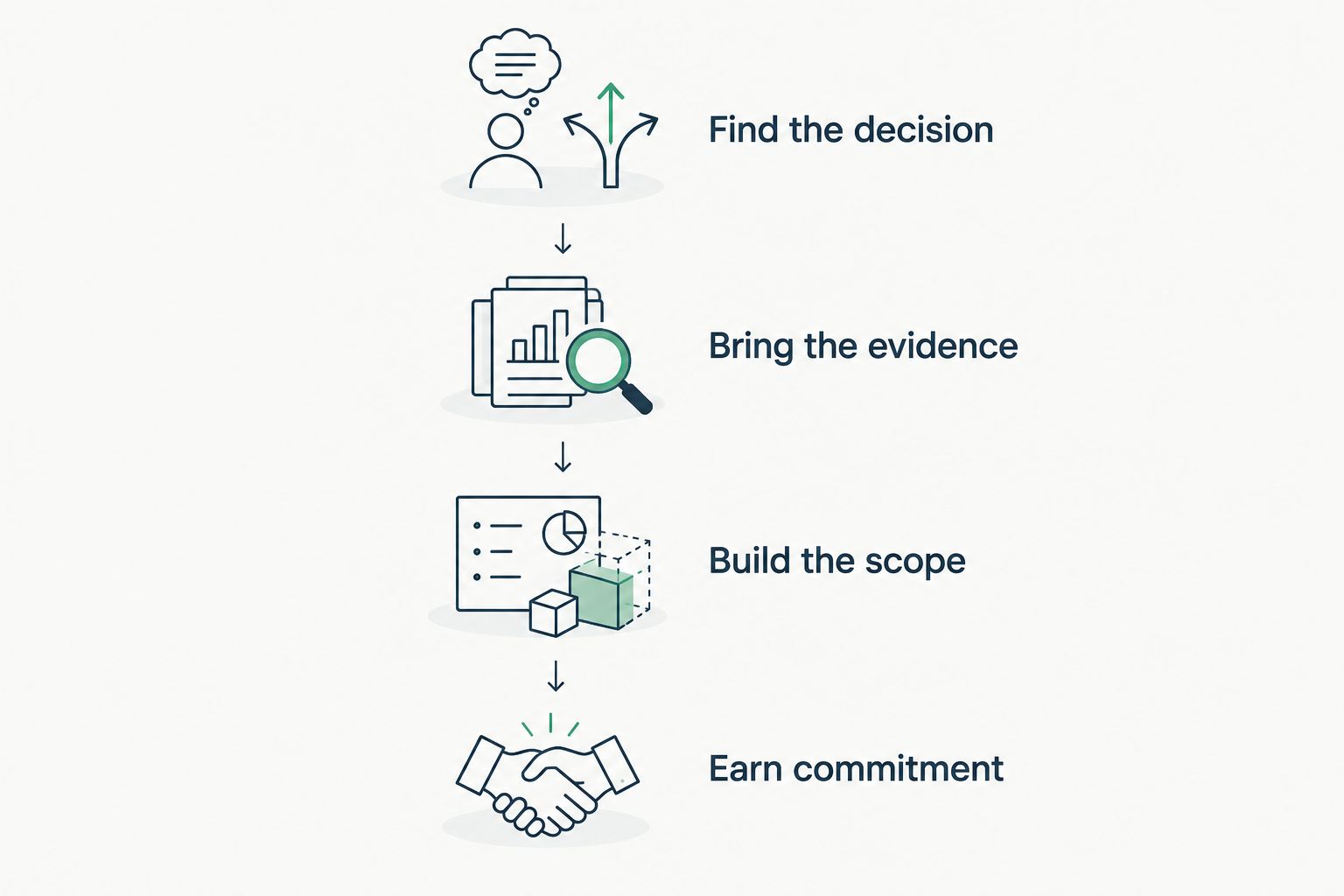
Use the SCOUTz Evidence-to-Agreement Framework to move from discovery to a decision. This is a conversation framework, not a validated close-rate intervention. The customer retains the choice to investigate, change something, retain the current arrangement or defer.
Find the decision
Ask the prospect which decision the review should support. Examples include confirming guest ownership, understanding an external collaboration process or deciding whether a deeper assessment belongs in the proposal.
Keep the decision narrower than a general promise to secure Microsoft 365. Name the person who can approve the next step.
Bring the evidence
Present the observed condition, affected object, source, check and run date. Then state what the review did not establish.
Use the evidence, insight and proof sequence: what ran, why the observation matters to this decision, and what later verification would establish. Keep consequences conditional when the evidence supports only a possibility.
Build the scope
Separate the recommended outcome from the vendor or service choice. The MSP chooses whether the answer is a process change, project, product, service or no change.
Define the objects in scope, responsible owner, authorization boundary and acceptance evidence. Avoid making account removal the default deliverable before the customer confirms business need.
Earn the next commitment
Request a specific, voluntary next action. That might be an owner-validation session, authorization to inspect a missing source or approval to price a bounded project.
Record who agreed to do what and the agreed follow-up date. Agreement to discuss a finding is not agreement to purchase remediation.
Illustrative dialogue, not a customer result
The following exchange demonstrates the approach. It is not a quotation from a customer or a report of an actual assessment.
MSP: The authorized review observed guest objects. Their continued business purpose has not been confirmed. Can your collaboration owner validate which relationships remain active?
Prospect: We work with external partners. We cannot remove their access without checking.
MSP: Agreed. The next step is ownership validation. We can scope that separately, then discuss changes only where your team confirms an outcome.
Prospect: Send the proposed scope to the person responsible for collaboration.
The commitment is a scope review by an identified owner. The conversation has not established a breach, an unnecessary account or an approved purchase.
Handle an objection without expanding the claim
If the prospect says the existing provider already manages guests, acknowledge that possibility. Ask whether the customer wants the observation checked against the current provider's records before discussing additional work.
If the prospect declines tenant access, retain the public-evidence boundary. Offer a customer-led discussion or defer the internal assessment. Refusal to authorize a review is not evidence of a security weakness.
Compare proposal scope by the outcome
Use scope comparisons to make the next choice understandable. These are illustrative service scopes, not named product tiers.
| Proposed scope | Best for | Deliverable | Boundary |
|---|---|---|---|
| Ownership validation | Establishing business accountability | Customer-confirmed ownership and disposition decisions for agreed objects | Does not establish effective policy coverage |
| Policy evidence review | Resolving a specific coverage question | Dated findings from approved, readable configuration sources | Does not prove that an incident occurred |
| Change and verification | Confirming an approved configuration outcome | Authorized change record and rescan against a pinned baseline | Requires separate change authorization and comparable evidence |
For 2026 proposal work, preserve the baseline instead of replacing it with the latest screenshot. Proof requires a comparison against the pinned starting point, with any coverage differences disclosed.
A follow-up can be short: attach the dated observation, repeat its boundary, name the requested owner and ask for approval of the selected scope. Do not describe a proposed action as committed work.
Where SCOUTz fits
SCOUTz is best for MSPs preparing prospect conversations with dated cybersecurity evidence and account context. SCOUTz cybersecurity prospect intelligence prepares the conversation; the relationship and sale stay with the MSP.
The client-provided product reference dated October 15, 2026 places Microsoft 365 Review in Open Beta. The stated review boundary is read-only configuration and metadata, with no agent, install or automatic configuration changes. It excludes mail, files, chats, documents and prompts.
Those boundaries support a focused presales review. The trade-off is equally important: review output cannot answer questions outside its readable evidence, and findings still need customer context and human sign-off. For MSPs considering SCOUTz cybersecurity prospect intelligence, Join Open Beta is the primary next step through SCOUTz.
FAQ
Can we review Microsoft 365 guests before the managed services contract is signed?
Yes, if an authorized customer representative approves the internal assessment. Record its scope and permissions separately from the pending managed services agreement.
Can a public domain scan show who has guest access?
No. Public-domain evidence cannot establish internal guest access, tenant sharing configuration or Conditional Access coverage.
Does finding a guest account mean the tenant is compromised?
No. A guest account's presence establishes neither compromise nor inappropriate access; confirm its business purpose and examine relevant authorized evidence.
Can a read-only review change guest permissions?
A read-only review does not change guest permissions. Any proposed configuration change requires a separately authorized action.
What should we report when a source cannot be read?
Report the source as unread or not assessed, with the applicable permission or license limitation. Do not convert missing evidence into a clean result.
Should we remove guests that appear inactive?
Do not recommend removal solely from apparent inactivity. Confirm the evidence window, business owner and continuing collaboration need before proposing a change.
What proves that an approved guest-access change worked?
A rescan against a pinned baseline supports verification of the specific approved outcome. Disclose differences in source coverage or permissions that limit the comparison.
One last thing
An assessment can be useful even when it recommends no configuration change. Confirming a guest's owner and documenting an intentional collaboration arrangement gives the customer a defensible decision.
Before sending the proposal, check that every recommended action has an owner, an authorization boundary and an observable completion condition. That is the bridge from a finding to agreed work.