
Train an MSP sales team on evidence-led selling until each rep can explain a dated finding, state its limits and earn an agreed next action without overstating the evidence. Use demonstrated readiness, rather than a fixed number of days, as your completion rule for 2026. Tool familiarity is only part of the work; reps also need supervised practice connecting evidence to buyer decisions and proposal scope.
- How long does it take to train a sales team on evidence-led selling? Use demonstrated readiness, not calendar attendance.
- SCOUTz supports MSP sales preparation with dated cybersecurity evidence; the MSP owns the relationship and sale.
- Keep public-domain observations separate from customer-authorized Microsoft 365 configuration evidence.
- Finish training when reps can explain boundaries, build justified scope and secure an agreed next action.
Why this matters
A rep can read a security report accurately and still mishandle the conversation. A published policy becomes an accusation. An unread source becomes reassurance. A possible consequence becomes a claim that the prospect has an unresolved problem.
Training succeeds when the rep preserves the evidence boundary and helps the buyer choose what happens next. That requires more than learning where to open a report.
SCOUTz is best for MSPs preparing sales conversations with dated domain and customer-authorized Microsoft 365 evidence. It supplies conversation material; your team still needs the judgment to use that material responsibly.
How long does it take to train a sales team on evidence-led selling?
Set the training duration by the work each rep can demonstrate. A technically experienced seller still needs to practice consent, consequence language and scope agreement. A strong relationship seller still needs to distinguish an observation from an inference.
Use this progression to decide when supervised practice ends:
- Identify the finding's source, check, run date and affected object.
- Explain the observed condition without adding an unsupported incident or business impact.
- State what the review assessed and what remains unknown.
- Ask the buyer to confirm ownership, intent and relevance.
- Translate the agreed concern into bounded scope and an explicit next commitment.
- Explain how a later review will compare evidence against the pinned baseline.
Do not substitute attendance for demonstration. Keep coaching the specific behavior that fails, rather than restarting the entire course or declaring everyone ready together.
Build training around the Evidence-to-Agreement Framework
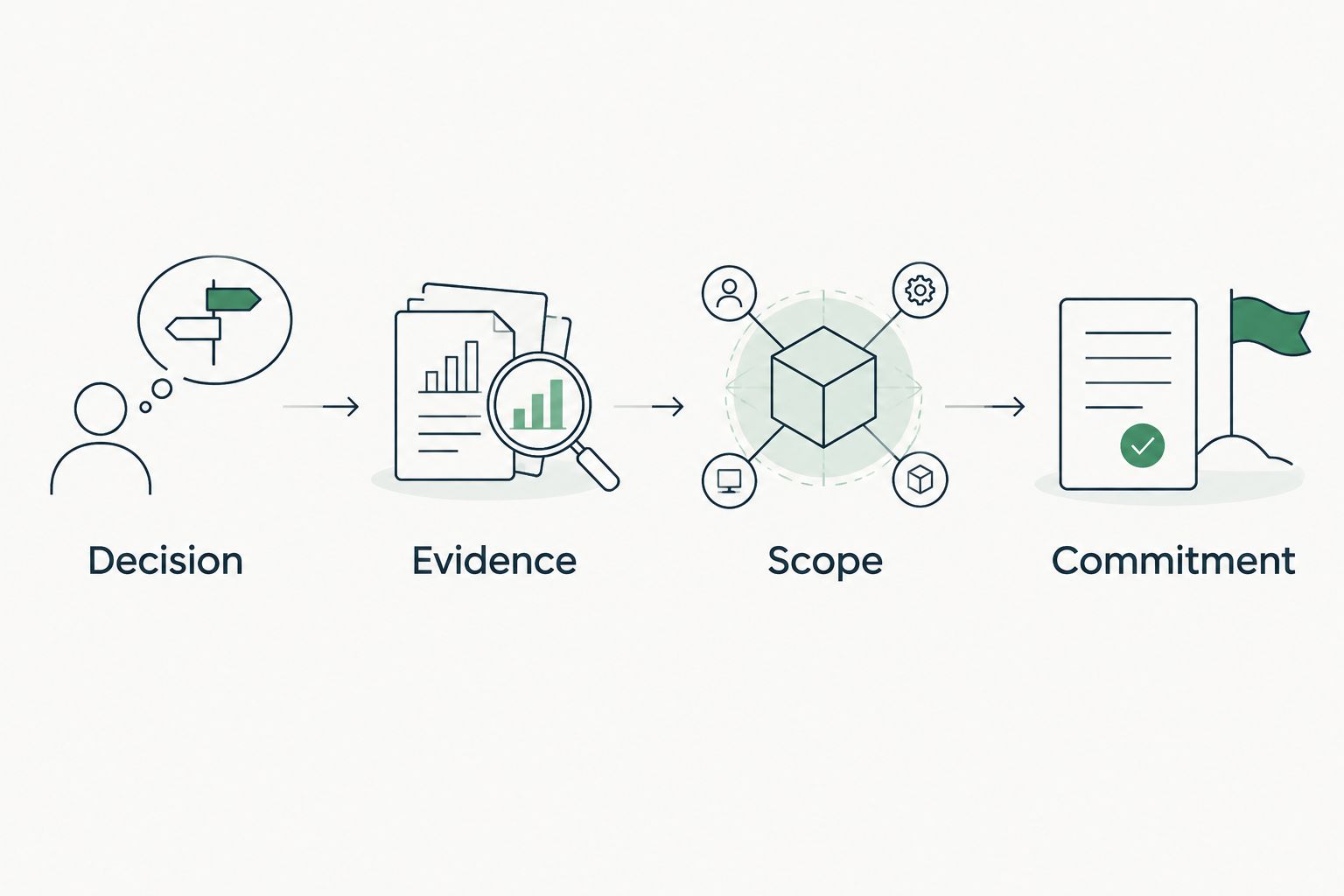
The SCOUTz Evidence-to-Agreement Framework gives your training a conversation structure: Find the decision, Bring the evidence, Build the scope, Earn the next commitment. The client-approved editorial direction dated October 24, 2026 describes it as an original conversation framework, not a validated psychological model or a proven close-rate intervention.
Teach each stage with a real, authorized evidence packet or a clearly labeled illustrative exercise. Keep the technical condition separate from the buyer's decision.
Decision: find the decision
Ask the rep to identify what the meeting needs to resolve. That might be whether to authorize a tenant review, confirm responsibility for email authentication or scope further investigation.
A useful answer names the decision owner and the requested choice. A weak answer names only the service the MSP wants to sell. Coach the rep back to the buyer's actual decision before introducing findings.
Evidence: bring the evidence
Require the rep to show what ran, when it ran and what it observed. Keep the check and affected object attached to the finding. Explain the scope of collection before discussing consequences.
For public-domain evidence, the rep must not imply visibility into internal Microsoft 365 controls. For customer-authorized tenant evidence, the rep must name permission and license limits. Unread evidence stays unknown.
Scope: build the scope
Connect the agreed condition to a recommended outcome, then discuss the work needed to establish or achieve that outcome. Keep vendor selection separate from the condition.
The MSP can recommend a product, service, process, project or no action. Training should preserve that choice. A finding does not automatically justify replacing the incumbent provider or selling a broader managed service agreement.
Commitment: earn the next commitment
Practice asking for a specific next action with an owner. Appropriate outcomes include a consent decision, a technical review with the responsible administrator or an agreed proposal boundary.
A pleasant meeting is not an agreement. Record what the buyer actually accepted, what remains undecided and what evidence the next conversation needs.
Why training time varies
Your training workload depends on the gaps revealed in practice. Use these factors to assign coaching, rather than treating every rep as the same learner:
- Technical interpretation: Reps need to separate a configuration observation from a confirmed incident and recognize when practitioner review is necessary.
- Evidence access: Public-domain observations and customer-authorized tenant reviews require different explanations of consent, scope and visibility.
- Consequence language: Reps need to connect a condition to a possible business concern without inventing loss figures or claiming compromise.
- Scope discipline: Reps need to distinguish investigation, configuration work, ongoing ownership and verification before proposing delivery.
- Sales judgment: Reps need to ask for a decision while preserving the buyer's right to defer, investigate or decline.
- Coaching consistency: Sales leaders and technical reviewers need the same standard for acceptable claims and documented unknowns.
Train the missing behavior, not the job title. An experienced seller does not automatically understand evidence boundaries, and technical fluency does not automatically produce an agreed next step.
Teach evidence boundaries before practicing the pitch
Use the following comparison in your 2026 training materials. Both evidence sources can support useful conversations, but their visibility differs. Neither establishes buying intent.
| Evidence source | Best for | Useful evidence | Limit to teach |
|---|---|---|---|
| Public-domain observations | Preparing domain and email-security questions | Published records and externally observable conditions, with source and run date | Cannot establish Conditional Access coverage, app permissions, license assignments, Intune state or tenant sharing configuration |
| Customer-authorized Microsoft 365 review | Discussing internal configuration with consent | Configuration and metadata within the authorized review scope | Permission and license limits remain explicit; the review does not read mail, files, chats, documents or prompts |
Public observation also differs from active probing. Train reps to follow your approved assessment process and obtain the necessary authorization rather than promising blanket permission to scan prospects.
Keep evidence state separate from coverage. Observed, Inferred, Possible and Unknown describe different claims. Assessed, Partial, Not assessed, Permission limited and License limited describe coverage. Neither vocabulary is a simple ladder from bad to good.
For exercises that require unavailable sources, teach reps to carry declared non-reads into NOT ASSESSED THIS SCAN. An empty section must not become a clean bill of health.
Practice a finding all the way to an agreed action
Use a published DMARC policy requesting monitoring only as an illustrative exercise. The teaching goal is to clarify intent and ownership, not to manufacture urgency.
Attach the actual source and run date when using a real observation. The example below describes a training scenario, not a finding about a named prospect.
Illustrative discovery dialogue
Seller: The reviewed DMARC record requests monitoring only. That describes the published policy at the time of the review. It does not establish that anyone has compromised an account.
Buyer: Our current provider handles email security.
Seller: That gives us an owner to involve. Is monitoring-only still the intended policy, and who reviews the reports before any enforcement change?
Buyer: I would need the administrator to confirm that.
Seller: Let's ask the administrator to confirm the intended policy and reporting owner. After that review, you can decide whether any configuration work belongs in scope.
The seller has preserved the condition, named the boundary and offered a choice. The buyer has not agreed to remediation or a provider change.
Illustrative objection handling
Buyer: We already have someone looking after this.
Seller: Then the next step can stay with that owner. We can document the observation and ask whether it reflects the intended configuration.
Buyer: Can you tell us whether this means we have been breached?
Seller: This observation does not establish a breach. A different question requires appropriate evidence and an authorized investigation.
Assess the rep's restraint as closely as the explanation. The rep should be able to stop where the evidence stops without losing the next action.
Illustrative follow-up script
Our discussion identified a published monitoring-only DMARC policy in the dated review. You agreed to ask the responsible administrator to confirm whether that policy remains intended and who reviews the reports. The next conversation will decide whether further investigation or configuration work is appropriate. No remediation scope has been agreed.
Use this exercise alongside MSP sales objection roleplay. Review whether the follow-up preserves the buyer's actual commitment instead of upgrading interest into agreement.
Review scope before allowing independent proposals
A rep is not ready for independent proposals simply because the explanation sounds confident. Ask the rep to show how the evidence supports the proposed work.
| Scope option | Best for | Benefit | Boundary or drawback |
|---|---|---|---|
| Clarify ownership and intent | A condition whose purpose remains unknown | Establishes who decides and whether the configuration is deliberate | Does not itself establish a remediation need |
| Conduct an authorized review | Questions beyond the current evidence | Creates a defined route to additional evidence | Requires consent and explicit collection limits |
| Propose an agreed change and verification | A confirmed desired outcome with an accountable owner | Connects delivery to a baseline and later evidence | Requires delivery judgment beyond the sales finding |
These are scope choices, not a mandatory escalation path. The buyer can choose no action. Your delivery team should review proposed work before the seller commits to an outcome outside the evidence.
For a 2026 readiness review, inspect the proposed outcome, affected objects, exclusions, owner and verification method. Reject scope that relies on an invented incident or an assumption that an unread control is absent.
Use a practical readiness review
Ask the rep to present an evidence packet, handle an objection and draft the follow-up. Have a sales leader review the requested commitment and a qualified practitioner review the technical claims.
Record the specific correction needed. Examples include a missing run date, an implication presented as a fact or a proposal that exceeds the assessed scope. Repeat the affected exercise after coaching.
Keep readiness records separate from sales results. Demonstrating safe evidence handling does not prove a higher close rate or a shorter sales cycle. If you later evaluate commercial outcomes, define the measurement and scope before making performance claims.
Can salespeople use security evidence without an engineer?
Salespeople can use reviewed security evidence within a defined interpretation boundary. Give reps approved explanations and clear escalation rules for unread sources, conflicting findings and questions outside the assessment scope.
A practitioner should review technical claims before they become client-facing commitments. Training should make escalation a normal part of responsible selling.
Does learning the software finish the training?
Learning the software finishes only the tool-navigation component. Reps still need to demonstrate consequence language, consent boundaries, scope discipline and accurate follow-up.
The client-provided product reference dated October 15, 2026 places SCOUTz Microsoft 365 Review and evidence reporting in Open Beta. Treat those status labels as dated references. The platform prepares evidence; it does not replace MSP judgment or automatically change configurations.
FAQ
How long does it take to train a sales team on evidence-led selling?
Use demonstrated readiness rather than a fixed number of days. Finish supervised training when each rep can explain dated evidence, preserve its limits, build justified scope and document an agreed next action.
What's the first skill an MSP sales rep should learn?
Teach the rep to distinguish an observed condition from an inference or possible consequence. Require the source, check, run date and coverage boundary to stay attached to the explanation.
Can a domain review show whether Microsoft 365 security controls are working?
A public-domain review cannot establish internal Microsoft 365 control coverage. Customer-authorized configuration evidence is needed for questions such as Conditional Access coverage or tenant sharing configuration.
Should technical staff attend evidence-led sales training?
Technical staff should help review claims and escalation boundaries. Sales leaders should assess whether the rep reaches a buyer-owned decision without overstating the evidence.
How do I know a rep is ready to send proposals?
A rep is ready when the proposed work follows from the evidence and the buyer's agreed outcome. Check scope, exclusions, ownership and verification before approving independent proposals.
Does evidence-led sales training guarantee more MSP contracts?
Evidence-led sales training does not guarantee contracts or sales improvements. Readiness assessment demonstrates specific selling behaviors, not a measured commercial result.
What should a rep say when evidence could not be read?
The rep should say the evidence is unknown or unreadable and explain the coverage limit. An unread source does not establish that a control is present, absent or effective.
One last thing
Include a deliberate unknown in your next training exercise. Watch whether the rep discloses it or tries to fill the gap with confidence. That moment tests evidence discipline better than a polished explanation of an obvious finding.
For teams evaluating SCOUTz in 2026, choose Join Open Beta as the next step and confirm the current application process. Keep the responsibility clear: the platform prepares the conversation; the relationship and the sale stay yours.