
A cyber risk scoring tool’s cost for an MSP depends on its billing unit, assessment scope, and contract terms; a defensible 2026 comparison starts with a current written quote, not a category average. Budget separately for your team’s consent handling, evidence review, client reporting, and verification work, because a subscription does not complete those tasks for you.
- How much does a cyber risk scoring tool cost for MSPs? Compare current quotes against the same assessment scope.
- SCOUTz fits MSPs seeking dated cybersecurity evidence and prospect intelligence for sales preparation.
- Separate public-domain observations from customer-authorized Microsoft 365 evidence before comparing assessment coverage.
- Include analyst review, client reporting, and rescans in your evaluation; subscription terms alone do not describe the work.
Why this matters
Buy the evidence your team needs to support a decision. A public-domain observation and a customer-authorized tenant review answer different questions. Treating them as equivalent makes a subscription comparison misleading before you reach the commercial terms.
Start with the job: prepare discovery, inspect an authorized environment, explain a finding, or verify a change. The guide to cyber risk scoring software for MSPs provides a separate comparison path; this page focuses on evaluating what you would actually pay for and operate.
How much does a cyber risk scoring tool cost for MSPs?
Use a written quote tied to a defined workload. For a 2026 purchasing decision, ask each vendor to describe the billing unit, included evidence sources, reporting rights, usage boundaries, renewal terms, and cancellation process. Keep the answers alongside the quote.
Separate the purchase into these components:
| Budget component | What to request | What your MSP must still own |
|---|---|---|
| Subscription | Billing unit, commitment, renewal terms | Approval against a defined use case |
| Assessment scope | Sources read and objects assessed | Permission and scope confirmation |
| Evidence review | Finding detail, dates, coverage states | Technical interpretation and sign-off |
| Client reporting | Operator and client-safe outputs | Accurate wording and agreed scope |
| Verification | Rescan method and baseline handling | Confirmation of what changed |
A quote becomes useful when you can connect each component to work your team performs. An included report has limited value if someone must rebuild its evidence trail before presenting it. A rescan needs a comparable baseline if you intend to use it as proof of change.
Keep commercial terms and security conclusions separate. Buying broader coverage does not establish that a prospect has a security problem, and receiving a finding does not establish a reason to buy your services.
Public-domain review: budget for externally observable evidence
A public-domain review supports preparation around externally observable conditions. It does not establish Conditional Access coverage, application permissions, license assignments, Intune device state, or tenant sharing configuration.
Best for: preparing a bounded first conversation about domain and email-security observations. Its strength is a specific starting point for discovery. Its limitation is the boundary around internal configuration and business intent.
For example, a published DMARC policy requesting monitoring provides an observable condition. It does not establish compromise or prove that the policy is unintended. Your next step is to ask who owns reporting and whether monitoring remains the intended approach.
When evaluating the commercial scope, request an explanation of how the vendor distinguishes public observation from active probing. Do not treat the phrase public domain as blanket permission for every assessment technique. Offer outreach scans as opt-in courtesies after a reply, and confirm the proposed scope.
Authorized Microsoft 365 review: budget for consent and interpretation
A customer-authorized Microsoft 365 review addresses a different evidence boundary. Ask which configuration and metadata sources it reads, what permissions it needs, and how it reports sources it cannot read.
Best for: consented discovery that requires internal configuration evidence. Its strength is access to evidence unavailable from public-domain observations. Its limitation is dependence on authorization, permissions, licensing, and the sources actually assessed.
For the workflow described here, read-only review means configuration and metadata, with no automatic configuration changes. Mail, files, chats, documents, and prompts remain outside the evidence scope. Confirm these boundaries during evaluation rather than assuming every vendor uses the same definition.
Unread evidence must remain Unknown or Unreadable, with coverage recorded separately. Permission limited and Not assessed are meaningful states. A report that hides those distinctions leaves your team with interpretation work before it can support a client decision.
Evidence reporting and verification: budget beyond the score
A score summarizes a method. Your client conversation still needs the underlying condition, affected object, source, run date, unknowns, and recommended outcome.
Best for: proposals and QBRs that need a traceable account of conditions and changes. Evidence reporting supports explanation; verification supports a claim about what changed. Neither determines the client’s preferred service or vendor.
Use this scope comparison when requesting quotes. These are assessment jobs, not claims about particular vendors’ packages.
| Scope | Best for | Useful output | Limitation to preserve |
|---|---|---|---|
| Public-domain review | Initial discovery preparation | Dated external observations | Internal tenant controls remain outside scope |
| Authorized tenant review | Consented configuration discovery | Configuration and metadata evidence | Permissions and licensing constrain coverage |
| Evidence reporting | Proposal and QBR preparation | Client-safe explanation with boundaries | A report does not establish buying intent |
| Baseline and rescan | Verification after agreed work | Comparison against a pinned baseline | Comparison depends on scope and readable sources |
For your 2026 evaluation, ask vendors to demonstrate the row you need. A polished presentation is insufficient evidence that the underlying review covers the required sources.
Why cyber risk scoring tool costs vary
Compare these factors in writing. They define the purchase more clearly than a feature count.
- Billing unit. Ask whether the agreement measures workspaces, users, domains, tenants, assessments, or another unit. Record the exact definition.
- Evidence scope. Separate public-domain observations from customer-authorized internal evidence. Confirm which job the quote covers.
- Usage boundaries. Request any fair-use conditions and the process for handling work outside them. Avoid treating unlimited language as a complete scope definition.
- Reporting rights. Confirm whether your team can prepare client-safe reports under its own brand and retain the evidence needed for explanation.
- Verification workflow. Establish how rescans relate to a pinned baseline and how changed coverage appears in the comparison.
- Contract terms. Read provisioning, conversion, renewal, and cancellation conditions together. Keep a dated copy of the terms used for approval.
These are procurement questions, not assumptions about every supplier. If a vendor uses a different commercial model, translate its quote into the same workload before comparing it.
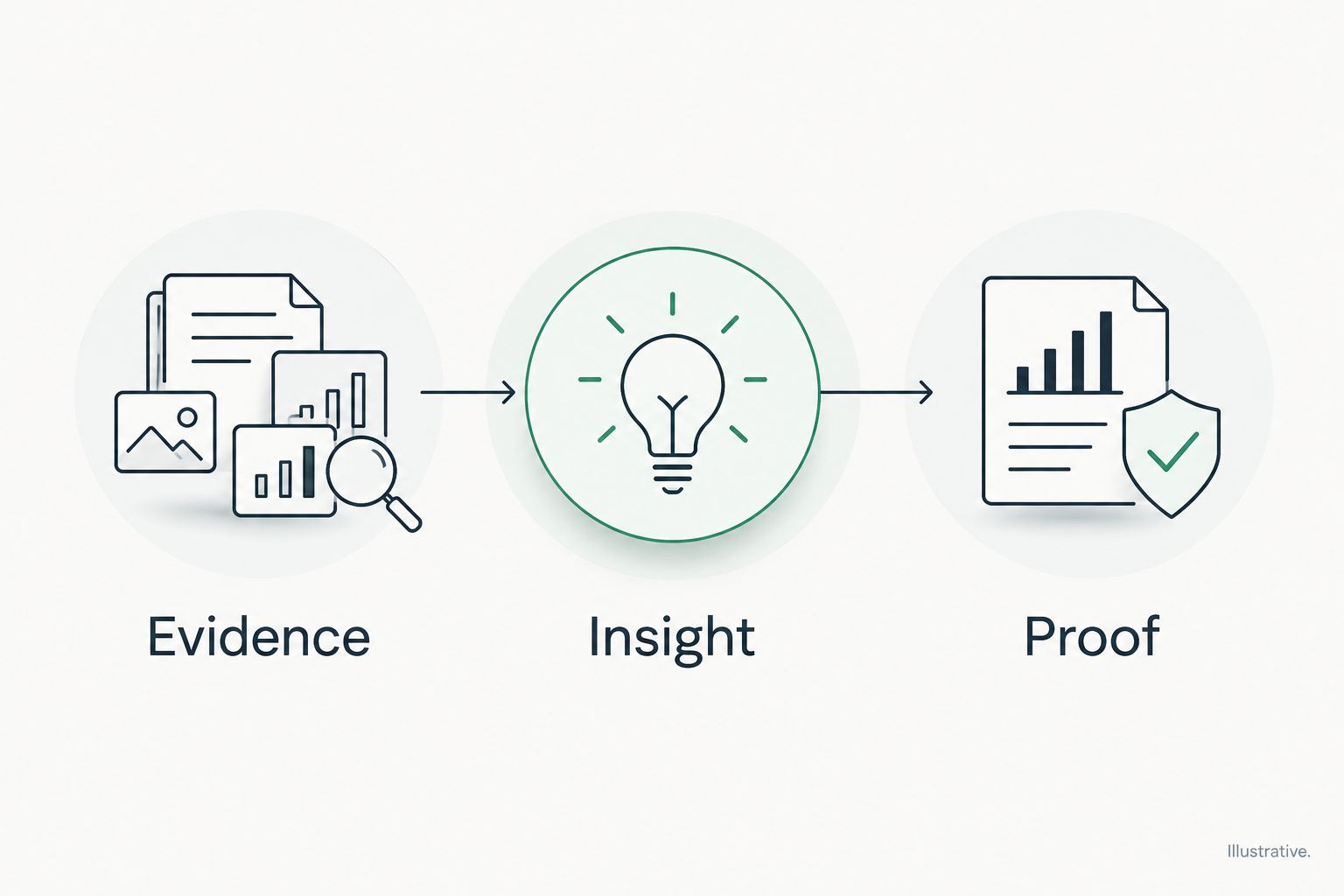
Evaluate evidence, insight, and proof before committing
Use a controlled evaluation rather than a speculative sales forecast. Set a test scope of 1 domain, 1 customer-authorized tenant, and 2 dated runs where authorization and the evaluation terms permit. These are proposed evaluation quantities, not product limits.
Evidence
Record what ran, against which object, and on what date. Keep the condition separate from its interpretation. Preserve unread sources under NOT ASSESSED THIS SCAN rather than treating them as clean.
Ask a practitioner to inspect the underlying evidence. A salesperson should be able to identify its source and limits without converting an inference into a confirmed incident. Deterministic checks establish the finding; a person signs off on the claim.
Insight
Translate the observed condition into a bounded business question. For monitoring-only DMARC, the useful question concerns intended enforcement, reporting ownership, and the reason for the current policy. It does not require an invented breach-loss forecast.
Identify the owner and the next choice. The choice can be a service, process change, project, further investigation, or no action. Your preferred product should not determine the finding’s wording.
Proof
Pin the baseline before agreed work begins. Compare the later run with that baseline, keeping assessment scope and coverage visible. Explain changed evidence separately from changes in what the tool could read.
A rescan can support a specific statement about a changed condition. It cannot establish that an organization is secure in every respect. Keep the claim as narrow as its evidence.
Turn the evaluation into an agreed sales action
For sales use, evaluate whether the tool supports an accountable conversation. The SCOUTz Evidence-to-Agreement Framework provides an original conversation structure, not a validated close-rate intervention.
- Find the decision. Establish what the buyer needs to decide and who owns that decision. Do this before selecting findings for a presentation.
- Bring the evidence. Present the dated condition, source, and boundary. Ask whether the observation matches the owner’s intended configuration.
- Build the scope. Separate confirmed observations from unanswered questions. Define the investigation or change needed to reach an agreed outcome.
- Earn the next commitment. Request a specific next action with an owner. Preserve the buyer’s choice to proceed, investigate further, or decline.
An illustrative follow-up structure is: record the observation, confirm the owner’s explanation, list the remaining unknowns, and request authorization for the next review. This is a proposed workflow, not a transcript or a customer result.
Judge the evaluation on whether your team can produce that record accurately. Do not use hypothetical contracts won as proof that the subscription will pay for itself.
Where SCOUTz fits in the purchase
SCOUTz is best for MSPs that need dated cybersecurity evidence and prospect intelligence for sales preparation. It prepares the conversation; the MSP owns the relationship and sale. It is not a contact database or a replacement for practitioner judgment.
The client’s October 15, 2026 product reference places Domain Review among the public-domain offerings and Microsoft 365 Review, Prospect Intelligence, and Evidence Reports / Studio + Reports in Open Beta. Treat that reference as dated product context. Confirm current scope and terms before approving a purchase.
The practical benefit is a defined evidence-to-conversation job. The trade-off is that beta workflows require evaluation, and the MSP still owns interpretation, proposal scope, and follow-up. Native ConnectWise sending is described as planned in that reference; ticket-ready text does not establish a shipping integration.
Your primary next step is Join Open Beta. Use SCOUTz to find the current application route and confirm assessment boundaries before submitting customer information.
What should an MSP ask before accepting a quote?
Ask the vendor to put the billing unit, assessment scope, reporting rights, usage boundaries, and contract conditions in writing. Attach those answers to your evaluation record so purchasing and technical reviewers assess the same offer.
For a 2026 approval, separate demonstrated functionality from roadmap statements. A menu label or article title does not establish that a workflow is shipping.
Can a public-domain score replace a Microsoft 365 review?
A public-domain score cannot establish internal Microsoft 365 configuration. Use public evidence for bounded external observations and obtain customer authorization for the internal evidence needed to answer tenant-specific questions.
Keep coverage separate in the proposal. Combining both into a single score conceals the source boundary your client needs to understand.
How should an MSP decide whether the tool is worth buying?
Decide whether your team can use its evidence to support a defined client decision and verify an agreed change. Inspect the work that remains after the report appears, including technical review, explanation, ownership, and follow-up.
Keep your 2026 purchase case tied to demonstrated workflow value. Claims about shorter sales cycles or higher close rates require separate evidence.
FAQ
How much does a cyber risk scoring tool cost for MSPs?
Evaluate a current written quote against a defined workload, billing unit, and contract scope. Include your team's evidence review, reporting, consent handling, and verification work in the purchasing decision.
What should I include in my MSP assessment-tool budget?
Include the subscription and the work needed to use its output responsibly. That includes authorization, technical interpretation, client-safe explanation, and comparison against a pinned baseline.
Is a public-domain review enough for Microsoft 365 security?
A public-domain review cannot establish internal Microsoft 365 configuration. Conditional Access coverage, application permissions, license assignments, device state, and tenant sharing configuration require a different evidence scope.
Does a security finding mean a prospect needs to buy?
A security finding does not establish buying intent or an unresolved problem. Confirm the owner's intent, the evidence boundary, and the next decision before proposing work.
What is SCOUTz best for?
SCOUTz is best for MSPs seeking dated cybersecurity evidence and prospect intelligence for sales preparation. The MSP retains responsibility for interpretation, the relationship, and the sale.
Should I count planned integrations in a purchasing decision?
Treat planned integrations as roadmap context rather than demonstrated capability. Confirm the current workflow and evaluate whether it meets your requirements without the planned feature.
Does an unread source mean the security control is absent?
An unread source does not establish an absent control. Record the evidence state and coverage limit explicitly, then decide whether additional authorization or investigation is needed.
One last thing
Ask to see a non-read before you approve the purchase. A report that clearly explains what it could not assess gives your team a boundary it can defend. That boundary belongs in discovery, the proposal, and the later verification record.