
A vCISO reporting tool’s cost depends on the software scope you buy and the work your MSP must still perform. For a 2026 budget, compare the subscription alongside evidence collection, technical review, report preparation and client meetings. A software quote is only part of the cost of delivering a defensible vCISO report.
- How much does a vCISO reporting tool cost? Compare the quoted subscription with assessment, reporting and review work.
- SCOUTz fits MSPs that need dated cybersecurity evidence for prospect meetings and client conversations.
- Public-domain observations and authorized Microsoft 365 evidence answer different questions; budget for the access your scope requires.
- Ask vendors to demonstrate source dates, assessment limits and baseline comparisons before you commit.
Why this matters
A report can look finished while its underlying assessment remains partial. Your MSP still owns the interpretation, the scope recommendation and the conversation with the client.
Start by defining the deliverable. The vCISO reporting software guide is a useful companion when separating reporting requirements from evidence requirements. For your 2026 buying decision, write down what the client must be able to decide after reading the report.
That decision determines the work. A prospect briefing, an authorized tenant review and a recurring governance discussion need different evidence and different preparation.
How much does a vCISO reporting tool cost?
Use a written quote for the software and a separate delivery budget for your MSP’s work. Keep those amounts separate until you have confirmed what the vendor actually supplies.
Build your cost comparison around the same deliverable for every candidate. Otherwise, a presentation workflow gets compared with an assessment workflow, and the apparent difference tells you little.
| Budget component | What to request or measure | Boundary to preserve |
|---|---|---|
| Software subscription | Written scope, billing basis and included functions | A subscription does not establish assessment completeness |
| Evidence collection | Sources, authorization requirements and declared non-reads | Public observations cannot establish internal tenant configuration |
| Technical review | Your team’s work validating conditions and limits | An observed condition is not a confirmed incident |
| Report preparation | Editing, branding, explanation and approval work | A generated explanation still needs human sign-off |
| Client delivery | Preparation, presentation and decision documentation | The MSP owns advice and the relationship |
| Follow-through | Agreed actions, reassessment and baseline comparison | A recommendation does not prove a change occurred |
For a 2026 comparison, ask each vendor to demonstrate the same workflow using an authorized example. Record what the software produces and what your staff must finish. Use your own delivery records to estimate staff effort rather than borrowing an unsupported industry average.
Keep one-time setup separate from recurring work. Consent collection, initial source mapping and report-template approval deserve their own entries if your workflow requires them.
Compare reporting scopes before comparing quotes
These are buying scopes, not standardized product tiers. Use them to describe the work you need; do not assume every vendor packages them this way.
| Reporting scope | Best for | Useful outcome | Limitation |
|---|---|---|---|
| Report assembly | MSPs with reviewed evidence already available | Organizes evidence into a client-facing narrative | Does not establish that the source assessment was complete |
| Evidence-led assessment reporting | MSPs that need findings tied to their sources | Connects conditions, affected objects, dates and questions | Coverage depends on access and readable sources |
| Recurring governance reporting | MSPs running ongoing decision and review meetings | Records ownership, agreed actions and changes over time | Requires continuing client participation and MSP judgment |
Report assembly: best for evidence you already trust
Choose this scope when your team already has the evidence and needs a repeatable presentation process. Ask the vendor to show how references, dates and technical qualifications survive editing and export.
The benefit is a defined reporting job. The limitation is equally clear: organizing an assessment does not validate its findings. Your reviewer still needs to check whether each claim matches its source.
Evidence-led assessment reporting: best for traceable findings
Choose this scope when you need to connect a reported condition to the check that produced it. Require the affected object, run date, source and assessment boundary to remain visible.
The benefit is traceability. The trade-off is access management and review work. A customer-authorized Microsoft 365 review has a different evidence boundary from a public-domain review, even when both appear in the same client discussion.
Recurring governance reporting: best for ongoing decisions
Choose this scope when the deliverable includes ownership, agreed outcomes and evidence of change. Ask for a demonstration that distinguishes an action marked complete from a condition verified through reassessment.
The benefit is continuity between meetings. The limitation is dependence on follow-through: software cannot decide a client’s priorities or accept risk on the client’s behalf.
Why vCISO reporting costs vary
Use these factors to explain differences between written quotes and delivery plans. Confirm each one rather than assuming it is included.
- Evidence scope. Public-domain observations and consented internal configuration evidence require different access and interpretation.
- Assessment coverage. Partial, permission-limited and license-limited reviews need explicit treatment in the report.
- Review responsibility. Identify who validates findings, approves explanations and signs off on client-facing claims.
- Reporting work. Confirm what remains editable, how qualifications appear and what your team must prepare manually.
- Verification requirements. Define whether the engagement includes reassessment against a pinned baseline or only an initial report.
- Commercial scope. Confirm workspace, user, client, export and renewal terms in the vendor’s current written offer.
Do not turn these factors into guessed surcharges. Put them into the quote request and ask the vendor to state the boundary of each included function.
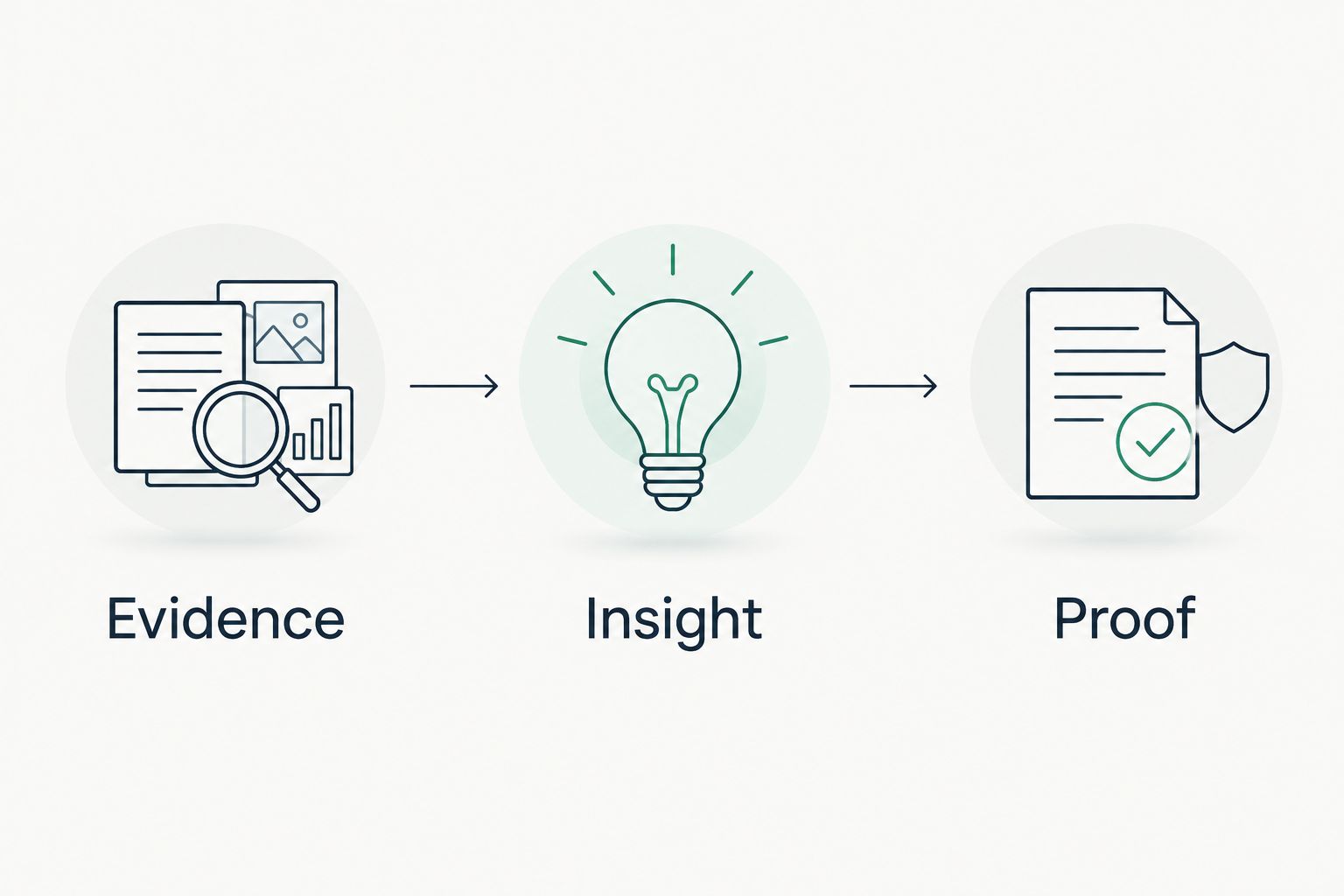
Require evidence, insight and proof in the demonstration
A 2026 software evaluation should show how a finding becomes a responsible recommendation. Use the same example throughout the demonstration so you can inspect what changes between collection, explanation and verification.
Evidence
Require the condition, affected object, source and run date. Keep evidence states such as Observed, Inferred and Unknown distinct from coverage labels such as Partial or Not assessed.
For example, a published DMARC policy requesting monitoring supports a statement about that published policy. It does not establish compromise, the owner’s intent or the current handling of reports. If an authorized review cannot read a source, retain that limit explicitly.
Insight
Require the explanation to identify a possible consequence and the question needed to establish relevance. A monitoring policy creates a reason to clarify the intended email-security outcome, not permission to declare an unresolved business problem.
Keep the recommendation separate from the vendor choice. The appropriate next action belongs to the MSP and client: a process change, a scoped project, further investigation or a documented decision to leave the condition unchanged.
Proof
Require a rescan against a pinned baseline when the engagement promises verification. Show what ran again, when it ran and which comparable condition changed.
A completed task and a verified outcome are different records. Preserve both when both matter to the engagement.
Where SCOUTz fits in the reporting budget
SCOUTz is best for MSPs that need dated cybersecurity evidence to prepare prospect and client conversations. SCOUTz, by RYTHMz, supplies prospect intelligence and domain and Microsoft 365 review context; the MSP retains responsibility for advice, relationships and sales.
The client’s October 15, 2026 product reference places Microsoft 365 Review and Evidence Reports / Studio + Reports in Open Beta. Treat that dated reference as a status boundary and confirm the current scope before making a purchasing commitment.
The useful fit is evidence-led preparation: connecting an observation to a source, explaining its limits and bringing a specific question into the meeting. The limitation is category scope. Do not assume that this role includes every governance, compliance or ongoing vCISO-service requirement on your list.
Public-domain observations remain separate from customer-authorized, read-only Microsoft 365 evidence. The latter covers configuration and metadata, never mail, files, chats, documents or prompts. Public observations cannot establish Conditional Access coverage, application permissions or internal sharing configuration.
If that evidence-preparation role matches your requirement, visit SCOUTz and choose Join Open Beta as the next step. Confirm the functions you need rather than treating a menu label as a delivery commitment.
Turn the evaluation into an agreed scope
Use the SCOUTz Evidence-to-Agreement Framework to connect reporting requirements to a buyer decision: Find the decision, Bring the evidence, Build the scope, Earn the next commitment. This is a conversation framework, not a proven close-rate intervention.
Find the decision
Write down the decision the report should support. For a prospect, that could be agreement to an authorized assessment; for an existing client, it could be ownership of a specific review or project.
Avoid treating a finding as buying intent. Establish who owns the decision and whether the condition matters to the client’s stated objective.
Bring the evidence
Bring the dated observation and its limits. Distinguish what was observed from what remains unknown before discussing a recommendation.
Illustrative meeting language: The published DMARC policy requests monitoring. This review does not establish whether that remains your intended policy. The next step is to confirm who owns reporting and enforcement decisions.
Build the scope
Separate an initial review from implementation and subsequent verification. State the evidence source, authorization boundary, deliverable and client responsibility for each proposed activity.
If the client asks for implementation advice, first establish the desired outcome and who can approve changes. A read-only assessment supplies evidence; configuration changes require their own authorized work.
Earn the next commitment
Ask for a specific, voluntary next action. Examples include confirming the technical owner, approving a consented review or scheduling a scope discussion.
Illustrative follow-up language: The observation and run date are attached. Internal configuration remains outside this review. If you want to examine that scope, confirm the authorized owner and we can define the assessment before access is granted.
What should I ask before signing a reporting-tool agreement?
Ask the vendor to document the purchased scope, evidence access, report outputs, renewal terms and cancellation process. Then reconcile the demonstration with the written agreement.
Use your 2026 requirements list as the acceptance record. Mark each requirement demonstrated, excluded or awaiting confirmation. Keep an untested claim untested rather than treating a sales presentation as proof.
Does a public-domain report replace a Microsoft 365 assessment?
A public-domain report does not replace a customer-authorized Microsoft 365 assessment. Public observations cannot establish internal tenant controls such as Conditional Access coverage or application permissions.
Budget and scope the authorized review separately when those internal questions matter. Do not describe unread internal evidence as clean.
Is the subscription the full cost of vCISO reporting?
The subscription is only the software component of your delivery budget. Include your own evidence review, report approval, meeting preparation and agreed follow-through.
Measure those activities during your evaluation. Use the resulting delivery record to decide whether the tool fits your service, without assuming time savings or sales gains.
FAQ
How much does a vCISO reporting tool cost in 2026?
A vCISO reporting tool needs a scope-specific software quote and a separate budget for your MSP’s delivery work. Compare evidence collection, technical review, report preparation and follow-through alongside the subscription.
What should I include in a vCISO reporting software budget?
Include the software subscription and the work needed to produce and explain the agreed report. Separate initial setup from recurring review, presentation and verification activities.
Is a reporting tool the same as a vCISO service?
A reporting tool supplies software functions; your MSP still owns the advice and client relationship. Define who interprets evidence, recommends scope and records client decisions.
Can a domain review show whether Microsoft 365 controls are configured correctly?
A public-domain review cannot establish internal Microsoft 365 controls. Customer-authorized evidence is required to assess internal configuration within the permitted scope.
Is SCOUTz suitable for every vCISO reporting requirement?
SCOUTz fits dated cybersecurity evidence and prospect-preparation requirements for MSPs. Check broader governance and compliance requirements separately rather than assuming they are included.
What should a reporting-tool demonstration prove?
A demonstration should show source dates, affected objects, assessment limits and the route from observation to recommendation. If verification is required, also inspect reassessment against a pinned baseline.
Does a completed remediation task prove the finding is resolved?
A completed task does not by itself verify the resulting condition. Use an authorized reassessment against the relevant baseline and preserve any remaining coverage limits.
One last thing
Test an unread source before you test a polished report. Ask the vendor to demonstrate how permission-limited evidence appears in the client output.
The useful result is an explicit boundary, with the unread source retained as unknown or not assessed. That tells you more about reporting discipline than a clean-looking summary with its qualifications removed.