
Compliance gap analysis for MSPs requires a scoped quote; there is no universal price that covers every framework, environment, and evidence requirement in 2026. Separate the assessment fee from remediation, repeat verification, and any independent audit work. Compare quotes against the same deliverables before comparing the totals.
- How much does compliance gap analysis cost for MSPs? Request a scoped quote separating assessment, remediation, and verification.
- SCOUTz suits MSPs preparing sales conversations with dated domain and customer-authorized Microsoft 365 evidence.
- A technical finding supports further review; it does not establish compliance across an entire framework.
- Require evidence sources, assessment dates, coverage limits, and acceptance criteria in every proposal.
How much does compliance gap analysis cost for MSPs?
The cost depends on the work you commission: collecting technical evidence, mapping evidence to requirements, or investigating broader organizational gaps. Those are different assignments. A software subscription also buys something different from a consultant's assessment engagement.
Start with the compliance gap analysis tools guide if you are selecting software. Then define the human review, documentation, and verification your client actually needs.
For a 2026 quote comparison, use the same scope categories across every provider:
| Assessment scope | Best for | Deliverables to request | Strength | Limitation |
|---|---|---|---|---|
| Technical evidence review | Preparing discovery or investigating a defined configuration question | Dated observations, affected objects, coverage limits | Establishes what the reviewed sources show | Cannot establish organization-wide compliance |
| Framework-mapped gap analysis | Comparing documented practices and evidence with specified requirements | Requirement mapping, supporting evidence, gaps, unknowns, ownership | Connects findings to a defined assessment scope | Depends on document quality, access, and interpretation |
| Gap analysis with verification | Checking whether agreed outcomes were achieved | Initial baseline, agreed actions, repeat evidence, exceptions | Makes changed conditions inspectable | Verification covers only the agreed requirements and evidence |
These are purchasing scopes, not standardized service tiers. Require each provider to explain which work its proposal includes and which work needs a separate agreement.
Why this matters
A proposal labeled “compliance assessment” can leave the most important work undefined. You need to know whether the engagement includes policy review, interviews, technical evidence, requirement mapping, or only a report generated from a scan.
That distinction matters when you sell the work onward. Your client needs a clear outcome, and your delivery team needs an assignment it can complete and defend. Sell an evidence-backed scope with explicit limits.
A gap analysis should also distinguish an observed condition from an unmet requirement. A configuration finding becomes relevant to compliance only after someone establishes the applicable requirement, the affected scope, and the evidence needed to evaluate it.
Technical evidence review: define the boundary
A public-domain review can support questions about published domain and email-security configuration. It cannot establish internal Microsoft 365 controls such as Conditional Access coverage, application permissions, license assignments, Intune device state, or tenant sharing configuration.
Customer-authorized Microsoft 365 review uses a different evidence boundary. For the platform discussed here, that boundary is read-only configuration and metadata, excluding mail, files, chats, documents, and prompts. Access and coverage still need to be recorded for the particular review.
Request an evidence register that keeps the source, check, run date, affected object, observation, and limitations together. An exported finding without that context is difficult to defend in a client conversation or compare with a later review.
This scope is best for establishing technical facts before expanding an engagement. Its limitation is coverage: technical observations alone do not establish whether organizational procedures exist or operate as intended.
Framework-mapped analysis: include the interpretation work
A framework-mapped engagement needs an agreed framework and version, an organizational boundary, and a method for evaluating evidence. The proposal should identify who makes the assessment judgment and how the client can resolve disputed interpretations.
Ask for a requirement-level record containing the evidence reviewed, the assessment conclusion, and any unanswered questions. Keep missing documents separate from confirmed deficiencies. A document that the assessor has not received remains unknown until the review establishes more.
This scope is best for clients who need to understand gaps against specified requirements. Its strength is traceability. Its limitation is that a completed mapping still depends on the evidence and assessment method behind each conclusion.
Do not let a dashboard score substitute for that record. You need to inspect why a requirement received its status and what evidence would support a different conclusion.
Verification: agree on what proves completion
Verification needs a pinned baseline and an agreed outcome. A later scan can show whether a reviewed configuration changed; it does not automatically prove that every related policy, procedure, or business practice changed with it.
Specify which evidence will be collected again, who reviews it, and what closes the finding. Include a way to record exceptions and controls that remain outside coverage.
This scope is best for clients who want proof of agreed work after remediation. Its limitation is the verification boundary. A repeat review proves only what its sources and method support.
For each action, separate the condition, affected object, unknowns, and desired outcome from the vendor choice. Your MSP can recommend a product, service, process change, project, or no change after considering the evidence and client decision.
Why compliance gap analysis cost varies
The quote should explain the work behind its scope. Use these factors to challenge unexplained differences:
- Framework and requirement coverage: identify the framework, version, selected requirements, and exclusions before requesting estimates.
- Environment boundaries: name the domains, tenants, business units, and other evidence sources included in the engagement.
- Evidence readiness: establish whether policies, records, ownership information, and authorized access are ready for review.
- Interpretation and reporting: specify whether you need a technical register, requirement mapping, executive explanation, or separately defined outputs.
- Follow-through: distinguish recommendations, implementation assistance, repeat review, and independent assurance work.
These factors define different tasks. Ask providers to describe the tasks included in their estimates rather than assuming a larger report represents a broader assessment.
Also ask who supplies client-side evidence. If that responsibility is absent from the statement of work, document it before signing.
Build a comparable scope before requesting quotes
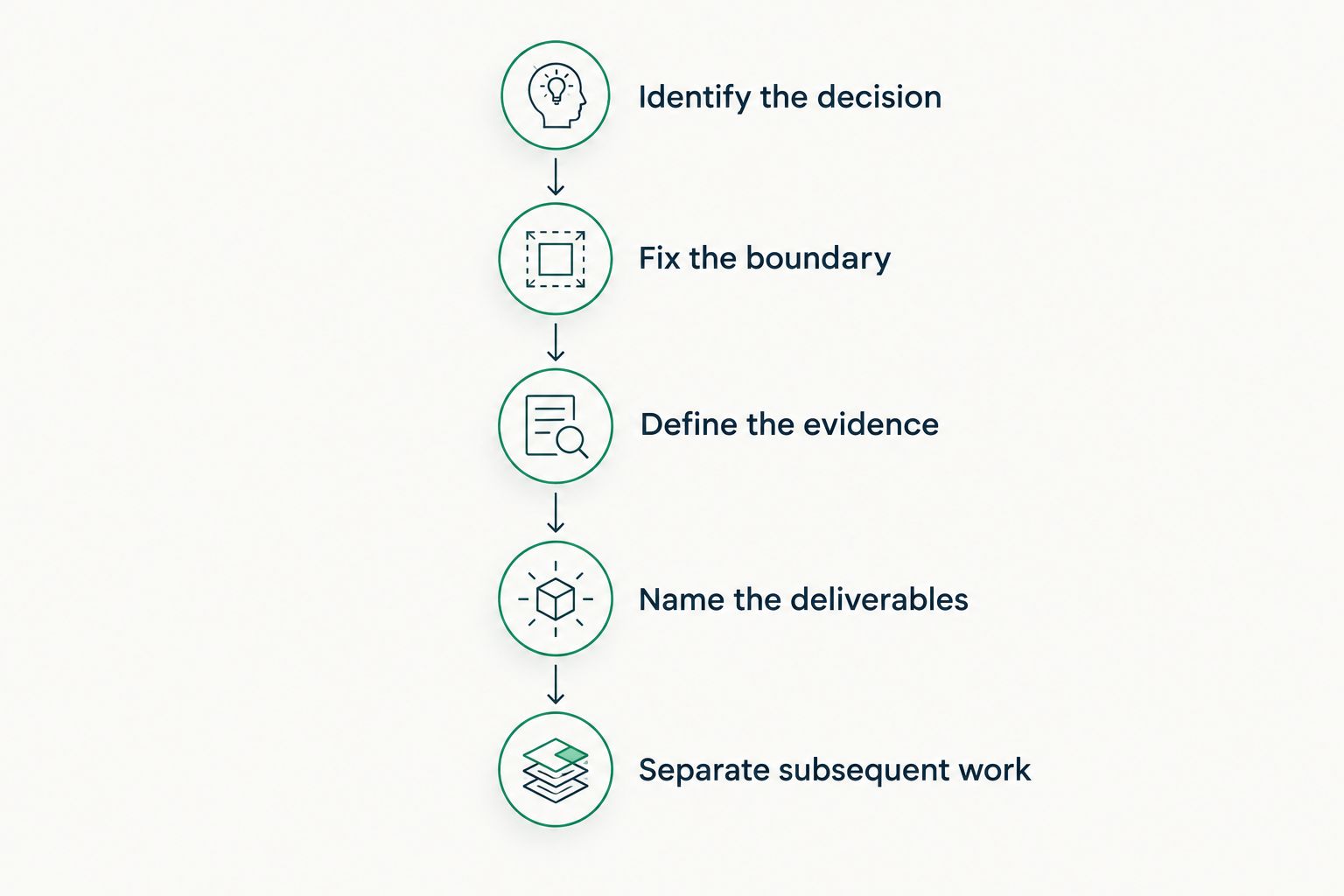
Use a written scope sheet instead of asking providers to estimate from an organization name and a general compliance goal. The following sequence turns the request into work that providers can describe consistently.
- Identify the decision. State whether the client needs discovery evidence, a requirement-level gap register, a remediation plan, or verification of completed work.
- Fix the boundary. Record the framework version, organizational scope, systems, authorized sources, and exclusions.
- Define the evidence. List the documents, interviews, configuration reviews, and records the assessor will examine.
- Name the deliverables. Specify the register, mapping, ownership fields, review meeting, and acceptance criteria.
- Separate subsequent work. Request distinct descriptions for remediation, repeat verification, and any additional assurance engagement.
An illustrative 2026 scope might specify 1 public domain, 1 customer-authorized Microsoft 365 tenant, and 1 named framework. Those are example purchasing boundaries, not a service package or a claim that those sources cover the framework.
Add the framework version and exact requirements before sending that request. Then ask each provider to explain which requirements the proposed sources can support and which require documents, interviews, or other evidence.
Where SCOUTz fits in the assessment conversation
SCOUTz is best for MSPs preparing sales conversations with dated cybersecurity evidence and account context. Its domain and customer-authorized Microsoft 365 reviews can support discovery and help an MSP define the next assessment question.
SCOUTz cybersecurity prospect intelligence prepares the conversation; the relationship and the sale stay with your MSP. Treat its observations as scoped evidence. Framework mapping, compliance judgments, organizational review, and service recommendations remain separate responsibilities that need explicit ownership.
The client-provided product reference dated October 15, 2026 identifies Microsoft 365 Review as Open Beta. Evaluate that scope and its coverage against your intended engagement rather than treating a product label as proof of assessment completeness.
For MSPs considering SCOUTz cybersecurity prospect intelligence, Join Open Beta is the next step. Use that evaluation to examine evidence boundaries, reporting needs, and fit with your own delivery process.
Turn evidence into an agreed assessment scope
Use the Evidence-to-Agreement Framework to move the conversation beyond a finding: Find the decision, Bring the evidence, Build the scope, Earn the next commitment. It is a conversation framework, not a proven sales-performance intervention.
Find the decision by recording what the buyer needs to authorize. An assessment request might concern a customer questionnaire, an internal review, or a specific control question. Establish that purpose with the buyer instead of inferring it from a public event.
Bring the evidence with its source, date, and limits. For example, a published DMARC policy requesting monitoring supports a discussion about intended enforcement and reporting. It does not establish compromise or prove that the configuration is unintended.
Build the scope around the unresolved question. Identify who reviews reports, what policy is intended, and whether further evidence is needed. Leave the implementation choice open until the responsible owner evaluates the requirement.
Earn the next commitment by agreeing on an action, owner, and completion condition. For a 2026 proposal, record that agreement alongside the evidence date so the buyer can distinguish the original observation from the current decision.
Does assessment software replace a consultant's gap analysis?
Assessment software supports evidence collection and reporting; it does not automatically perform every task in a gap-analysis engagement. Compare the software's job with the consultant's documented responsibilities.
Require named ownership for requirement interpretation, interviews, evidence review, and final conclusions. If your MSP performs those tasks, include them in your delivery scope instead of treating the report export as the finished service.
Should remediation be included in the assessment?
Remediation belongs in the engagement only when the proposal explicitly includes it. Keep the assessment conclusion and recommended outcome inspectable even when the same provider implements the change.
Separate authorization for configuration changes from authorization to review evidence. Read-only assessment access does not authorize implementation.
Can a public-domain scan establish compliance?
A public-domain scan cannot establish organization-wide compliance. Its findings are limited to the public sources and checks reviewed at the stated time.
Use those findings to identify specific questions for discovery. Internal controls, operational practices, and requirements beyond the public evidence need their own assessment scope.
FAQ
How much does compliance gap analysis cost for MSPs in 2026?
Compliance gap analysis requires a scoped quote based on the framework, environment, evidence review, deliverables, and verification work. Compare assessment, remediation, and follow-up as distinct parts of the engagement.
What should an MSP include in a compliance gap analysis quote?
Include the framework version, organizational boundary, evidence sources, deliverables, exclusions, ownership, and acceptance criteria. State whether implementation and repeat verification are included.
Is a domain security report enough for a compliance assessment?
A domain security report is insufficient for an organization-wide compliance assessment. It supports only the public observations and assessment boundaries documented in the report.
Does a Microsoft 365 review prove that a client is compliant?
A Microsoft 365 review does not establish compliance across an entire organization or framework. Its evidence must be evaluated against specified requirements, with access and coverage limits recorded.
Should an MSP include a rescan after remediation?
Include a rescan when repeat technical evidence is part of the agreed acceptance criteria. Compare it with the pinned baseline and record what remains outside the review.
Can I describe unread controls as passing?
Unread controls must remain explicitly unknown or not assessed. Record permission limits, license limits, and other coverage restrictions separately from evidence conclusions.
One last thing
An explicit unknown is a useful assessment result. It tells the buyer which decision needs more evidence and prevents an unread source from being mistaken for a clean control.
Before approving a 2026 engagement, ask the provider to show how the report distinguishes Unknown, Unreadable, and Not assessed from an evaluated condition. Buy a defensible assessment boundary, not the appearance of complete coverage.