
External attack surface monitoring costs depend on the assets covered, the monitoring schedule and the investigation or remediation work included; use a current written quote tied to those requirements rather than a category-wide average. Budget separately for your MSP's validation, client discussion and follow-up unless the agreement explicitly includes that work. For a 2026 purchase, compare the delivered evidence and response responsibilities before comparing subscription terms.
- How much does external attack surface monitoring cost? Compare written quotes against the same asset scope and service responsibilities.
- SCOUTz fits MSP prospect preparation: dated cybersecurity evidence and account context for a sales conversation.
- Public-domain observations cannot establish Microsoft 365 tenant configuration or confirm a breach.
- Separate recurring monitoring, analyst investigation and remediation when reviewing a proposal.
How much does external attack surface monitoring cost?
The useful cost is the cost of an agreed scope, with ownership attached to every follow-up task. A domain review, recurring external monitoring and an authorized Microsoft 365 review answer different questions. Treating them as interchangeable leaves you comparing different services.
Start with the job. The guide to external attack surface assessment tools helps frame that comparison before you request quotes.
Use these 3 scope options to structure your requirements. The table describes work to specify, rather than features to assume any supplier includes.
| Scope option | Best for | Useful output | Boundary or trade-off |
|---|---|---|---|
| Public-domain review | Preparing a prospect conversation | Dated observations about the domain and externally visible configuration | A review captures assessed conditions; it does not establish ongoing monitoring or internal tenant state |
| Recurring external monitoring | Tracking changes across an agreed external inventory | Repeated observations, change history and agreed notifications | You still need an owner to validate changes and decide what action follows |
| Customer-authorized Microsoft 365 review | Investigating tenant configuration questions with consent | Configuration and metadata evidence within granted access | Coverage depends on permissions, licenses and readable sources; it is a separate evidence boundary |
For each quote, record the assets, collection method, cadence, evidence retained and human work included. Ask the supplier to identify exclusions in the same document. Your 2026 purchasing comparison should preserve those differences instead of compressing them into one security score.
Why this matters
An MSP owner needs to know what the purchase helps the team decide. Preparing for discovery requires different evidence from operating a recurring monitoring service. A prospect report also needs careful explanation before it becomes a proposal.
The commercial boundary matters as much as the technical boundary. If your team owns validation, client communication and remediation, those responsibilities belong in your delivery plan. A subscription does not assign that work by itself.
Keep 2 evidence sources distinct: public-domain observations and customer-authorized internal evidence. Public Domain Review cannot establish Conditional Access coverage, application permissions, license assignments, Intune device state or tenant sharing configuration.
Why external attack surface monitoring costs vary
Use these 6 factors as quote requirements. Each factor should produce a written inclusion, exclusion or responsibility, rather than an assumption about what a service provides.
- Asset scope. Define the domains, subdomains, addresses and other externally visible objects you want assessed. State how additions, removals and uncertain ownership are handled.
- Collection method. Separate public observation from active probing. Review authorization and applicable requirements for the proposed activity; public visibility does not establish blanket permission to scan.
- Review cadence. Specify when observations repeat, how failed collection is handled and when the team receives notice of a change.
- Evidence depth. Require the condition, affected object, source, run date and limits. Separate an observation from an inference about its consequence.
- Human responsibility. Identify who validates findings, explains them to the client, proposes action and approves any change. Specify whether that work is included.
- Verification and reporting. Define baseline retention, rescans, client-facing reports and the handling of unread sources. Decide what constitutes evidence that an agreed condition changed.
These factors describe what to compare, not a universal billing model. Ask each supplier which factors affect its quote. Record the answer without assuming that every supplier charges by domain, asset, user or scan.
Build a comparable quote before choosing a subscription
A 2026 procurement brief should describe the outcome you need and the evidence required to support it. Keep the brief independent of vendor terminology so the responses remain comparable.
Define the inventory boundary
List the assets you believe belong in scope and identify who confirms ownership. Include a process for disputed or newly discovered objects. An answering service establishes that something responded; it does not establish an exploitable service.
Ask how the report distinguishes confirmed ownership from inferred association. Do not build a remediation commitment around an asset until the responsible party accepts the ownership decision.
Define what monitoring must prove
Specify whether you need repeated collection, change detection, notifications, analyst review or a combination. Ask the supplier to demonstrate those functions using its actual service documentation and outputs.
A report generated on demand and an ongoing monitoring obligation are different deliverables. Write down the expected collection schedule, the notification route and the person responsible for reviewing it.
Define unread evidence
Require the report to distinguish Unknown and Unreadable evidence from an assessed condition. Coverage should separately identify Assessed, Partial, Not assessed, Permission limited and License limited where applicable.
Unread sources are not clean. Ask for declared non-reads under NOT ASSESSED THIS SCAN, with enough context to decide whether another authorized review is needed.
Define the acceptance test
Before approving a 2026 agreement, ask what you will receive and how you will verify delivery. Specify the inventory, observation dates, evidence boundaries, reporting format and assigned responsibilities.
Acceptance should test the contracted work. It should not depend on discovering a frightening issue, producing a particular score or securing a sales meeting.
Turn evidence into an agreed MSP scope
SCOUTz's cybersecurity prospect intelligence fits the preparation stage between a booked meeting and an agreed client scope. SCOUTz is best for MSP owners and sales leaders who need dated cybersecurity evidence for prospect conversations. It prepares the conversation; the relationship and the sale stay yours.
The client-provided product reference dated October 15, 2026 describes public-domain reviews separately from customer-approved Microsoft 365 evidence. The latter is read-only configuration and metadata review, excluding mail, files, chats, documents and prompts. Confirm current product status and coverage before making a client commitment.
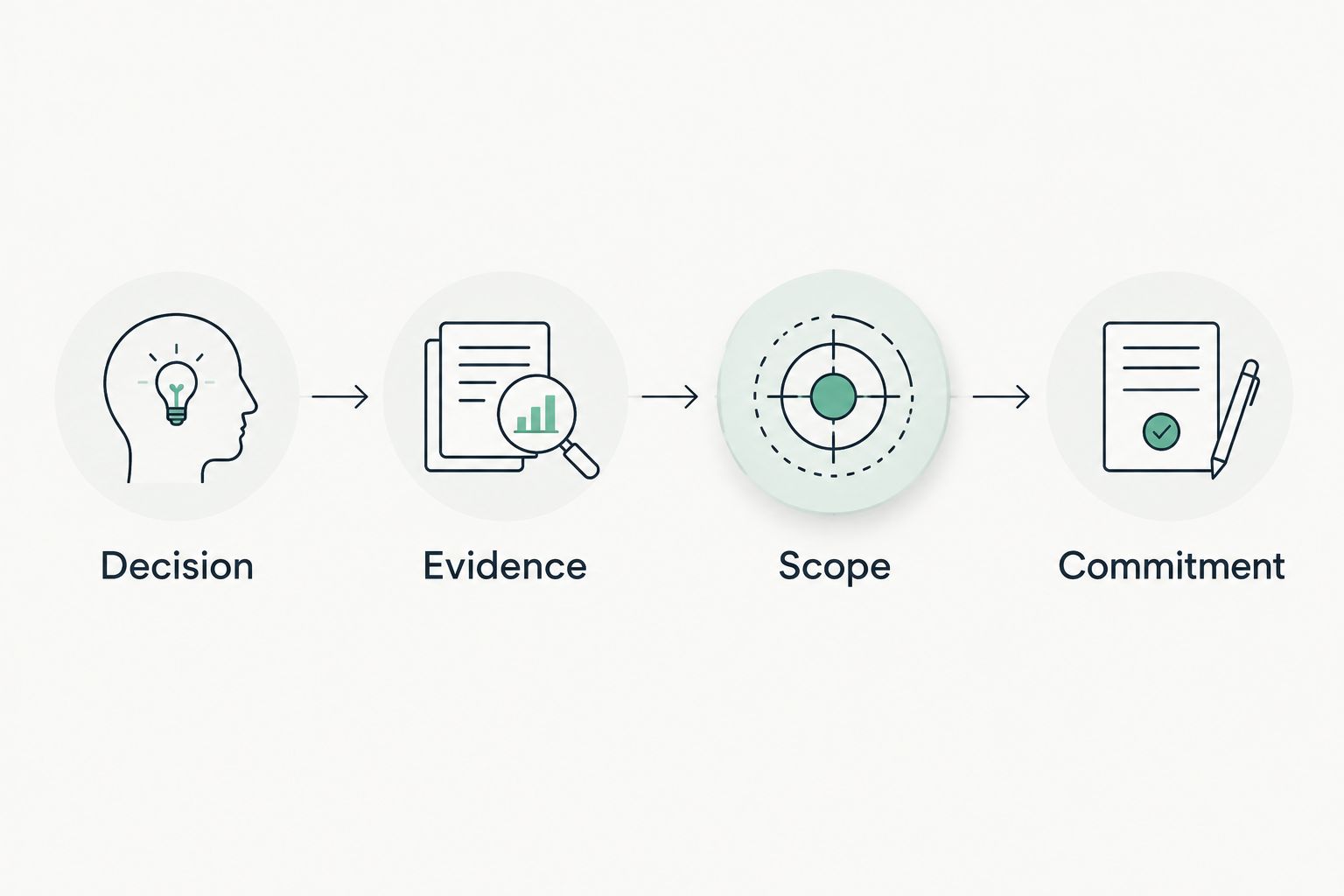
Use the SCOUTz Evidence-to-Agreement Framework, approved in the client editorial direction dated October 24, 2026, to turn observations into a buyer-controlled next action. It is a conversation framework, not evidence of improved close rates.
Decision
Find the decision. Establish what the prospect wants to decide before presenting a finding. That decision might concern ownership of domain configuration, whether a deeper review is justified or whether an existing policy remains intentional.
Illustrative dialogue: “Before we discuss changes, let's agree whether you want to confirm the current policy, review its operation or evaluate a different outcome.”
This keeps the meeting tied to a choice. A public event or technical observation supplies context, not proof of buying intent.
Evidence
Bring the evidence. State the condition, show its source and run date, and explain the boundary. For example, a published DMARC policy requesting monitoring only supports a discussion about intended enforcement and reporting.
It does not establish compromise. Ask who reviews the reports and whether the monitoring-only policy remains intentional. Keep the possible consequence separate from what the record actually proves.
Scope
Build the scope. Separate validation, investigation, configuration work and verification. Name the owner of each task and the evidence required before work proceeds.
Illustrative objection: “Our current provider already handles email security.”
Illustrative response: “Let's ask the current owner to confirm the policy's purpose and reporting process. Then you can decide whether anything needs to change.”
Commitment
Earn the next commitment. Offer a specific, proportionate action that the prospect can accept or decline. That might be confirming ownership, authorizing a bounded review or approving a scoped proposal.
Illustrative follow-up: “We discussed the published policy observed on the report date. Please confirm who owns it and whether the current setting is intentional. With your approval, the next step is to review the relevant evidence together.”
Compare proposal scope without turning findings into sales claims
Your proposal should preserve the difference between an observation and a purchased outcome. A finding explains why a question deserves attention. The buyer's decision determines whether work follows.
| Proposed next action | Best for | Advantage | Limit |
|---|---|---|---|
| Confirm policy ownership and intent | A condition whose purpose is unclear | Establishes accountability before recommending change | Does not validate operation or resolve a technical condition |
| Conduct an authorized deeper review | Questions public evidence cannot answer | Brings the relevant configuration into scope | Requires consent and sufficient access; unread evidence remains unknown |
| Implement and verify an agreed change | A validated condition with an approved outcome | Connects action to a baseline and rescan | Requires separate implementation responsibility and buyer approval |
Price and approve the agreed work, rather than an assumed incident. Keep the condition, affected object, unknowns and recommended outcome separate from vendor choices. The MSP and client can choose a product, service, process, project or no change.
For MSPs evaluating SCOUTz cybersecurity prospect intelligence, the primary next step is Join Open Beta. Confirm the current scope through SCOUTz before committing it to a client proposal. Its useful role is preparation and evidence explanation; it does not replace MSP judgment or assign remediation responsibility.
Does a domain review include ongoing monitoring?
A domain review does not establish an ongoing monitoring commitment. Confirm whether the agreement includes repeated collection, change history, notifications and an assigned reviewer.
A dated review supports a dated statement. Keep its observation date attached when you use it in discovery or a proposal.
Can external monitoring replace a Microsoft 365 assessment?
External monitoring cannot establish internal Microsoft 365 configuration. Conditional Access, application permissions and tenant sharing require the appropriate customer-authorized evidence.
Keep both scopes separate in a 2026 proposal. Do not represent a public-domain result as a tenant assessment.
Should remediation be included in the monitoring quote?
Remediation belongs in the quote only when the supplier explicitly accepts that responsibility. Otherwise, identify who validates the finding, approves the change, implements it and verifies the outcome.
Read-only review makes no automatic configuration changes. A recommendation and an implemented change are different deliverables.
FAQ
How much does external attack surface monitoring cost for an MSP?
External attack surface monitoring cost depends on the agreed inventory, review cadence, evidence depth and service responsibilities. Request a current written quote and separate subscription scope from your team's validation, communication and remediation work.
What's included in an external attack surface monitoring quote?
The written agreement determines what is included. Require explicit terms for assets, collection methods, repeated reviews, notifications, evidence retention, reporting and human follow-up.
Is a public domain scan the same as continuous monitoring?
A public domain scan is not evidence of a continuous monitoring service. Confirm the recurring collection schedule, change reporting and ownership of follow-up in the agreement.
Can an external scan tell me whether a Microsoft 365 tenant is secure?
An external scan cannot establish internal Microsoft 365 tenant configuration. Customer-authorized access is needed for the relevant configuration and metadata evidence, and coverage limits must remain visible.
Does a security finding prove that a prospect was breached?
A security finding does not by itself prove a breach. Keep the observed condition, possible consequence and evidence boundary separate before deciding what further investigation is justified.
Can my MSP scan any prospect because the domain is public?
Public visibility does not establish blanket permission for scanning. Distinguish public observation from active probing, review applicable requirements and offer outreach scans as opt-in courtesies after a reply.
How should I check whether remediation worked?
Verify an agreed change with a rescan against a pinned baseline. Retain the affected object, original observation, new run date and coverage limits so the comparison supports the claim being made.
One last thing
A finding that disappears from a report is not automatically proof of remediation. Check whether the source was readable, the object remained in scope and the relevant assessment ran. Verify the changed condition against the pinned baseline before presenting it as proof.
That acceptance rule gives your MSP a concrete purchasing requirement: the service must preserve enough evidence to distinguish changed conditions from changed coverage.