
A public domain scan shows the externally observable part of a company's security posture, such as published email-security records and the configuration of assessed public services. It cannot establish internal identity controls, endpoint protection, backup recoverability or overall security effectiveness, and no defensible percentage follows from a domain scan alone.
- How much of a company's security posture can a domain scan show? Public evidence, not a complete assessment.
- SCOUTz suits MSPs preparing evidence-led prospect conversations; public findings still require context and owner confirmation.
- Public DNS observations cannot establish Microsoft 365 Conditional Access coverage, application permissions or device state.
- Keep security posture findings dated, separate unknowns from observations, and verify changes against a pinned baseline.
Why this matters
An MSP can bring useful evidence into discovery without presenting an outside view as an internal assessment. The distinction determines what you can say, what you should ask and what work belongs in a proposal.
For your 2026 prospect reviews, treat every public finding as a scoped observation. The domain scan to first-call evidence packet workflow provides a related framework for organizing that conversation.
A useful finding opens a specific question. It does not settle the company's security posture.
How much of a company's security posture can a domain scan show?
A domain scan can establish selected public conditions at the time of collection. Its reach depends on the checks performed, the objects assessed and the evidence returned. A domain name is a starting point, not an inventory of everything the company operates.
Compare review scopes by the questions they can answer:
| Review scope | Best for | Useful evidence | Limitation |
|---|---|---|---|
| Public domain review | Preparing external-security discovery | Published DNS records and assessed public-service responses | Cannot establish internal tenant or endpoint controls |
| Customer-authorized Microsoft 365 review | Examining tenant configuration and metadata | Authorized evidence about identity, applications and tenant settings | Coverage depends on permissions, licensing and readable sources |
| Broader authorized assessment | Investigating agreed operational questions | Evidence collected within the approved assessment scope | Conclusions remain limited to the systems and methods assessed |
Each scope has a legitimate job. Public evidence supports initial questions with less internal access; authorized internal evidence supports questions that the public internet cannot answer. Broader assessment requires an agreed scope and additional work.
Do not convert the proportion of passing public checks into a percentage of company-wide security. Those checks describe their own assessed surface. They do not supply a denominator for the entire business.
Public domain evidence: visible configuration with defined limits
Public DNS can reveal published SPF and DMARC records. DKIM assessment requires identifying the relevant selectors and evaluating the evidence available for them. A failed search without adequate selector coverage does not establish that the organization never signs email.
Public-service checks can also examine certificate presentation and TLS configuration on the endpoints actually assessed. An observation about one hostname belongs to that hostname. Extend it to other services only when supporting evidence exists.
A DMARC policy containing p=none, for example, requests no DMARC enforcement action through that policy. It does not establish compromise, explain why the owner chose monitoring or prove that nobody reviews reports.
Keep the business interpretation narrow. The useful next question concerns intended enforcement, legitimate senders and reporting ownership. The unsafe shortcut is treating a published policy as proof of an incident.
Public observations also need attribution. A company can use hosted infrastructure or third-party services without directly controlling every configuration. Identify who owns the affected object before assigning responsibility or proposing changes.
Authorized Microsoft 365 evidence: internal questions require consent
A public domain scan cannot establish Conditional Access coverage, application permissions, license assignments, Intune device state or tenant sharing configuration. Those questions require appropriate internal evidence and customer authorization.
Customer-authorized read-only review provides a different evidence scope. Its conclusions still depend on what the review could read. Permission-limited and license-limited areas stay visible as coverage boundaries.
Microsoft 365 evidence in the client-described product scope is configuration and metadata only. It excludes mail, files, chats, documents and prompts. That boundary should remain clear when you request consent or explain the review to a prospect.
Do not equate read-only access with complete visibility. A successful connection can coexist with unread sources. Record the source-level coverage before interpreting results or presenting an apparent absence of findings.
For a 2026 proposal, separate external observations from authorized tenant work. This makes the requested access understandable and prevents the public review from appearing to include work it never performed.
Why public domain scan coverage varies
The useful scope of a domain review varies with the evidence collected, rather than the confidence of the sales presentation.
- Domain and hostname scope determines which objects the review actually assesses. An unlisted business domain remains outside that scope.
- Check selection determines which conditions the review attempts to examine. Running an email-policy check does not establish endpoint health.
- Collection timing determines when an observation was true. DNS, certificates and service configuration can change after collection.
- Readability determines whether a source returned usable evidence. A failed or restricted read leaves a question open.
- Ownership context determines who can explain or change the condition. Hosted services and delegated administration require clarification.
- Authorization determines which additional evidence you can collect. Public observation and active probing require separate consideration.
A report with more observations does not automatically answer more business questions. Relevance depends on whether each observation concerns the prospect's actual environment and the decision under discussion.
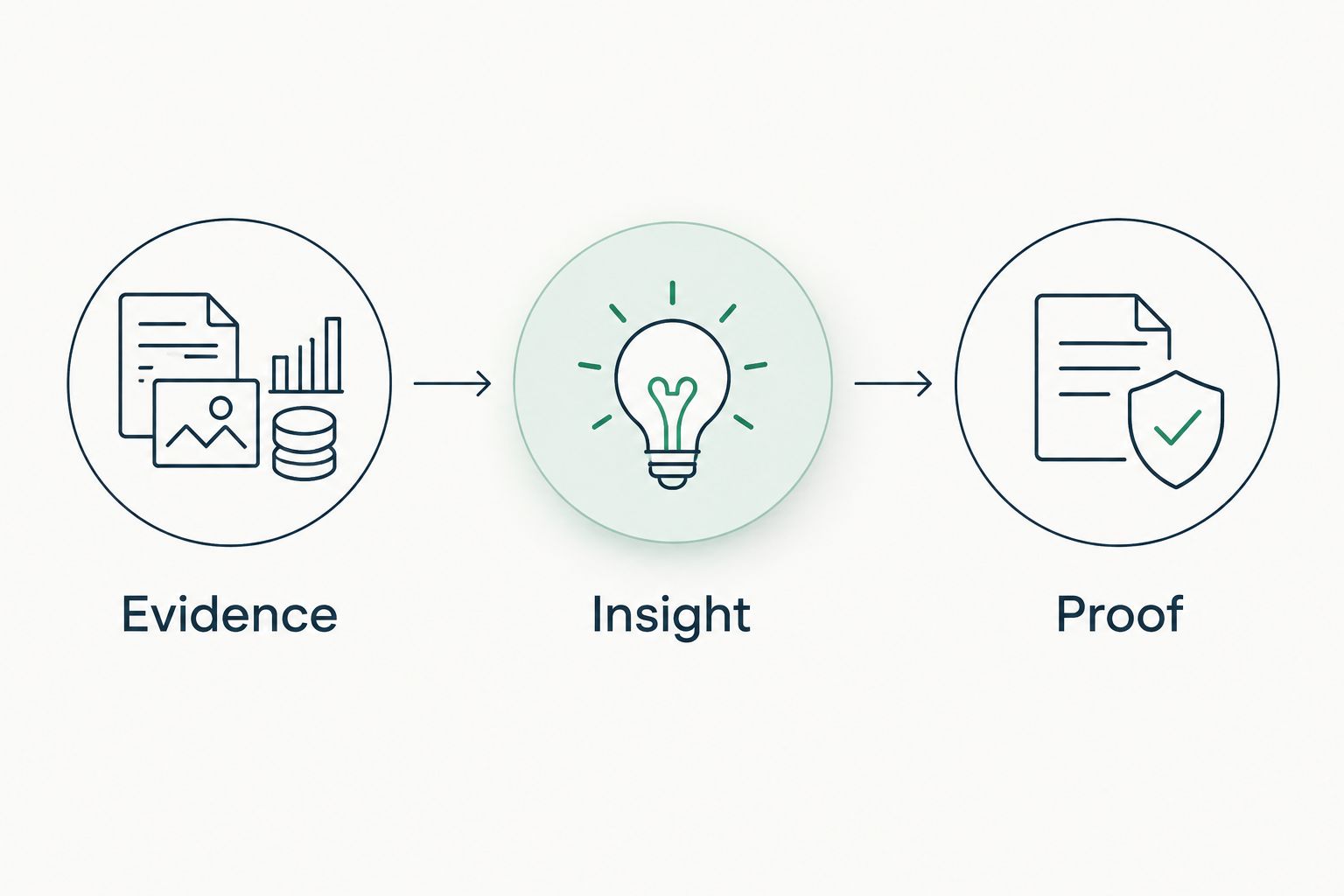
Evidence, insight and proof belong in separate fields
Use 3 evidence fields in your working record: condition, source and run date. Then record the interpretation, unknowns, owner and proposed next action separately. This keeps an explanation from quietly becoming part of the observation.
Evidence
State what the check observed and name the affected object. Preserve the returned record or relevant response with the collection date. For a 2026 review, an old screenshot should retain its original date rather than inherit the date of the new presentation.
Insight
Explain the possible consequence within the evidence boundary. A monitoring-only DMARC policy creates a question about enforcement intent. It does not establish compromised accounts, successful impersonation or an unresolved remediation obligation.
Proof
Pin 1 baseline before agreed changes, then rescan the same scoped condition. Explain what changed and what remains unknown. A successful configuration change proves that measured change, not the effectiveness of every security control.
Keep 2 review scopes separate in the report: public-domain observations and consented internal evidence. The separation lets a business owner understand which conclusions came from outside and which required authorized access.
Evidence state and coverage answer different questions
Evidence state describes the nature of a claim. Coverage describes what the review assessed. Neither should disappear into a single overall score.
Use states such as Observed, Inferred, Possible, Unknown and Unreadable deliberately. Verified requires the verification appropriate to the specific claim. These labels are distinct descriptions, not steps on a maturity ladder.
Coverage labels such as Assessed, Partial, Not assessed, Permission limited and License limited describe collection boundaries. Place declared non-reads under NOT ASSESSED THIS SCAN so the reader can distinguish silence from a completed check.
An unread source cannot support a clean result. Likewise, an answering service does not establish an exploitable service, and a breach-data match does not establish a currently compromised user. Each stronger claim needs its own evidence.
Turn a public finding into an agreed next action
The SCOUTz Evidence-to-Agreement Framework organizes discovery around a decision. It is a conversation framework, not a measured promise of sales results. Apply it to a finding only after confirming the evidence and its limits.
Find the decision
Identify the choice the prospect needs to make. For a published monitoring-only DMARC policy, that choice might be whether the current policy remains intentional and whether someone should review reporting and sender coverage.
Ask who owns email authentication and who approves policy changes. An owner-confirmed decision is more useful than a severity label without operational context.
Bring the evidence
Show the observed policy, domain, check and run date. Keep the statement factual and distinguish the current observation from any older account notes.
Illustrative dialogue, not an actual customer exchange:
MSP: The public record we reviewed requests monitoring only. That does not establish compromise. Who owns the decision about enforcement and reporting?
This gives the buyer something specific to confirm or correct. It also leaves room for the current configuration to be intentional.
Build the scope
Agree on the question before selecting a service. Reviewing reporting ownership is different from changing policy, and both differ from assessing tenant identity controls.
If the buyer says another provider already handles the area, ask whether the buyer wants that provider to confirm the intended state. Do not turn an existing provider relationship into evidence of neglect.
Earn the next commitment
Offer an explicit choice: confirm ownership, authorize a defined review, request a scoped proposal or leave the configuration unchanged. Record the buyer's decision without treating interest as a purchase commitment.
An illustrative follow-up can stay short: Please confirm the policy owner and whether you want a review of reporting and legitimate senders. Any configuration changes require separately agreed approval and scope.
Where the platform fits
SCOUTz cybersecurity prospect intelligence is best for MSPs preparing evidence-led prospect conversations. It supplies dated evidence and account context; the MSP remains responsible for interpretation, the relationship and the sale.
The client editorial reference dated October 15, 2026 describes public-domain reviews and customer-authorized Microsoft 365 evidence as separate scopes. It describes Microsoft 365 Review as Open Beta. That dated reference is product context, not evidence about any prospect's environment.
SCOUTz supports preparation, but a domain review cannot substitute for internal assessment or MSP judgment. The practical next step for interested MSPs is Join Open Beta through SCOUTz.
Can a domain scan prove a company has been breached?
A domain scan alone cannot prove a company has been breached. Published configuration, reachable services and historical exposure indicators require separate investigation before you make an incident claim.
Keep the condition separate from the consequence. A risky configuration can justify a review without establishing that anyone exploited it.
Can a public scan show whether Microsoft 365 MFA is enforced?
A public scan cannot establish Microsoft 365 MFA enforcement. Authorized tenant evidence is needed to investigate the relevant policies, users, exclusions and coverage.
Registration and enforcement also answer different questions. Knowing that a user registered a method does not, by itself, establish that the intended access paths require it.
Does a clean domain scan mean the company is secure?
A clean domain scan means the completed checks did not report findings within their assessed scope and collection limits. It says nothing conclusive about controls the review did not assess.
In a 2026 client report, keep the scope and run date beside that result. Leave unread or unassessed areas explicitly unknown.
FAQ
How much of a company's security posture can a domain scan show?
A domain scan shows selected externally observable conditions, not a defensible percentage of the company's total security posture. Its conclusions depend on assessed objects, completed checks, collection dates and readable evidence.
Can I assess a prospect without accessing its network?
You can review selected public-domain evidence without internal network access. That scope cannot establish internal controls, and public observation must remain distinct from active probing and authorized internal review.
Does a missing DMARC record prove an email breach?
A missing DMARC record does not prove an email breach. Confirm the lookup scope and result, then discuss email-authentication ownership and intended policy without claiming compromise.
Can a domain scan tell me whether backups work?
A domain scan cannot establish backup recoverability. Even evidence that backup software exists does not demonstrate successful restoration.
What should I do when a security check cannot read its source?
Record the evidence as unreadable or unknown and state the coverage limitation. Do not convert an unread source into a passing control.
Is public-domain evidence enough for an MSP proposal?
Public-domain evidence can support a narrowly scoped proposal tied to the observed condition. Internal claims and broader remediation work require appropriate additional evidence, authorization and agreement.
Who is SCOUTz best for?
SCOUTz cybersecurity prospect intelligence is best for MSP owners and sales leaders preparing evidence-led prospect conversations. It supports preparation while the MSP retains responsibility for judgment, the relationship and the sale.
One last thing
Before sending a report, remove its overall score from view and read the remaining evidence. The reader should still understand what was observed, when it was observed, what remains unknown and which decision you are asking them to make.
If those answers disappear with the score, revise the report before using it in discovery.