
To qualify an MSP prospect before the first call in 2026, confirm account fit, check dated public evidence, separate observations from assumptions, and prepare a specific next action for discovery. Budget, decision authority, internal security controls, and willingness to change remain unknown until the prospect confirms them; a domain finding establishes a discussion point, not buying intent.
- How to qualify an MSP prospect before the first call: establish fit, document evidence, and leave buying intent unconfirmed.
- SCOUTz suits MSP owners who need dated cybersecurity prospect intelligence for sales preparation.
- Public-domain evidence supports discovery; Microsoft 365 configuration evidence requires customer authorization.
- Leave the call with an agreed owner, scope, and next action before preparing a proposal.
How to qualify an MSP prospect before the first call
Use these 4 steps to prepare an account for discovery. The objective is a defensible reason to talk and a clear decision to explore, rather than a verdict about whether the prospect will buy.
- Confirm account fit. Compare the organization with your own service boundaries: geography, supported environments, delivery capacity, and work you accept. Record the source for each account fact. Leave unconfirmed details blank or explicitly unknown.
- Review permitted public evidence. Identify the relevant domain and record what you observed, where it came from, and when. Separate passive public observation from active probing. Set authorization boundaries before any assessment activity that needs approval.
- Write the consequence and its limits. Explain what the observed condition means without declaring compromise, urgency, or an unresolved problem. Add the question that would establish whether the condition matters to this organization.
- Choose the next commitment. Prepare an appropriate discovery outcome: identify the responsible owner, confirm intended configuration, obtain consent for a scoped review, or agree that no further work is needed.
Use the MSP sales discovery questions guide to turn those unknowns into a meeting agenda. Research should remove repetitive questions while preserving the questions only the buyer can answer.
Why this matters
A public finding and a qualified sales opportunity answer different questions. The finding describes an observed condition. Qualification establishes whether your MSP can help, whether the organization wants help, and who can agree to the next step.
Your 2026 qualification process should preserve that distinction in the CRM. An account with incomplete information belongs in research or discovery, with its unknowns visible. Moving it into a proposal stage requires buyer participation, not a more alarming report.
Evidence earns a question. Buyer agreement earns the next sales stage.
Separate public evidence from authorized Microsoft 365 evidence
Choose an evidence source according to the question you need to answer. Broader access is appropriate only when the prospect authorizes it and the review has a defined purpose.
| Evidence route | Best for | What it supports | Main limit |
|---|---|---|---|
| Public-domain review | Preparing an initial domain or email-security discussion | Dated observations about publicly available domain evidence | Cannot establish internal Microsoft 365 configuration or buyer intent |
| Customer-authorized read-only Microsoft 365 review | Investigating agreed tenant configuration questions | Configuration and metadata evidence within approved access and coverage | Permission and license limits can leave relevant sources unread |
| Buyer-confirmed discovery | Establishing business relevance and an agreed decision | The prospect's stated priorities, ownership, constraints, and next action | Statements still need clarification where technical proof is required |
Public-domain evidence cannot establish Conditional Access coverage, application permissions, license assignments, Intune device state, or tenant sharing configuration. Keep those questions open until an authorized review supplies relevant evidence.
Read-only Microsoft 365 evidence has a different boundary. For SCOUTz, it covers configuration and metadata, never mail, files, chats, documents, or prompts. A permitted review still needs a coverage statement explaining what was assessed and what remained unread.
Record evidence state separately from coverage. Observed, Inferred, Possible, Unknown, and Unreadable describe different kinds of knowledge. Assessed, Partial, Not assessed, Permission limited, and License limited describe coverage. They are separate fields, not points on a shared score ladder.
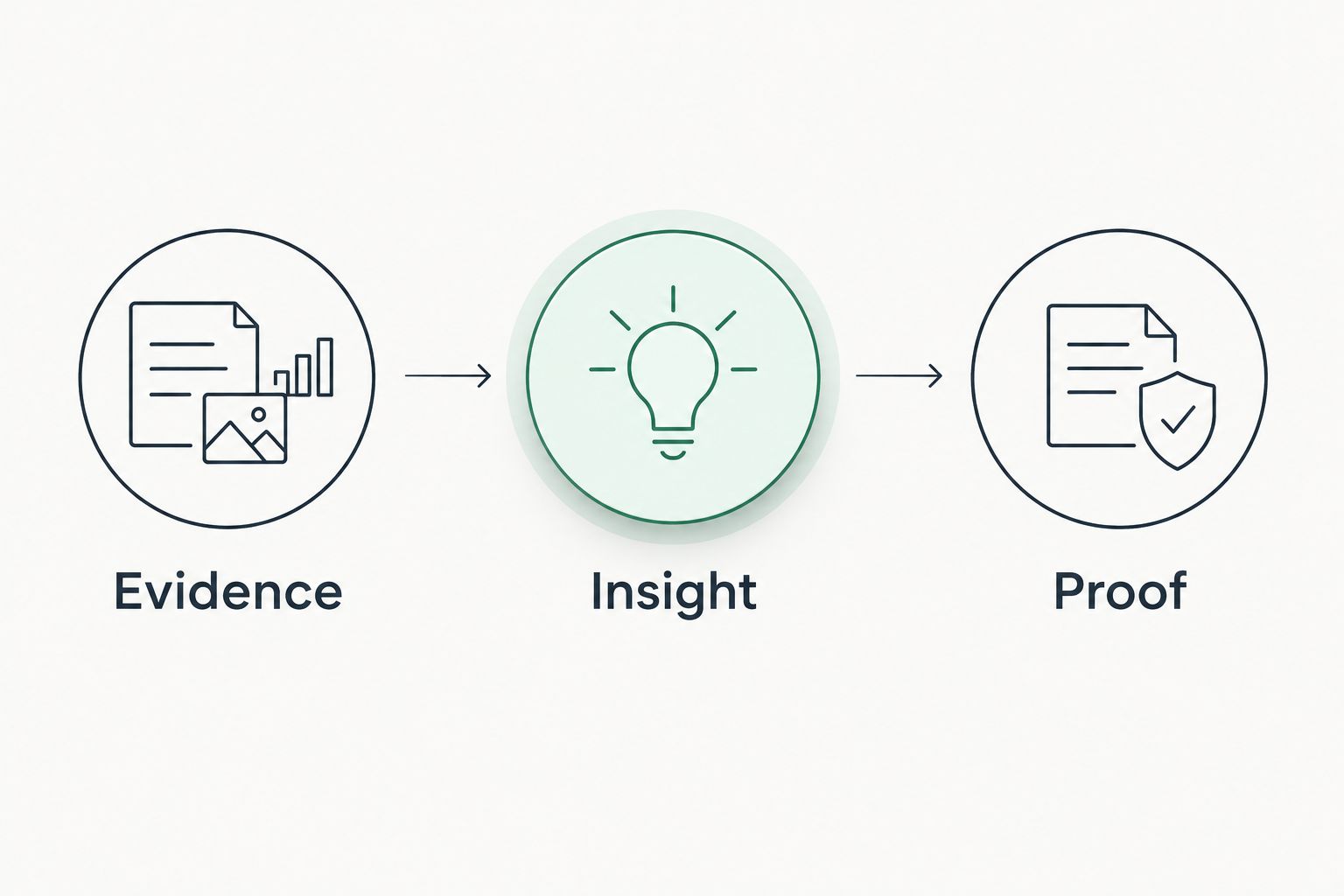
Build an evidence, insight, and proof packet
Prepare 3 sections for the meeting: Evidence, Insight, and Proof. Keep the packet short enough to discuss, with supporting detail available for whoever owns the technical work.
Evidence
State the condition and affected object. Attach the check name, source, run date, and coverage boundary. A reviewer should be able to distinguish the observation from your explanation without reconstructing your research.
For example, a published DMARC policy requesting monitoring supports a statement about the published policy at the recorded time. It does not establish compromise, prove that reporting is ignored, or show that enforcement remains unfinished.
Insight
Connect the condition to a question about intended operation. Explain the possible consequence, identify what remains unknown, and ask who owns the decision.
For the DMARC example, establish whether monitoring remains intentional and who reviews reports. The answer determines whether the next step concerns reporting, configuration, ownership, or no change. Keep the recommended outcome separate from a particular vendor or service package.
Proof
Define how an agreed change would be verified. Proof is a rescan against a pinned baseline, with the relevant check and scope attached. A different overall score alone does not explain what changed.
A 2026 observation is still a dated observation. Recheck evidence before presenting it as current, and preserve the earlier baseline when comparing results. If the source becomes unreadable, report that state instead of carrying forward an implied clean result.
Why qualification depth varies
Match research depth to the decision ahead. More findings do not establish stronger commercial fit.
- Evidence access: public sources and customer-authorized tenant sources answer different questions.
- Coverage limits: permission, license, and unreadable-source boundaries affect what you can responsibly conclude.
- Buyer participation: confirmed priorities and ownership require a conversation with the prospect.
- Service fit: an issue outside your delivery boundaries does not become suitable work because you found it.
- Evidence freshness: a dated observation needs rechecking before you describe the condition as current.
- Decision scope: an introductory conversation needs a different evidence packet from an agreed configuration review.
Avoid assigning a single qualification score that blends security condition, commercial fit, and engagement. Keep those dimensions separate so your team can explain its decision to pursue, pause, or decline the account.
Turn preparation into an agreed next action
Use the SCOUTz Evidence-to-Agreement Framework: Find the decision, Bring the evidence, Build the scope, Earn the next commitment. It is a conversation framework, not a validated model or a proven close-rate intervention.
Find the decision
Identify what the prospect needs to decide before proposing delivery work. For a 2026 opportunity, that might be whether to review an email-security policy, authorize a tenant review, or bring the current provider into the discussion.
The decision belongs to the buyer. Your preparation supplies context; discovery establishes whether that context matters now.
Bring the evidence
Present the observation with its source, date, and limits. Ask the owner to confirm intended operation before recommending a change.
Illustrative dialogue, not a customer exchange:
MSP: The recorded public policy requests monitoring. That tells us the published instruction at that time. Who owns the policy, and is monitoring still the intended setting?
Prospect: Our existing provider handles it.
MSP: Then the useful next step is to confirm intent with that provider. Would you prefer to introduce them, check internally, or leave this here?
The exchange preserves ownership and buyer choice. It does not manufacture a reason to replace the incumbent.
Build the scope
Translate confirmed relevance into bounded work. Name the objects to review, required access, expected evidence, exclusions, and acceptance criteria. Compare possible scopes by the decisions they support.
| Scope choice | Best for | Useful outcome | Boundary |
|---|---|---|---|
| Confirm intended domain policy | Resolving a public-policy question | Owner confirms intent and identifies whether further review is needed | Does not establish tenant controls |
| Authorize a Microsoft 365 configuration review | Answering agreed internal configuration questions | Dated configuration evidence with coverage limits | Does not establish compromise or inspect content |
| Pause further assessment | Accounts without an agreed need or appropriate consent | Clear record of the decision and any permitted follow-up | Leaves unassessed technical questions unknown |
An agreed small scope is more actionable than an unaccepted broad proposal. Include the option to do nothing when the evidence and buyer's priorities support it.
Earn the next commitment
Ask for 1 agreed next action with an owner and completion condition. A prospect accepting a report has not necessarily accepted assessment work, remediation, or a proposal.
Illustrative follow-up, not a customer record:
The public review recorded a monitoring policy. We have not established whether a change is needed. You agreed to confirm the intended policy with the responsible provider; after that confirmation, we can decide whether a scoped review is useful.
Only describe an agreement that actually occurred. If the prospect made no commitment, record the outcome accurately and follow the prospect's communication preferences.
Can I qualify a prospect without knowing the budget?
You can establish preliminary fit without a confirmed budget. Mark funding as unknown and use discovery to establish whether the prospect wants to fund an assessment, consider ongoing service, or take no action.
Do not infer budget from company appearance, a security finding, or a public event. Those inputs do not establish spending authority or an approved purchase.
Should I send a security report before the prospect replies?
Offer an opt-in courtesy review after a reply rather than using an unsolicited report as pressure. Confirm the scope and authorization appropriate to the activity before proceeding.
Report emails need appropriate sender identity and opt-out handling. Public observation and active probing have different boundaries; preliminary scanning-law research does not establish blanket permission to scan prospects.
Where the platform fits
SCOUTz cybersecurity prospect intelligence is best for MSP owners and sales leaders preparing evidence-led prospect conversations. Its job is dated evidence and account context, with the MSP responsible for interpretation, the relationship, and the sale.
The client-supplied product reference dated October 15, 2026 identifies Domain Review as available and Microsoft 365 Review and Prospect Intelligence as Open Beta. Confirm current product status and terms before committing a workflow to a prospect.
The benefit is a structured basis for discovery and later verification. The boundary is equally important: public evidence leaves internal questions unanswered, authorized reviews have coverage limits, and findings cannot establish buying intent.
For MSPs evaluating this workflow, Join Open Beta is the primary next step. Keep your CRM as the relationship record and your delivery platforms responsible for service operations.
FAQ
What's the first thing to check before calling an MSP prospect?
Check whether the organization fits your MSP's service boundaries. Then record the relevant domain, reliable account facts, and the questions discovery must answer.
Can a domain review tell me whether a prospect needs Microsoft 365 remediation?
A public-domain review cannot establish internal Microsoft 365 configuration. Use it to prepare questions, then obtain authorization for an appropriately scoped internal review.
Does a security finding mean the prospect is ready to buy?
A security finding does not establish buying intent. Confirm relevance, ownership, willingness to act, and the next decision directly with the prospect.
What should I do when a review cannot read a source?
Record the source as unreadable or not assessed, with the applicable coverage limit. An unread source does not establish that a control is absent or operating correctly.
Should I recommend replacing the prospect's current MSP?
A finding alone does not support recommending provider replacement. Establish intended operation and ownership, then let the buyer decide whether any change or outside help is appropriate.
What should the first call end with?
End with an agreed next action, an owner, and a completion condition. If the prospect declines further work, record that decision without treating engagement as agreement.
One last thing
The most useful pre-call note can be an explicit unknown. Naming what you cannot establish gives the buyer a precise question to answer and prevents an unsupported claim from entering the proposal.
Before the meeting, remove any sentence that turns a public observation into confirmed internal failure. Replace it with the condition, the evidence boundary, and the next question. That is preparation your sales team can defend.