
Use evidence-based prospecting for MSP cold outreach by attaching a source, observation date and clear boundary to each security finding, then asking the prospect whether the condition matters to an actual business decision. Start with permitted public-domain observations; request customer authorization before reviewing Microsoft 365 configuration and metadata. A finding supports a conversation, but it does not establish compromise, buying intent or an unresolved problem.
- Use evidence-based prospecting for MSP cold outreach to connect dated observations with a permission-based next step.
- SCOUTz supports MSP prospect intelligence and sales preparation; the MSP owns the relationship and sale.
- Public-domain evidence cannot establish internal Microsoft 365 controls or tenant configuration.
- Keep the check, source, date, limits and owner attached through discovery, proposal and verification.
Why this matters
A technical observation becomes useful sales evidence when you explain its limits and connect it to a decision the prospect owns. Without that connection, a security report is a list of conditions awaiting interpretation.
SCOUTz is best for MSP owners and sales leaders who need dated cybersecurity evidence for prospect conversations. Its role is preparation. Your team still qualifies the account, checks the claim and earns agreement on the next action.
For your 2026 outreach process, separate the technical record from the sales hypothesis. A published email-security policy is evidence about that policy. Whether the prospect wants help changing it remains unknown until the prospect tells you.
How to use evidence-based prospecting for MSP cold outreach
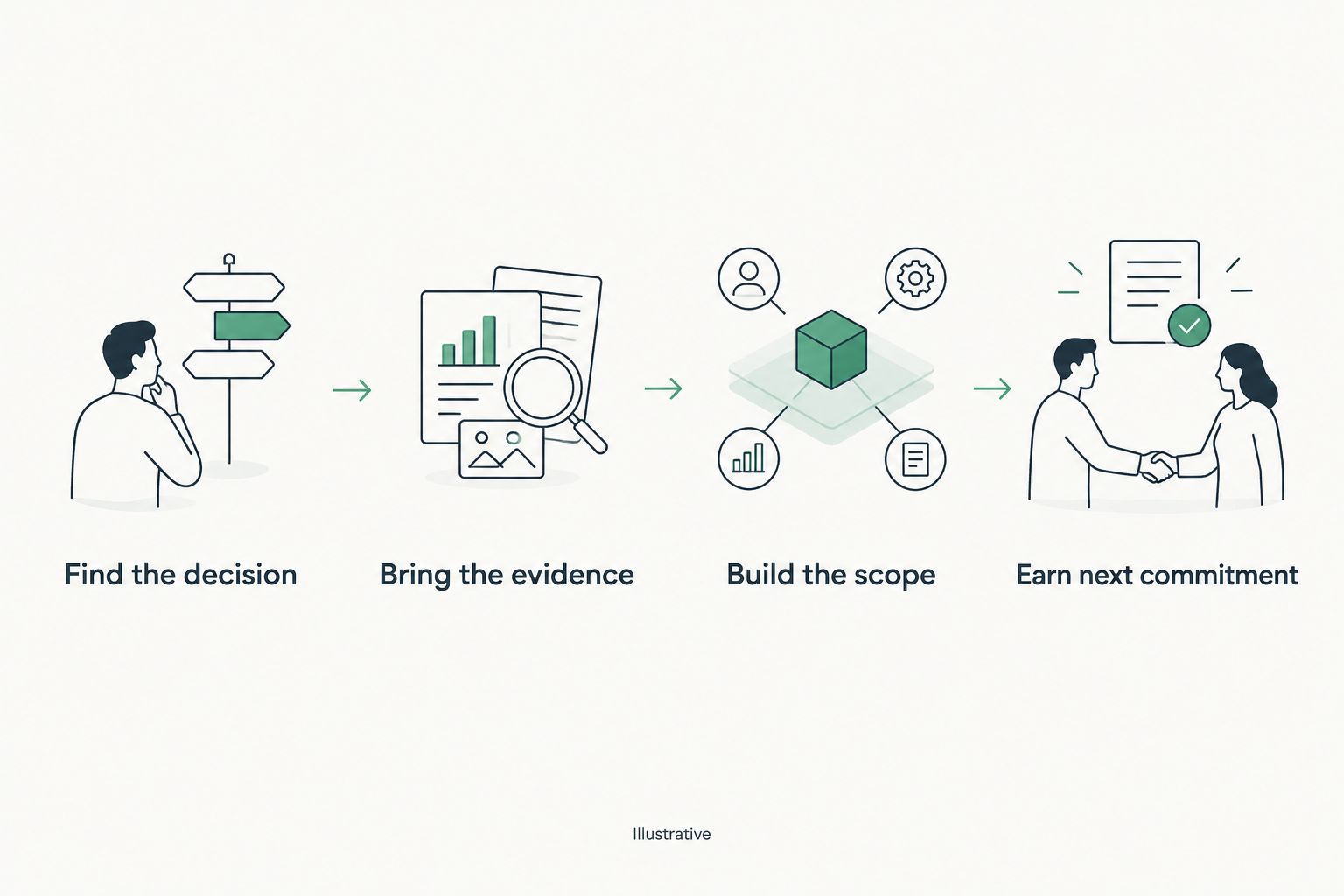
Use the SCOUTz Evidence-to-Agreement Framework: Find the decision, Bring the evidence, Build the scope, Earn the next commitment. This is a conversation framework, not a proven close-rate intervention.
The following workflow uses an illustrative DMARC observation. It does not describe an actual prospect, customer result or live scan.
Find the decision
Choose an account because it fits your service model and you can identify a relevant business responsibility. Record the reason for your research separately from the security observation. A public event can explain timing; it cannot establish buying intent.
For an email-security conversation, the decision might be whether the organization wants to review its current sender-authentication policy. Establish who owns that decision before proposing technical work. The owner might be an internal administrator, an existing provider or another authorized stakeholder; verify rather than assume.
Prepare a short account note:
- The domain and organization relationship you have established.
- The business responsibility relevant to the observation.
- The source and date of any public context.
- The decision owner, or an explicit statement that ownership is unknown.
- The smallest useful next choice you can offer.
An email open belongs in follow-up activity. It does not change the account's evidence state or demonstrate agreement.
Bring the evidence
Keep the check name, affected object, observation date and underlying source together. Add what the evidence cannot establish before writing the outreach message.
For illustration, suppose an authorized review on October 24, 2026 observes a published DMARC record containing p=none. That policy requests monitoring rather than quarantine or rejection through DMARC. The record alone does not establish which legitimate senders are configured correctly, whether reports are reviewed or whether a policy change is appropriate.
A useful evidence note separates:
- Observed: the published DMARC record and its policy value at the recorded time.
- Possible consequence: the policy does not request quarantine or rejection of messages that fail DMARC.
- Unknown: the organization's intended enforcement policy and report-review process.
- Ask: confirm who owns sender authentication and whether monitoring-only remains intended.
A finding is a condition to discuss, not a diagnosis of the prospect's business. Retain the original evidence so a practitioner can check the sales explanation.
Build the scope
Turn an agreed concern into a bounded review. Specify the affected domain, evidence sources, permissions, exclusions and expected deliverable. Keep the recommended outcome separate from a vendor or product choice.
For the illustrative DMARC case, an initial scope can be a review of the published policy and customer-provided aggregate reports. Changing enforcement is a separate decision after the responsible administrator understands legitimate sending sources and relevant exceptions.
If discovery moves into Microsoft 365, obtain customer authorization for the read-only review. Configuration and metadata evidence stays distinct from public-domain observations. Mail, files, chats, documents and prompts are outside the stated review boundary.
The MSP chooses whether the appropriate response is a service, process, project, product or no change. The proposal should preserve that choice rather than treating every observation as a mandatory purchase.
Earn the next commitment
Close the conversation with a named owner, an agreed action and a definition of completion. Permission to send a summary is different from permission to assess a tenant. Keep those agreements separate.
A useful next commitment could be an introduction to the email administrator, approval for a bounded review or a meeting to discuss evidence already collected. Record what the prospect accepted and what remains undecided.
After authorized work, verify against a pinned baseline. If the baseline is dated October 24, 2026, compare the later observation with that baseline and identify the specific changed condition. Do not turn a changed DNS record into a claim that the organization is secure.
Keep public and authorized evidence separate
Choose the evidence source that answers the agreed question. Public observation is useful for external conditions; customer-authorized Microsoft 365 review addresses internal configuration and metadata within the permissions granted.
| Evidence approach | Best for | Useful evidence | Boundary or drawback |
|---|---|---|---|
| Public-domain review | Preparing a bounded external-security conversation | Published domain and email-security observations | Cannot establish Conditional Access coverage, application permissions or tenant sharing configuration |
| Customer-authorized Microsoft 365 review | Examining an agreed internal configuration question | Read-only configuration and metadata evidence within approved access | Permission and license limits can leave sources unread or unassessed |
| Baseline and rescan comparison | Verifying a specific changed condition | Dated observations against a pinned baseline | A changed condition does not prove every related control works |
SCOUTz prospect intelligence supports preparation across these boundaries, but evidence coverage still needs explanation. Its Microsoft 365 Review is labeled Open Beta in the client-supplied October 15, 2026 product reference. Treat beta status as a product boundary, not evidence of customer outcomes.
Keep evidence states such as Observed, Inferred, Possible, Unknown and Unreadable distinct. Coverage labels such as Partial, Not assessed and Permission limited answer a different question: what the review actually covered. Unread sources belong under NOT ASSESSED THIS SCAN rather than being presented as clean.
Write an outreach message the evidence can support
Offer a bounded review after a reply rather than attaching an unsolicited assessment that overstates your authority. Use appropriate sender identity and opt-out handling. Distinguish public observation from active probing; neither a public website nor a sales objective establishes blanket permission.
Before choosing collection methods, review the relevant jurisdiction and obtain qualified advice where needed. The guide to unsolicited security scanning research is educational research, not legal clearance to scan prospects.
Illustrative first message
The following is suggested copy for the illustrative DMARC condition, not a real exchange:
Your domain's published DMARC record requested monitoring when reviewed on October 24, 2026. That describes the published policy, not a compromise. If you own email security, would a brief review of the policy and its limits be useful? We would agree the review scope with you first. If someone else owns this, please direct us to the appropriate contact.
Use that wording only when your own permitted observation supports every statement. Replace the illustrative date with the actual observation date. Add your real sender identity and the opt-out handling appropriate to your outreach process.
The message gives the recipient a choice. It also avoids implying that a monitoring policy is accidental or that the current provider has failed.
Illustrative objection handling
These responses are suggested scripts, not attributed quotations or evidence of sales results.
| Prospect response | Evidence-led reply | Next choice |
|---|---|---|
| Our existing provider handles this. | That helps establish ownership. The published record alone does not explain the provider's intended policy. | Offer a short evidence note for the provider to review. |
| Are you saying we were breached? | The observation describes a published policy. It does not establish compromise. | Clarify the boundary before discussing any review. |
| Send us your proposal. | A useful proposal needs the agreed outcome, review boundary and responsible owner. | Confirm those details before pricing or recommending work. |
| We do not want a review. | Understood. | Respect the decision and record the contact preference. |
A declined review is a valid outcome. Keep the technical observation separate from the prospect's decision about whether to engage.
Why the next step varies by account
The same public finding can support different actions. Use these factors to decide whether the appropriate next step is clarification, authorized assessment, a proposal or no action:
- Evidence freshness: recheck the condition before relying on an older observation in a 2026 proposal.
- Ownership: confirm whether the prospect, another provider or another authorized party controls the affected object.
- Intended state: establish whether the observed configuration matches an approved operating decision.
- Coverage: identify permission limits, unread sources and controls outside the review.
- Business relevance: connect the condition to an outcome the prospect actually wants to discuss.
- Buyer choice: honor the prospect's decision to proceed, defer or decline.
These factors qualify the conversation. They do not produce a score for purchase intent.
Carry the evidence into the proposal and follow-up
Build the proposal around the agreed outcome. Include the condition, affected object, source, observation date, unknowns, responsible owner and acceptance criteria. State exclusions alongside deliverables so the buyer can distinguish a review from implementation and ongoing service.
For the illustrative DMARC account, compare scope choices without pretending either is automatically necessary:
| Scope choice | Best for | Deliverable | Limit |
|---|---|---|---|
| Review only | An owner who first needs to understand the current policy | Evidence summary, intended-state questions and recommended next decision | Does not include configuration changes |
| Authorized implementation and verification | An owner who has approved a defined change | Agreed implementation work and comparison against the pinned baseline | Does not establish security beyond the agreed checks |
Follow up on the agreement rather than escalating the language. A useful follow-up names the decision still open, the person responsible and the evidence needed to resolve it. If nobody agreed to a review, ask whether the recipient wants to continue before sending a larger report.
Use SCOUTz for dated cybersecurity evidence and prospect context; use your CRM to record relationship activity and commitments. A report prepares the conversation. Your team remains responsible for the recommendation and sale.
FAQ
How do I use evidence-based prospecting for MSP cold outreach?
Attach a source, observation date and clear boundary to a relevant finding, then ask whether the prospect wants to discuss the decision it raises. Keep public-domain evidence separate from customer-authorized Microsoft 365 evidence and agree the next step before expanding the review.
Can I tell a prospect that a DMARC monitoring policy means they were breached?
A DMARC monitoring policy does not establish a breach. Describe the published policy at the observation date, explain its limits and ask whether the policy matches the organization's intended state.
Do I need permission before scanning a prospect?
Permission requirements depend on the activity and applicable law; a public domain does not provide blanket authorization for active probing. Distinguish public observation from active testing, agree the scope and seek qualified legal advice where needed.
Can a domain review show whether Microsoft 365 MFA is enforced?
A public-domain review cannot establish Microsoft 365 MFA enforcement or Conditional Access coverage. Internal configuration questions require customer-authorized evidence, with permission and coverage limits stated.
What should an MSP proposal include after a security review?
An evidence-led MSP proposal should include the agreed outcome, affected objects, dated sources, unknowns, owner, scope, exclusions and acceptance criteria. Keep vendor choices separate from the condition and verify agreed changes against a pinned baseline.
Does evidence-based outreach guarantee more MSP sales?
Evidence-based outreach does not guarantee more MSP sales, shorter sales cycles or higher close rates. It gives your team a dated factual basis for discovery while the prospect retains the choice to proceed, defer or decline.
One last thing
The strongest next step can be permission to leave a setting unchanged. If the owner confirms that a condition is intentional, record the decision and its evidence rather than manufacturing a project. That preserves an accurate baseline for the next review.
For MSPs evaluating SCOUTz, Join Open Beta is the primary next step. Confirm current scope and terms before applying; product access does not transfer responsibility for the relationship or sale.