
A compliance gap analysis is not a default prerequisite for an MSP sales meeting; use the meeting to establish which requirements apply and what evidence the buyer needs. Complete an analysis beforehand when the buyer's procurement instructions, agreed scope or applicable requirement calls for it. A domain finding alone does not establish regulatory noncompliance.
- Is a compliance gap analysis required before an MSP sales meeting? Only when an applicable requirement or agreed scope requires it.
- SCOUTz cybersecurity prospect intelligence suits MSPs preparing evidence-led discovery; it does not replace a scoped compliance gap analysis.
- Separate public-domain observations from customer-authorized Microsoft 365 configuration evidence.
- Agree on the requirement, evidence boundary, accountable owner and next action before proposing remediation.
Why this matters: Doing a full analysis before you know the buyer's decision risks answering the wrong question. Arriving with a security finding and calling it a compliance failure creates a different problem: the conclusion exceeds the evidence.
SCOUTz supports sales preparation with dated cybersecurity evidence and account context. The MSP still owns the interpretation, relationship and sale. For a 2026 prospect meeting, preparation should make the next decision clearer without implying that an assessment has already established the prospect's compliance status.
Is a compliance gap analysis required before an MSP sales meeting?
Treat a compliance gap analysis as a scoped deliverable, not an automatic admission ticket to discovery. First establish whether the meeting concerns service fit, a specific control question or a formal assessment obligation. Those are different jobs.
A compliance gap analysis compares evidence against identified requirements within a defined scope. A sales-preparation review can provide useful observations without making that comparison. Keep the distinction visible in the meeting agenda and proposal.
| Review scope | Best for | What it supports | Main limitation |
|---|---|---|---|
| Public-domain review | Preparing external domain and email-security questions | Dated observations about publicly accessible evidence | Cannot establish internal tenant controls or overall compliance |
| Customer-authorized Microsoft 365 review | Discussing tenant configuration with permission | Configuration and metadata findings within authorized coverage | Unread or inaccessible sources remain unknown |
| Scoped compliance gap analysis | Comparing an agreed environment against named requirements | Documented gaps, evidence boundaries and follow-up work | Requires applicable criteria and evidence beyond isolated technical findings |
These are 3 review scopes, not ascending quality ratings. Choose the scope that answers the buyer's actual decision. A carefully bounded public observation is more useful than a compliance conclusion built on missing evidence.
If the buyer requires a completed analysis before procurement discussions, follow that process. If applicability is disputed, involve the person responsible for interpreting the obligation rather than letting a sales report settle it.
Public-domain review: prepare questions about external evidence
A public-domain review fits an introductory conversation about domain and email-security conditions. It does not establish Conditional Access coverage, application permissions, license assignments, Intune device state or tenant sharing configuration.
Consider a published DMARC policy requesting monitoring only. The observation supports a question about intended enforcement and reporting. It does not establish compromise, prove an unresolved problem or demonstrate that a named compliance requirement has been violated.
Use the finding's check name, affected domain, source and run date. Then separate the observed condition from the possible consequence and the question for the owner.
For a 2026 meeting, keep the collection date attached when you move evidence into a slide or proposal. A current presentation date does not make an older observation current.
The advantage is a bounded starting point for discovery. The limitation is equally important: public evidence cannot answer questions that require internal configuration, operational records or authorized access.
Public observation and active probing also require separate consideration. Do not treat a publicly reachable service as blanket permission for testing; agree on scope and obtain appropriate guidance for the activity involved.
Authorized Microsoft 365 review: discuss internal configuration
A customer-authorized Microsoft 365 review supports a more specific configuration conversation. Authorization, coverage and evidence limits belong beside the findings, not in a footnote after the recommendation.
SCOUTz cybersecurity prospect intelligence distinguishes public-domain evidence from customer-approved cloud evidence. Its Microsoft 365 review uses configuration and metadata, never mail, files, chats, documents or prompts. The review is read-only, with no agent or install and no automatic configuration changes.
That boundary helps explain the work to a prospect. It also limits the conclusions: read-only configuration evidence does not establish every operational practice, policy decision or compliance outcome.
Keep evidence states separate from coverage. Observed, Inferred, Possible, Unknown and Unreadable describe different evidence conditions; they are not a score ladder. Assessed, Partial, Not assessed, Permission limited and License limited describe coverage.
If a source was unreadable, record that boundary under NOT ASSESSED THIS SCAN. Do not convert failed collection into a clean result. Likewise, tenant-wide application permission does not by itself establish a malicious application.
This review's strength is internal configuration evidence within consented scope. Its limitation is that configuration evidence still needs requirement mapping and human interpretation before it supports a compliance conclusion.
Scoped compliance gap analysis: establish criteria before conclusions
A formal gap analysis becomes appropriate when the buyer needs a documented comparison against identified obligations. Start with the named requirement, its applicable version, the environment in scope and the person accountable for interpreting it.
For a 2026 engagement, distinguish the assessment date from the requirement version. The year on the report cover does not determine which criteria apply.
The evidence request should follow the criteria. Depending on the agreed requirement, that request can include configuration evidence, policies, operating records, interviews and evidence of how a process works. Do not imply that a technical scan alone completes this work.
Write each conclusion so another reviewer can follow it: requirement, affected object, supporting evidence, unknowns and recommended outcome. Identify who owns the next decision.
The advantage is a traceable basis for an agreed compliance discussion. The trade-off is additional scope and evidence collection. Avoid committing to a complete assessment before you understand the environment, access and deliverables.
Keep vendor selection separate. An identified gap can lead to a product, service, process change, project or an accepted decision to take no action, subject to the buyer's obligations and authority.
Why pre-meeting assessment scope varies
The right preparation depends on the decision, not the size of the report. Use these factors to set the boundary:
- Meeting purpose: an introductory service-fit discussion needs different evidence from a procurement review requesting documented control gaps.
- Applicable criteria: name the requirement before claiming that a condition fails it.
- Buyer instructions: a requested pre-meeting deliverable changes the preparation scope; an assumed deliverable does not.
- Evidence access: public observations and consented internal evidence answer different questions.
- Coverage limits: permissions, licensing and unread sources constrain what an assessment can establish.
- Evidence age: a dated observation describes the collection point; a rescan is needed to show a changed condition against a baseline.
Resolve these factors before promising the analysis. Otherwise, the proposal can quietly expand from meeting preparation into an assessment neither party has defined.
Move from evidence to an agreed next action
Use the SCOUTz Evidence-to-Agreement Framework: Find the decision, Bring the evidence, Build the scope, Earn the next commitment. These 4 steps structure a conversation; they are not a validated psychological model or a proven close-rate intervention.
Find the decision
Establish what the buyer needs to decide after the meeting. Examples include whether to authorize a review, involve the compliance owner or request a scoped proposal.
Record the decision in the agenda. Keep it separate from the MSP's preferred service package so the conversation starts with the buyer's requirement.
Bring the evidence
Present the condition, source, check date and collection boundary. Label an inference as an inference. Keep unknowns visible.
Use a compact evidence packet rather than a wall of findings. The domain-scan-to-first-call evidence workflow provides a related preparation path. The purpose is to support a useful question, not to manufacture urgency.
Build the scope
Translate the evidence into a bounded choice. Separate confirmation work from remediation work, and distinguish both from a formal compliance assessment.
Name the affected object, intended outcome, owner, access needed and exclusions. If the applicable requirement is still unknown, make clarifying it part of discovery rather than inventing a control mapping.
Earn next commitment
Finish with 1 agreed next action, an owner and a date. That action can be an authorized review, a requirements workshop or a proposal discussion.
A buyer can also decline further work. Record the decision without treating it as agreement that a finding is harmless or evidence that the buyer lacks concern.
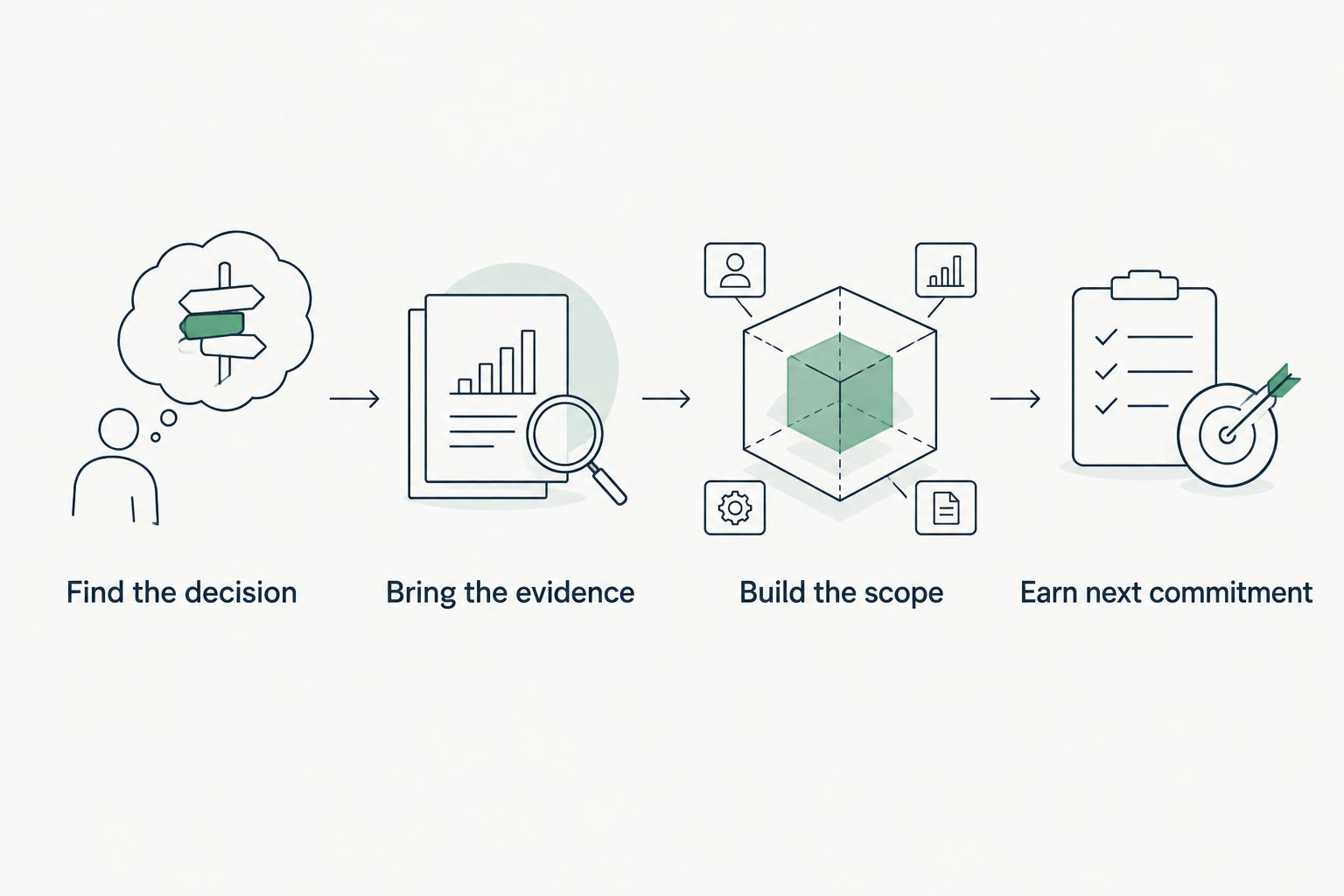
The framework keeps evidence, interpretation and commitment connected. It leaves the buyer free to choose and the MSP responsible for the recommendation.
Handle the compliance objection without overstating the finding
The following dialogue is illustrative, not a customer quotation or an observed assessment result.
Prospect: “Do you need to complete a compliance gap analysis before we meet?”
MSP: “Only if your process requires that deliverable before the meeting. Otherwise, let's identify the requirement, the decision you need to make and the evidence you already have.”
Prospect: “Does the domain finding mean we are noncompliant?”
MSP: “The observation does not establish that. We need the applicable requirement and enough evidence to compare the condition against it. We can scope that work with the responsible owner.”
This response gives the buyer a next choice without withdrawing the observation. Keep the finding intact and reduce the claim to what the evidence supports.
Turn the meeting into a bounded proposal
The proposal should preserve the distinction established in discovery. Name the deliverable as a domain review, authorized tenant review or compliance gap analysis according to the work actually agreed.
For a 2026 proposal, carry forward the evidence dates and coverage limits. Avoid replacing them with an undated summary that sounds more certain than the source.
A useful follow-up separates the observed condition, the interpretation awaiting confirmation and the proposed work. State who supplies access, who interprets the requirement, who approves changes and what evidence will demonstrate completion.
Illustrative follow-up wording: “The meeting identified a published monitoring-only DMARC policy. Its intended state and compliance significance remain unconfirmed. The proposed next step is an authorized review with the domain owner, followed by an agreed recommendation.”
If work proceeds, pin the baseline before changes. Proof means a rescan against that baseline, with the scope and date attached. It does not mean every risk or obligation has been resolved.
For MSPs using SCOUTz, Join Open Beta is the next step for exploring evidence-led preparation. Keep that product evaluation separate from any promise about sales results or compliance outcomes.
Can I hold discovery before assessing compliance?
Yes. Use discovery to establish the relevant requirements, stakeholders, existing evidence and authorization boundary before agreeing on assessment work. Follow any explicit pre-meeting requirement the buyer has already supplied.
An introductory meeting can end with a well-defined evidence request. That is a concrete outcome even when no remediation proposal is ready.
Can a security finding prove a compliance gap?
A security finding needs an applicable requirement and sufficient supporting evidence before it supports a compliance-gap conclusion. The same observed condition can have different significance depending on scope and the criteria being assessed.
Keep the technical condition visible while the compliance interpretation remains unresolved. Unknown applicability is not proof of either compliance or noncompliance.
Should I propose remediation during the first meeting?
Propose remediation when the evidence, authority and intended outcome support a bounded recommendation. When those elements remain unresolved, propose confirmation or assessment work first.
Separate the desired outcome from the vendor choice. The buyer should understand what needs to change before being asked to approve a particular product or service.
FAQ
Is a compliance gap analysis required before an MSP sales meeting?
A compliance gap analysis is required beforehand when an applicable requirement, procurement instruction or agreed scope calls for it. Otherwise, use discovery to establish the criteria and evidence needed before commissioning the analysis.
Can I use a domain scan instead of a compliance gap analysis?
A domain scan cannot substitute for a scoped compliance gap analysis. It supports bounded questions about public evidence but cannot establish internal controls or overall compliance.
Does a monitoring-only DMARC policy mean the prospect is noncompliant?
A monitoring-only DMARC policy does not by itself establish noncompliance. Confirm the intended policy, applicable requirement and supporting evidence before making that conclusion.
Do I need permission for a Microsoft 365 review?
A Microsoft 365 review requires customer authorization for the agreed access and scope. Keep configuration and metadata evidence separate from public-domain observations, and disclose collection limits.
What should I bring to the first MSP sales meeting?
Bring dated evidence, its source, coverage limits and questions tied to the buyer's decision. Identify the requirement owner before presenting a technical observation as a compliance gap.
What does an unreadable assessment result mean?
An unreadable result means the source could not be assessed within that review. Record the limitation explicitly rather than reporting the control as absent or clean.
Is SCOUTz a replacement for a compliance assessor?
SCOUTz prepares MSP conversations with dated cybersecurity evidence and account context. Requirement interpretation, assessment scope and the final recommendation remain human responsibilities.
One last thing
An explicit unknown can be the most useful item in the meeting. It identifies the evidence request that belongs in the next scope instead of hiding uncertainty behind a confident score.
Before sending the follow-up, check that every proposed action has an owner and every conclusion retains its source boundary. The report should make the next decision easier to justify, not harder to question.