
No. A domain security scan gives you dated public evidence for discovery, but it does not establish a prospect's priorities, decision authority, willingness to act or permission for an internal assessment. Qualify the opportunity by connecting an observed condition to an owner-confirmed concern and an agreed next action.
- Is a domain security scan enough to qualify a prospect? No. Public findings support discovery, not buying intent.
- SCOUTz is best for MSPs preparing evidence-led prospect conversations; qualification still requires buyer participation.
- Separate public-domain observations from customer-authorized Microsoft 365 configuration evidence.
- Keep the finding's source, run date, limits and next decision attached to the account.
Why this matters
A scan can help you prepare a relevant conversation. Qualification requires the prospect to participate in that conversation. Treating the two as interchangeable produces proposals built around conditions the buyer has never confirmed as priorities.
SCOUTz is best for MSPs that need dated cybersecurity prospect intelligence before discovery. Its role is preparation: evidence and account context you can bring into a meeting. Your CRM holds the relationship, and your judgment determines whether the opportunity merits further work.
For your 2026 sales preparation, start with a simple boundary: public evidence supports a question; an owner-confirmed concern supports scoping. Visit SCOUTz and choose Join Open Beta if that preparation fits your workflow.
Is a domain security scan enough to qualify a prospect?
A domain security scan is enough to inform discovery, not enough to qualify the commercial opportunity. It can establish what a public source exposed when a check ran. It cannot establish what the prospect wants to change or who can approve the work.
Keep these three inputs separate when deciding what happens next:
| Input | Best for | Useful evidence | Qualification limit |
|---|---|---|---|
| Public domain review | Preparing a specific discovery question | Dated observations about public domain and email-security configuration | Cannot establish internal tenant controls or buying intent |
| Customer-authorized Microsoft 365 review | Investigating agreed tenant questions | Read-only configuration and metadata within authorized coverage | Cannot establish business priority, decision authority or willingness to proceed |
| Buyer discovery | Confirming ownership and an agreed next action | The prospect's stated concern, intended outcome and decision process | Statements still need technical validation before detailed scope |
A domain finding has value even when it produces no project. The prospect might confirm that the configuration is intentional, explain work already underway or decline further review. Record that answer instead of preserving an alarming interpretation in the pipeline.
Use the domain-scan-to-first-call evidence workflow to organize the handoff from a technical observation to a buyer conversation.
Public evidence: a starting point for discovery
Consider a published DMARC policy requesting monitoring only. The observation concerns a public policy at the time of the check. It does not establish compromise, identify every legitimate sender or prove that the organization has neglected email security.
Prepare the finding in this order:
- Condition: the published DMARC policy requests monitoring only.
- Evidence: retain the checked domain, returned policy, source and run date.
- Boundary: the public record does not explain the organization's rollout plan or reporting process.
- Owner: ask who manages email authentication and reviews reports.
- Next choice: confirm whether monitoring remains intended before discussing changes.
The possible consequence is limited: that policy does not request quarantine or rejection for messages that fail DMARC. Receiving systems still apply their own handling. Do not turn the observation into a claim that messages reached an inbox or that an attacker used the domain.
A finding becomes commercially relevant when the prospect confirms why the condition matters to them. Until then, it remains evidence for research and discovery.
Authorized tenant evidence: deeper coverage, same qualification boundary
A public domain review cannot establish Conditional Access coverage, application permissions, license assignments, Intune device state or tenant sharing configuration. Those questions require appropriately authorized internal evidence.
Customer-authorized Microsoft 365 review is a different evidence source. Keep its consent, coverage and collection date separate from public observations. Read-only collection concerns configuration and metadata, never mail, files, chats, documents or prompts, and makes no automatic configuration changes.
In the client's October 15, 2026 product reference, SCOUTz Microsoft 365 Review is labeled Open Beta. That status does not turn a tenant review into a complete account qualification or a guarantee of assessment coverage.
Use explicit coverage labels: Assessed, Partial, Not assessed, Permission limited and License limited. Keep evidence states distinct from coverage. Observed, Inferred, Possible and Unknown describe different claims; they are not steps on a score ladder.
If a source is unreadable, leave it unreadable. Put declared non-reads under NOT ASSESSED THIS SCAN rather than describing the account as clean.
Why qualification varies between prospects
Identical public findings can lead to different sales decisions because the surrounding account context differs. These factors determine whether the evidence supports further work:
- Ownership: the person attending the meeting must identify who manages the affected configuration and who approves changes.
- Intended state: a monitoring-only policy can reflect an intentional stage in an email-authentication rollout. Confirm the intended outcome.
- Evidence coverage: public observations and consented tenant evidence answer different questions. Unread sources remain unknown.
- Business priority: the buyer must explain whether the condition connects to an outcome they want to address.
- Existing work: another provider or internal team might already own the change. Ask for the current status before describing an unresolved problem.
- Agreed commitment: permission for a review, an owner introduction or a scope discussion establishes a next action. An email open does not.
Keep these factors visible in your 2026 opportunity notes. A finding count should never stand in for an explanation of why the prospect wants to proceed.
Move from evidence to an agreed next action
Use the SCOUTz Evidence-to-Agreement Framework to structure the conversation: Find the decision, Bring the evidence, Build the scope, Earn the next commitment. This is a conversation framework, not a validated close-rate intervention.
Find the decision
Identify the decision the prospect needs to make before presenting a proposed solution. For a DMARC observation, the decision might be whether to review intended enforcement and reporting ownership.
Ask who owns that decision and what information they need. Avoid opening with a remediation package before the prospect has confirmed the desired outcome.
Bring the evidence
Show the observed condition with its source, run date and limits. Distinguish a returned public record from any interpretation of the organization's intent.
Use one relevant finding to start the discussion. A larger report belongs behind the conversation as supporting material, with coverage and unknowns preserved.
Build the scope
Separate the condition from the vendor choice. The appropriate response can be a service, process change, project, further assessment or no action.
Define the affected object, responsible owner, permissions needed, intended outcome and verification method. If those remain unknown, propose discovery rather than presenting a finished remediation scope.
Earn the next commitment
Ask for a specific, voluntary next action. That might be an introduction to the email administrator or approval for a limited read-only review.
Record who agreed, what they approved and what remains undecided. A meeting that ends without agreement should not become a proposal-ready opportunity merely because the scan produced findings.
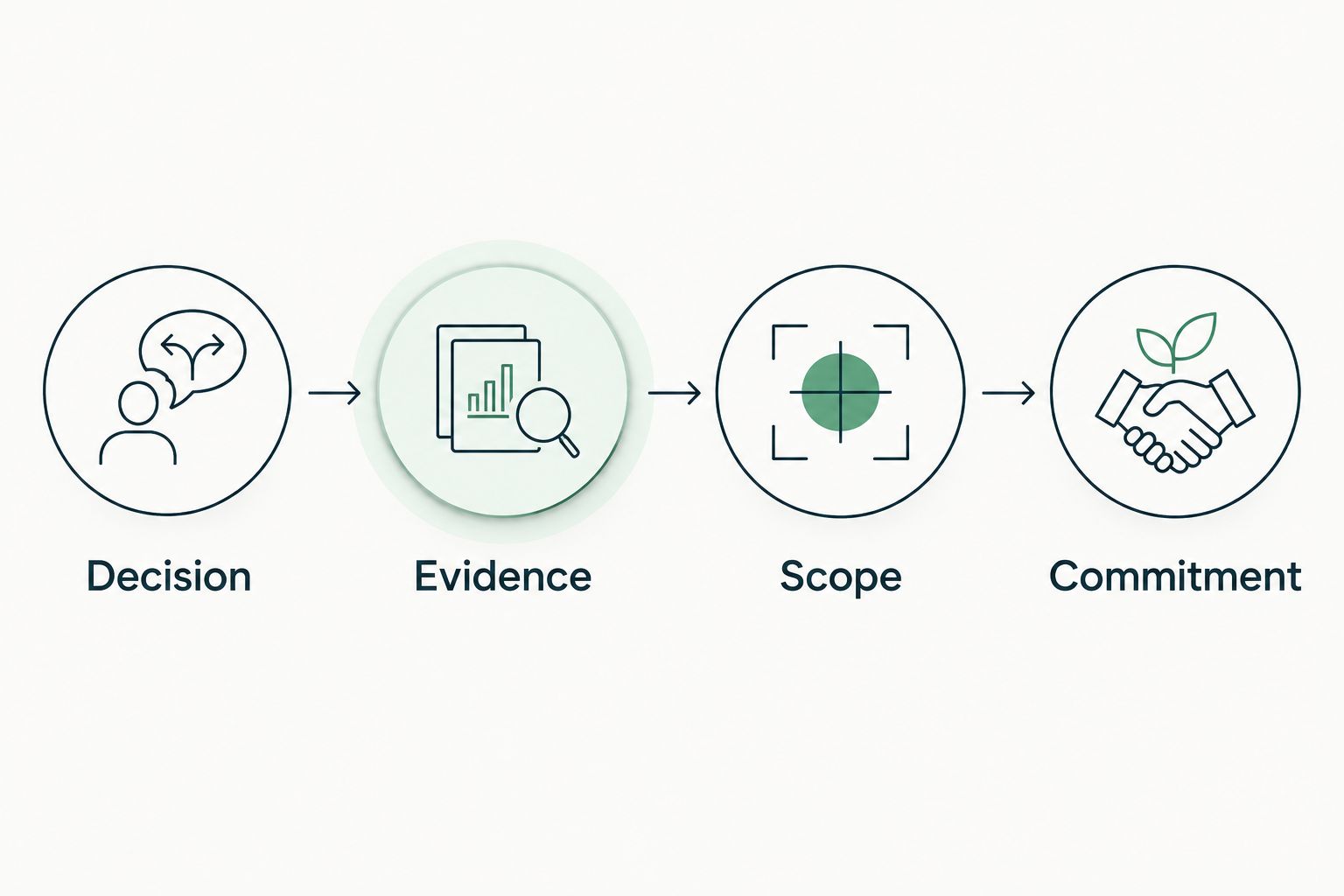
Turn a DMARC observation into a bounded conversation
The following dialogue is illustrative, not a customer transcript or a claim about an actual scan. Use it only when your dated evidence supports the stated condition.
MSP: The public DMARC record returned during this review requests monitoring only. That tells us the published policy, but it does not tell us your intended enforcement plan. Who owns that decision?
Prospect: Our current provider handles it. We do not want another assessment.
MSP: Understood. Would you prefer to confirm with that provider whether monitoring remains intended, or leave this here?
Prospect: Send me the observation so I can ask.
MSP: I will send the record, check date and the question to confirm. There is no tenant access or configuration change in that step.
The commitment is permission to send a bounded observation. It is not agreement to an assessment, evidence of dissatisfaction with the incumbent or authorization to change anything.
If the prospect later confirms a need for help, scope the work around the unanswered question. Keep the original observation attached so the proposal remains traceable to evidence rather than an expanding sales claim.
Choose a scope that matches the agreement
A useful 2026 proposal distinguishes the next decision from the eventual delivery project. Offer the smallest scope that answers the agreed question and preserves buyer choice.
| Next action | Best for | Included purpose | Limit to state |
|---|---|---|---|
| Confirm the observation | A buyer who wants the existing owner involved | Share dated evidence and clarify intended configuration | No assumption that a change is required |
| Authorize further review | A buyer with an unanswered internal-control question | Collect agreed read-only evidence within approved permissions | Coverage depends on readable, authorized sources |
| Define a change project | A buyer who has confirmed an intended outcome | Specify ownership, implementation boundaries and verification | The initial scan alone does not establish implementation requirements |
Do not combine these into one implied approval. Permission to receive a public observation is narrower than permission to review a tenant. Permission to review is narrower than approval to implement changes.
For follow-up, use a short structure: the observed condition, its limit, the agreed owner and the requested next action. Recheck time-sensitive evidence before reusing it in a proposal.
Prepare your next prospect conversation
Visit the site and choose Join Open Beta to apply for an MSP-fit review.
What should I record before calling a prospect qualified?
Record the owner-confirmed concern, decision owner, intended outcome and agreed next action. Attach the supporting evidence with its source, run date, coverage and unknowns.
For your 2026 CRM template, give observations and buyer statements separate fields. That prevents a technical inference from becoming an apparent customer admission when someone else picks up the account.
Does a clean domain scan mean the prospect has no security needs?
No. A domain review covers its assessed public sources, while internal controls and unread sources remain outside that conclusion.
A report without findings does not establish Conditional Access coverage, backup recoverability or the absence of business needs. Continue discovery without manufacturing a security problem to justify the meeting.
FAQ
Is a domain security scan enough to qualify a prospect?
No. A domain security scan supplies dated public evidence, while qualification requires buyer-confirmed context and an agreed next action. Keep observations separate from assumptions about need or intent.
What should I ask after finding a monitoring-only DMARC policy?
Ask who owns email authentication and whether monitoring-only remains the intended policy. Keep the checked domain, returned policy and run date attached; the finding does not establish compromise.
Can a public domain scan show whether Microsoft 365 MFA is enforced?
No. Public-domain evidence cannot establish internal tenant enforcement. Use customer-authorized evidence with explicit coverage and permission boundaries to investigate the relevant control.
Does permission to receive a report authorize a tenant assessment?
No. Permission to receive a report covers that agreed communication, not internal tenant access. Obtain appropriate authorization and define the review scope separately.
Can I scan any prospect domain without permission?
Do not assume blanket permission. Distinguish public observation from active probing, review the planned activity and applicable rules, and offer outreach scans as opt-in courtesies after a reply. This is educational guidance, not legal advice.
Does SCOUTz replace my CRM or sales judgment?
No. SCOUTz supports cybersecurity prospect intelligence and sales preparation. Your CRM owns the relationship, and the MSP remains responsible for qualification, scope and the sale.
What counts as proof after a prospect approves a change?
A rescan against a pinned baseline provides evidence of what changed within the assessed coverage. Retain the original condition, later result, collection dates and remaining unknowns; a changed finding does not prove the whole environment is secure.
One last thing
An intentional configuration can be a useful qualification outcome. If the owner explains the policy, identifies the responsible team and confirms that no further review is wanted, record the answer accurately.
That closes a question without inventing a project. For the next prospect, carry the same discipline from evidence to insight to proof: what ran, why the buyer cares and what changed against the baseline.