
Yes, a Microsoft 365 security assessment is worth doing before a sales pitch in 2026 when the prospect authorizes access and the review supports a specific decision about scope, ownership or next steps. The trade-off is preparation and interpretation work: findings need dated evidence, clear limits and technical review before you turn them into a proposal.
- Is a Microsoft 365 security assessment worth it before a sales pitch? Yes, with consent and a decision.
- SCOUTz fits MSP prospect intelligence and evidence-led sales preparation; the MSP owns the relationship and sale.
- Public-domain observations cannot establish internal Microsoft 365 configuration. Customer-authorized evidence requires a separate review.
- Carry the source, run date, affected object and coverage limits into discovery, scope and follow-up.
Is a Microsoft 365 security assessment worth it before a sales pitch?
Assess before the pitch when the evidence can change the proposed work. Defer tenant access when the prospect has not agreed to a purpose or cannot authorize the review.
SCOUTz is best for MSPs preparing evidence-led prospect conversations. Its role is sales preparation; your team still interprets the evidence and earns the next commitment.
| Preparation option | Best for | Useful evidence | Limitation |
|---|---|---|---|
| Discovery before assessment | Establishing the decision and authorized owner | Business priorities, responsibilities and stated concerns | Statements still need verification |
| Public-domain review | Preparing external email-security questions | Published domain observations, including DMARC policy | Cannot establish internal tenant controls |
| Authorized Microsoft 365 review | Building a tenant-specific scope | Configuration and metadata within approved access | Permission and license limits leave coverage gaps |
These are scope choices, not a ranking of prospect quality. Start with the least access needed to answer the agreed question, then expand only with permission.
Why this matters
A generic pitch asks the buyer to imagine a problem. Dated evidence gives the buyer a condition to confirm, explain or challenge. That distinction matters because a configuration finding alone does not establish urgency, compromise or an unresolved issue.
For a 2026 prospect meeting, separate three things: what the review observed, what the condition could mean, and what the prospect wants to do. An intentional exception belongs in a different conversation from an unknown owner or an unread source.
The useful sales outcome is an agreed decision. That might be a deeper review, a scoped change, a request for existing documentation or no action. An assessment has earned its place when it helps both parties choose among those outcomes without overstating the evidence.
Public-domain review: prepare questions without tenant claims
A public-domain observation supports questions about the domain. A published DMARC policy requesting monitoring only, for example, supports asking who reviews reports and whether that policy remains intentional. It does not establish account compromise or the effectiveness of internal identity controls.
Keep the observed record, collection source and run date together. Then name the boundary: public evidence cannot establish Conditional Access coverage, application permissions, license assignments, Intune device state or tenant sharing configuration.
Use the result to offer an opt-in review after the prospect replies. Distinguish public observation from active probing, and establish authorization for the activity you propose. A public-facing service does not provide blanket permission for every scanning method.
Public evidence is useful before discovery because it makes questions specific. Its disadvantage is limited reach. Do not fill that gap with assumptions about the tenant or the prospect's buying intent.
Authorized Microsoft 365 review: prepare a defensible scope
A tenant review becomes useful when the prospect agrees to the question, access and handling of results. Document the authorized tenant, reviewer, purpose and evidence boundaries before collection. Read-only describes the access mode; the prospect still needs to understand what information the review will collect.
SCOUTz's Microsoft 365 review uses customer-authorized, read-only configuration and metadata evidence. It excludes mail, files, chats, documents and prompts, requires no agent or install, and makes no automatic configuration changes. The client-supplied product reference dated October 15, 2026 places Microsoft 365 Review in Open Beta.
That scope supports preparation, but incomplete access still constrains conclusions. Keep Permission limited, License limited, Partial and Not assessed coverage visible. An unread source stays unknown rather than becoming evidence that a control is absent or working.
For a current proposal, retain the check name, affected object and actual run date. A report headed “2026 assessment” is insufficient by itself: the buyer needs to know when the supporting observation was collected and what the review could read.
Why pre-pitch assessment value varies
The value depends on the decision the evidence supports, not the size of the report. Use these factors to decide whether to assess now or begin with discovery:
- Decision clarity: identify what the buyer needs to approve, verify or understand before proposing collection.
- Authorization: establish who can approve tenant access and who can receive the findings.
- Coverage: distinguish assessed configuration from permission-limited, license-limited and unread sources.
- Evidence freshness: keep the run date attached and recheck conditions before relying on them in scope.
- Interpretation: separate the observed condition from its possible consequence and the prospect's explanation.
- Follow-through: name the owner, next choice and verification method before proposing remediation.
If those elements are missing, begin with a conversation about scope. More collection will not resolve an undefined buying decision or replace the prospect's explanation of an intentional configuration.
Use the evidence-to-agreement framework
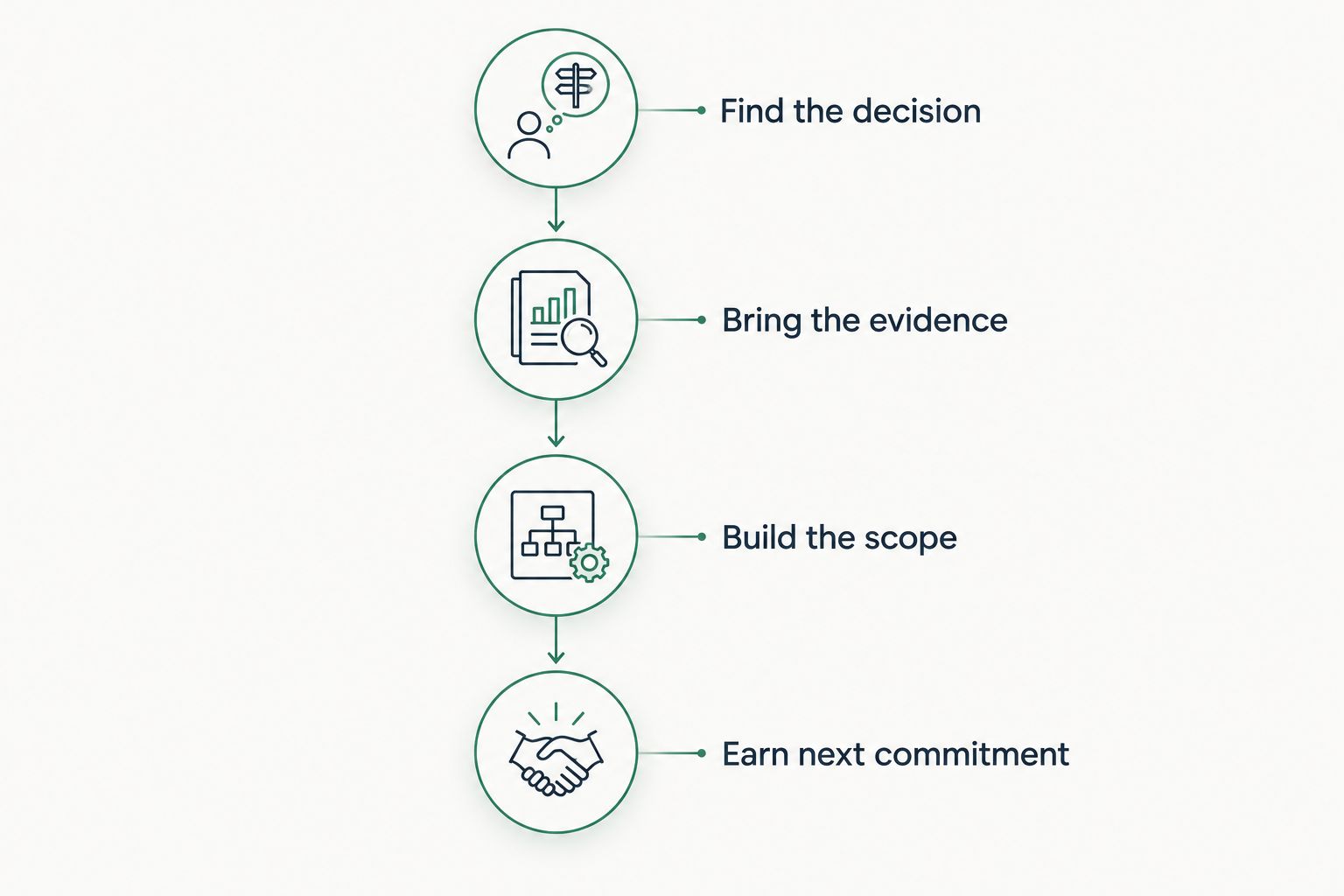
SCOUTz's Evidence-to-Agreement Framework has 4 steps: Find the decision, Bring the evidence, Build the scope, Earn the next commitment. It is a conversation framework, not a validated psychological model or a proven close-rate intervention.
Find the decision
Establish the decision before requesting access. For example, the prospect might want to determine whether an existing policy meets its stated requirements or whether an ownership gap needs investigation. Record the decision in the prospect's terms.
Name the person who can approve the next step. A technical contact can explain configuration without necessarily owning budget, policy or tenant authorization. Keep those responsibilities separate in the meeting notes.
Bring the evidence
Present the condition, source, check and run date before discussing implications. Keep the affected object visible and state what remains unknown. This gives the prospect something specific to verify rather than a broad assertion about security posture.
Maintain evidence states such as Observed, Inferred, Possible and Unknown without treating them as a score ladder. Coverage is a separate dimension: an observation from an assessed source does not make an unread source assessed.
Build the scope
Translate the agreed condition into a proposed outcome. Keep that outcome separate from a vendor choice so the MSP can recommend a product, service, process, project or nothing according to the evidence and buyer priorities.
For the collection-to-conversation handoff, use the Microsoft 365 scan-to-sales-ready evidence workflow. The proposal should preserve the evidence boundaries rather than replacing them with a stronger sales claim.
Earn the next commitment
Ask for a defined action with an owner and a mutually agreed date. That action might be permission to inspect an unread source, confirmation of an intentional exception or approval to scope a change.
For a 2026 follow-up, record the actual agreed date rather than adding artificial urgency. A dated finding is evidence of a condition at collection time, not proof that the buyer must act immediately.
Turn a finding into an agreed next action
Use an illustrative scenario, not a fabricated customer result. Suppose an authorized review returns an application permission finding. The observation establishes the permission reported by the check; it does not establish a malicious application or misuse.
Illustrative dialogue:
- MSP: The review observed this permission on the named application. The report includes the source and run date; it does not establish misuse.
- Prospect: That application supports an existing business process.
- MSP: Let's identify its business owner and confirm the intended access before recommending a change.
- Prospect: Our application owner can review that with you.
- MSP: The next step is an owner review of purpose and approved access, followed by a decision on whether any change is needed.
The sales movement is explicit: evidence leads to an owner review, then a scope decision. You have earned a useful next commitment without converting permission into an incident claim.
Handle an access objection without pressure
If the prospect declines tenant access, narrow the offer. Provide the proposed evidence categories and exclusions, then let the authorized owner decide whether to proceed. Public-domain observations can support a separate conversation within their limits.
Illustrative response: We can begin with the published domain evidence and your stated priorities. Internal tenant configuration remains unknown until you authorize a review of the relevant sources.
Declining access is a boundary to respect. It is not evidence of concealment or poor security.
Compare scope before proposing work
Give the buyer 3 scope choices when the evidence leaves a condition unresolved. Explain what each choice accomplishes and what remains outside it.
| Scope choice | Best for | Proposed outcome | Trade-off |
|---|---|---|---|
| Validate first | Unclear ownership or intended configuration | Confirm the condition, business purpose and responsible owner | Defers a remediation decision |
| Scoped change | An agreed condition with an approved outcome | Make the authorized change and verify against the baseline | Requires change approval and delivery scope |
| Document and revisit | An intentional exception or deferred decision | Record rationale, owner and review trigger | Leaves the condition in place |
Do not attach an invented breach-loss estimate to make one choice look inevitable. Explain the condition and possible consequence, then let the buyer weigh the proposed outcome against operational requirements.
Proof is a rescan against a pinned baseline. If work proceeds, preserve the original evidence and compare the relevant condition after the authorized change. Keep unassessed areas outside the claim of completion.
Is an assessment necessary before every first meeting?
No, an assessment is unnecessary when the first meeting's purpose is to establish priorities, authority and review scope. Discovery comes first when you cannot yet name the decision the evidence would support.
Use public-domain observations only within their limits. Save internal tenant collection for a customer-authorized review with a clear purpose.
Does an assessment prove the prospect needs a new MSP?
No, an assessment does not prove that the prospect needs a new MSP. A finding can reflect an intentional exception, incomplete coverage or a condition already under review.
Ask who owns the condition and what outcome the prospect wants. The evidence supports a discussion; it does not establish dissatisfaction or buying intent.
FAQ
Is a Microsoft 365 security assessment worth it before a sales pitch?
Yes, when the prospect authorizes the review and the evidence supports a specific scope or ownership decision. The value is preparation and a defensible next action, not a guaranteed sale.
Can I assess Microsoft 365 security using only a prospect's domain?
A public-domain review cannot establish internal Microsoft 365 controls. Conditional Access coverage, application permissions and tenant sharing configuration require appropriate customer-authorized evidence.
What should I show a prospect from a Microsoft 365 assessment?
Show the observed condition, affected object, source, check name and run date. State coverage limits and unknowns before explaining the possible consequence or proposing an action.
Does read-only access mean the review reads employee email?
SCOUTz's Microsoft 365 evidence is configuration and metadata only; it excludes mail, files, chats, documents and prompts. Define the approved evidence scope before collection.
Can a Microsoft 365 finding prove that an account was compromised?
A configuration finding alone does not prove account compromise. Keep the observed condition separate from any inference and require supporting evidence for an incident claim.
What if a prospect refuses tenant access before the pitch?
Respect the decision and offer a narrower discovery conversation or public-domain review within its limits. Internal tenant configuration remains unknown without authorized evidence.
How do I turn an assessment into a proposal?
Connect the agreed condition to an owner, a recommended outcome and a defined scope. Include exclusions, authorization requirements and a verification method rather than promising a sales or security result.
One last thing
An unread source can be the most useful boundary in your proposal. Put it under NOT ASSESSED THIS SCAN and explain what authorization or access would be needed to answer the open question. That turns uncertainty into an explicit scope choice rather than an unsupported assurance.
For MSP owners evaluating this approach, the primary next step is Join Open Beta. SCOUTz prepares the conversation. The relationship and the sale stay yours.