
Yes. External attack surface assessment examines what is exposed to the internet, which assets belong to the organization, and what those exposures mean; a vulnerability scan tests specified targets for known weaknesses. They overlap, but neither automatically establishes exploitability, compromise, or complete coverage, and the right choice depends on the question you need answered.
- Is external attack surface assessment different from a vulnerability scan? Yes: discovery and exposure context differ from scoped weakness detection.
- SCOUTz supports MSP prospect intelligence and meeting preparation with dated domain evidence and customer-authorized Microsoft 365 reviews.
- Use vulnerability scanning for authorized technical testing; keep untested assets and unread sources explicitly unknown.
- Choose the assessment scope before choosing a tool, and preserve each finding’s source, date, and limits.
Is external attack surface assessment different from a scan?
External attack surface assessment starts with exposure and ownership. Vulnerability scanning starts with defined targets and tests. An external assessment can include vulnerability scanning, and a scanner can include discovery features. Compare the work performed rather than relying on the product category.
For MSPs, SCOUTz supports the prospect-intelligence part of that work: dated evidence and account context for a sales conversation. That role differs from testing every externally reachable system for vulnerabilities.
| Approach | Best for | Main strength | Main limitation |
|---|---|---|---|
| External attack surface assessment | Understanding internet-facing assets and exposure | Connects discovery, ownership, configuration, and context | External visibility alone cannot establish internal controls or complete ownership |
| Vulnerability scan | Testing an agreed target set for known weaknesses | Produces technical findings tied to the tests performed | Missed targets, restricted access, and disabled tests limit coverage |
| Customer-authorized Microsoft 365 review | Reviewing tenant configuration and metadata | Adds internal configuration evidence unavailable from public DNS | Results depend on consent, permissions, licensing, and readable sources |
The comparison remains useful in 2026 because a report can contain several kinds of evidence without explaining their boundaries. Ask which sources were read, which tests ran, and which objects were excluded.
Why this matters
An MSP can bring a technically accurate finding into a meeting and still draw the wrong conclusion. A published email policy, a responding service, and an authenticated tenant setting answer different questions. Treating them as interchangeable creates an unsupported proposal.
The practical consequence is scope. If the prospect needs an inventory of exposed assets, begin with discovery and ownership confirmation. If the prospect needs validation of suspected software weaknesses, agree on authorized vulnerability testing. If the question concerns tenant access policies, obtain consent for the relevant internal evidence.
Choose the evidence needed for the decision, then choose the assessment. A longer report does not resolve a question its sources cannot answer.
External attack surface assessment: exposure and ownership
An external attack surface assessment examines internet-facing assets and their observable conditions. Depending on the agreed method, that work can include domain records, certificates, reachable services, related hostnames, and ownership research.
Its value is context. An unfamiliar hostname becomes useful evidence only after you establish whether the organization owns it, uses it, or has delegated responsibility to a provider. A certificate association or naming similarity is a research lead until ownership is confirmed.
Public observation also has strict limits. A published DNS record does not reveal the organization’s complete Microsoft 365 configuration. An answering service does not establish that the service is exploitable.
For an external review in 2026, separate the asset record from the security conclusion. Keep the observed condition, ownership status, collection date, and unresolved questions attached to each object.
Vulnerability scanning: scoped technical testing
A vulnerability scan applies selected tests to selected targets. Depending on configuration and authorization, it can examine internet-facing services, internal systems, or authenticated information from a host.
The strength is repeatable technical checking. The limitation is that results describe the targets and tests actually covered. A scan of an approved address range does not establish the status of an omitted cloud application or an undiscovered domain.
Scanner findings also need interpretation. Version detection can suggest that a vulnerability applies, while authentication, configuration, vendor backports, or validation change the conclusion. Preserve the difference between a detected indicator and a confirmed applicable weakness.
Use vulnerability scanning when you need authorized weakness detection on a defined scope. Follow technical findings with validation, ownership assignment, and a rescan appropriate to the original test.
Why assessment results vary
Assessment labels hide important differences. Before comparing findings or recommending work, review these factors:
- Scope determines whether the work covers a domain, a target list, related assets, tenant configuration, or a combination.
- Discovery method changes what becomes visible. Public records, direct service interaction, and authenticated access provide different evidence.
- Authorization determines which activities and systems are permitted. Public accessibility alone does not settle permission for active probing.
- Access affects coverage. Missing credentials, permissions, or licenses can leave relevant sources unread.
- Timing matters because DNS, services, software, and configuration change. A dated finding describes the observation at that time.
- Validation changes the claim you can make. An inferred association needs different wording from a verified configuration condition.
These factors explain why reports disagree without proving that either report is wrong. Compare their scope and collection conditions before comparing their totals.
Separate public evidence from consented tenant evidence
Use 2 evidence sources as distinct categories in your assessment plan: public-domain observations and customer-authorized tenant evidence. Do not merge their conclusions into a single claim about organizational security.
Public-domain evidence can support a discussion of published DNS and email-security configuration. It cannot establish Conditional Access coverage, application permissions, license assignments, Intune device state, or tenant sharing configuration.
Customer-authorized Microsoft 365 evidence can address readable configuration and metadata within its permissions. SCOUTz Microsoft 365 reviews use configuration and metadata only, excluding mail, files, chats, documents, and prompts. Read-only access makes no automatic configuration changes.
A Microsoft 365 review in 2026 still needs a coverage statement. Record whether each source was assessed, partially assessed, permission limited, license limited, or not assessed. An unread source remains unknown.
Keep evidence state separate from coverage. Observed, inferred, possible, and unknown describe different claims; assessed and permission limited describe collection. Neither set is a ladder that automatically ends in confirmed compromise.
Set the scope before collecting evidence
Make 4 scoping decisions before authorizing work. These decisions turn a vague request for a security assessment into an agreed technical task.
- Define the decision. State whether the buyer needs asset discovery, weakness validation, tenant configuration review, or evidence for a proposed service.
- Confirm ownership. Identify the domains, systems, tenants, and third-party responsibilities covered by the request.
- Agree on methods. Separate public observation, active probing, and customer-authorized read-only access. Record permission and exclusions.
- Define the handoff. Name who reviews findings, approves changes, receives the report, and verifies the result.
Documenting these decisions also protects the sales conversation. You can explain what the assessment answers without implying that it examined every system.
For prospect outreach, distinguish public research from active testing. Offer additional assessment as an opt-in courtesy after a reply, and use the prospect-scanning permission guide to frame the issues that require review. Educational scanning guidance is not legal advice or blanket authorization.
Turn a finding into an evidence-led next action
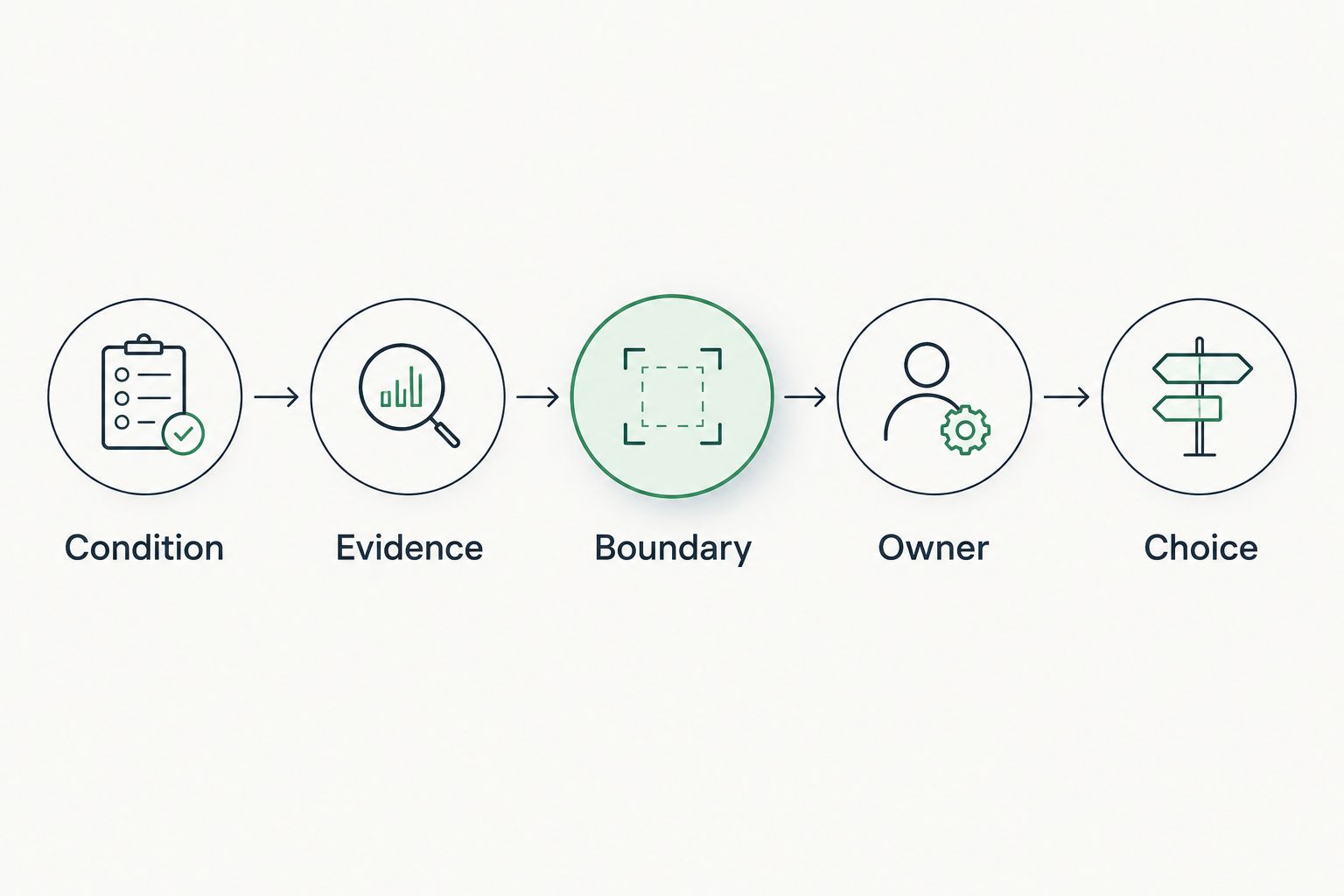
Use the same sequence for a domain observation or a validated scanner finding. The sequence is condition, evidence, boundary, owner, and choice. It keeps technical detail connected to a decision without manufacturing urgency.
- Condition: State what was observed on the affected object.
- Evidence: Attach the check, source, collection date, and relevant result.
- Boundary: Explain what the observation does not establish and what remains unread.
- Owner: Identify the person responsible for confirming intent or approving work.
- Choice: Offer a scoped next action, further investigation, or no change.
Keep 3 evidence fields visible in the meeting summary: source, run date, and collection limits. Preserve the detailed technical record behind that summary. A readable summary should simplify presentation without removing the qualifiers that make the claim defensible.
Consider an illustrative DMARC observation, not an actual prospect result: a published policy requests monitoring only. The possible consequence is that the policy itself does not request quarantine or rejection. That observation does not establish compromise, and monitoring could be intentional during deployment.
The owner-facing next action is to confirm who reviews reports and whether monitoring remains the intended policy. If a change is agreed, scope the review of legitimate senders before enforcement changes. The choice follows evidence rather than fear.
For MSP prospect intelligence, SCOUTz is best for preparing a sales conversation with dated evidence. Its boundary is equally important: public-domain findings do not replace an authorized vulnerability scan or establish internal tenant controls.
Can an external assessment replace a vulnerability scan?
An external assessment replaces a vulnerability scan only when its agreed work actually includes the required vulnerability tests and coverage. A domain review alone cannot satisfy a request to test specified servers for known weaknesses.
For a 2026 statement of work, name the deliverables rather than using “security assessment” as the whole description. Separate discovered assets, ownership confirmation, vulnerability test coverage, tenant evidence, exclusions, and verification requirements.
This also keeps proposals honest. The MSP can recommend further testing without claiming that an initial review already proved the problem that testing is meant to investigate.
Which assessment should an MSP use before a sales meeting?
Use the least intrusive authorized method that answers the meeting’s actual question. Public-domain evidence can prepare discovery; consented tenant evidence or vulnerability testing belongs in the conversation when the buyer agrees that it is relevant.
Move from evidence to agreement with a defined next step. Identify the decision, bring the evidence, build the scope, and ask for the next commitment. That commitment can be ownership confirmation, approval for additional collection, or agreement to review a proposal.
“Join Open Beta” is the primary next step for MSPs evaluating SCOUTz for evidence-led preparation. Confirm the current application terms and review requirements before applying. The MSP retains responsibility for the relationship, technical judgment, and sale.
FAQ
Is external attack surface assessment different from a vulnerability scan?
Yes. External attack surface assessment examines exposed assets, ownership, and context; a vulnerability scan applies selected weakness tests to defined targets. Some assessments combine both, so compare the actual scope.
Does a public-domain review show whether Microsoft 365 is secure?
A public-domain review cannot establish internal Microsoft 365 security configuration. Conditional Access coverage, application permissions, license assignments, device state, and tenant sharing settings require appropriate customer-authorized evidence.
Does an open port mean a system is vulnerable?
An open port establishes reachability from the observation point, not exploitability. Identify the service, confirm ownership, and perform authorized validation before claiming a weakness.
Can an MSP scan a prospect without permission?
Public accessibility alone does not establish permission for active vulnerability testing. Distinguish public observation from probing, obtain appropriate authorization, and review the applicable legal and contractual requirements.
What should a useful security finding include?
A useful security finding includes the condition, affected object, evidence source, run date, limits, owner, and recommended outcome. Keep the security outcome separate from the choice of vendor or service.
Does a clean scan prove that an organization is secure?
A scan with no reported findings does not establish complete security. Its conclusions remain limited to the assessed targets, readable sources, enabled tests, and collection time.
How do you prove that an assessment finding changed?
Rescan against a pinned baseline using the relevant check and comparable scope. Preserve the original evidence, later result, collection dates, and any coverage differences before describing the change.
One last thing
The most useful line in a 2026 assessment can be “not assessed this scan.” It prevents an unread source from being presented as an absent problem or a working control.
Before presenting the report, check every conclusion against the evidence actually collected. If the source, date, or boundary disappeared during editing, restore it before asking the buyer to approve work.