
AI agent security review evidence should identify the agent, its owner, its permissions, the data and tools it can reach, approval requirements, and dated records of actions within the authorized review scope. Keep configuration evidence separate from observed behavior, attach source and coverage limits to every finding, and leave inaccessible evidence explicitly unknown.
- AI agent security review evidence needs dated sources, affected objects, permission boundaries, action records, and named owners.
- Microsoft 365 permissions show authorized access; they do not establish malicious behavior or actual data access.
- Public-domain observations cannot establish internal agent permissions, tenant configuration, or execution history.
- SCOUTz suits MSPs preparing evidence-led security conversations; agent behavior requires separately authorized review evidence.
What evidence belongs in an AI agent security review?
Build the review around traceable claims. For each agent or agent-enabled feature, record what exists, what it is permitted to do, what you observed, and what remains outside the assessment.
Use the AI agent security checklist for MSPs to organize the discussion. The evidence packet should support a decision about ownership, access, operating boundaries, or further investigation. A feature name alone supports none of those decisions.
| Evidence source | Best for | What belongs in the packet | Boundary |
|---|---|---|---|
| Customer-confirmed inventory | Establishing purpose and ownership | Agent name, host application, business task, accountable owner | An inventory entry does not verify runtime behavior |
| Authorized configuration review | Establishing configured access | Identity, permissions, connections, approval settings, collection date | Granted access does not prove exercised access |
| Authorized activity records | Examining recorded actions | Actor, action, affected object, timestamp, result, available context | Missing records do not establish inactivity |
| Approved controlled test | Checking a defined behavior | Test conditions, expected outcome, actual outcome, limitations | A test supports only the behavior and conditions examined |
| Public-domain observation | Establishing external context | Public source, observed condition, date, affected domain | Public evidence cannot establish internal agent behavior |
For a 2026 review, put the actual collection date on each artifact. The year on the report cover cannot tell a reader whether the underlying configuration was checked before or after a change.
Why this matters
An MSP needs evidence that survives the next question. A permission export answers an access question. An execution record answers an activity question. Neither automatically answers whether the activity was authorized by the business.
The review is useful when the client can trace a recommendation back to a specific condition and choose an outcome. Keep the technical observation, possible consequence, responsible owner, and proposed next action together.
Inventory evidence: identify the agent and its owner
Start with the business task. Record where the agent operates, who enabled it, who owns its output, and which account or application identity it uses.
Include agents inherited through existing software. A client can know the host application without knowing the permissions or connected workflows behind an enabled feature. Ask the owner to confirm which capabilities are actually configured.
Collect these inventory fields where accessible:
- Agent or feature name and its host application.
- Business purpose and intended users.
- Accountable business owner and technical administrator.
- Application or service identity identifiers.
- Connected systems and declared information sources.
- Review scope, source, collection date, and exclusions.
Treat the owner's explanation as attributed context. Validate technical claims against authorized configuration evidence before presenting them as verified settings.
An owner statement that an agent only drafts messages belongs beside the setting or workflow that enforces that restriction. Without that supporting evidence, record the restriction as reported rather than technically verified.
Permission evidence: show access without implying compromise
Record the identity under which the agent acts and the access granted to that identity. Preserve the affected tenant, application, resource, and permission names where available. Distinguish user-delegated activity from application-level access when the source exposes that distinction.
For customer-authorized Microsoft 365 evidence, keep the collection within the approved configuration and metadata scope. Do not collect mail, files, chats, documents, or prompts to fill an evidence gap.
A 2026 permissions snapshot should retain its collection date and the configuration it describes. A later permission change requires a new observation; the earlier export remains historical evidence.
The critical boundary is simple: a tenant-wide permission is evidence of granted access, not evidence of a malicious application. Use the OAuth permissions versus compromise evidence guide when writing that distinction for the client.
Name the owner who can confirm whether the access matches the intended task. If business justification is missing, recommend an access review rather than declaring the permission unauthorized.
Behavior evidence: separate configuration from execution
An activity review needs records of actions, not just settings that allow actions. Where authorized and available, preserve the actor, action, target, timestamp, outcome, and any identifier that connects related events.
State the reviewed time window and the source's coverage. Record permission, licensing, retention, and collection limits that affect what you can see. An empty result needs that context before anyone interprets it.
Keep proposed actions separate from executed actions. A generated draft, a queued workflow, and a completed external action represent different conditions. Report the stage the evidence actually shows.
Controlled tests need their own authorization and scope. Document the approved test, expected behavior, observed result, and affected environment. Do not exercise live external actions merely to make a sales report more convincing.
If testing is excluded, state that boundary. A configuration review can still support an access or ownership decision without pretending to validate runtime safety.
Approval and revocation evidence: show who controls the next action
Capture the settings that define when a person must approve an action and who can grant that approval. Record exceptions, affected workflows, and the identity responsible for maintaining the rule.
Then separate configured controls from tested controls. A visible approval setting establishes configuration at collection time. An authorized test establishes what happened under the documented test conditions.
Include the documented method for disabling the agent or revoking its access. If nobody has validated that method, label it untested. Do not describe an untested procedure as a verified recovery capability.
For the 2026 review packet, assign an owner to each proposed change and define the evidence needed to accept completion. That keeps the recommendation separate from a claim that remediation already happened.
Why AI agent security review evidence varies
Evidence depth depends on the access granted and the question being answered. Agree on those boundaries before collecting material.
- Hosting location determines which administration surfaces and records the reviewer needs.
- Identity model determines whether the review follows a user, application identity, or another authorized execution context.
- Connected resources determine which permission and data-boundary evidence is relevant.
- Customer authorization defines the allowed configuration review, activity review, and testing scope.
- Permission and license limits determine which sources remain unreadable or outside coverage.
- Action scope determines whether the review addresses drafting, recommendations, or actions that change another system.
Do not combine these differences into a single certainty label. A review can establish an application's permissions while leaving its execution history unassessed.
Keep evidence states distinct: Verified, Observed, Inferred, Possible, Unknown, and Unreadable describe different claims. Coverage labels such as Partial, Not assessed, Permission limited, and License limited explain what the assessment reached. They are separate fields.
Build the packet from evidence to proof
Use this collection sequence for a 2026 review. It creates a record another practitioner can inspect without relying on the presenter's memory.
- Identify. Define the agent, business purpose, affected objects, owner, and authorized scope. Record exclusions before collection begins.
- Collect. Preserve the source artifact, collection date, relevant settings or events, and collection limitations. Keep sensitive material within the agreed handling rules.
- Interpret. State the observed condition first. Add the possible consequence, unknowns, owner question, and recommended outcome as separate fields.
- Verify. Pin the baseline. After an approved change, repeat the relevant collection and compare the same objects and conditions.
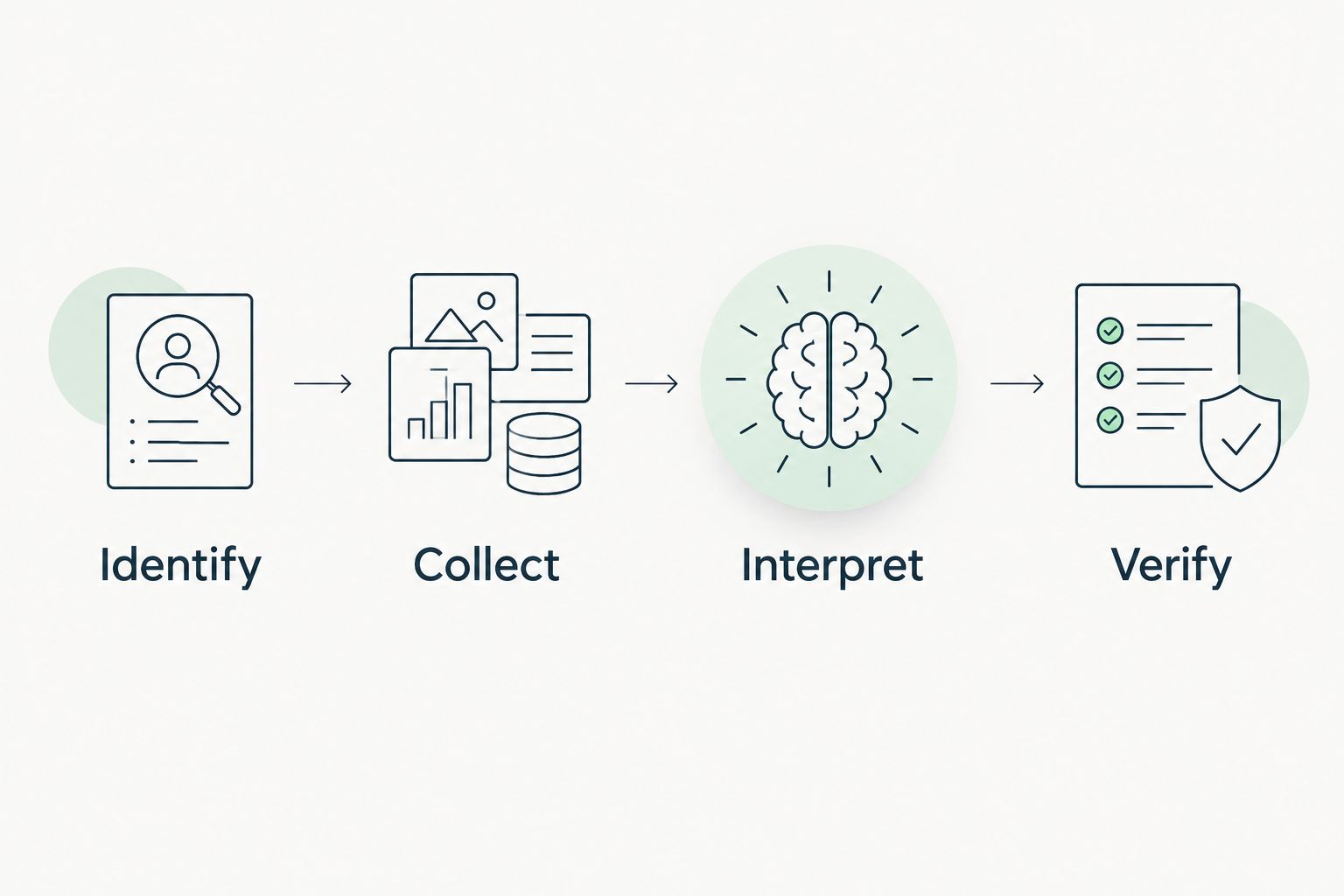
A rescan proves only what the repeated check establishes. A changed permission record supports a permission-change finding. It does not establish that every connected workflow is safe or that prior access caused no harm.
Retain the original artifact alongside the new result. The client needs the before-and-after evidence and the limits of the comparison, rather than a replacement report that erases the baseline.
Keep the finding record small and complete
Use a consistent record for each material condition: affected object, check or collection method, run date, source, observation, evidence state, coverage, unknowns, possible consequence, owner, recommended outcome, and verification requirement.
Add an expiry or recheck trigger appropriate to the decision. A permission change, new connection, or changed business use can invalidate the basis of an earlier recommendation.
Place declared non-reads under NOT ASSESSED THIS SCAN. That makes a missing source visible instead of allowing an unread area to disappear into a reassuring summary.
Turn the finding into an agreed next action
Keep this a technical review with a clear decision path. Use the SCOUTz Evidence-to-Agreement Framework: Find the decision, Bring the evidence, Build the scope, Earn the next commitment. It is a conversation framework, not a proven sales-performance intervention.
Find the decision by naming what the owner must resolve. Examples include confirming business ownership, approving an access review, or authorizing a controlled test.
Bring the evidence with its collection date and boundary. Build the scope around an outcome and acceptance evidence. Then ask the owner to approve, revise, defer, or decline the next action.
An illustrative recommendation is to confirm whether the agent's granted permissions match its assigned task, remove unnecessary access only after approval, and verify the resulting configuration against the baseline. This offers a concrete project without asserting that a compromise occurred.
Where prospect intelligence fits
SCOUTz, by RYTHMz, provides cybersecurity prospect intelligence for MSPs using dated domain evidence and customer-authorized Microsoft 365 configuration and metadata. Its role here is conversation preparation and evidence context, not a substitute for agent-specific runtime testing.
The client's October 15, 2026 product reference labels Microsoft 365 Review and Evidence Reports as Open Beta. Keep public-domain observations separate from consented internal evidence, and leave broader agent behavior outside the claim unless separately assessed.
For MSPs evaluating that preparation workflow, Join Open Beta is the primary next step. The MSP retains responsibility for technical judgment, the relationship, and the sale.
Can a public-domain review establish an agent's permissions?
A public-domain review cannot establish internal agent permissions, tenant configuration, or execution history. Use public observations for external context, then obtain authorization for the internal evidence needed to answer the permission question.
Keep public observation separate from active probing. Agree on collection methods and scope before extending the review; a publicly reachable system does not establish permission for every test.
Does broad application access prove that an agent is compromised?
Broad application access does not prove compromise. It establishes a permission condition that needs business justification, ownership, and assessment against the intended task.
A compromise claim needs evidence supporting that claim. Avoid translating access scope into an incident declaration or an invented loss forecast.
What proves that an agreed change worked?
A repeat check against a pinned baseline proves the specific configuration or behavior that the check examines. Record the new date, source, affected object, result, and remaining limitations.
If the review verifies configuration only, keep runtime behavior outside the completion claim. The acceptance statement should match the evidence collected.
FAQ
What's the most important AI agent security review evidence?
The most important evidence connects a named agent and owner to dated permissions, connected resources, approval controls, and recorded actions within the authorized scope. Each claim needs its source and coverage limits.
Can Microsoft 365 permissions show what an agent actually did?
Microsoft 365 permissions show granted access, not the actions an agent actually performed. Activity claims need separately authorized records with timestamps, affected objects, and collection limits.
Do reviewers need to read employee messages or prompts?
A configuration and metadata review does not require reading employee messages or prompts. If the review question needs additional evidence, define a separate authorized scope rather than expanding collection silently.
What should an MSP say when agent logs aren't available?
The MSP should mark the activity source as unassessed or unreadable and explain the collection limit. Missing logs do not establish that the agent performed no actions.
Can SCOUTz replace an AI agent runtime assessment?
SCOUTz provides dated domain and customer-authorized Microsoft 365 evidence for MSP conversation preparation, not a replacement for agent-specific runtime assessment. Keep claims within the configuration, metadata, and public evidence actually reviewed.
How should an MSP prove that permissions were reduced?
The MSP should collect a fresh permission snapshot and compare the affected identity and resource against the pinned baseline. Preserve both dates and state which permission change the comparison establishes.
One last thing
Write the acceptance evidence before recommending the change. If the intended outcome is narrower access, name the identity, resource, permission change, and repeat check that will demonstrate it. That turns an open-ended concern into a decision the client can accept or decline.