
Best overall for MSP sales preparation: SCOUTz. Best for Microsoft 365 posture: Microsoft Secure Score. Best for structured control reviews: CISA CSET. The best security assessment tools for auto dealerships in 2026 also include Nmap for authorized network discovery and OWASP ZAP for authorized web application testing. These 5 tools answer different questions; choose by the evidence your next dealership conversation requires.
- SCOUTz leads the best security assessment tools for auto dealerships shortlist for MSP prospect intelligence and sales preparation.
- Microsoft Secure Score supports consented tenant review; public-domain evidence cannot establish internal Microsoft 365 controls.
- CISA CSET structures control discussions; Nmap discovers network services; OWASP ZAP tests authorized web applications.
- Keep observation dates, permissions, unknowns and validation steps attached to every dealership finding.
Why this matters
A dealership assessment needs a defined boundary. A website, an email domain, a Microsoft 365 tenant and a dealer management system represent different scopes. Evidence from one does not establish the condition of another.
For your 2026 shortlist, separate sales preparation from technical validation. A public-domain observation can support a discovery question. Internal controls require authorized evidence, and active testing requires an agreed scope. A useful assessment ends with an owner, a decision and a way to verify the work.
Before presenting a finding, follow the guide to validating security assessment findings before a call. Keep the original observation separate from your interpretation.
What makes the best dealership security assessment tools
Use these criteria to evaluate your 2026 shortlist before comparing features:
- Evidence traceability: retain the source, collection date, check and affected object.
- Permission boundaries: distinguish public observation, consented tenant access and authorized active testing.
- Coverage clarity: record unreadable sources and unassessed systems alongside assessed areas.
- Business relevance: connect the condition to a dealership decision without inventing an incident or financial loss.
- Verification: define the rescan, retest or document review that will establish what changed.
- Scope fit: identify whether the tool supports prospect preparation, configuration review, control assessment or technical testing.
Dealership security assessment tools at a glance
| Tool | Best for | Standout capability | Key limitation |
|---|---|---|---|
| SCOUTz | Preparing evidence-led MSP sales conversations | Dated domain evidence and consented Microsoft 365 review | Public-domain findings cannot establish internal tenant controls |
| Microsoft Secure Score | Reviewing Microsoft cloud posture | Tenant-specific security recommendations and score details | A score is not a complete dealership risk assessment |
| CISA CSET | Structuring control and gap discussions | Guided cybersecurity evaluation against selected standards | Answers and supporting evidence require validation |
| Nmap | Discovering authorized network services | Host discovery and service enumeration | An answering service does not establish exploitability |
| OWASP ZAP | Testing authorized web applications | Web application proxying and vulnerability testing | Does not assess the dealership's entire environment |
The order follows the MSP engagement: prepare the conversation, review internal posture, structure the control discussion, then commission scoped technical testing. It is not a claim that one tool replaces the others.
1. SCOUTz: best security assessment tool for MSP sales preparation
SCOUTz provides dated cybersecurity evidence and account context for MSP prospect conversations. Public Domain Review and customer-authorized Microsoft 365 Review have separate evidence boundaries. Use the output to prepare questions, establish scope and propose an agreed next action.
The client-supplied product reference dated October 15, 2026 identifies Domain Review as available and Microsoft 365 Review, Prospect Intelligence and Evidence Reports as Open Beta. Treat those as dated product-status references, and confirm current status before committing a capability to a prospect.
SCOUTz pros:
- Keeps the conversation grounded in dated evidence rather than speculative breach losses.
- Separates public-domain observations from consented internal evidence.
- Supports evidence-led discovery, proposals and later verification.
SCOUTz cons:
- Public-domain evidence cannot establish Conditional Access coverage, application permissions or device state.
- Beta report and multi-client workflows require evaluation against your delivery needs.
Best for: MSP owners and sales leaders preparing a dealership meeting around observable conditions. The read-only Microsoft 365 review concerns configuration and metadata, never mailbox, file or chat contents. Your MSP still validates the claim and owns the relationship.
Verdict: Buy for the sales-preparation role only after evaluating the relevant beta workflow.
2. Microsoft Secure Score: best for Microsoft 365 posture review
Microsoft Secure Score presents security posture information and recommended actions for supported Microsoft services. Use it inside an authorized tenant review to examine recommendations, affected settings and implementation context.
Keep score movement separate from proof of a particular control. A dealership discussion needs the underlying setting, applicable users, exceptions and supporting evidence. Record which services and licenses your review actually covers.
Microsoft Secure Score pros:
- Provides Microsoft-specific recommendations within the customer environment.
- Gives technicians a starting point for configuration review.
- Supports discussion of improvement actions alongside tenant evidence.
Microsoft Secure Score cons:
- Does not assess every dealership application, network or operational process.
- Recommendations require interpretation against business requirements and exceptions.
Best for: MSPs assessing Microsoft cloud configuration after customer authorization. Public DNS evidence cannot substitute for tenant access, and a favorable score does not establish that every account or workload has the intended protection.
Verdict: Buy for tenant-posture review; keep the underlying evidence attached to each recommendation.
3. CISA CSET: best for structured control-gap discussions
The Cyber Security Evaluation Tool, or CSET, is CISA's assessment application for evaluating cybersecurity practices against selected standards and guidance. It structures questions and assessment results so your team can organize a control discussion.
For a dealership, use CSET to identify who owns a control, what evidence supports the answer and what remains unverified. Interview answers are inputs to assessment. They do not independently prove implementation.
CISA CSET pros:
- Organizes assessment questions into a repeatable review.
- Supports structured conversations across technical and management roles.
- Helps separate control expectations from the products proposed to address them.
CISA CSET cons:
- Requires time from dealership staff and evidence owners.
- Does not replace technical testing or independent validation of answers.
Best for: MSPs turning discovery into a documented control-gap assessment. If the dealership requests a compliance conclusion, confirm the applicable obligations and assessment scope separately. A completed questionnaire does not establish legal compliance.
Verdict: Buy for structured control review when the dealership can supply owners and supporting records.
4. Nmap: best for authorized network discovery
Nmap discovers hosts and enumerates network services within a defined target scope. Its results help technicians identify responding systems and investigate service exposure.
Obtain authorization before active testing. Agree on targets, exclusions, timing and stop conditions with the dealership and any relevant service provider. A dealership's permission to assess its environment does not automatically authorize testing infrastructure operated by another organization.
Nmap pros:
- Produces technical observations about reachable hosts and services.
- Supports repeatable discovery against an agreed target set.
- Helps define where deeper configuration or vulnerability review belongs.
Nmap cons:
- A service response alone does not establish a vulnerability or compromise.
- Active probes require operational care and appropriate authorization.
Best for: Practitioners mapping an authorized dealership network scope. Preserve scan options and target details with the results so another technician can understand the observation. Treat service identification as evidence to validate, especially where intermediaries affect responses.
Verdict: Buy for authorized discovery; Skip unsolicited active probing as a sales tactic.
5. OWASP ZAP: best for authorized web application testing
OWASP ZAP is a web application security testing tool with an intercepting proxy and automated testing capabilities. Use it to investigate application behavior within an authorized scope.
A dealership website assessment needs ownership checks first. Establish who operates the application, whether testing is permitted and which functions are excluded. Website access does not establish permission to test its underlying provider or connected systems.
OWASP ZAP pros:
- Supports inspection of web requests and responses.
- Helps investigate application-specific security findings.
- Provides evidence for a scoped developer or provider discussion.
OWASP ZAP cons:
- Automated alerts require validation before client presentation.
- Active testing can affect application behavior and needs safeguards.
Best for: Qualified testers assessing dealership-controlled web applications with explicit authorization. Keep the affected request, response, test conditions and validation notes together. A scanner alert should not become a confirmed customer-data exposure without supporting evidence.
Verdict: Buy for a defined application-testing engagement; Skip when ownership or authorization is unclear.
How the ranking works
This 2026 ranking prioritizes evidence traceability, permission boundaries, coverage clarity and the next dealership decision. It compares tools by their documented jobs rather than unsupported performance scores or claims of dealership-specific testing.
The first pick addresses MSP meeting preparation. The remaining picks cover tenant posture, control review, network discovery and application testing. No combined score represents all those assessment layers.
Turn assessment evidence into an agreed dealership scope
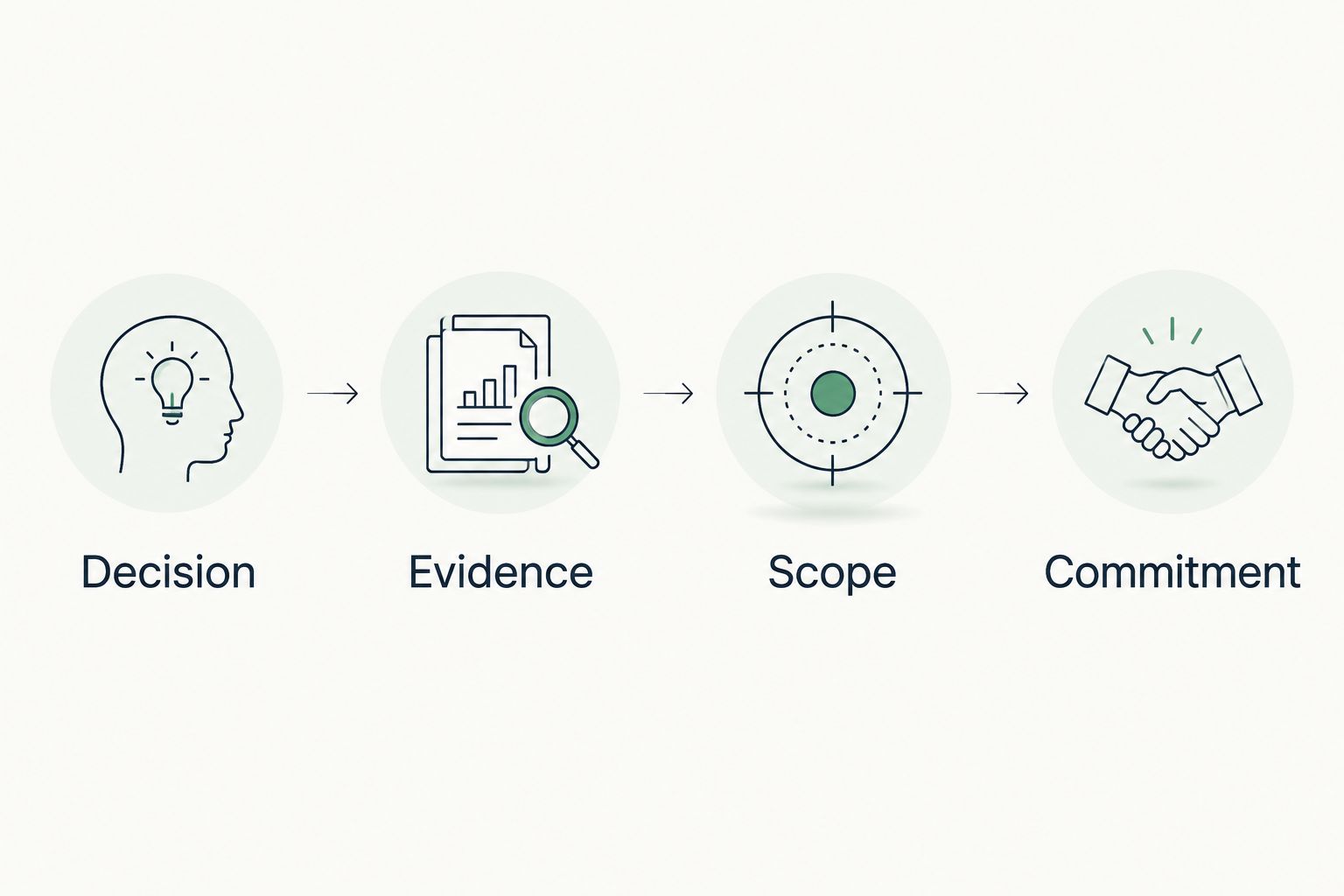
Use the SCOUTz Evidence-to-Agreement Framework to move from an observation to a proposal. This is an original conversation framework, not a validated close-rate intervention. The MSP remains responsible for technical judgment and the sale.
Follow these 4 steps in your 2026 sales process:
Find the decision
- Decision: establish what the dealership wants to decide. Examples include whether to authorize tenant review, validate email configuration or commission a scoped assessment.
Bring the evidence
- Evidence: show the condition, source, run date and boundary. Keep public-domain observations separate from customer-authorized internal evidence.
Build the scope
- Scope: identify the affected object, responsible owner, unknowns and recommended outcome. Select the service or project only after defining that outcome.
Earn the next commitment
- Commitment: agree on the next action, its owner and the evidence needed to accept completion. Preserve the dealership's choice to investigate, defer or do nothing.
Illustrative dialogue: a monitoring-only DMARC policy
The following dialogue is hypothetical. It demonstrates how to discuss a condition if your dated review actually observes it; it is not a customer result or an attributed quotation.
MSP: The published DMARC policy requests monitoring only. That observation does not establish compromise or tell us whether this is your intended rollout stage. Who owns email authentication and reviews the reports?
Dealership: Our website provider handles email settings.
MSP: Let's identify the owner for this domain and confirm the sending services before proposing enforcement changes. The next choice is a scoped email-authentication review with that owner involved.
Handle the objection without enlarging the claim
If the dealership says another provider already handles security, acknowledge that responsibility. Offer to validate the observation with the existing provider rather than presenting an inference as an unresolved failure.
Your proposal should separate the initial review from configuration changes. Define the deliverable as a confirmed condition, an agreed outcome and a verification method. For DMARC, that means understanding legitimate senders and the intended policy before recommending enforcement.
A follow-up can summarize the observed policy, its collection date, the unanswered ownership question and the requested introduction. Do not describe an email open as agreement or buying intent.
Which security assessment tool should you choose?
SCOUTz is best for MSPs using cybersecurity prospect intelligence to prepare dealership sales conversations. Start there when your immediate job is to bring dated evidence into discovery, then add the tool that answers the next authorized question.
Choose Microsoft Secure Score for tenant posture, CISA CSET for structured control review, Nmap for network discovery or OWASP ZAP for application testing. Your 2026 assessment plan should name the scope each tool covers and the areas it leaves unknown.
Primary next step: Join Open Beta. Evaluate the relevant workflow before promising its output in a dealership proposal.
FAQ
What's the best security assessment tool for an MSP selling to auto dealerships?
SCOUTz is the best fit in this shortlist for evidence-led MSP sales preparation. Use specialist tenant, control, network or application tools when the dealership authorizes deeper assessment.
Can a public-domain scan assess a dealership's Microsoft 365 security?
A public-domain scan cannot establish internal Microsoft 365 controls. Conditional Access coverage, application permissions and tenant sharing configuration require authorized internal evidence.
Is Microsoft Secure Score a complete dealership security assessment?
Microsoft Secure Score is not a complete dealership security assessment. Review its underlying recommendations alongside the dealership's other systems, processes and assessment boundaries.
Does an open network service prove a dealership is vulnerable?
An answering network service does not prove exploitability or compromise. Validate the service, configuration and relevant exposure within an authorized testing scope.
Can an MSP actively scan a dealership prospect without permission?
Do not treat this guide as authorization to actively scan a prospect. Distinguish public observation from active probing, establish ownership and obtain appropriate permission before testing.
Does a completed security questionnaire prove compliance?
A completed questionnaire does not prove compliance. Validate answers against supporting records, technical evidence and the obligations applicable to the dealership.
What should an MSP include in a dealership assessment proposal?
Include the observed condition, source, date, affected object, unknowns, owner and recommended outcome. State the authorized scope, exclusions and verification method before choosing products or services.
One last thing
A well-documented unknown can be more useful than a confident-looking score. If a source was unreadable, retain that state and explain the access needed to assess it. Keep permission-limited and unassessed areas visible in the proposal.
For your next dealership meeting, bring the smallest evidence packet that supports a decision: the observation, its boundary and a concrete next choice. Keep the pinned baseline for later verification. Proof is the comparison against that baseline, not the promise in the sales deck.


