
Best overall for a municipal control assessment: CISA CSET. Best for MSP prospect preparation: SCOUTz. Best for Microsoft tenant posture: Microsoft Secure Score. This 2026 guide ranks the best security assessment tools for municipal governments by the decision each tool supports, from an initial MSP conversation to authorized technical validation.
- The best security assessment tools for municipal governments serve different jobs; CISA CSET leads for structured control assessment.
- SCOUTz is best for MSPs preparing municipal prospect conversations with dated domain and authorized Microsoft 365 evidence.
- Microsoft Secure Score supports tenant posture review; Greenbone supports vulnerability assessment; Nmap supports service discovery.
- Keep public observations, authorized internal findings, coverage limits, and remediation proof separate.
Why This Matters
A municipality can need a governance review, an email-security check, and an internal vulnerability assessment. Those are different assignments. Buying a scanner does not establish who owns a control, and completing a questionnaire does not demonstrate that a technical weakness has been corrected.
For an MSP, the first decision is the scope of the engagement. Identify the municipal sponsor, the authorized systems, the evidence needed, and the person who can approve the next step. Keep public-facing systems separate from internal networks and operational technology unless the written scope explicitly includes them.
What Makes the Best Municipal Security Assessment Tool
Use these criteria for your 2026 shortlist:
- Evidence traceability: Preserve the source, collection date, affected object, and check behind a finding.
- Scope control: Distinguish public observation, authenticated review, active scanning, and exploitation testing.
- Coverage disclosure: Identify inaccessible systems and unread sources instead of presenting them as clean.
- Decision fit: Match the output to governance, tenant configuration, vulnerability management, or sales preparation.
- Validation: Require technical review before presenting a finding and a repeatable check after corrective work.
- Ownership: Give the municipal sponsor a clear choice, a responsible owner, and a defined acceptance condition.
These criteria favor tools with different jobs. There is no defensible single score that combines a public domain, a Microsoft tenant, an internal server, and a department's operating procedures.
Municipal Security Assessment Tools at a Glance
| Tool | Best For | Standout Capability | Key Limitation |
|---|---|---|---|
| CISA CSET | Structured control assessment | Guided assessment questions and assessment reporting | Answers need supporting evidence and technical validation |
| SCOUTz | MSP municipal prospect preparation | Dated domain evidence and customer-authorized Microsoft 365 review | Public observations cannot establish internal tenant controls |
| Microsoft Secure Score | Microsoft tenant posture | Security recommendations tied to supported Microsoft services | Its score does not represent the municipality's entire environment |
| Greenbone / OpenVAS | Authorized vulnerability assessment | Vulnerability scanning with the OpenVAS scanning engine | Findings require validation, ownership checks, and safe scan planning |
| Nmap | Authorized service discovery | Host discovery, port scanning, and service identification | Discovery output is not a complete risk or control assessment |
1. CISA CSET: Best for Structured Municipal Control Assessment
CISA's Cyber Security Evaluation Tool, or CSET, supports structured cybersecurity assessments through guided questions and reporting. It gives municipal staff and an MSP a way to organize a control discussion rather than starting with an unstructured list of technical findings.
CSET is the default choice when your assignment concerns assessment breadth and control ownership. The assessment still depends on the accuracy of the responses and the supporting records you examine.
CISA CSET Pros
- Organizes a repeatable control-assessment conversation.
- Supports discussion across technical and management responsibilities.
- Produces assessment outputs that can inform an improvement plan.
CISA CSET Cons
- Questionnaire answers alone do not verify implementation.
- Completing an assessment requires staff participation and evidence collection.
- Technical testing remains a separate task when the scope requires it.
Best for: Municipal IT leaders and MSPs defining control gaps, responsibilities, and assessment scope.
Ask for an evidence reference beside each material answer. A written backup policy establishes what the organization intends; a reviewed restore-test record addresses a different question. Keep those evidence types distinct.
Verdict: Buy into CSET as the assessment framework when governance and control coverage are the main job.
2. SCOUTz: Best for MSP Municipal Prospect Preparation
SCOUTz is best for MSPs preparing municipal security assessment conversations with dated evidence. Its role is the account context you bring into discovery: what was observed, what remains unknown, and what the municipality can choose to review next.
The client-provided product reference dated October 15, 2026 identifies Microsoft 365 Review and Evidence Reports as Open Beta. Public-domain observations and customer-authorized Microsoft 365 evidence have different boundaries. The read-only cloud review covers configuration and metadata, excluding mail, files, chats, documents, and prompts.
SCOUTz Pros
- Connects dated security evidence to prospect preparation.
- Separates public-domain observations from consented cloud evidence.
- Supports an evidence, insight, and proof conversation without automatically changing configurations.
SCOUTz Cons
- Public Domain Review cannot establish Conditional Access coverage or tenant sharing configuration.
- Microsoft 365 review requires customer authorization and appropriate evidence access.
- Findings still require MSP judgment before they become client-facing claims or scope recommendations.
Best for: MSP owners and sales leaders preparing a municipal discovery meeting or evidence-led proposal.
A public DMARC policy requesting monitoring supports a question about intended enforcement and report ownership. It does not demonstrate mailbox compromise or prove that a municipality has an unresolved project. Confirm the condition, attach its date, and ask the owner about intent.
Verdict: Buy for MSP conversation preparation; keep internal vulnerability testing and municipal control assessment as separate scopes.
3. Microsoft Secure Score: Best for Microsoft Tenant Posture
Microsoft Secure Score summarizes security posture and recommended actions across supported Microsoft services. It belongs in an authorized tenant review when you need to discuss Microsoft configuration and improvement actions with the tenant administrator.
Use the score as an organizing aid. Review the underlying recommendations and their applicability before turning them into proposed work.
Microsoft Secure Score Pros
- Connects posture review to Microsoft security recommendations.
- Gives administrators a shared reference for discussing supported controls.
- Helps organize follow-up review of configuration changes.
Microsoft Secure Score Cons
- Coverage depends on supported services, permissions, and the tenant environment.
- A higher score does not establish that every control works as intended.
- Municipal systems outside its scope need separate assessment.
Best for: Municipal Microsoft administrators and authorized MSPs reviewing tenant security configuration.
For your 2026 review, record the assessment date and the evidence behind each proposed action. MFA registration and MFA enforcement answer different questions. Confirm the applicable policy, intended population, and exceptions before describing coverage.
Verdict: Buy into Microsoft Secure Score as a tenant-review input, with separate validation of material controls.
4. Greenbone / OpenVAS: Best for Authorized Vulnerability Assessment
Greenbone's vulnerability-management tooling uses the OpenVAS scanning engine to identify potential vulnerabilities in scoped systems. It fits the technical assessment stage after the municipality has authorized targets and scan conditions.
The work starts with an asset list and a scan plan. It ends with validated findings and assigned actions, rather than an unreviewed scanner export.
Greenbone / OpenVAS Pros
- Supports systematic vulnerability discovery across authorized targets.
- Produces technical findings for investigation and prioritization.
- Supports repeat assessment after corrective work.
Greenbone / OpenVAS Cons
- Scanner findings need validation and affected-asset confirmation.
- Credentials, reachability, and scan configuration affect coverage.
- Sensitive systems require separate authorization and operating precautions.
Best for: Technical teams conducting a defined municipal vulnerability-assessment engagement.
Agree on target ranges, exclusions, credentials, timing, escalation contacts, and stop conditions before scanning. Treat an inaccessible host as a coverage limit. Keep operational technology outside a general IT scan unless its owner approves a suitable testing plan.
Verdict: Buy for authorized vulnerability discovery when you have the people and process to validate the output.
5. Nmap: Best for Authorized Service Discovery
Nmap supports host discovery, port scanning, and service identification. It helps establish what answers on an authorized network and provides evidence for an asset or exposure review.
That evidence needs interpretation. An answering service establishes reachability under the test conditions; exploitability requires additional evidence.
Nmap Pros
- Supports focused discovery of reachable hosts and services.
- Helps investigate differences between an asset inventory and observed exposure.
- Gives practitioners control over discovery methods and targets.
Nmap Cons
- Results depend on network position, filtering, and selected options.
- Service identification needs review before you make consequential claims.
- Output requires additional analysis to become an owner-facing assessment.
Best for: Security practitioners establishing authorized network scope and investigating service exposure.
Record the command options, source network, target scope, and collection time. An internal scan and an external scan can legitimately produce different results because they observe different paths.
Verdict: Buy into Nmap for discovery; skip it as a standalone municipal risk assessment.
How the Ranking Works
This 2026 ranking prioritizes decision fit, traceable evidence, visible coverage limits, and repeatable validation. It is a job-based comparison, not a hands-on performance benchmark or a claim that one product covers every municipal requirement.
CSET leads because it organizes a broad control assessment. The remaining tools address narrower work: MSP preparation, Microsoft posture, vulnerability discovery, and service discovery. Your statement of work determines which belongs first in the actual engagement.
Turn Assessment Evidence Into an Agreed Scope
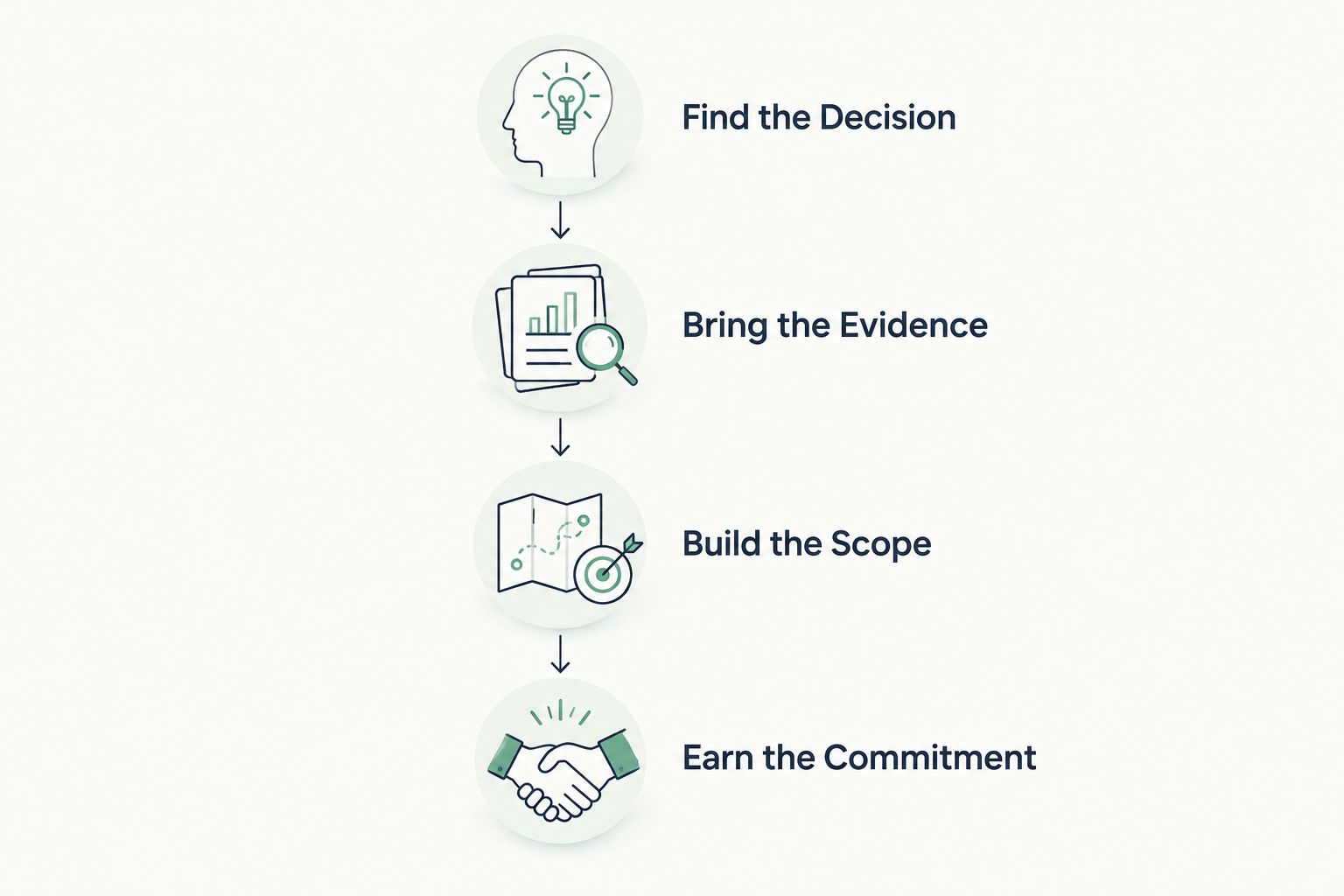
The SCOUTz Evidence-to-Agreement Framework gives MSPs a structure for moving from an observation to a buyer-approved next action. It is an original conversation framework, not a proven close-rate intervention.
Find the Decision
Identify the decision the municipal sponsor needs to make. A decision to authorize a tenant review differs from a decision to purchase ongoing managed services. Record the sponsor, approval process, and evidence needed for that specific choice.
Bring the Evidence
Begin with 1 municipal domain as a bounded preparation scope when a domain review is appropriate. Preserve 3 required fields on every finding: source, run date, and affected object. Add the check, evidence state, coverage limits, and responsible reviewer.
Before a client meeting, validate the security assessment findings. An observation that has changed since collection needs an updated explanation.
Build the Scope
Create 2 evidence packets when your engagement includes both public observations and authorized tenant review. Keep their permissions and conclusions separate, then connect each recommended outcome to an owner and an acceptance condition.
If the assignment requires testing exploitability, penetration testing as a service belongs in a separately authorized scope with rules of engagement. A domain review or vulnerability scan does not establish that exploitation testing has occurred.
Earn the Commitment
Request the smallest explicit commitment that advances the agreed decision. That can be permission for a read-only review, confirmation of a system owner, or approval of a bounded investigation.
The following dialogue is illustrative, not a customer account:
MSP: The dated public record shows a monitoring-only DMARC policy. That establishes the published policy; it leaves internal mail controls unknown. Will you introduce the email owner so we can confirm the intended policy before proposing work?
Municipal sponsor: We already have an email provider.
MSP: Keep that provider in the conversation. The proposed step is to confirm intent and ownership, then decide whether any change belongs in scope.
Which Municipal Security Assessment Tool Should You Choose?
Choose CISA CSET first when you need a structured municipal control assessment. Add Microsoft Secure Score for authorized tenant posture review, Greenbone for vulnerability assessment, and Nmap for service discovery as the scope requires.
Choose SCOUTz when your immediate job is preparing an MSP conversation with a municipal prospect. Keep the relationship, technical judgment, proposal, and sale with the MSP.
For your 2026 procurement discussion, request a sample output showing assessed systems, unread sources, evidence dates, and validation steps. Reject an acceptance criterion that consists only of a better score. Specify the condition that must change and the evidence that will demonstrate the change.
Prepare Your Municipal Prospect Review
Discuss MSP fit, evidence boundaries, and the Join Open Beta next step.
FAQ
What's the best security assessment tool for a municipal government?
CISA CSET is the default choice for a structured municipal control assessment. Use separate tools for Microsoft tenant posture, vulnerability discovery, and service discovery when those jobs are included in scope.
Which tool is best for an MSP preparing a municipal prospect meeting?
SCOUTz fits MSP prospect preparation using dated domain evidence and customer-authorized Microsoft 365 reviews. Keep public observations separate from internal evidence, and ask the municipal owner to confirm intent before proposing work.
Is Microsoft Secure Score enough for a municipal security assessment?
Microsoft Secure Score alone does not cover a municipality's entire environment. It supports review of supported Microsoft services; other systems, operating procedures, and technical validation require separate assessment.
Can a public domain scan show whether a city enforces MFA?
A public domain scan cannot establish Microsoft 365 MFA enforcement. That conclusion requires appropriate authorized tenant evidence, including applicable policies, covered identities, and exceptions.
Should an MSP scan a municipal network before a sales meeting?
Obtain explicit authorization before active municipal network scanning. Define targets, exclusions, timing, methods, escalation contacts, and stop conditions; public observation and active probing have different boundaries.
Does an open port prove a municipal system is vulnerable?
An open port establishes that a service answered under the test conditions. It does not by itself establish exploitability, compromise, or an unresolved security problem.
How should a municipality confirm that corrective work succeeded?
Repeat the relevant check against a pinned baseline and compare the affected object, configuration, and coverage. Preserve the original evidence, change record, verification date, and remaining unknowns.
One Last Thing
Write the acceptance test before approving corrective work. If the finding concerns a published email policy, specify the intended policy and the evidence needed to confirm it. If it concerns recoverability, require restore evidence: backup software presence answers a different question.
That discipline turns a report into an accountable project. It also gives the municipality a defensible reason to approve the next step, defer it, or choose no change.


