
Best for MSP prospect preparation: SCOUTz. Best for external asset discovery: attack surface assessment. Best for tenant configuration evidence: an authorized Microsoft 365 review. The best alternatives to traditional vulnerability scanners for financial services answer a specific decision; none replaces vulnerability scanning across every security task.
- SCOUTz is best for MSP prospect intelligence and dated evidence before financial-services sales conversations.
- Alternatives to traditional vulnerability scanners for financial services should match the decision, access permissions, and evidence required.
- Use authorized Microsoft 365 reviews for tenant configuration evidence, not public-domain observations.
- Keep vulnerability scanning when the job is identifying technical vulnerabilities across an agreed asset scope.
Why This Matters
A financial-services prospect meeting and a technical vulnerability assessment have different purposes. Your sales team needs enough evidence to ask a useful question, establish ownership, and agree on the next action. Your delivery team needs the access and scope required to investigate technical exposure.
SCOUTz is best for MSPs that need dated cybersecurity prospect intelligence before financial-services sales conversations. It prepares the conversation; the relationship and sale remain yours.
For your 2026 selection, start with the work you need to perform. A bank, credit union, insurance agency, and accounting firm do not automatically share the same assessment scope or regulatory obligations. Establish the entity, systems, and applicable requirements before choosing an assessment method.
What Makes The Best Scanner Alternative
Use these criteria before comparing features. They separate evidence you can use from conclusions the assessment cannot support.
- Decision fit: Identify whether you need discovery preparation, asset discovery, configuration review, compliance evidence, or exploit validation.
- Evidence provenance: Keep the source, affected object, check name, and observation date attached to each finding.
- Access boundary: Distinguish public observations from authorized internal evidence and active testing.
- Coverage disclosure: Require explicit treatment of partial, unreadable, permission-limited, and unassessed sources.
- Action ownership: Connect the condition to a responsible person and a defined next choice.
- Verification: Preserve a baseline so a later assessment can show what changed within comparable coverage.
A useful evaluation produces 1 dated baseline, 1 accountable owner, and 1 agreed next action. These are recommended workflow requirements, not measured product results.
Scanner Alternatives At A Glance
These options are ranked by their fit for an MSP preparing a financial-services conversation in 2026. They are different assessment jobs, rather than interchangeable products.
| Option | Best For | Standout Capability | Key Limitation |
|---|---|---|---|
| SCOUTz | MSP prospect preparation | Dated domain and consented Microsoft 365 evidence with account context | Does not replace technical vulnerability management |
| External attack surface assessment | Discovering internet-facing assets | Identifying externally observable services and ownership questions | Public visibility does not establish internal control coverage |
| Authorized Microsoft 365 configuration review | Investigating tenant settings | Reviewing configuration and metadata within approved permissions | Unread evidence remains unknown |
| Compliance gap assessment | Mapping evidence to applicable requirements | Connecting a defined requirement to supporting evidence and an owner | A completed checklist does not establish technical security |
| Scoped penetration testing | Testing a specific exploitation hypothesis | Authorized investigation of attack paths within agreed boundaries | Conclusions apply to the tested scope and conditions |
1. SCOUTz: Best Scanner Alternative For MSP Prospect Preparation
SCOUTz provides cybersecurity prospect intelligence for MSPs through domain reviews and customer-authorized Microsoft 365 reviews. Its purpose is to bring dated evidence and account context into discovery, so you can build a defensible scope rather than present an unexplained score.
For financial-services conversations, keep public-domain observations separate from consented tenant evidence. A published DMARC policy is evidence about that policy. It does not establish Conditional Access coverage, application permissions, device state, or tenant sharing configuration.
Evidence, Insight, And Proof
Consider a clearly illustrative example: a dated DNS observation shows a DMARC policy requesting monitoring only. The insight is a question about intended enforcement and report ownership. Proof requires a later review against the pinned baseline, with any coverage differences disclosed.
Do not turn that observation into a claim of compromise or an unresolved issue. The prospect might already have a documented transition plan. Ask before prescribing work.
SCOUTz Pros
- Connects dated security observations to MSP sales preparation.
- Separates public-domain evidence from customer-authorized cloud evidence.
- Supports a read-only review without an agent or automatic configuration changes.
- Keeps the MSP responsible for interpretation, scope, and the relationship.
SCOUTz Cons
- Does not establish internal tenant conditions from a public-domain review.
- Does not replace vulnerability scanning or penetration testing.
- Microsoft 365 Review and report experiences carry Open Beta labels in the client-supplied October 15, 2026 product reference.
Microsoft 365 evidence is configuration and metadata only. It excludes mail, files, chats, documents, and prompts.
Best for: MSP owners and sales leaders preparing an evidence-led prospect conversation.
Verdict: Buy for the prospect-preparation job, subject to evaluating the relevant beta experience; retain technical assessment tools for delivery.
2. External Attack Surface Assessment: Best For Asset Discovery
External attack surface assessment helps you investigate the organization's internet-facing footprint. Depending on the method, the work includes public records, externally visible services, and asset attribution.
Its value starts with the asset question. Before discussing remediation, establish whether a domain, hostname, or answering service belongs to the prospect and remains in scope. A third-party service or stale attribution changes the conversation.
External Attack Surface Assessment Pros
- Focuses discovery on externally observable assets.
- Gives the prospect concrete ownership questions to resolve.
- Helps define a later authorized technical assessment scope.
External Attack Surface Assessment Cons
- External observations do not establish internal control effectiveness.
- An answering service is not proof of an exploitable service.
- Active probing requires a separate authorization and legal review appropriate to the activity.
Keep observation methods visible in your 2026 assessment brief. Passive public-record review and active testing are different activities; do not describe them as one permission-free workflow.
Best for: MSPs that need to identify and attribute external assets before proposing deeper assessment work.
Verdict: Buy for asset discovery; skip any interpretation that treats internet visibility alone as confirmed vulnerability.
3. Authorized Microsoft 365 Review: Best For Tenant Configuration Evidence
An authorized Microsoft 365 configuration review examines tenant evidence within customer-approved access. The review should state which settings and metadata were assessed, which permissions were available, and which sources remained unread.
This is the right assessment category when your question concerns tenant configuration rather than software vulnerabilities. Keep MFA registration separate from enforcement, and application permissions separate from evidence of malicious activity.
Microsoft 365 Review Pros
- Addresses configuration questions a public-domain review cannot answer.
- Connects observations to specific tenant objects and settings.
- Supports a bounded proposal for further investigation or approved configuration work.
Microsoft 365 Review Cons
- Permissions and licensing constrain the evidence available.
- Configuration evidence does not establish every aspect of operational effectiveness.
- A read-only review does not perform remediation.
For each conclusion, record both evidence state and coverage. “Observed” describes the evidence; “Permission limited” describes coverage. These are separate dimensions, not interchangeable confidence scores.
Use the guide to Microsoft 365 assessment tools when defining the questions your tenant review must answer.
Best for: MSPs with customer consent to investigate identity, application, and sharing configuration within a defined scope.
Verdict: Buy for authorized tenant questions; wait when the required consent or access is absent.
4. Compliance Gap Assessment: Best For Requirement Mapping
A compliance gap assessment compares a defined set of applicable requirements with available evidence. Its output should identify the requirement, supporting material, evidence gaps, and responsible owner.
For financial-services clients, establish applicability before building the checklist. A tool cannot make every framework relevant merely by including it in a template. Have the appropriate compliance owner or adviser confirm the assessment basis.
Compliance Gap Assessment Pros
- Organizes policies, records, technical evidence, and ownership around stated requirements.
- Helps distinguish missing evidence from a verified control failure.
- Produces a defined scope for evidence collection and specialist review.
Compliance Gap Assessment Cons
- A requirement mapping does not establish exploitability.
- Documentation alone does not demonstrate that a control operates effectively.
- Conclusions depend on correct applicability and adequate evidence.
Treat a missing document as an evidence request until further investigation supports a stronger conclusion. Keep regulatory interpretation separate from a sales claim about what your service will deliver.
Best for: MSPs preparing a requirement-specific engagement with a named compliance owner.
Verdict: Buy for evidence organization and gap analysis; skip blanket claims that the assessment proves compliance.
5. Scoped Penetration Testing: Best For Exploit Validation
Penetration testing investigates whether an authorized attack path works under agreed conditions. It serves a different purpose from collecting prospect context or reviewing a configuration baseline.
Use it when the buyer has a specific validation objective and authority to approve testing. Establish assets, exclusions, permitted techniques, escalation contacts, and handling of sensitive evidence before work begins.
Penetration Testing Pros
- Investigates specific exploitation hypotheses.
- Adds technical context beyond an isolated scanner finding.
- Supports a defined retest after approved remediation.
Penetration Testing Cons
- Conclusions remain bounded by scope and testing conditions.
- It is not continuous coverage of every asset or change.
- Active testing requires operational coordination and explicit authorization.
A penetration test is not a substitute for routine vulnerability management. Neither does a scanner finding, by itself, establish that a particular attack path succeeds.
Best for: Financial-services engagements with a defined technical validation question and approved testing scope.
Verdict: Buy for authorized exploit validation; wait until scope and operational safeguards are agreed.
How The Options Are Ranked
The ranking follows decision fit, provenance, access boundaries, coverage disclosure, ownership, and verification. Prospect preparation comes first because this guide addresses MSPs selecting an assessment approach before a financial-services sales conversation.
This is a workflow comparison, not a laboratory performance test. For a 2026 delivery-tool decision, reverse the priority when your actual job is vulnerability identification or exploit validation. Choose the method that answers the question you are accountable for answering.
Turn Evidence Into An Agreed Scope
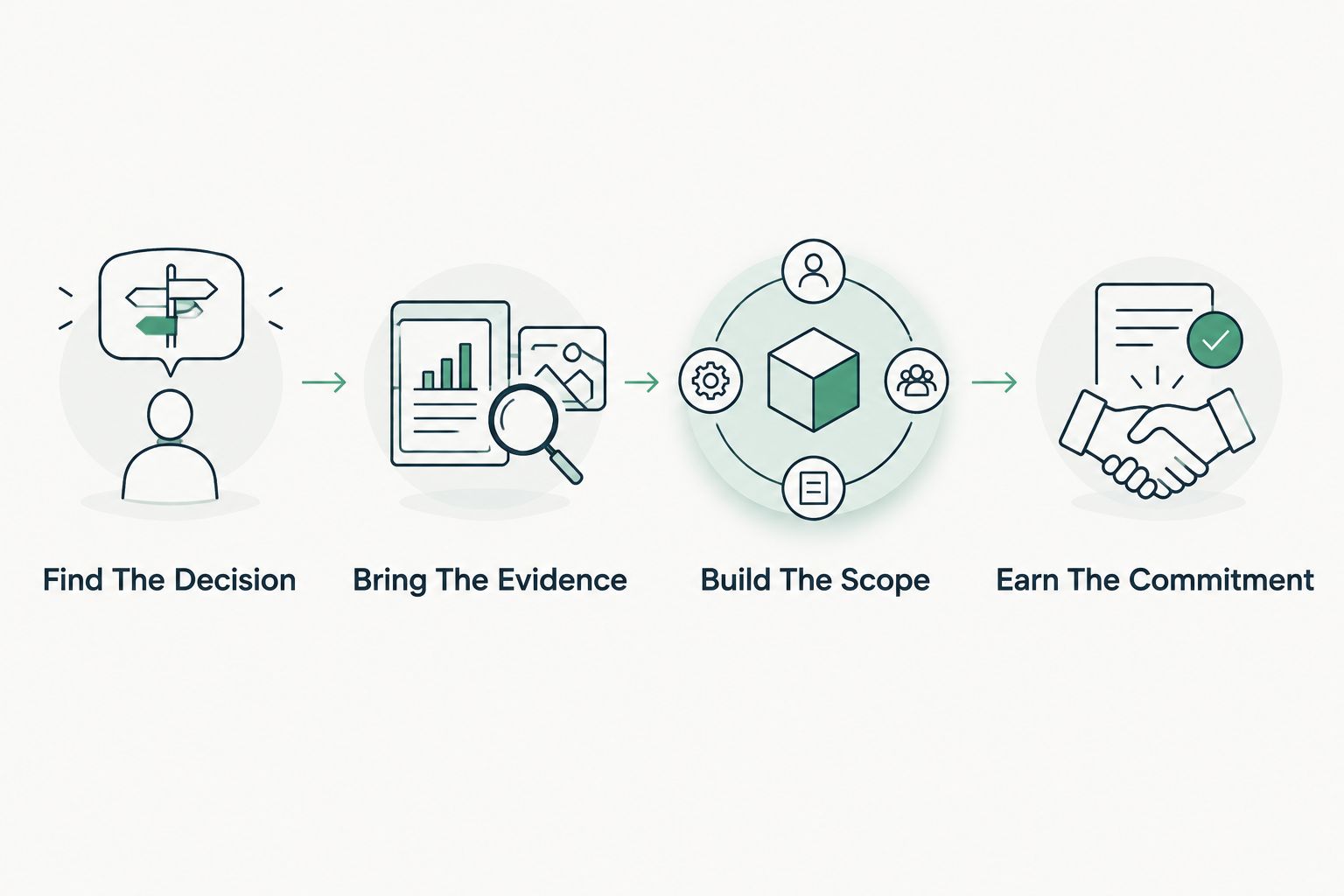
The SCOUTz Evidence-to-Agreement Framework provides a conversation structure: Find the decision, Bring the evidence, Build the scope, Earn the next commitment. It is an original framework, not a proven close-rate intervention.
Find The Decision
Identify the decision owner and the decision the meeting must support. Define whether the buyer wants explanation, investigation, remediation planning, or verification.
Bring The Evidence
Show the condition, source, run date, and affected object. State the boundary immediately, including what the assessment did not read.
Build The Scope
Separate the desired outcome from the vendor choice. The next step might be a service, process change, project, further assessment, or no work.
Earn The Commitment
Agree on an owner, deliverable, and review date. Permission for a configuration review is a next commitment; it is not agreement to a managed-services contract.
Illustrative Dialogue And Follow-Up
The following dialogue is illustrative, not a customer quotation or measured outcome.
MSP: “The dated domain review shows a monitoring-only DMARC policy. That does not establish compromise. Who owns reporting, and does this remain the intended policy?”
Buyer: “Our current provider already manages email security.”
MSP: “Keep that owner involved. The next choice is to confirm the intended policy and review the supporting evidence together, rather than assume a change is needed.”
A useful follow-up records the observation and boundary, then offers a bounded scope: “Please confirm the policy owner and whether a review is useful. If approved, the deliverable is a documented recommendation and verification plan.” Keep broader tenant review as a separate, consented engagement.
Which Scanner Alternative Should You Choose?
Choose SCOUTz when your immediate job is prospect preparation. Choose external asset assessment for discovery, an authorized Microsoft 365 review for tenant configuration, compliance gap assessment for requirement mapping, and penetration testing for exploit validation.
Keep traditional vulnerability scanning when that remains the delivery requirement. For MSPs evaluating the prospect-preparation workflow, Join Open Beta is the primary next step. Assess the relevant experience against your own evidence and reporting requirements before committing.
FAQ
What's the best alternative to a vulnerability scanner for financial-services prospect meetings?
SCOUTz is best for MSP prospect preparation using dated domain and customer-authorized Microsoft 365 evidence. It prepares discovery and scope discussions rather than replacing technical vulnerability management.
Can a public-domain review assess a financial firm's Microsoft 365 tenant?
A public-domain review cannot establish internal Microsoft 365 configuration. Conditional Access, application permissions, license assignments, device state, and tenant sharing require appropriate authorized evidence.
Is attack surface assessment the same as vulnerability scanning?
Attack surface assessment and vulnerability scanning answer different questions. Asset discovery establishes what is externally observable and attributable; vulnerability scanning investigates technical weaknesses within its defined scope.
Does a compliance gap assessment prove a financial-services business is compliant?
A compliance gap assessment does not by itself prove compliance. Its conclusions depend on applicable requirements, adequate evidence, and the scope of the review.
Should an MSP replace vulnerability scanning with penetration testing?
An MSP should retain vulnerability scanning when routine vulnerability identification is required. Penetration testing addresses authorized exploitation questions within an agreed scope and testing conditions.
What should happen when an assessment cannot read a source?
Unread evidence must remain explicitly unknown. Record the coverage limitation and distinguish it from an assessed source that supports a particular conclusion.
How should an MSP turn a security finding into a proposal?
Connect the dated finding to a confirmed owner and buyer-approved next action. State the evidence boundary, define the outcome and exclusions, and preserve the buyer's choice about further work.
One Last Thing
A prospect who says the condition is intentional has supplied useful discovery evidence. Record the explanation and request supporting evidence only where appropriate. Your 2026 proposal should reflect the confirmed decision, rather than keep selling against an assumption the buyer has already corrected.