
No. A security posture assessment identifies conditions within its assessed scope; it cannot establish whether or when a future data breach will occur. Use the findings to choose a review, change or verification step, while keeping unassessed systems and unread evidence explicitly unknown.
- Can a security posture assessment predict a data breach? No. Dated findings support decisions, not breach forecasts.
- SCOUTz cybersecurity prospect intelligence is best for MSPs preparing evidence-led prospect conversations.
- Public-domain observations cannot establish internal Microsoft 365 controls; customer-authorized evidence requires separate scope and consent.
- Proof means rescanning against a pinned baseline and reporting what changed, including remaining unknowns.
Why this matters
A finding becomes misleading when a sales conversation gives it more meaning than the evidence supports. A published email policy describes a configuration. It does not establish that someone stole data, that the condition remains unresolved or that the prospect wants to buy.
SCOUTz provides cybersecurity prospect intelligence for MSPs preparing those conversations. The useful outcome is an agreed decision with an owner and a verification method. Keep the security claim narrow enough that a practitioner can defend it and a business owner can understand the choice.
For your 2026 assessment process, separate the question of what was observed from the question of what to do next. They require different evidence.
Can a security posture assessment predict a data breach?
No. An assessment supports a scoped statement about observed conditions, not a prediction that a breach will happen. Its usefulness depends on the source, run date, access, checks performed and evidence that remained unread.
Different review methods answer different questions. Choose the method for the decision you need to make, and carry its limitations into the report.
| Review method | Best for | Useful evidence | Limit that stays attached |
|---|---|---|---|
| Public-domain review | Preparing questions before authorized internal review | Published domain and email-security observations | Cannot establish internal tenant controls or compromise |
| Customer-authorized Microsoft 365 review | Examining accessible tenant configuration and metadata | Evidence within granted permissions and supported coverage | Permission and license limits leave some areas unassessed |
| Rescan against a pinned baseline | Checking whether an assessed condition changed | Comparable results for the affected object and check | A changed finding does not establish organization-wide security |
The advantage of public evidence is that it supports an initial discussion without implying internal access. Its disadvantage is limited visibility. Authorized tenant evidence adds configuration context, but authorization alone does not mean every source was readable.
A rescan answers a narrower question: what changed between comparable observations? For ongoing review, use the distinction between dated evidence and static reports. A report's continued existence does not make its findings current.
Public-domain evidence: useful context with an outside boundary
A public-domain review can give your MSP a specific condition to discuss. A published DMARC policy requesting monitoring only, for example, supports a question about intended enforcement and report ownership.
The observation does not establish mailbox compromise. It also does not establish whether the owner has already planned a change or intentionally retained that policy.
Keep the evidence package concrete:
- Record the check name, affected domain, source and run date.
- Preserve the observed policy separately from its possible consequence.
- Ask who owns reporting and whether the observed policy remains intended.
- Identify what would require customer-authorized internal review.
Public Domain Review cannot establish Conditional Access coverage, application permissions, license assignments, Intune device state or tenant sharing configuration. Those boundaries belong beside the finding, where the reader makes the decision.
Public observation and active probing also require separate consideration. Do not treat the availability of a scanner as permission to run every test against a prospect. Define the proposed activity and obtain appropriate authorization for its scope.
Microsoft 365 evidence: deeper access still has limits
Customer-authorized Microsoft 365 evidence supports statements about configuration and metadata that the review actually read. It does not turn a configuration assessment into an investigation of every possible incident.
SCOUTz describes its Microsoft 365 review as read-only, with no agent or install and no automatic configuration changes. Its evidence scope excludes mail, files, chats, documents and prompts. The client-provided product reference dated October 15, 2026 labels Microsoft 365 Review as Open Beta.
That boundary is useful for setting expectations before consent. It also limits the conclusions you can draw afterward.
Keep these distinctions explicit:
- Tenant-wide application permission does not establish a malicious application.
- Backup software presence does not establish backup health or recoverability.
- A breach-data match does not establish that the matched user is compromised.
- An unread source does not establish that a control is absent.
Use coverage labels such as Assessed, Partial, Not assessed, Permission limited and License limited. A permission-limited result belongs in the report as a limitation, with an owner for deciding whether further review is justified.
Why assessment conclusions vary
Assessment conclusions vary because the available evidence varies. A useful report explains those differences rather than hiding them inside a single score.
- Scope determines which domains, tenants, objects and sources the review covers.
- Access determines which evidence the review can read, including permission and license restrictions.
- Timing determines when the observation was true; later changes require fresh evidence.
- Check coverage determines which conditions the review evaluates and which remain outside its remit.
- Business context determines whether an observed configuration is intended, approved or awaiting a decision.
- Verification determines whether the report contains an initial observation or a comparable rescan showing change.
Keep evidence state separate from coverage. Verified, Observed, Inferred, Possible, Unknown and Unreadable describe different relationships to evidence; they are not a linear score ladder.
For a 2026 client report, place declared non-reads under NOT ASSESSED THIS SCAN. Do not bury them in a general disclaimer or combine different platforms into one score.
Use evidence, insight and proof to make a defensible claim
Give every finding a small, repeatable structure. Use 3 stages to keep the condition, interpretation and verification separate.
Evidence
State what ran and what it returned. Attach the check, affected object, source, run date and coverage limit. If the source was unreadable, preserve that state rather than filling the gap with an assumption.
Insight
Explain why the condition deserves a decision now. Name the possible consequence, the unknowns and the person who can clarify intent. Keep a hypothesis labeled as a hypothesis.
Proof
Define the outcome before work starts. Use 1 pinned baseline for the agreed comparison, then rescan the relevant condition and record what changed. Describe the remaining limits alongside the result.
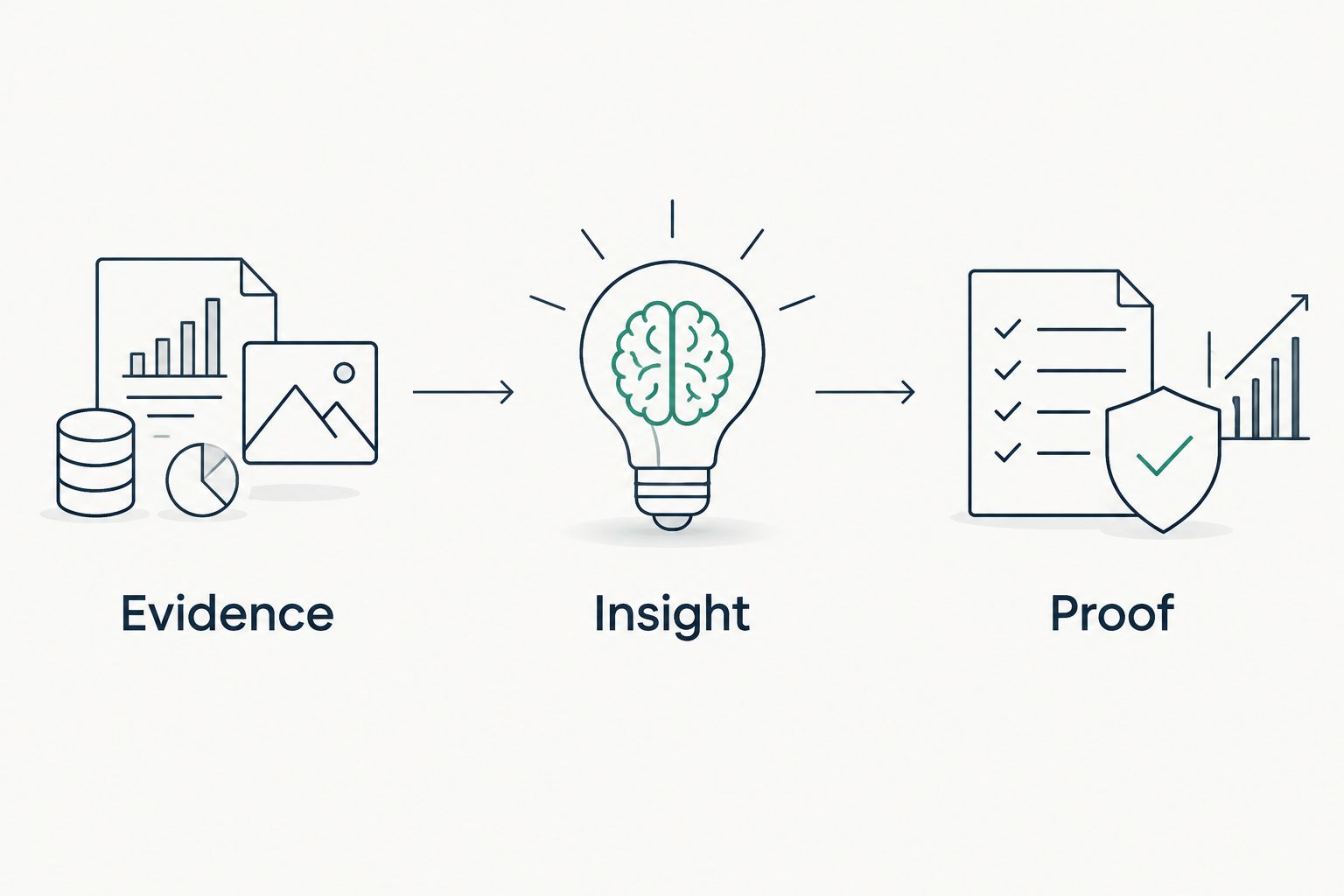
A useful result statement identifies the condition checked, the comparison dates and the change observed. Avoid expanding that result into a declaration that the entire organization is secure. The rescan proves only what its scope and evidence support.
Turn the finding into an agreed next action
Your MSP needs more than an accurate warning. You need a conversation that lets the buyer choose an appropriate next step.
The SCOUTz Evidence-to-Agreement Framework has 4 stages: Find the decision, Bring the evidence, Build the scope, Earn the next commitment. The client approved this sales editorial direction on October 24, 2026. It is a conversation framework, not a proven close-rate intervention.
Find the decision
Identify the choice before presenting a recommendation. For a monitoring-only DMARC observation, the first decision is whether to review current intent and reporting ownership. Do not assume the buyer has approved enforcement changes.
Bring the evidence
Present the dated observation and its boundary together. Explain that the published policy was observed, while compromise and current internal handling remain unestablished.
Build the scope
Keep the condition and desired outcome separate from vendor selection. A discovery scope can establish ownership, intended policy and the evidence needed for a later change decision. An implementation scope requires authorization for the agreed work and a verification method.
Earn the next commitment
Ask for a named owner and an agreed action. The buyer can approve further review, request clarification, defer or decline. A finding does not remove that choice.
Illustrative conversation and follow-up
The following dialogue is illustrative. It describes a discussion about a monitoring-only DMARC observation, not a real customer finding or outcome.
MSP: The published DMARC policy observed in this review requests monitoring only. That tells us the policy, but it does not tell us whether anyone has compromised your email. Who owns the reports and the decision about enforcement?
Buyer: Our current provider already handles that.
MSP: Then the useful next step is to confirm the intended policy with that owner. If the policy is intentional and supported by their review, record that context. If they recommend a change, agree on the scope and verification before work starts.
This response preserves the incumbent provider's role and avoids claiming an unresolved problem. It also gives the buyer a concrete choice rather than another security slide.
An illustrative follow-up can stay equally narrow:
Follow-up script: Attached is the observation we discussed, including its source, run date and review limits. The proposed next step is an owner-led review of intended DMARC policy and reporting. Please confirm whether you want that review scoped, need clarification or prefer to defer.
The follow-up asks for agreement to a defined action. An email open remains a follow-up cue, not agreement or buying intent.
Can a good security score rule out a breach?
No. A favorable security score cannot rule out a breach. It summarizes the conditions and coverage represented by that scoring method; it does not establish what happened in unread or unassessed sources.
Keep the score beside its contributing evidence and exclusions. If a buyer asks for assurance about an incident, distinguish that request from a posture review and agree on the evidence needed to investigate it.
Does a failed check mean the business was compromised?
No. A failed check establishes the reported condition only within the check's scope. An answering service does not establish an exploitable service, and a permission finding does not establish malicious use.
Ask what additional evidence would distinguish configuration exposure from actual activity. Avoid recommending an incident response solely because a sales report contains a concerning configuration.
How should an MSP use an assessment in a proposal?
Use the assessment to define the decision, scope, owner and acceptance evidence. Attach each proposed action to a dated finding, then state what the action will verify or change.
For your 2026 proposal template, include the affected object, remaining unknowns, authorized work and rescan method. Leave breach forecasts and hypothetical breach-loss figures out of the commercial argument.
FAQ
Can a security posture assessment predict a data breach?
No. A security posture assessment identifies conditions within its assessed scope; it cannot establish whether or when a future data breach will occur. Use dated findings to choose further review, changes and verification.
Does a clean assessment mean my business is secure?
No. A report without findings does not establish security across unread or unassessed sources. Check the scope, run date, coverage and declared non-reads before interpreting the result.
Can a public-domain scan assess Microsoft 365 security?
A public-domain scan cannot establish internal Microsoft 365 controls. Conditional Access coverage, application permissions, license assignments, Intune device state and tenant sharing configuration require appropriate authorized evidence.
Does a DMARC monitoring-only policy prove email compromise?
No. A monitoring-only DMARC policy describes the published policy, not evidence of email compromise. Confirm intended enforcement, report ownership and the observation date before proposing work.
What should an MSP do when assessment evidence is unreadable?
An MSP should label unreadable evidence explicitly and identify the coverage limitation. Record who can decide whether additional permission or another review is appropriate.
Can a rescan prove that remediation worked?
A comparable rescan can establish that a specific assessed condition changed against a pinned baseline. It does not establish that every security issue is resolved or that a future breach cannot occur.
Who is SCOUTz cybersecurity prospect intelligence best for?
SCOUTz cybersecurity prospect intelligence is best for MSPs preparing evidence-led prospect conversations. It provides dated evidence and account context while the MSP retains responsibility for judgment, the relationship and the sale.
One last thing
An unknown can improve the proposal when it becomes an explicit decision. Instead of concealing a permission-limited source, identify the owner, explain what remains unanswered and offer a scoped way to resolve it.
For MSPs evaluating SCOUTz, Join Open Beta is the primary next step. Bring a real prospect-preparation question and keep the desired outcome specific: an evidence-backed conversation and an agreed next action.