
A security evidence packet has no fixed generation time: collection, access approval, evidence review and report preparation are separate stages. A generated report is ready for a prospect conversation only after an MSP checks its sources, dates, coverage and claims; Microsoft 365 evidence also requires customer authorization.
- How long does it take to generate a security evidence packet? Separate collection, authorization, review and approval.
- SCOUTz cybersecurity prospect intelligence suits MSPs preparing evidence-led sales conversations; the MSP still approves the claims.
- Public-domain evidence cannot establish internal Microsoft 365 controls or tenant configuration.
- A meeting-ready packet needs dated observations, explicit unknowns, an owner and an agreed next step.
Why this matters
Measure time to an approved packet, not just time to a rendered report. A document can look finished while its evidence remains partial, unreadable or outside the agreed scope. Sending it creates a claim your MSP must defend.
For your 2026 sales workflow, define the finish line before collecting evidence. A first-call packet should support a specific decision, such as whether the prospect wants an authorized tenant review. It does not need to answer every security question.
The domain scan to first-call evidence packet workflow provides a related preparation path. Keep the technical evidence and the proposed conversation together.
How long does it take to generate a security evidence packet?
The useful answer is the elapsed time from agreed scope to approved claims. Collection is one component. Permission, source availability, interpretation and sign-off determine whether the packet is ready to use.
Use these stages to record your own preparation time without presenting an unsupported benchmark:
- Confirm scope. Identify the prospect, domain, intended meeting and permitted sources. Name the decision the packet should support.
- Collect evidence. Preserve the check, affected object, source and run date. Separate public observations from customer-authorized tenant evidence.
- Review claims. Check that every implication follows from the observation. Record unread sources and unresolved questions explicitly.
- Approve packet. Have a person sign off on the client-facing claims, proposed scope and next action.
Record when each stage begins and ends. Track waiting for authorization separately from active preparation, so a delayed approval does not become a claim about collection speed.
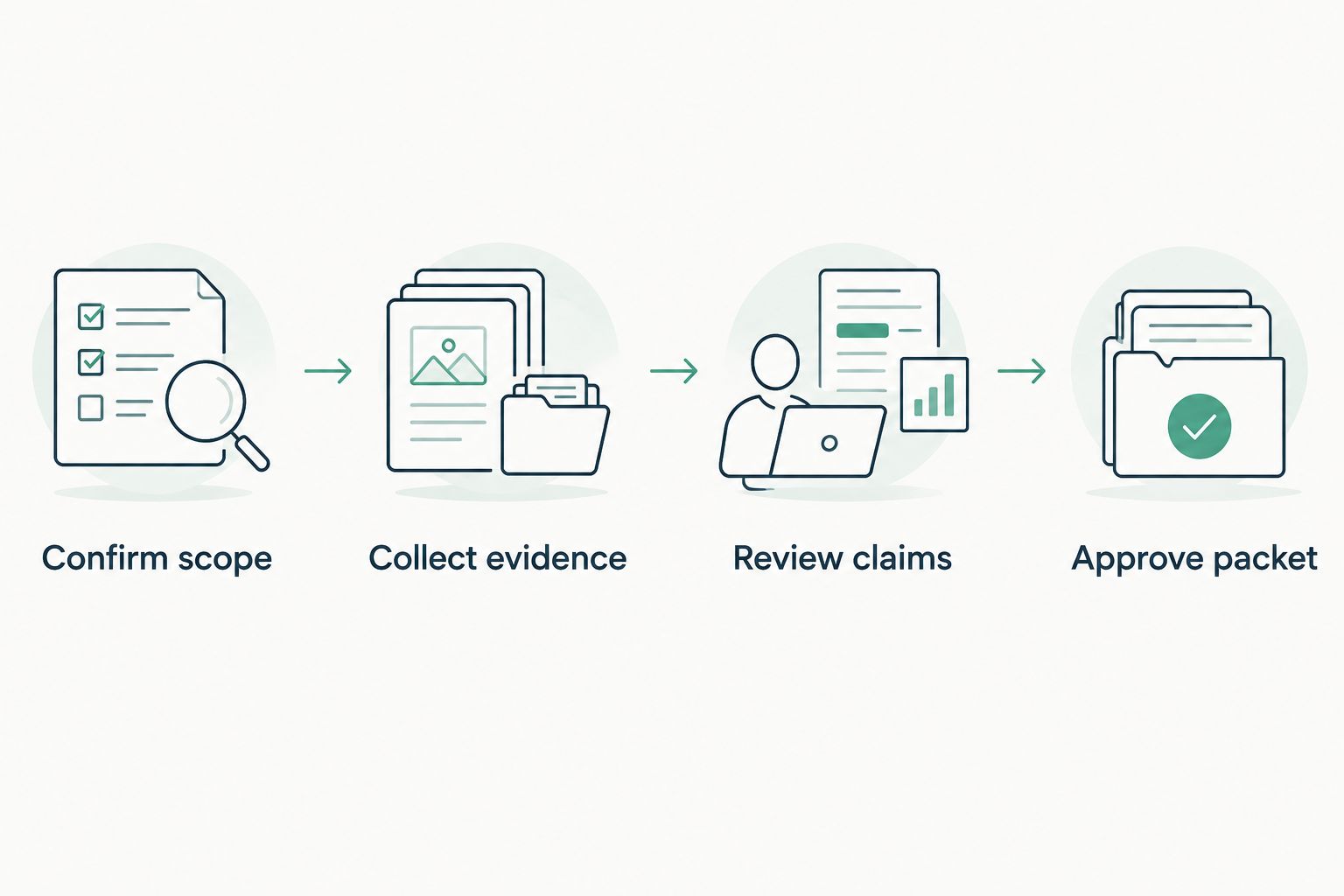
A useful internal timing record distinguishes a report becoming available from a salesperson being authorized to send it. Preserve both timestamps. That distinction gives your team an honest basis for future scheduling commitments.
Public-domain packet: best for first-call preparation
A public-domain packet supports a conversation about externally observable conditions. Its advantage is the narrower evidence boundary: you can discuss a published domain configuration without presenting it as an internal tenant assessment.
Its limitation is equally important. Public Domain Review cannot establish Conditional Access coverage, application permissions, license assignments, Intune device state or tenant sharing configuration.
For example, a published DMARC policy requesting monitoring only supports a question about intended enforcement and report ownership. It does not establish compromise, an unresolved problem or dissatisfaction with the incumbent provider.
Before collecting evidence, distinguish public observation from active probing. Do not treat a domain being publicly reachable as blanket permission for every assessment technique. For outreach, offer an opt-in review after the prospect replies.
Microsoft 365 packet: best for authorized tenant discovery
A customer-authorized Microsoft 365 packet supports questions about internal configuration and metadata within the permitted scope. Authorization is a dependency, not an administrative detail to hide inside a generation-time promise.
The boundary remains read-only. The review uses configuration and metadata, never mail, files, chats, documents or prompts. It requires no agent or install and makes no automatic configuration changes.
Permissions and licensing also affect coverage. A source the review cannot read stays unknown or unreadable; the packet must explain that limit instead of treating the control as absent or satisfactory.
The client’s October 15, 2026 product reference labels Microsoft 365 Review and Evidence Reports as Open Beta. Treat that dated status as product context, not a collection-time guarantee.
| Packet scope | Best for | Strength | Limitation | Release condition |
|---|---|---|---|---|
| Public-domain packet | First-call preparation | Dated external observations | Cannot establish internal tenant controls | Claims stay within public evidence |
| Authorized Microsoft 365 packet | Tenant discovery | Configuration and metadata within consented scope | Permission and license limits affect coverage | Authorization and coverage are documented |
| Follow-up evidence packet | Reviewing agreed changes | Comparison against a pinned baseline | Requires comparable evidence and explicit remaining unknowns | Rescan supports the stated change |
Why security evidence packet preparation time varies
The main drivers are scope, access and the work needed to approve a defensible claim. Use these factors when planning a 2026 prospect meeting:
- Evidence boundary. Public-domain observations and authorized internal evidence require different preparation and permission decisions.
- Authorization readiness. A tenant review depends on the customer approving the access needed for the agreed scope.
- Coverage limits. Permission-limited, license-limited and unreadable sources require explicit handling in the packet.
- Interpretation work. An observed configuration, a possible consequence and a confirmed incident are different claims.
- Report purpose. A discovery packet, proposal attachment and change-verification packet answer different questions.
- Evidence freshness. A changed configuration or expired observation calls for a new review before reuse.
Do not remove an unknown to make the packet look finished. Narrow the claim or the scope instead. A smaller packet with clear boundaries is usable; an expansive packet that conceals its gaps is not ready.
What a meeting-ready packet contains
A packet earns its place in a sales conversation by connecting evidence to a decision. Start with the condition, show its basis, name the boundary, identify the owner and offer the next choice.
For each finding, retain these fields:
- Condition and object. State what was observed and which domain, account or configuration it concerns.
- Source and date. Identify the source, check and run date attached to the observation.
- Evidence state. Keep Verified, Observed, Inferred, Possible, Unknown and Unreadable distinct.
- Coverage. State Assessed, Partial, Not assessed, Permission limited or License limited separately from evidence state.
- Business question. Explain what the owner needs to clarify without declaring buying intent.
- Recommended outcome. Describe the desired result separately from any vendor selection.
Evidence states are not a linear score ladder. Coverage describes what the review reached, not how serious a finding is. Declared non-reads belong under NOT ASSESSED THIS SCAN.
For a 2026 packet, keep the actual run date attached to each observation. A current cover page does not refresh older evidence, and a recent observation does not prove that every related control was assessed.
Move from evidence to an agreed next action
The SCOUTz Evidence-to-Agreement Framework connects preparation to the next sales decision: Find the decision, Bring the evidence, Build the scope, Earn the next commitment. It is a conversation framework, not a proven close-rate intervention.
Find the decision
Choose the decision the meeting can support. For a public-domain review, that might be identifying who owns email authentication and whether an authorized follow-up review is appropriate.
Avoid arriving with a predetermined remediation project. The prospect might already have a planned change, an accepted exception or evidence your packet does not contain.
Bring the evidence
Present the observation with its date and boundary. A published DMARC policy requesting monitoring only is a configuration observation. Its meaning depends on the organization’s intended policy and reporting process.
Illustrative dialogue: “The dated review observed a monitoring-only DMARC policy. That does not establish compromise. Who owns the reports, and does this match your intended policy?”
This is sample conversation wording, not a customer quote or an account finding. Replace it with the actual observation before using it.
Build the scope
Separate the recommended outcome from the delivery choice. The MSP can propose a service, process change, project, further assessment or no action, depending on what the customer confirms.
| Next action | Best for | Benefit | Boundary |
|---|---|---|---|
| Confirm with the existing owner | An observation needing context | Tests the interpretation before proposing work | Does not independently verify internal controls |
| Conduct an authorized review | Questions requiring tenant evidence | Expands discovery within agreed access | Requires consent and documented coverage |
| Define a change and rescan | An agreed configuration outcome | Creates a basis for checking what changed | A single change does not establish overall security |
Earn the next commitment
Ask for a bounded action with an owner: confirm the intended policy, authorize the review or approve a scoped proposal. Preserve the buyer’s choice.
Illustrative follow-up: “We reviewed the dated observation and its limits. Please confirm the policy owner and whether you want an authorized follow-up review. The proposed scope will separate assessed sources from remaining unknowns.”
If the buyer says the existing provider handles it, request confirmation rather than disputing the relationship. The packet supports discovery; it does not prove that another provider failed.
Where SCOUTz fits in packet preparation
SCOUTz cybersecurity prospect intelligence is best for MSPs preparing evidence-led sales conversations. It supplies dated cybersecurity evidence and account context; the MSP remains responsible for interpretation, the relationship and the sale.
Its fit is preparation between a booked meeting and an agreed next action. Its boundary is judgment: a finding does not establish buying intent, confirm a breach or select the right commercial response.
For MSPs evaluating this workflow, Join Open Beta is the primary next step. Keep the evaluation focused on source traceability, coverage disclosure, client-safe explanations and whether the packet supports a specific decision. Do not evaluate it as a contact database.
Can you use a public-domain packet before tenant consent?
A public-domain packet can support an external-evidence conversation without establishing internal Microsoft 365 conditions. Keep collection within the appropriate authorization boundary and distinguish public observation from active probing.
If the next question requires tenant configuration, make customer authorization the next agreed action. Do not fill the gap with an inference presented as fact.
Is an automatically generated report ready to send?
An automatically generated report still needs human approval of its client-facing claims. Check the source, date, affected object, evidence state and coverage before sharing it.
During a 2026 review, remove language that turns a possible consequence into a confirmed incident. Keep unread evidence visible and identify the person responsible for follow-up.
Does a rescan prove the security issue is fixed?
A rescan supports a change claim when it compares the relevant evidence against a pinned baseline. State what changed, what remained comparable and what stayed unassessed.
Keep the conclusion specific to that evidence. For example, backup software presence does not establish recoverability, and a changed domain policy does not establish tenant-wide security.
FAQ
How long does it take to generate a security evidence packet?
A security evidence packet has no fixed generation time across scopes. Separate collection, customer authorization, evidence review and human approval before committing to a delivery time.
What should I measure when timing security packet preparation?
Measure the elapsed time from agreed scope to approved claims. Record authorization waiting time separately from active collection, review and report preparation.
Can I prepare a packet without accessing the prospect’s network?
You can prepare a public-domain packet using appropriately collected external observations. That packet cannot establish internal tenant controls, and public availability does not provide blanket permission for active probing.
Does a Microsoft 365 review read customer emails or files?
The described Microsoft 365 review uses configuration and metadata only. It does not read mail, files, chats, documents or prompts, and its coverage depends on authorized access.
What happens if a source cannot be read?
An unread source remains unknown or unreadable and must be disclosed. Keep coverage limits separate from findings and list declared non-reads under NOT ASSESSED THIS SCAN.
Can a salesperson send the generated packet without technical review?
A person must approve the client-facing claims before the packet is sent. The reviewer should verify sources, dates, boundaries and the difference between an observation and an inference.
Does a security finding mean the prospect needs to buy?
A security finding does not establish buying intent or an unresolved problem. Use it to confirm ownership, intended configuration and the next decision with the prospect.
One last thing
A packet can get smaller during approval and become more useful. Remove claims the evidence cannot support, retain the unknowns and end with a decision the prospect can actually make.
Before sending, ask the reviewer to trace every proposed action back to a dated observation or an explicitly labeled question. If that connection is missing, revise the scope before the meeting.