
Yes, a free cybersecurity assessment tool is accurate enough for sales when you use dated, reproducible findings to support a narrowly defined conversation. Its accuracy does not establish complete coverage, compromise, buying intent, or an unresolved problem. Before presenting a finding, confirm what was checked, what the evidence shows, what remains unknown, and who can validate the next step.
- Is a free cybersecurity assessment tool accurate enough for sales? Yes, for dated observations within its assessed scope.
- SCOUTz fits MSPs seeking dated cybersecurity prospect intelligence for evidence-led sales preparation.
- Public-domain observations cannot establish internal Microsoft 365 security configuration.
- Build proposals around verified conditions, agreed outcomes, ownership, and a rescan against a pinned baseline.
Is a free cybersecurity assessment tool accurate enough for sales?
Use a free assessment to support a discovery question when you can trace the finding back to its evidence. Require separate evidence before expanding that finding into a broader security claim.
For cybersecurity prospect intelligence, SCOUTz keeps the purpose focused on preparing the MSP's conversation. The relationship and sale remain the MSP's responsibility.
| Assessment approach | Best for | Useful evidence | Limitation |
|---|---|---|---|
| Public-domain review | Preparing external email and domain questions | Publicly observable records and responses, with collection dates | Cannot establish internal tenant configuration |
| Customer-authorized Microsoft 365 review | Discussing assessed tenant configuration | Consented configuration and metadata evidence | Conclusions depend on permissions, licenses, and assessed sources |
| Rescan against a pinned baseline | Verifying an agreed change | Comparable evidence before and after the work | Proves only what the repeated checks establish |
The useful distinction is claim fit. A correct DNS observation can support a question about published email policy. It cannot establish how every employee account is protected.
Why this matters
A prospect can accept your observation and still reject your proposed work. The condition might be intentional, already assigned to another provider, or changed since collection. Accuracy matters, but so do relevance and ownership.
For a 2026 assessment review, separate these decisions: whether the observation is supported, whether the consequence applies, and whether the prospect wants an action. Treat each as a distinct conversation. A technically valid finding does not answer all of them.
Your sales preparation should end with an evidence packet that another person can inspect. It should contain the observation, its source and date, its limits, and the question you want the owner to answer.
Public-domain evidence: Useful for a bounded opening
Public-domain evidence is best for discussing what an external observer can establish. A published DMARC policy requesting monitoring only is an observable condition. Whether that policy still matches the organization's intentions requires discovery.
Use the evidence → insight → proof structure:
- Evidence: Record the domain, check name, collection date, and published policy.
- Insight: Explain that the policy requests monitoring rather than enforcement, then establish whether that is intentional.
- Proof: If the owner approves a change, compare a later observation with the pinned baseline.
Keep the boundary visible. A monitoring-only policy does not establish compromised accounts, successful impersonation, or an unresolved remediation task.
For an illustrative 2026 evidence packet, include the actual collection timestamp rather than a generic statement that the result is current. If someone changed the record after collection, preserve the original observation and collect fresh evidence before recommending work.
Ask who owns the policy and who reviews the reports before recommending enforcement changes. That answer connects the technical condition to a responsible person and a decision.
Microsoft 365 evidence: Consent changes the scope
Customer-authorized Microsoft 365 evidence is best for questions that public-domain observations cannot answer. Conditional Access coverage, application permissions, license assignments, device state, and tenant sharing configuration require the relevant internal evidence.
Consent alone does not make a review complete. Record what the granted permissions allowed, what the relevant licenses exposed, and which sources were actually read. Keep configuration and metadata separate from message or document content.
Use explicit coverage labels: Assessed, Partial, Not assessed, Permission limited, and License limited. A source that could not be read remains unknown. Preserve declared non-reads under NOT ASSESSED THIS SCAN.
A salesperson should be able to explain that boundary without improvising a technical answer. If the report does not establish a control's state, the proposal can request an authorized review of that control. It cannot describe the control as absent.
This is also where you separate observation from interpretation. A tenant-wide permission does not establish a malicious application. Backup software presence does not establish recoverability.
Why assessment accuracy varies
Accuracy depends on how evidence was collected and interpreted. Review these factors before a finding enters a 2026 sales deck:
- Source access: Public records and consented tenant sources answer different questions. Name the source behind each claim.
- Collection date: A dated observation describes the collection point. Recheck evidence that no longer supports the proposed decision.
- Object matching: Confirm the domain, tenant, record, or application belongs to the account being discussed.
- Check logic: Preserve the observed response and the rule that produced the finding. Explanation alone is insufficient.
- Coverage limits: Record permission failures, license limits, partial collection, and unread sources separately from findings.
- Human interpretation: Have a person review whether the proposed consequence follows from the evidence and applies to the prospect.
Evidence states also need distinct meanings. Verified, Observed, Inferred, Possible, Unknown, and Unreadable are separate states, not a severity ladder. Keep them separate from coverage labels so the reader can distinguish confidence in a condition from completeness of the review.
Turn an accurate finding into an agreed next action
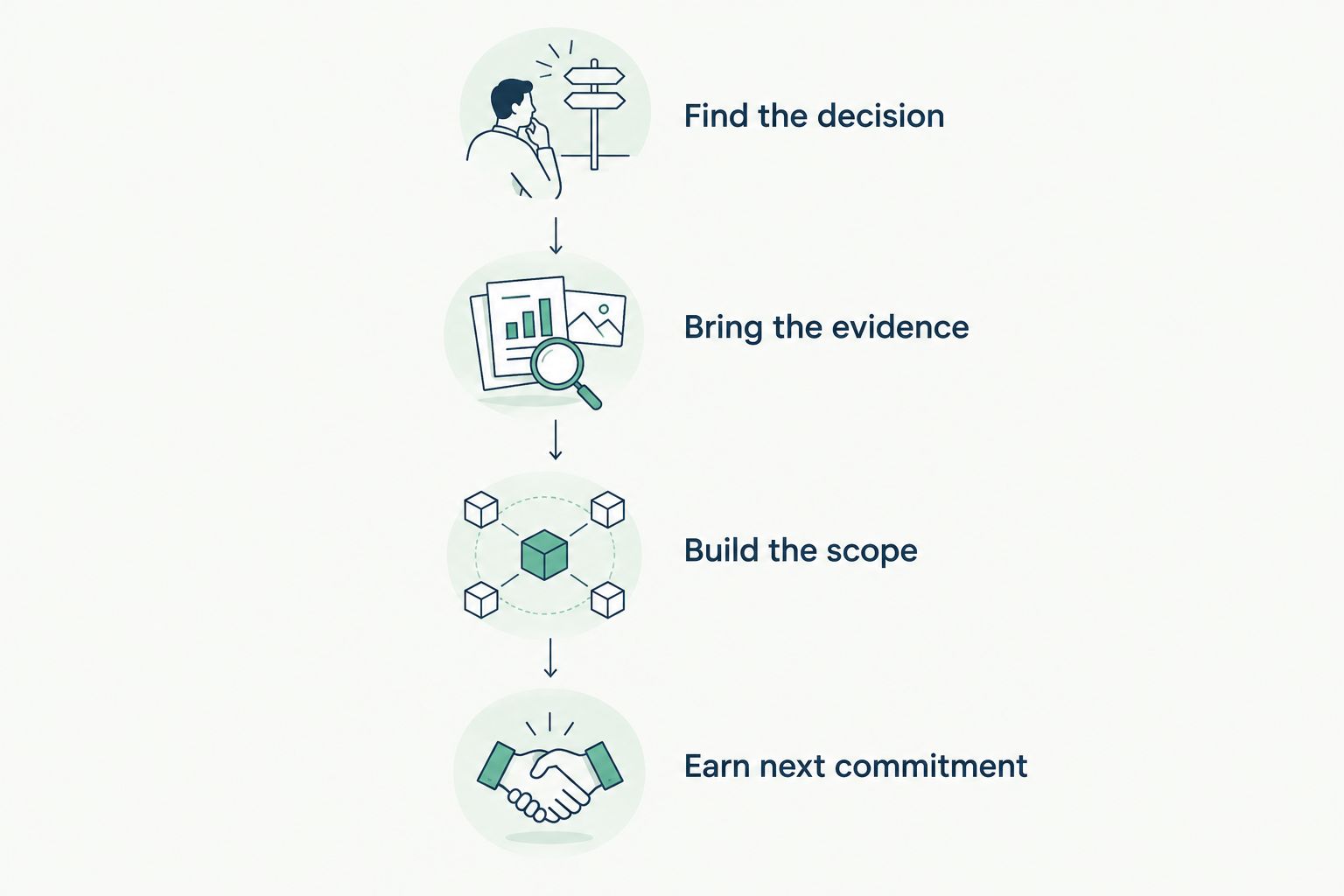
The SCOUTz Evidence-to-Agreement Framework has 4 stages: Find the decision, Bring the evidence, Build the scope, and Earn the next commitment. It is a conversation framework, not a validated close-rate intervention.
Use it to move from an observation to a decision the buyer understands. Each stage adds something the assessment alone cannot supply: business context, an accepted interpretation, a bounded scope, or explicit agreement.
Find the decision
Identify the decision owner and the outcome under discussion. For a domain email-policy finding, establish whether the owner wants to confirm the existing setup, investigate it, or consider a change.
Illustrative conversation prompt: Your published policy requests monitoring. Who owns that policy, and is monitoring still the intended position?
This prompt leaves room for a valid existing decision. It does not presume failure or force a remediation project into the meeting.
Bring the evidence
Present the condition, affected object, check name, source, and run date together. Show the boundary immediately beside the finding rather than burying it in a report appendix.
Illustrative explanation: This observation concerns the published domain policy at collection time. It does not establish whether an account was compromised. The next question is whether the policy matches your intended email-authentication approach.
Give the prospect room to supply newer evidence. If another provider already changed the configuration, update the account context before discussing scope.
Build the scope
Separate the recommended outcome from the vendor or service you sell. The MSP can recommend a product, service, process, project, or no action, depending on the agreed condition and objective.
| Scope choice | Best for | Proposed deliverable | Boundary |
|---|---|---|---|
| Validate the observation | Uncertain ownership or potentially changed evidence | Fresh evidence and an owner-confirmed interpretation | Does not include configuration changes |
| Review the configuration | Questions requiring authorized internal evidence | Findings, unknowns, and recommended outcomes within agreed coverage | Read-only review does not perform remediation |
| Verify approved work | A completed, agreed change | Rescan compared with the pinned baseline | Does not certify the entire environment |
Propose the smallest scope that resolves the agreed question. A broader engagement needs its own evidence and buyer agreement.
Earn the next commitment
Ask for a concrete action: an introduction to the owner, permission for a bounded review, acceptance of a proposed scope, or agreement to inspect a rescan.
Illustrative follow-up script: The attached evidence records the condition and collection date. The proposed next step is to confirm ownership and intended policy. If you approve the review, we will document coverage, unknowns, and the decision needed before discussing changes.
A useful follow-up preserves buyer choice. Record an explicit decision to defer or take no action alongside the accepted next steps.
For the supporting preparation sequence, use the domain scan to first-call evidence packet workflow. Keep the evidence packet attached to the agreed question rather than treating the report itself as the proposal.
Handle objections without overstating the result
A prospect's objection can reveal a scope problem. Respond with the evidence boundary and a choice, rather than escalating the claim.
If the prospect says another provider handles it, ask whether that owner can confirm the intended configuration. Existing ownership is relevant context. The finding alone does not establish poor service.
If the prospect says the result is outdated, compare the collection date with the change date and request permission to refresh the evidence. Do not defend an obsolete observation as an unresolved issue.
If the prospect asks whether the finding proves a breach, answer directly: it does not establish a breach unless the evidence specifically supports that conclusion. Return to the condition actually observed.
If the prospect declines access, preserve the public-domain scope and mark internal questions unassessed. Permission limits change the claim you can make, not the buyer's obligation to cooperate.
Where the platform fits
SCOUTz is best for MSPs that need dated cybersecurity prospect intelligence before a sales conversation. Its role is to connect account context and assessment evidence to preparation; MSP judgment determines what to recommend.
The client's October 15, 2026 product reference identifies Microsoft 365 Review and Prospect Intelligence as Open Beta. That status matters when evaluating fit: confirm the current workflow and report experience before relying on them in a client engagement.
The benefit is evidence-led preparation. The limit is equally important: a scan does not establish buying intent or close a deal. For MSPs evaluating SCOUTz, Join Open Beta is the primary next step.
Does a clean assessment mean a prospect is secure?
A clean result establishes only that the assessed checks did not report findings within their coverage. Unreadable or unassessed sources remain unknown. A public-domain review cannot substitute for authorized internal evidence.
For a 2026 proposal, name the assessed scope beside the result. Avoid turning a limited result into a whole-environment assurance statement.
Can you use a free assessment in a proposal?
Yes, when the proposal preserves the evidence source, collection date, limits, and agreed outcome. Verify the tool's applicable use terms and obtain any required authorization for the collection activity.
Public observation and active probing require separate consideration. Offer outreach scans as opt-in courtesies after a reply, and avoid blanket claims that scanning prospects is lawful everywhere.
FAQ
Is a free cybersecurity assessment tool accurate enough for sales?
Yes, when its findings are dated, reproducible, and used within their assessed scope. Use them to support discovery questions and agreed review work, rather than unsupported claims about compromise or buying intent.
What should I check before showing a prospect a security finding?
Check the source, affected object, check name, collection date, observed evidence, and coverage limits. Confirm that the interpretation still applies before recommending work.
Can a public domain scan assess Microsoft 365 security?
A public-domain scan cannot establish internal Microsoft 365 configuration such as Conditional Access coverage or application permissions. Those questions require relevant customer-authorized evidence.
Does a monitoring-only DMARC policy prove a security incident?
A monitoring-only DMARC policy does not prove a security incident. It supports a question about intended enforcement, reporting ownership, and whether the current policy remains appropriate.
What should an MSP do when an assessment cannot read a source?
Mark the source unreadable or unassessed and preserve the reason. Do not describe unread evidence as a clean result or an absent control.
Is SCOUTz a replacement for an MSP's sales judgment?
SCOUTz prepares cybersecurity sales conversations with dated evidence and prospect context. The MSP retains responsibility for interpretation, recommendations, the relationship, and the sale.
One last thing
Write the acceptance condition before proposing remediation. Specify what a rescan must observe, which baseline it will use, and who will accept the result. That turns a finding into a bounded piece of work whose outcome you can inspect, without promising security beyond the evidence.