
Prospect intelligence software is worth it for solo MSP owners when it turns account research into dated evidence, a useful discovery conversation, and an agreed next action. It is a poor purchase when your immediate problem is finding contacts or getting meetings. For a 2026 buying decision, include the work of checking findings, securing consent, and preparing the proposal alongside the subscription commitment.
- Is prospect intelligence software worth it for solo MSP owners? Yes, when evidence preparation is the bottleneck.
- SCOUTz fits MSP meeting preparation; it does not replace contact sourcing, technical judgment, or relationship ownership.
- Keep public-domain observations separate from customer-authorized Microsoft 365 configuration evidence.
- Evaluate the finished conversation and proposed scope, rather than the volume of findings.
Why this matters
A solo MSP owner handles discovery, technical review, proposals, and delivery. Adding software only makes sense when its output supports a task you actually need to complete. A report that requires extensive correction or never reaches a buyer adds another responsibility.
SCOUTz prospect intelligence is best for MSP owners who need dated security evidence for an existing sales conversation. Its purpose sits between meeting preparation and an agreed scope. Your CRM still owns the relationship, and your delivery platforms still run the work.
Before expanding your 2026 software stack, identify what prospect intelligence adds to your existing tools. Judge the purchase against a missing job, rather than another feature list.
Is prospect intelligence software worth it for solo MSP owners?
Yes, if you have prospects to engage and need a repeatable way to bring relevant evidence into those conversations. Wait if you cannot identify a real sales-preparation task that the software would support.
Compare these approaches by the work each leaves with you. None removes your responsibility to interpret the evidence or earn the buyer's agreement.
| Approach | Best for | Benefit | Limitation | Recommendation |
|---|---|---|---|---|
| Manual research and existing tools | Owners handling occasional preparation with a working process | Keeps research close to your judgment | You must preserve sources, dates, boundaries, and follow-up yourself | Keep it when the finished evidence packet meets your needs |
| Dedicated prospect intelligence software | Owners repeatedly assembling security evidence for meetings | Provides a dedicated evidence and account-context workflow | Requires interpretation, appropriate access, and proposal work | Evaluate it against an actual prospect conversation |
| Defer the purchase | Owners without a defined prospect or preparation workflow | Keeps attention on establishing the sales process | Leaves evidence preparation to your existing methods | Wait until you can name the job the software will perform |
There is no supported universal return-on-investment figure for a solo MSP here. Measure your own preparation effort and the usefulness of the resulting scope. A report count alone cannot establish commercial value.
Where SCOUTz fits
SCOUTz provides public-domain reviews and customer-authorized Microsoft 365 reviews for MSP prospect preparation. Its strength is bringing dated cybersecurity evidence and account context into discovery. The limitation is equally concrete: a scan does not establish buying intent, and the software does not close the deal.
The client-supplied October 15, 2026 product reference lists Domain Review as available and Microsoft 365 Review, Evidence Reports, and Prospect Intelligence as Open Beta. Treat that as dated product information. Check the current program and terms before committing a live prospect workflow.
Why the value varies for solo MSP owners
The value depends on where evidence fits into your sales process. These factors determine whether the output earns its place:
- Your preparation bottleneck. Repeatedly assembling findings and account context gives the software a defined job. A shortage of conversations requires a different response.
- Your existing evidence process. If your current workflow preserves sources, dates, coverage, and buyer-ready explanations, compare the proposed software against that baseline.
- Your access boundary. Public-domain observations support different conclusions from consented Microsoft 365 configuration evidence. Plan for the evidence you can actually obtain.
- Your interpretation work. Findings still need context, affected objects, unknowns, and a defensible recommended outcome.
- Your proposal discipline. Evidence becomes commercially useful when you connect it to an owner, a bounded scope, and a decision the buyer can make.
- Your verification process. A pinned baseline and rescan support proof of change. An old report supports only what was observed at that time.
Keep public and consented evidence separate
Use 2 evidence sources as distinct inputs: public-domain observations and customer-authorized internal evidence. Their boundaries belong in the report and in your spoken explanation.
Public-domain evidence
A public-domain review can support a conversation about published domain and email-security conditions. For example, a DMARC policy requesting monitoring supports a question about intended enforcement and report ownership.
It does not establish Conditional Access coverage, application permissions, license assignments, Intune device state, or tenant sharing configuration. Public-domain evidence also does not establish that an attacker has exploited a condition.
Preserve the check, source, affected domain, and run date. Distinguish public observation from active probing, and obtain appropriate authorization for the activity you propose. There is no blanket legal clearance for scanning prospects.
Customer-authorized Microsoft 365 evidence
SCOUTz Microsoft 365 reviews use customer-authorized, read-only configuration and metadata evidence. They do not read mail, files, chats, documents, or prompts, and they do not automatically change configuration.
Permissions and licensing can restrict coverage. Keep those restrictions visible. An unread source remains unknown; it cannot support a clean result.
Use evidence states such as Observed, Inferred, Possible, Unknown, and Unreadable distinctly. Keep coverage labels such as Partial, Not assessed, Permission limited, and License limited separate from the finding itself.
Evidence, insight, proof
Evidence records what ran and what it observed. Insight explains the relevant consequence without turning an inference into a confirmed incident. Proof requires a rescan against a pinned baseline to show what changed.
For a solo owner, this separation keeps a sales explanation defensible. It also prevents a polished report from carrying a stronger claim than its source supports. The domain scan to first-call evidence workflow is a related preparation guide.
Turn evidence into an agreed next action
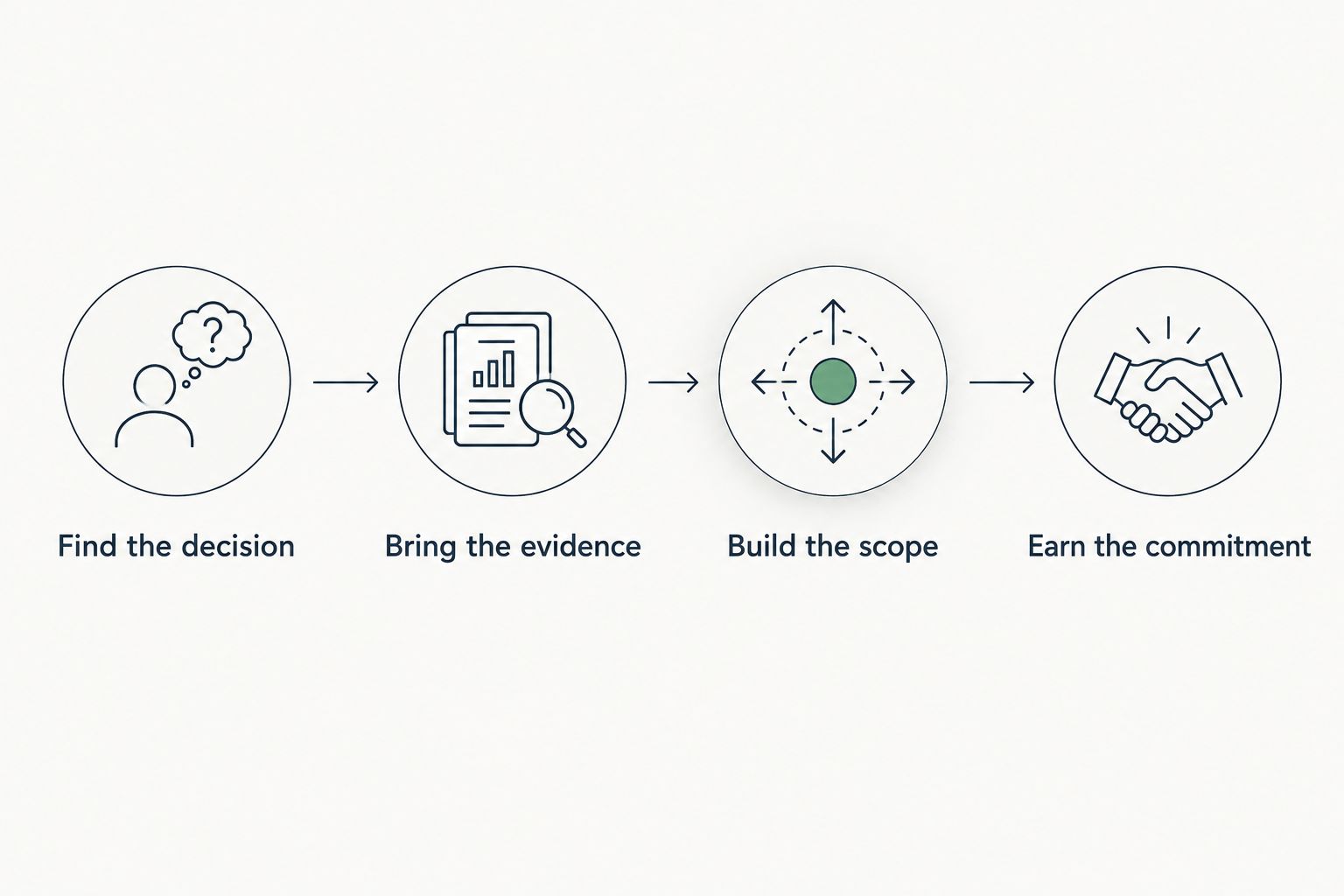
Use the SCOUTz Evidence-to-Agreement Framework to organize 4 decisions: identify the buyer's decision, bring relevant evidence, build a bounded scope, and earn the next commitment. This is a conversation framework, not a validated close-rate intervention.
Find the decision
Identify what the prospect is deciding before presenting findings. The decision might concern ownership of email-security reporting, permission for a deeper review, or approval of a defined assessment scope.
Illustrative dialogue: The public review gives us a starting point. Before we discuss changes, let's establish who owns email-security policy and what you want this review to decide.
This gives the evidence a purpose. It leaves the buyer free to confirm that the proposed conversation is relevant.
Bring the evidence
Present the condition, source, check date, and boundary together. For a monitoring-only DMARC policy, explain what the published policy requests and ask whether that remains intentional. Do not convert that observation into a claim of compromise.
Illustrative dialogue: The dated review observed a monitoring-only DMARC policy for this domain. That does not establish mailbox compromise. Please confirm who reviews the reports and whether monitoring remains the intended policy.
Separate what the review observed from what the prospect tells you. Both inform discovery, but they have different sources.
Build the scope
Offer a scope that matches the evidence and the buyer's decision. Keep the recommended outcome separate from vendor selection. The appropriate response can be a service, process, project, product, or no change.
| Scope option | Best for | Included outcome | Boundary |
|---|---|---|---|
| Public-domain review | Establishing a domain and email-security baseline | Dated observations, unknowns, and discovery questions | Does not assess internal tenant controls |
| Authorized Microsoft 365 review | Examining internal configuration with customer consent | Configuration evidence with explicit coverage limits | Does not inspect message or document contents |
| Verification rescan | Checking an agreed change against its baseline | Evidence of what changed within the reviewed scope | Does not guarantee future security |
Avoid attaching a broad remediation project to a narrow observation. Explain what additional evidence the larger scope would require.
Earn the next commitment
Ask for 1 next action that the buyer can explicitly accept, decline, or revise. Record its owner and the evidence required to complete it. Permission for a read-only tenant review is a different commitment from approval to make changes.
Illustrative follow-up script: The review observed the published policy on the attached run date. Internal tenant controls were outside this review. The proposed next step is an authorized read-only review to answer the agreed configuration questions. Please confirm the scope and responsible approver before access is arranged.
Keep the observation and the proposed action separate in your follow-up. Agreement to receive a report is not agreement to buy remediation.
Handle objections without overstating the finding
A buyer's objection often identifies a missing boundary or an unagreed scope. Answer it directly. Keep the next choice with the buyer.
The prospect already has an MSP
Illustrative response: The current provider can help establish the intended configuration and ownership. This observation is a question to validate with them, rather than evidence that their service has failed.
Offer a bounded review or a discussion with the responsible provider. Do not use a public finding to invent an unresolved service problem.
The prospect says the configuration is intentional
Illustrative response: Let's record that intention and the responsible owner. If the configuration matches the agreed outcome, the appropriate recommendation can be to leave it unchanged.
A deliberate decision with an accountable owner is useful discovery. It does not need to become a remediation sale.
The prospect declines tenant access
Illustrative response: We can keep this review within public-domain evidence. Internal controls will remain outside the assessed scope, and the report will state that boundary.
Do not fill the gap with inferred tenant findings. Narrow the proposal to the evidence and consent available.
Evaluate the workflow before committing
For your 2026 evaluation, use a prospect context you are authorized to review. Define the intended output before starting: a dated evidence packet, a discovery agenda, a bounded proposed scope, and a follow-up the buyer can answer.
Record preparation time in minutes using your existing process and the evaluated workflow. Include verification and correction work. This creates your own baseline without assuming a time-saving result.
Then inspect the output:
- Does every finding retain its source, check date, affected object, and limit?
- Are unread sources and incomplete coverage visible?
- Can the explanation survive a technical review?
- Does the proposed scope answer the buyer's stated decision?
- Can you explain the next action without relying on a score or a frightening prediction?
Keep the software only if the finished workflow supports your actual sales preparation. Feature volume does not answer that question. Neither does a report that looks finished before you have checked its claims.
Evaluate SCOUTz for prospect preparation
Review the Open Beta program and assess the fit for your evidence-led sales workflow.
FAQ
Is prospect intelligence software worth it if I don't have clients yet?
Prospect intelligence software is worth evaluating when you have a defined prospect conversation to prepare for. If your immediate task is finding contacts or establishing an outreach process, address that task first.
Will SCOUTz find leads for my solo MSP?
SCOUTz provides cybersecurity prospect intelligence and evidence for MSP sales preparation; it is not a contact database. You retain responsibility for prospect selection, outreach, relationships, and the sale.
Can I assess a prospect without Microsoft 365 access?
You can review public-domain evidence without Microsoft 365 tenant access, within an appropriately authorized scope. That evidence cannot establish internal controls such as Conditional Access coverage or tenant sharing configuration.
Does a security finding mean the prospect needs to buy?
A security finding does not establish buying intent or a confirmed unresolved problem. Validate the condition, its business relevance, the responsible owner, and the buyer's preferred next action.
How should I measure whether the software is useful?
Measure the complete preparation workflow, including verification and correction, against your existing baseline. Evaluate whether the output supports a defensible discovery agenda, bounded scope, and explicit next action.
Can I use a public finding to recommend tenant remediation?
A public finding alone does not establish an internal tenant condition. Obtain customer authorization and the relevant configuration evidence before making a tenant-specific recommendation.
Should I send an unsolicited security report to a prospect?
Offer an outreach scan as an opt-in courtesy after a reply and confirm the proposed scope. Report emails require appropriate sender identity and opt-out handling; distinguish public observation from active probing.
One last thing
A prospect confirming that a setting is intentional can be a useful outcome. You have established context and ownership instead of creating an unnecessary project.
Keep the original observation, the buyer's explanation, and the agreed decision together in your 2026 account record. That preserves the distinction between what the review found and what the conversation established. The most useful report ends with an agreed choice, including the choice to make no change.