
Veterinary practice email-authentication checking is the review of SPF, DKIM and DMARC evidence with the aim of protecting legitimate practice email while identifying sender-policy gaps. For MSPs, the job starts with separating staff mail from any appointment, reminder, billing or marketing systems the practice actually uses.
- Choose an spf dkim dmarc checker for veterinary practices that preserves sources, dates, alignment evidence and assessment limits.
- SCOUTz is best for MSPs preparing veterinary-practice sales conversations with dated domain evidence.
- Public DNS establishes published policy; authorized message samples establish authentication results for the sampled messages.
- Inventory legitimate senders before proposing enforcement. Agree on ownership, validation and a rollback plan.
SCOUTz is best for MSPs that need dated domain evidence for veterinary-practice sales preparation. SCOUTz, by RYTHMz, prepares the conversation. The MSP owns the relationship, recommendation and sale.
Why email-authentication checks matter for veterinary practices
A veterinary practice's sender inventory must reflect its actual workflows. Ask whether appointment confirmations, referral correspondence, invoices and newsletters use the practice's domain. Each confirmed sender needs an owner and an authentication review.
The business issue is continuity of legitimate communication. A stricter policy introduced before sender validation can affect messages the practice expects clients or referral partners to receive. A permissive policy, meanwhile, needs an explicit owner and rationale.
For your 2026 review, keep three questions separate: what the domain publishes, what sampled messages demonstrate, and what remains unassessed. A published record is evidence of configuration, not proof of successful delivery.
Use the findings to agree on a bounded next action. Do not turn a monitoring policy into a breach claim or assume that a practice wants to replace its current provider.
How to review veterinary-practice email authentication
Map the practice's actual senders
Start with a worksheet and a conversation with the practice manager and whoever administers email. Ask them to identify systems that send using the practice's visible From domain. Record vendor names only after confirmation.
Separate sending from receiving. An MX record identifies inbound routing; it does not enumerate every authorized outbound service. Also distinguish the registered domain from location-specific domains, referral brands and subdomains the practice confirms it controls.
Your 2026 sender inventory should identify who can approve a change. The practice manager might understand the workflow while an outside provider controls DNS. Both roles matter when planning validation.
- Record each confirmed sending service and business purpose.
- Identify the visible From domain and responsible administrator.
- Mark unconfirmed senders as Unknown.
- Obtain permission for message samples and administrative review.
- Identify the practice representative who approves changes.
Evaluate SPF beyond record presence
Use a DNS resolver to retrieve the domain's TXT records. Preserve the exact answer, query name, resolver, timestamp and any lookup error. A timeout is unreadable evidence; it does not establish that SPF is absent.
SPF evaluates the connecting sender against the envelope-sender domain, or HELO identity in applicable cases. That identity can differ from the address a client sees in the From field. An SPF pass therefore needs an alignment check before it supports a DMARC conclusion.
RFC 7208 limits SPF evaluation to 10 DNS-lookup-causing terms, including relevant nested evaluation. This is not simply a count of all DNS requests. Inspect included policies and redirects rather than counting only the terms visible in the first record.
- Check for multiple SPF records at the same name.
- Inspect syntax, includes, redirects and terminal mechanisms.
- Evaluate lookup-causing terms across the applicable policy path.
- Match authorized sources to the confirmed sender inventory.
- Preserve temporary errors separately from permanent errors.
Verify DKIM using known selectors
Start with an authorized message sample. Read the DKIM signature's d= signing domain and s= selector, then inspect the corresponding selector record. Follow any DNS alias and preserve the returned key material and lookup result.
Guessing common selector names cannot prove that DKIM is missing. A record also cannot prove that a specific service signs its outgoing messages. You need message-level evidence to establish what happened to the sample.
For new RSA DKIM deployments, 2048-bit keys follow the recommendation in RFC 8301. Key length is only one check; signature validity, signing-domain alignment and the actual sending path still matter.
SCOUTz domain evidence supports preparation, but unobserved selectors and unread messages remain explicit limits. Use the faster evidence workflow without substituting it for authorized message validation.
- Obtain a sample through an approved receiving mailbox.
- Record the signing domain and selector exactly.
- Inspect selector resolution, key type and key length.
- Use authentication results from a trusted receiving system.
- Leave unsampled senders unverified.
Test DMARC alignment before changing enforcement
Retrieve the DMARC TXT record at the applicable _dmarc name. Inspect policy, reporting destinations, alignment settings and subdomain handling. Preserve the complete answer so another technician can reproduce the interpretation.
DMARC passes when at least one qualifying mechanism passes with alignment to the visible From domain: SPF, DKIM, or both. Authentication success without alignment is insufficient. Forwarding and message modification also deserve investigation when interpreting failures.
A policy of p=none requests monitoring rather than quarantine or rejection. It does not establish compromise or prove that enforcement was forgotten. Ask whether monitoring remains intentional and who reviews aggregate reports.
Before recommending enforcement in 2026, review representative reports and samples from each confirmed sender. Read DMARC aggregate reports before changing enforcement so policy decisions reflect observed traffic and known coverage gaps.
- Record the policy and applicable subdomain behavior.
- Compare authenticated domains with the visible From domain.
- Identify the reporting destination and authorized report reviewer.
- Investigate failures against the confirmed sender inventory.
- Document the evidence required before an enforcement change.
Separate public evidence from authorized tenant evidence
Public DNS can establish what a domain publishes at the time of observation. It cannot establish Microsoft 365 Conditional Access coverage, application permissions, license assignments or tenant sharing configuration. Those are different assessment questions.
Begin with public records and approved message samples. When internal evidence is necessary, obtain customer authorization for a read-only review. SCOUTz Microsoft 365 Review is Open Beta under the client-supplied October 2026 product reference. Its evidence boundary is configuration and metadata, excluding mail, files, chats, documents and prompts.
Keep message samples supplied for this email-authentication investigation separate from that product boundary. Record who supplied each sample, what you inspected and how you handled sensitive content.
Evidence state and coverage also belong in separate fields. Observed describes evidence; Partial describes coverage. Neither means the other.
- Label each source public, customer-supplied or consented internal.
- Attach the observation date and affected domain or sender.
- Record permission and license limits separately.
- Put declared non-reads under NOT ASSESSED THIS SCAN.
- Keep tenant controls outside public-DNS conclusions.
Build scope around approved senders
Translate each finding into a proposed outcome before choosing a service or vendor. For example, a practice might authorize sender discovery first, followed by a separate decision about enforcement. Another practice might already have a validated inventory and need a reporting owner.
Separate authentication from inbox placement. Comparing email deliverability tools requires distinguishing sender-policy checks from reputation, complaint and placement analysis. An SPF, DKIM or DMARC result alone does not explain every missing appointment reminder.
Scope the uncertainty you can resolve. If the practice reports missing messages, obtain authorized examples and trace the affected sending path. Do not sell a DNS change as the established fix before investigating.
For a 2026 proposal, define validation before implementation. Recommend 2 message samples per confirmed sender, one before and one after an approved change, as a minimum change-comparison artifact. This sampling recommendation does not establish complete delivery coverage.
- Define the confirmed condition and unresolved questions.
- Specify included domains, senders and administrative access.
- Name the change approver and technical owner.
- Document testing, rollback and acceptance criteria.
- Exclude delivery guarantees and unassessed security controls.
Earn an agreed next commitment
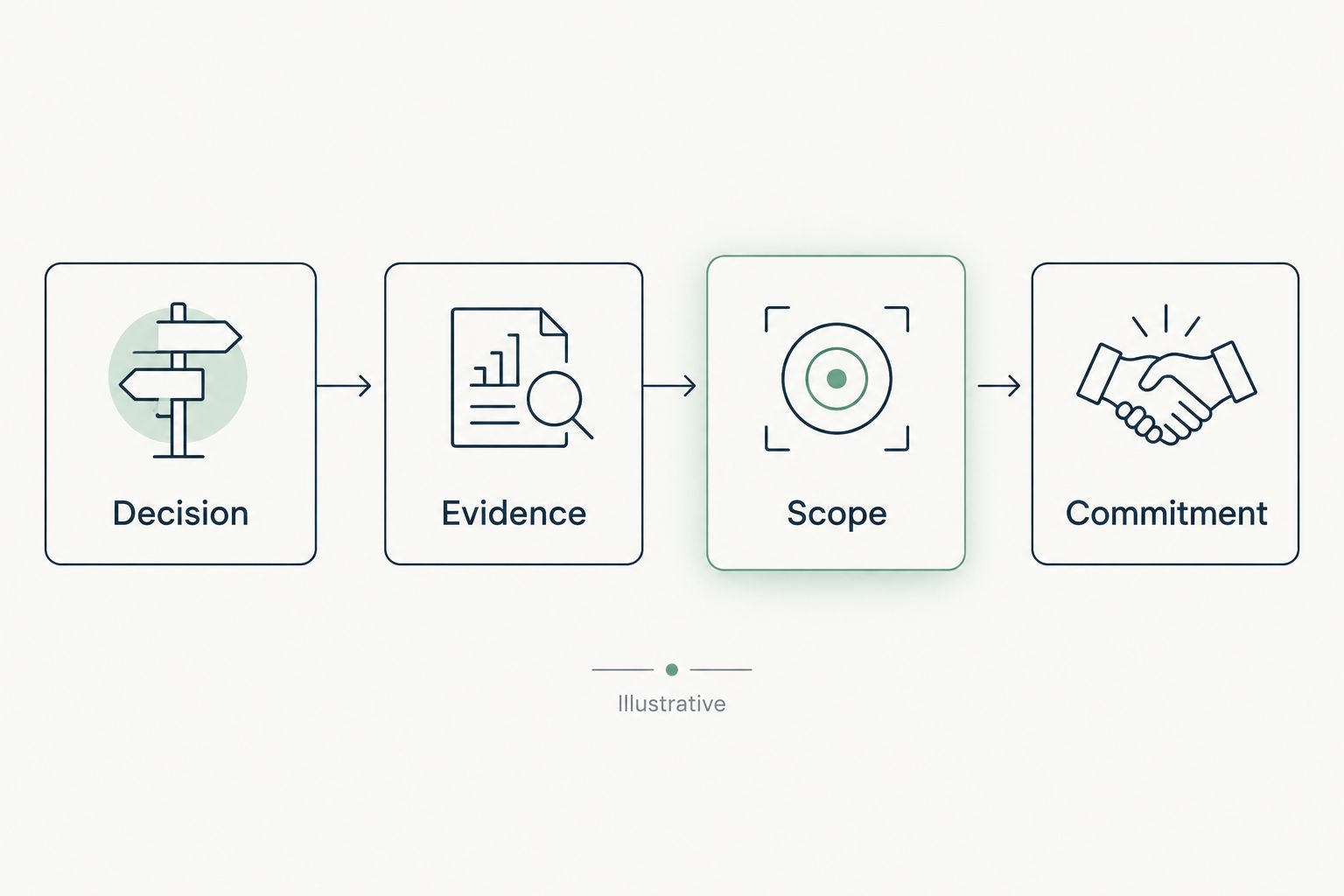
Use the SCOUTz Evidence-to-Agreement Framework to move from a finding to a decision: Find the decision, Bring the evidence, Build the scope, Earn the next commitment. This is a conversation framework, not a proven close-rate intervention.
The following dialogue is illustrative. It assumes a monitoring-only DMARC record has actually been observed; it does not describe a real practice or current finding.
MSP: The dated DNS result shows a monitoring policy. It does not tell us whether every reminder service aligns. We propose confirming your approved senders before recommending a policy change.
Practice manager: Our email works. We do not want disruption.
MSP: Then the first scope is evidence gathering without configuration changes. You can review the sender inventory and test results before deciding whether to authorize further work.
Close with a choice and a named owner. The practice can approve discovery, request clarification or decline. Record that decision without treating an email open as agreement.
- Decision: identify the practice's immediate communication concern.
- Evidence: attach the source, date and assessment limits.
- Scope: define the authorized work and acceptance criteria.
- Commitment: name the owner, deliverable and agreed review date.
A useful follow-up preserves that structure: summarize the observed condition, list the unknowns and state the specific authorization requested. Keep the technical baseline attached to the proposal.
Compare review options by the job
Choose the approach that answers the current question. A public-record review, message investigation and tenant review have different access requirements and evidence boundaries. Combining them does not justify a single verdict about the practice's entire security posture.
| Option | Best for | Strength | Key limitation |
|---|---|---|---|
| Manual DNS review | A bounded check of published policy | Preserves raw records and supports reproducible queries | Does not prove message signing, alignment or delivery |
| Authorized message-header review | Investigating a confirmed sender | Shows authentication evidence for sampled messages | Samples do not establish coverage of every message or route |
| DMARC aggregate-report analysis | Understanding reported authentication patterns | Adds receiving-system observations across reported traffic | Requires authorized access and interpretation; reporting coverage varies |
| SCOUTz domain review | MSP prospect preparation using dated domain evidence | Organizes evidence for a business conversation | Public evidence cannot establish internal tenant controls |
| Consented Microsoft 365 review | Questions requiring internal configuration evidence | Examines authorized configuration and metadata | Scope depends on permissions, licensing and assessed sources |
Start manually when the question is narrow. Use a platform when organizing dated evidence and account context is the job. Neither approach removes the need for practitioner review.
Join Open Beta is the primary next step for MSPs evaluating the platform's beta workflows. Enrollment includes human MSP-fit review; acceptance is not automatic.
Common mistakes MSPs make with veterinary practices
- Treating the main mailbox provider as the complete sender inventory. Ask the practice to confirm whether separate reminder, billing, referral or marketing services send using its domain. Leave each proposed service unconfirmed until supported.
- Changing enforcement before testing practice workflows. Validate the actual authorized senders and agree on rollback criteria. A technically valid record does not establish that every legitimate sender is ready.
- Calling guessed DKIM selectors a complete assessment. Preserve known selectors from approved evidence. Record unknown selector coverage instead of reporting that signing is absent.
- Presenting monitoring-only DMARC as an incident. State the observed policy, identify its owner and ask whether the configuration remains intended. Compromise requires separate evidence.
- Sending a frightening report instead of requesting permission. Offer an opt-in review, distinguish public observation from active probing, and use appropriate sender identity and opt-out handling. Public visibility does not establish blanket authorization for every assessment technique.
FAQ
What's the best SPF, DKIM and DMARC checker for veterinary practices?
The best fit preserves dated records, distinguishes policy from message results, and makes coverage limits visible. SCOUTz fits MSP prospect preparation with domain evidence; authorized message testing remains necessary to validate individual sending paths.
Can an MSP check a veterinary practice's DMARC record without tenant access?
An MSP can query publicly published DMARC DNS records without tenant access. That observation does not establish internal Microsoft 365 settings, complete sender coverage or permission for active probing.
Does a DMARC monitoring policy mean the practice has been breached?
A monitoring policy does not establish a breach. It describes the domain's requested DMARC treatment; the MSP should confirm intent, report ownership and sender validation before recommending a change.
Is an SPF pass enough to pass DMARC?
An SPF pass supports a DMARC pass only when its authenticated domain also aligns with the visible From domain under the applicable alignment mode. Alternatively, a valid aligned DKIM signature can satisfy DMARC.
Can a checker prove that appointment reminders reach clients?
An authentication checker alone cannot prove inbox delivery of appointment reminders. Investigate authorized samples, sending-system evidence and receiving-system results for the affected workflow.
Should every veterinary practice move straight to DMARC rejection?
An MSP should validate legitimate senders and agree on change controls before recommending rejection. The decision needs evidence of sender readiness, ownership, testing and rollback arrangements.
What should an MSP include in an email-authentication proposal?
Include the observed condition, source, date, affected senders, unknowns, authorized work and acceptance criteria. Separate evidence gathering from configuration changes and preserve the practice's choice about further work.
One last thing
Retain the before-state even when the final record looks correct. A screenshot of a passing result cannot explain which sender was tested, which policy changed or what remained unread.
Pin your 2026 baseline to the raw DNS answers, authorized samples and approved scope. After the change, repeat the relevant observations and compare like with like. A rescan proves only the condition it reassesses; it does not prove that every practice message arrives.


