
Best for Microsoft 365 peer comparisons: Microsoft Secure Score; best for evidence-led MSP conversations: SCOUTz. Best for external rating comparisons: SecurityScorecard; best for external-risk portfolio benchmarking: Bitsight. This 2026 guide separates actual peer comparisons from dated security evidence so you can choose a tool for the decision your client needs to make.
- The best MSP tools for benchmarking client security against peers need comparable scope, dated evidence, and explicit coverage limits.
- Microsoft Secure Score is the default choice for Microsoft 365 peer comparisons, not whole-business security rankings.
- SCOUTz is best for MSPs turning dated cybersecurity evidence into discovery questions, agreed scope, and verification.
- SecurityScorecard and Bitsight fit external benchmarking; external ratings do not establish internal Microsoft 365 control coverage.
Why this matters
A peer comparison is defensible only when the comparison group and assessment scope are clear. An organization assessed through public observations cannot be compared directly with one assessed through authorized tenant access. The second assessment sees evidence the first cannot read.
Your client needs to know what the comparison measures before deciding what to change. A percentile without that context invites the wrong conclusion: that a relative position establishes a security outcome.
For your 2026 shortlist, separate three jobs: comparing organizations, assessing a client's controls, and proving change. Read the guide to validating security assessment findings before a call before turning a ranking into a proposal.
What makes the best MSP security benchmarking tools
- Comparable cohorts: Identify the population behind the benchmark. Organization size, sector, technology stack, and assessment scope affect whether a comparison answers your client's question.
- Traceable evidence: Keep the condition, affected object, source, and observation date available behind the summary. A rating alone does not explain the required work.
- Explicit coverage: Separate public-domain observations from authorized internal evidence. Permission-limited and unread sources must remain visible.
- Stable comparisons: Preserve assessment scope and methodology when comparing periods. Explain changes in coverage before calling a score movement an improvement.
- Actionable reporting: Connect evidence to an owner, a decision, and an agreed verification method. Keep the recommended outcome separate from the vendor selected to deliver it.
- Buyer-safe interpretation: Distinguish an observed condition from an inferred consequence. Neither a weak ranking nor a security finding establishes compromise or buying intent.
MSP security benchmarking tools at a glance
These 4 tools serve different jobs. The order starts with MSP conversation preparation, while the peer-comparison default remains Microsoft Secure Score for Microsoft 365 environments.
| Tool | Best for | Standout capability | Key limitation |
|---|---|---|---|
| SCOUTz | Evidence-led discovery and proposals | Dated domain and customer-authorized Microsoft 365 evidence | A peer-cohort benchmarking capability is not established in the supplied product description |
| Microsoft Secure Score | Microsoft 365 peer comparisons | Microsoft security-posture measurement with comparison context | Microsoft-focused scope does not describe the whole business |
| SecurityScorecard | External security-rating comparisons | Letter-grade ratings derived from externally observable signals | External observations do not establish internal control coverage |
| Bitsight | External-risk portfolio benchmarking | Security ratings used to compare organizations and portfolios | Relative ratings require investigation before they become remediation scope |
1. SCOUTz: best for evidence-led MSP sales preparation
SCOUTz provides cybersecurity prospect intelligence for MSPs through domain reviews and customer-authorized Microsoft 365 reviews. Its role is to prepare discovery with dated evidence and account context, then support an agreed next action. Treat it as the evidence layer in a benchmarking conversation, rather than assuming it supplies a statistically defined peer cohort.
The client-supplied product reference dated October 15, 2026 places Domain Review in the available product set and Microsoft 365 Review and Evidence Reports in Open Beta. Keep those status distinctions in procurement discussions. Multi-client reporting remains in beta validation under that reference.
SCOUTz pros
- Dated findings support questions tied to a specific condition instead of a general security pitch.
- Public-domain evidence stays separate from consented Microsoft 365 configuration and metadata evidence.
- Rescans against a pinned baseline provide a basis for checking what changed.
- Client-safe reporting supports business-owner conversations while the MSP retains responsibility for interpretation.
SCOUTz cons
- Peer-cohort composition and peer-percentile benchmarking are not established product capabilities in the supplied reference.
- Microsoft 365 review and reporting workflows carry Open Beta status in the dated reference.
- Public-domain observations cannot establish Conditional Access coverage, application permissions, or tenant sharing configuration.
Best for: MSP owners and sales leaders who need evidence-led discovery, proposals, and QBRs.
Verdict: Buy for conversation preparation only when that is the job you need; hold if a verified peer-ranking dataset is mandatory.
2. Microsoft Secure Score: best for Microsoft 365 peer comparisons
Microsoft Secure Score measures security posture within Microsoft's supported services and presents recommended improvement actions. Microsoft's Secure Score documentation describes comparison views, including comparison with similar organizations. That makes it the clearest starting point here when your client's question concerns Microsoft 365 posture relative to peers.
Keep the interpretation narrow. A higher Secure Score reflects the tool's scoring model and supported scope; it does not establish that an organization is secure or predict whether it will experience a breach. Review the underlying recommendations and applicable services before translating a comparison into work.
Microsoft Secure Score pros
- Microsoft-specific recommendations connect the summary to identifiable security actions.
- Comparison context supports a more relevant discussion than an isolated tenant score.
- Assessment within the Microsoft environment provides a different evidence source from public-domain observation.
- Score history helps frame a review of changes over time.
Microsoft Secure Score cons
- Microsoft service coverage does not represent every application, endpoint, network, or business process.
- A comparison group does not automatically match your client's obligations or risk decisions.
- Score movement requires explanation when applicable services, recommendations, or assessment scope change.
Best for: MSPs whose clients want Microsoft 365 posture comparisons alongside Microsoft-specific improvement work.
Verdict: Buy into this approach first for Microsoft 365 benchmarking; skip any claim that it ranks the client's entire security program.
3. SecurityScorecard: best for external security-rating comparisons
SecurityScorecard provides security ratings based on externally observable signals and uses an A–F grading system. Its comparison and benchmarking capabilities suit discussions about organizations' externally visible security posture. This is a different job from reviewing customer-authorized tenant configuration.
For a 2026 evaluation, ask the vendor to demonstrate the actual comparison population and the evidence behind a sample grade. Then inspect asset attribution. An observation assigned to the wrong organization produces the wrong conversation, regardless of how clearly the dashboard presents it.
SecurityScorecard pros
- Letter grades provide an accessible entry point for an owner-facing discussion.
- External observations support comparison without requiring the same internal access as a tenant assessment.
- Benchmarking provides context beyond a single organization's isolated rating.
SecurityScorecard cons
- A letter grade compresses distinct observations into a summary that still needs explanation.
- External visibility cannot establish internal Microsoft 365 configuration or operational control effectiveness.
- Attribution and observation timing require review before a finding becomes proposal scope.
Best for: MSPs that need an external-rating comparison and are prepared to validate the underlying observations.
Verdict: Buy for external benchmarking after reviewing cohort and attribution details; hold for questions requiring internal evidence.
4. Bitsight: best for external-risk portfolio benchmarking
Bitsight provides security ratings used to assess and compare organizations through externally observable security information. Its benchmarking role fits portfolio and third-party risk discussions where relative external posture matters. Use that context to identify subjects for investigation, then establish the client's actual condition.
A portfolio comparison and a remediation plan answer different questions. Before recommending work, identify the affected asset, confirm ownership, review the observation date, and determine whether the condition remains observable. Keep uncertainty attached to the finding throughout that process.
Bitsight pros
- Organization-level ratings support comparisons across a portfolio.
- External-risk context suits supplier and third-party review discussions.
- Relative position provides a starting point for deciding where to investigate.
Bitsight cons
- A portfolio rating alone does not explain a client's authorized internal configuration.
- A relative position does not establish the business priority of an individual finding.
- Turning rating observations into scoped work requires asset validation and client discussion.
Best for: MSPs supporting clients with portfolio-level or third-party external-risk benchmarking needs.
Verdict: Buy for external-risk portfolio comparison; skip using the rating alone as proof that a particular project is necessary.
How the recommendations are ranked
The ranking follows job fit, evidence traceability, comparison scope, and usefulness in a client decision. It is a capability-based shortlist, not a hands-on performance test or a measured ranking of security outcomes.
Microsoft Secure Score is the default for Microsoft 365 peer comparisons because that comparison belongs to its documented job. External-rating platforms answer broader external comparison questions. The first-listed evidence platform serves discovery and verification without an established peer-cohort claim.
For any 2026 purchase, require a demonstration using the assessment scope you intend to sell. Ask for the cohort definition, exclusions, evidence dates, and treatment of unread sources before accepting a sample report as representative.
Turn a benchmark into an agreed next action
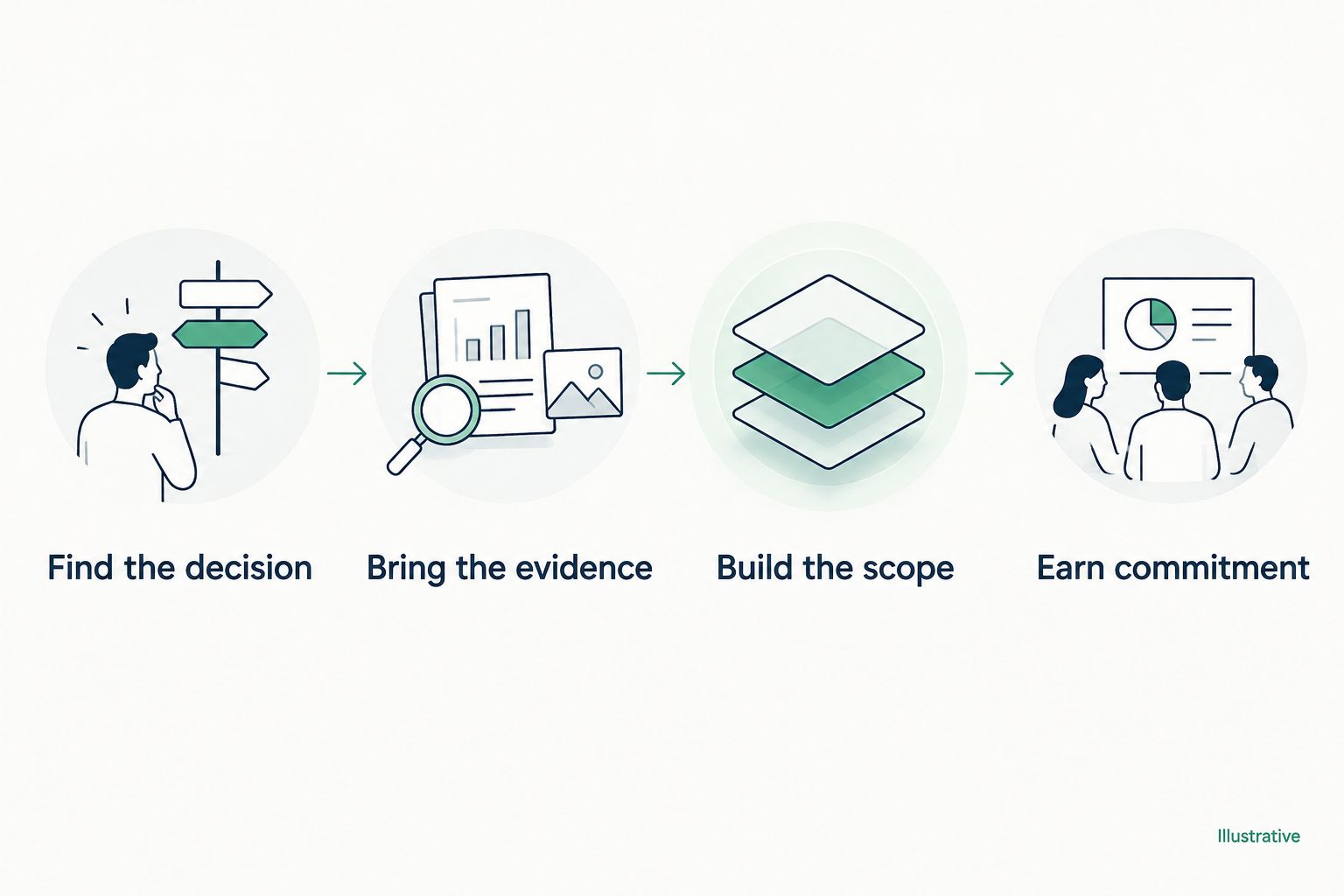
The SCOUTz Evidence-to-Agreement Framework gives an MSP a practical conversation structure: Find the decision, Bring the evidence, Build the scope, Earn the next commitment. It is an original conversation framework, not a proven close-rate intervention.
Find the decision
Establish what the client wants to decide. Comparing Microsoft 365 configuration, prioritizing external-domain work, and evaluating supplier exposure require different evidence.
Record the decision in the meeting notes before showing a ranking. Otherwise, an easy-to-read score becomes the subject of the meeting while the business question stays unanswered.
Bring the evidence
State the condition, source, date, and boundary. For example, a published DMARC policy requesting monitoring is an observable configuration. It does not establish compromise, unauthorized sending, or an unresolved problem.
Ask who owns reporting and whether monitoring remains the intended policy. Keep internal evidence separate: a public-domain review cannot establish tenant-wide MFA enforcement.
Build the scope
Offer a choice that matches the evidence. These 3 scope options illustrate different commitments rather than an automatic escalation toward a larger engagement.
| Scope option | Best for | Benefit | Limitation |
|---|---|---|---|
| Clarify ownership | An observed condition with unclear intent | Establishes who decides and why | Does not verify implementation |
| Authorize deeper review | A decision blocked by missing internal evidence | Expands the evidence available | Requires consent and appropriate access |
| Agree a change and rescan | A confirmed condition with an agreed outcome | Creates a defined verification step | Requires a comparable baseline and clear owner |
Earn commitment
Use the next commitment to resolve the actual uncertainty. Record the owner, authorized scope, expected evidence, and acceptance condition.
Illustrative dialogue: If monitoring remains intentional, keep that decision documented. If the owner wants to review enforcement, agree who will review legitimate senders and what evidence is needed before a change.
For a follow-up, summarize the observed condition, the client's stated intent, and the agreed next action. Do not convert silence into approval or an opened email into buying intent.
Which MSP benchmarking tool should you choose?
Start with Microsoft Secure Score when the decision is specifically about Microsoft 365 peer comparisons. Evaluate SecurityScorecard for external-rating comparisons and Bitsight for external-risk portfolio benchmarking. Require each vendor to show the relevant cohort and evidence boundaries.
For sales preparation, choose the evidence workflow separately from the peer-rating workflow. A comparison establishes context. A dated finding, an accountable owner, and an agreed outcome establish the basis for scope.
Join Open Beta is the primary next step for MSPs evaluating evidence-led conversation preparation. You can also book a demo to discuss the review and reporting workflow before deciding whether it fits your sales process.
FAQ
What's the best MSP tool for benchmarking Microsoft 365 security against peers?
Microsoft Secure Score is the default starting point for Microsoft 365 peer comparisons. Review the comparison population and underlying recommendations before turning a score difference into proposal scope.
Does SCOUTz provide peer security rankings?
A peer-cohort ranking capability is not established in the supplied SCOUTz product reference. Its stated role is dated domain and customer-authorized Microsoft 365 evidence for MSP conversation preparation and verification.
Is an external security rating better than Microsoft Secure Score?
Neither replaces the other because they assess different evidence. External ratings describe externally observable posture, while Microsoft Secure Score addresses supported Microsoft services.
Can a public-domain scan show whether a client enforces MFA?
A public-domain scan cannot establish Microsoft 365 MFA enforcement. That question requires authorized internal evidence and a review of the relevant enforcement configuration.
Can I tell a client its security is worse than its peers?
Make only the comparison the evidence supports. Name the metric, cohort, observation date, and scope instead of turning a relative rating into a whole-business security claim.
How should an MSP prove that security improved?
Use comparable dated reviews against a pinned baseline and inspect the underlying condition. Explain changed coverage, permissions, or methodology separately from changes in the client's configuration.
What should I request in a security benchmarking demo?
Request the cohort definition, asset attribution, evidence dates, coverage exclusions, and a finding-to-verification example. Ask the vendor to distinguish unavailable evidence from assessed controls.
One last thing
A score can change even when the client's configuration has not. A changed scoring method, expanded assessment scope, or newly readable source changes the basis of comparison.
For your next 2026 QBR, bring 2 dated reviews and separate configuration changes from assessment changes. If the scope differs, show that difference before discussing progress. The most useful proof is an inspectable change against an agreed baseline, followed by a decision the client understands.


