
Best overall for MSP sales preparation: SCOUTz. Best for Microsoft 365 posture review: Microsoft Secure Score. Best for authorized network discovery: Nmap. The best security assessment tools for hospitality clients in 2026 serve different jobs; add Wireshark for packet investigation and OWASP ZAP for authorized web application testing.
- SCOUTz leads this shortlist for hospitality prospect preparation using dated evidence, with Microsoft 365 Review in Open Beta.
- Microsoft Secure Score supports tenant posture review; Nmap supports authorized network discovery.
- Wireshark investigates captured traffic; OWASP ZAP tests web applications within an agreed scope.
- Choose the best security assessment tools for hospitality clients by evidence source, permission, coverage and verification.
Why this matters
A hotel assessment starts with ownership. Establish who controls the domain, email tenant, property network, booking application and payment environment before choosing a tool. A property owner cannot authorize testing of a separate provider's infrastructure merely because the property uses its service.
The buying decision also needs a boundary. A domain observation supports an email-security conversation. A packet capture supports a traffic investigation. Neither establishes the security of every system supporting a hospitality business.
For a 2026 shortlist, prefer tools that preserve evidence and disclose coverage. Your proposal should distinguish what you observed, what remains unknown and what the prospect has authorized you to investigate next.
What makes the best hospitality security assessment tools
Rank tools against these criteria before comparing feature lists:
- Evidence source: retain the check, affected object, source and collection date.
- Authorization boundary: distinguish public observation, consented tenant review and active testing.
- Coverage disclosure: identify assessed, partial, unreadable and unassessed areas.
- Operational fit: agree targets, exclusions, escalation contacts and stopping conditions.
- Decision support: connect the observation to an owner and a bounded next action.
- Verification: preserve a baseline and repeat the relevant check after approved work.
The right tool answers the agreed question without turning missing evidence into reassurance. A larger finding count does not establish better coverage or a better recommendation.
Hospitality security assessment tools at a glance
The order below follows an MSP engagement from meeting preparation into increasingly specific technical work. It is a job-based shortlist, not a claim that one tool replaces the others.
| Tool | Best for | Standout capability | Key limitation |
|---|---|---|---|
| SCOUTz | Prospect meeting preparation | Dated domain evidence and customer-authorized Microsoft 365 review | Public evidence cannot establish internal tenant controls; Microsoft 365 Review is Open Beta |
| Microsoft Secure Score | Microsoft 365 posture prioritization | Microsoft security recommendations tied to tenant posture | A score does not establish property-wide security |
| Nmap | Authorized network discovery | Host, port and service discovery | An answering service does not establish exploitability |
| Wireshark | Investigating network behavior | Packet capture and protocol analysis | Visibility depends on capture location and captured traffic |
| OWASP ZAP | Authorized web application testing | Passive analysis and active web security testing | Results depend on scope, authentication and application coverage |
1. SCOUTz: best for hospitality prospect preparation
SCOUTz is best for MSPs preparing hospitality sales conversations with dated cybersecurity evidence. Its role is the missing middle between a booked meeting and a scoped next commitment, while the MSP retains responsibility for the relationship and sale.
The client-supplied product reference dated October 15, 2026 identifies Domain Review as available and Microsoft 365 Review as Open Beta. Treat that reference as dated product information, not independent confirmation of today's status.
Public-domain observations and customer-authorized Microsoft 365 evidence belong in separate sections. The latter is read-only configuration and metadata evidence, excluding mail, files, chats, documents and prompts.
SCOUTz pros:
- Gives MSPs evidence and account context for discovery.
- Separates public observations from consented internal evidence.
- Supports an evidence-to-scope conversation rather than a generic security pitch.
SCOUTz cons:
- Public Domain Review cannot establish Conditional Access coverage or tenant sharing configuration.
- Microsoft 365 Review and reporting experiences carry beta boundaries in the dated product reference.
- Findings still require human interpretation and owner confirmation.
Best for: MSP owners and sales leaders preparing a hospitality prospect meeting. Verdict: Buy for evidence-led preparation only when the dated coverage and beta boundaries fit your workflow.
2. Microsoft Secure Score: best for tenant posture prioritization
Microsoft Secure Score provides a view of security posture and recommended improvement actions within Microsoft's environment. Use it when a hospitality client has authorized a tenant review and the meeting concerns Microsoft 365 controls.
Review the underlying configuration evidence with the tenant owner. Keep the assessment date, applicable scope and exclusions alongside any score used in a 2026 presentation.
Microsoft Secure Score pros:
- Provides Microsoft-specific improvement recommendations.
- Gives technical reviewers a starting point for configuration discussions.
- Supports tracking posture changes alongside the underlying evidence.
Microsoft Secure Score cons:
- Does not assess the full property network or every hospitality application.
- A score alone does not prove that a particular account or workflow is protected.
- Interpretation still depends on tenant context and applicable capabilities.
Best for: An authorized Microsoft 365 improvement discussion after discovery. Verdict: Buy into the workflow when tenant configuration is the agreed subject; skip it as a property-wide assurance statement.
3. Nmap: best for authorized network discovery
Nmap discovers hosts and services on networks. It helps an MSP establish which approved targets respond and which ports or services warrant further investigation.
Before running active discovery, confirm target ownership and written scope. Ask whether the proposed range includes guest networking, operational systems or third-party-managed equipment; do not assume permission extends to those systems.
Nmap pros:
- Supports repeatable host and service discovery.
- Produces target-specific technical evidence.
- Helps compare observed exposure against an approved inventory.
Nmap cons:
- Open ports are observations, not confirmed vulnerabilities.
- Service identification requires validation before becoming a proposal claim.
- Active discovery needs an agreed scope and operating conditions.
Best for: Establishing an authorized network inventory and service baseline. Verdict: Buy into the assessment workflow after authorization; wait when ownership or testing boundaries remain unclear.
4. Wireshark: best for investigating network behavior
Wireshark captures and analyzes network packets. Use it to investigate a defined traffic question rather than to generate a broad security grade.
For a hospitality engagement, specify the capture point and the question first. A capture from one segment cannot establish what happened on every other segment, and encrypted content limits what a reviewer can inspect.
Wireshark pros:
- Exposes protocol behavior in captured traffic.
- Supports detailed investigation of a specific connection or transaction.
- Preserves packet evidence for technical review.
Wireshark cons:
- Coverage is limited to traffic visible at the capture point.
- Encryption restricts payload visibility without appropriate decryption material.
- Captures can contain sensitive information and require controlled handling.
Best for: A bounded investigation with an authorized capture plan. Verdict: Buy into the diagnostic workflow; skip it as a standalone executive assessment.
5. OWASP ZAP: best for authorized web application testing
OWASP ZAP supports web application security testing through passive analysis and active testing capabilities. It fits an engagement where the client has authority to approve testing of the application and its supporting environment.
A booking service linked from a hotel website is not automatically an authorized target. Confirm ownership, provider approval, authentication requirements and exclusions before selecting testing modes.
OWASP ZAP pros:
- Supports examination of web requests and responses.
- Offers passive analysis and active testing for different scopes.
- Helps reviewers retain application-specific evidence.
OWASP ZAP cons:
- Authentication and application coverage affect what testing reaches.
- Findings need validation before being treated as confirmed weaknesses.
- Active testing requires operational safeguards and explicit authorization.
Best for: An approved review of a client-controlled web application. Verdict: Buy into the application-testing workflow; wait for provider authorization on outsourced systems.
How the shortlist is ranked
The ranking prioritizes the first decision an MSP needs to support: preparation, tenant improvement, network discovery, traffic investigation or application testing. It does not claim hands-on comparative testing or measured hospitality outcomes.
For 2026 procurement, ask each supplier to demonstrate source retention, coverage disclosure and verification using your intended workflow. Product demonstrations should distinguish observed evidence from illustrative examples.
Turn assessment evidence into an agreed next action
Use the Evidence-to-Agreement Framework to move from a technical observation to a proposal. This is SCOUTz's conversation framework, not a validated close-rate intervention.
Find the decision
Identify the decision and its owner. A hotel manager discussing email reliability may need to involve a central IT team, brand representative or external provider before approving work.
Bring the evidence
Use a 3-part evidence packet: observation, boundary and question. Attach the source and collection date to the observation, and identify anything unread or outside scope.
For example, a published DMARC policy requesting monitoring supports a question about intended enforcement. It does not establish compromise, an unresolved problem or buying intent.
Build the scope
Compare 2 scopes: a bounded validation review and an approved change project. Separate the condition, affected object, unknowns and desired outcome from vendor selection.
A deeper assessment can require specialist work. Selecting hotel penetration testing companies belongs after agreeing application ownership, test targets, exclusions and evidence requirements; a public-domain observation alone does not justify active testing of a property's systems.
Earn the commitment
Ask the buyer to choose an action, an owner and a confirmation point. The buyer can authorize further review, involve another stakeholder, defer the decision or choose no work.
Pin 1 baseline before approved changes. Proof is a rescan against that baseline, with the same check and scope or an explicit explanation of what changed.
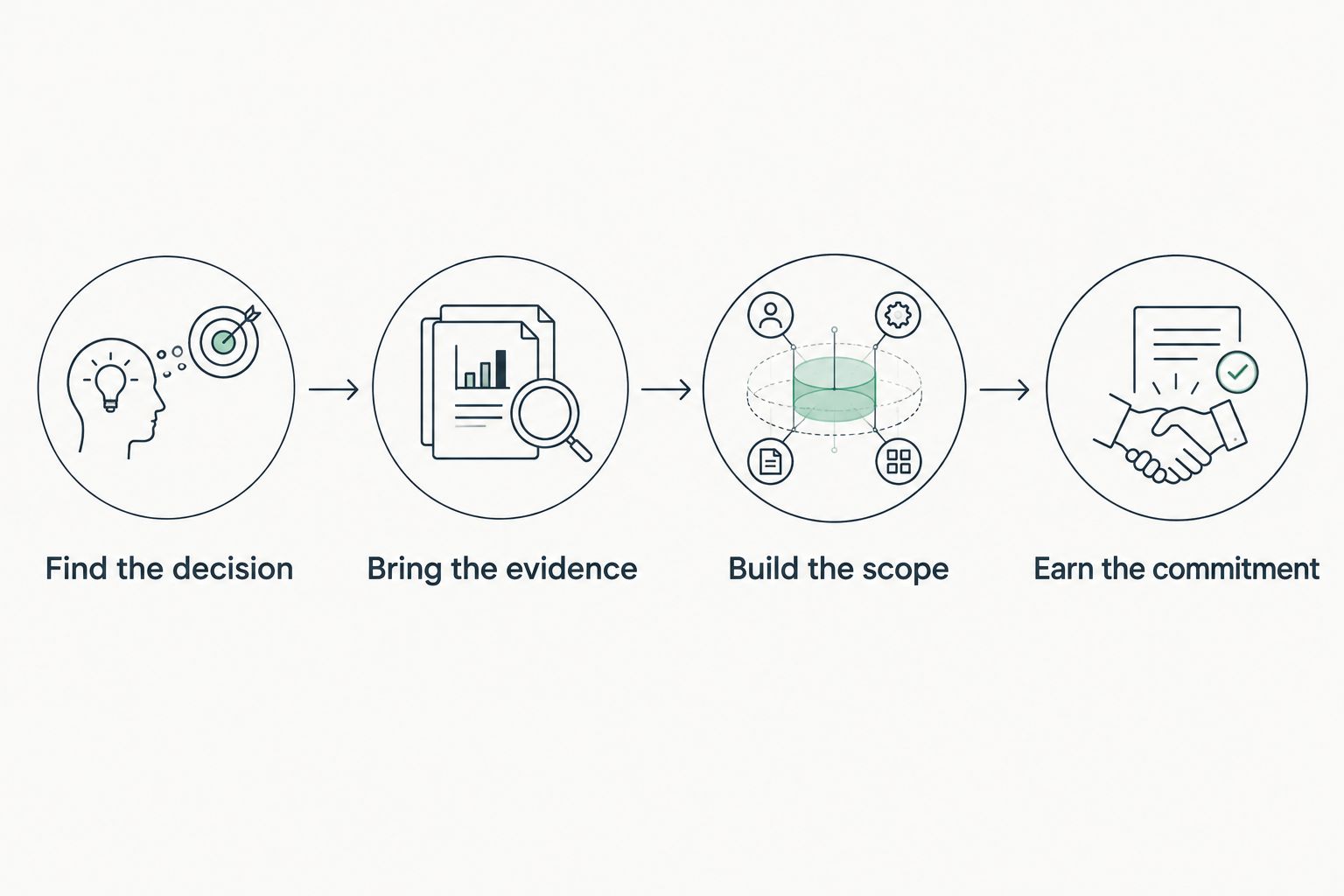
The framework keeps the technical claim intact while giving the buyer a concrete decision. Your proposal should preserve that boundary rather than expand a narrow finding into a broad remediation promise.
Handle objections without expanding the claim
The following dialogue is illustrative. It is not a customer transcript or evidence of sales results.
Prospect: Our booking provider handles security.
MSP response: That establishes a provider relationship. Let's confirm which systems the provider controls and which remain yours, then limit the proposed review to your authorized scope.
Prospect: Does this finding mean someone accessed our email?
MSP response: The observation concerns a published email policy. It does not establish account access. We can discuss a separate authorized review if that is the decision you need to make.
Prospect: Send a proposal for everything.
MSP response: The current evidence supports a bounded validation scope. We can identify the remaining systems, owners and permissions before proposing broader work.
A follow-up can stay equally specific: Attached is the dated observation and its limits. Please confirm the responsible owner and whether you want the proposed validation review, a discussion with your provider or no further action.
Choose the tool for the next decision
Start with SCOUTz when the job is hospitality prospect preparation; add specialist tools only when the agreed question requires them. Microsoft Secure Score addresses tenant posture, Nmap discovers network services, Wireshark investigates captured traffic and OWASP ZAP tests authorized applications.
For a 2026 buying decision, require a representative output before committing. Check whether a reviewer can trace each material claim back to its source, date and coverage boundary.
Make Join Open Beta the primary next step for evaluating the preparation workflow. Confirm the current application process and product scope before planning a client engagement around beta capabilities.
FAQ
What's the best security assessment tool for hospitality clients?
The best tool depends on the decision: SCOUTz fits MSP prospect preparation, Microsoft Secure Score fits tenant posture, and specialist tools address network, traffic or application questions. No tool in this shortlist establishes security across an entire hospitality operation.
Can a public-domain review assess a hotel's Microsoft 365 security?
A public-domain review cannot establish internal Microsoft 365 controls. Conditional Access coverage, application permissions and tenant sharing configuration require appropriately authorized internal evidence.
Is an open port evidence that a hotel has been compromised?
An open port is not evidence of compromise. It establishes that a service answered within the observed scope and time; exploitability and incident conclusions require separate evidence.
Can an MSP test a hotel's outsourced booking platform?
Testing requires authorization covering the platform and the proposed activity. A hotel's use of a booking service does not itself establish authority to approve tests against the provider's infrastructure.
Is Microsoft Secure Score enough for a hospitality assessment?
Microsoft Secure Score is not enough for a property-wide assessment. It supports Microsoft tenant posture discussions, while networks, applications and other systems require separate scope and evidence.
What should a hospitality security proposal include?
A proposal should include the dated observation, affected object, evidence limits, responsible owner and proposed outcome. Keep validation work separate from configuration changes and define how approved work will be verified.
Can a security assessment predict a hotel's next breach?
A security assessment cannot establish that a future breach will occur. It records conditions within a defined scope and supports decisions about further review or approved changes.
One last thing
A tool can produce more findings while leaving the buyer's decision unchanged. Before adding another scan, ask the owner to confirm which outcome needs evidence and which systems they can authorize you to assess.
Keep unread evidence explicitly unknown. A clearly bounded unknown is more useful than a reassuring statement the assessment cannot support.


